
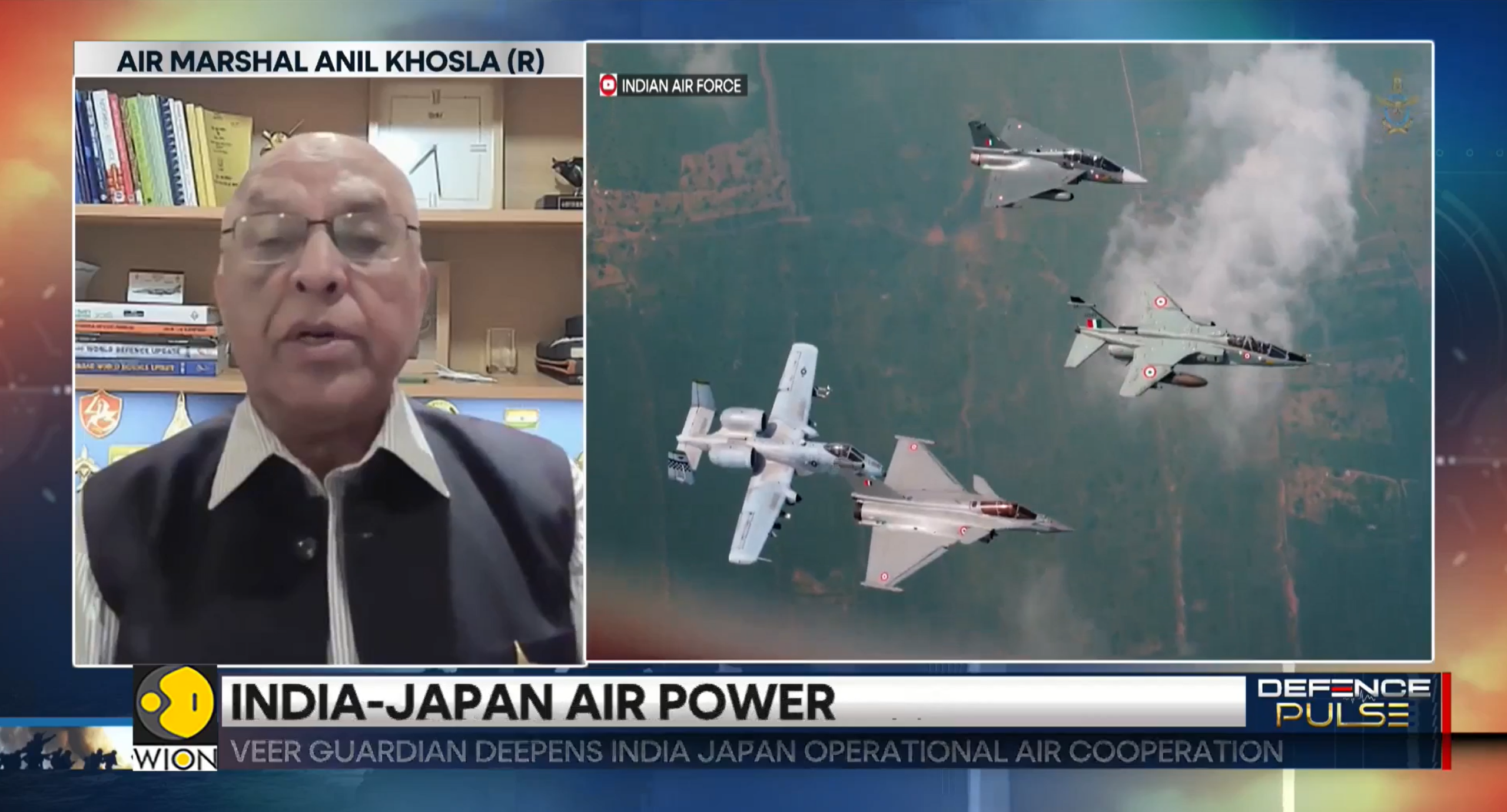
Discussion with Shivan Chanana on the “DefencePulse” program of WION TV
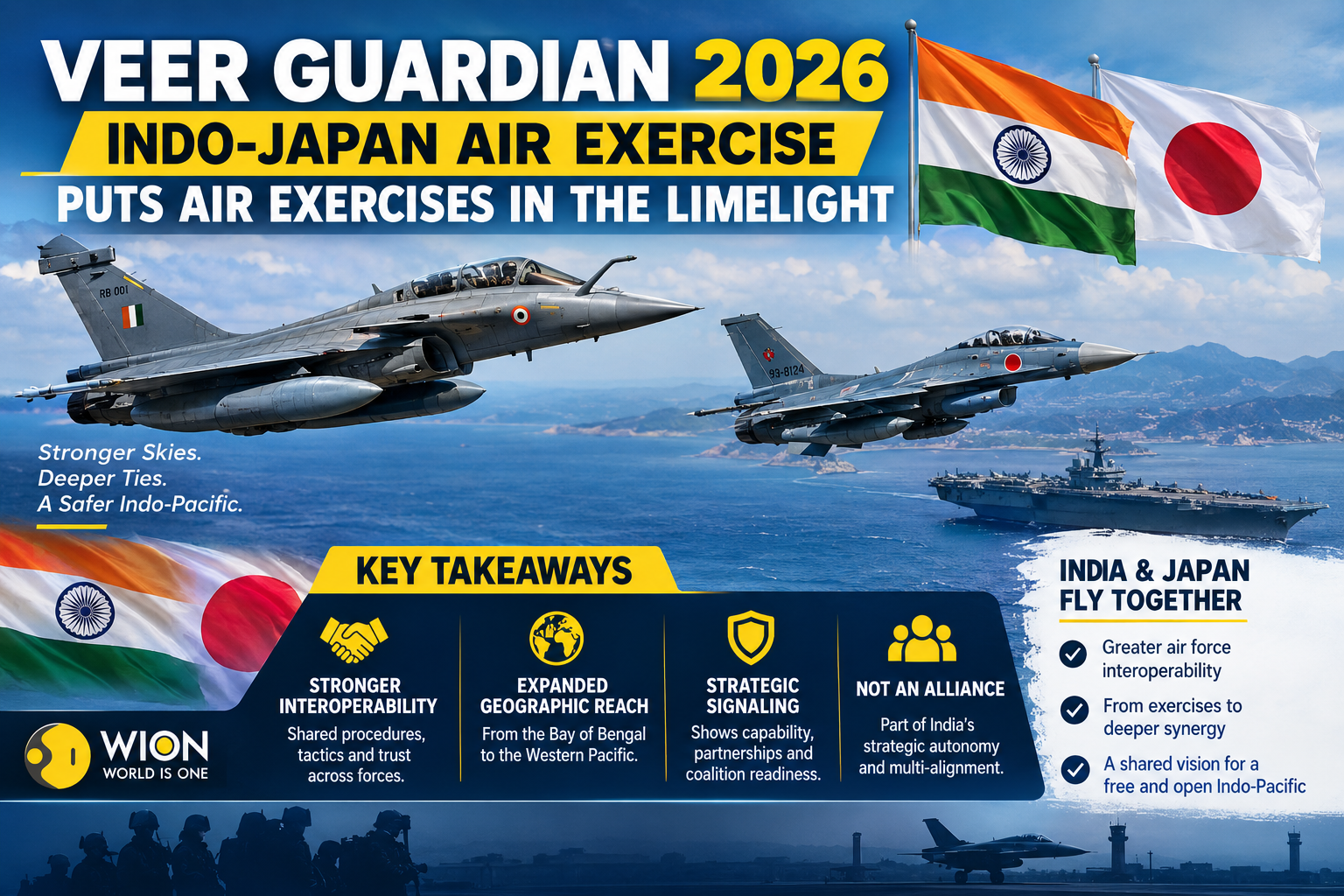
Talked about “Beyond Exercise Veer Guardian”: Japanese fighter operates from Indian soil for the first time. Fighters fly together: India & Japan build greater air force interoperability. India and Japan are moving from air exercises to deeper synergy.
Link to the WION post:-
https://x.com/WIONews/status/2102410803395834225?s=20
Inputs to the questionnaire from a journalist on exercise.
- What’s driving the jump in India’s exercise tempo in the last 12–18 months?
I don’t think there’s really a “jump” in the strict sense. India has been steadily engaging in bilateral and multilateral exercises with a wide range of countries as part of its defence cooperation and military diplomacy for years now. What has changed is media attention. These exercises are, in fact, a continuation of an established trajectory. India’s participation has also evolved and expanded in scope over time, a logical progression as its defence relationships and operational engagements grow.
- Given today’s volatile geopolitics, China’s assertiveness in the Indo-Pacific, Russia’s war in Ukraine, and persistent border/maritime tensions—is India’s surge in joint exercises about deterrence, asserting power, or both?
In my view, it would be difficult to characterise these exercises primarily as being about either deterrence or power projection. At its core, India’s participation is an evolving, natural progression, increasing in scope and complexity as our forces mature and our partnerships deepen.
That said, these exercises do carry strategic and political signalling value. Globally, partners and adversaries alike read into who exercises with whom, and how often. Highly complex, multi-domain drills (such as Malabar, Tarang Shakti, or Yudh Abhyas) signal that India has both high-end capability and coalition interoperability. Expanding exercise zones into the Western Pacific, the South China Sea, and deep into the Southern IOR asserts India’s status as a power capable of out-of-area contingency responses.
The exercises should therefore be seen in the broader context of India’s growing engagement with different countries and armed forces, rather than being attributed to a single strategic objective.
- Apart from geopolitical benefits, what are the military benefits for a country conducting these many exercises?
Beyond diplomacy and geopolitics, these exercises yield critical military-technical advantages. Exercises provide several direct military benefits:
-
- They increase interoperability between participating forces, including communications, procedures, command relationships and tactical coordination.
- They allow each force to learn from the other’s operational practices, training methods, logistics systems and tactical experience.
- They build military-to-military familiarity and trust, which are particularly valuable during a crisis.
- They expose personnel to unfamiliar operating environments, doctrines and equipment.
- They improve the ability to conduct coordinated humanitarian assistance, disaster relief, maritime-security and evacuation operations.
- They strengthen military solidarity and professional relationships among participating forces.
- How do these exercises fit into India’s broader alliance calculus balancing Quad engagements, SCO ties with Russia/China, and deeper drills with France/UK without slipping into a NATO-style bloc?
India engages in joint bilateral and multilateral exercises across a wide spectrum of partners, but that participation does not signal a drift toward any military alliance. Strategic autonomy remains a cornerstone of Indian policy, and historically India has never been part of a formal military alliance. Exercising with multiple, even competing, blocs simultaneously is entirely consistent with that autonomy; it is not a contradiction. India’s model is closer to strategic autonomy with selective interoperability rather than a collective security model.
- What’s one clear sign this high tempo of exercises will last, not just a short spike? For example, more back-to-back drills, new first-time exercises with partners, or procurement/MRO deals linked to the platforms used in these drills.
These exercises are not ad hoc events. The proposals are drawn up for three-to five-year horizons and put up for in-principle approval, followed by detailed annual planning. Naturally, execution of the planned calendar depends on several factors. The mix of exercise partners (old and new) changes with the geopolitical landscape. These exercises are not intended to secure defence procurement deals. Dedicated platforms like DefExpo or Aero India serve that function. However, they do advertise and showcase exportable equipment.
- Where do you see the clearest line from exercise outcomes to procurement/co-production in the next 12–24 months?
Exercises primarily have an operational and training purpose. They can improve understanding of each other’s capabilities and operating procedures, but that does not mean that participation will automatically lead to a procurement or co-production agreement. Those decisions are driven by separate strategic, operational, technological and commercial considerations. The two tracks, operational exercises and acquisition, are largely separate and run through different processes and forums.
- Is it smarter for India to keep connections and allies across groups—Quad, SCO, France/UK rather than locking into one bloc like NATO, and does this exercise-heavy approach fit India’s non-aligned strategy better?
India engages with countries across different blocs based on mutual interest and benefit, not bloc allegiance. This approach is consistent with India’s long-standing emphasis on strategic autonomy. Maintaining defence relationships across different groupings gives India greater flexibility to cooperate with individual countries on areas of common interest without necessarily joining a formal military bloc.
- With drills stretching from the Bay of Bengal to the Western Pacific and new activities with Japan, Mongolia, the Philippines and others, is India subtly pushing back on China’s “String of Pearls,” and how does this change the South Asian geopolitical game?
I would not characterise India’s exercise engagements as being directed at any particular adversary. They are part of India’s broader defence cooperation with partner countries.
That said, the interoperability and logistical familiarity built through these exercises do enable operations across diverse geographies.
Clearly, a common strategic concern or adversary can incentivise closer defence cooperation, including joint exercises, between two or more countries. But that does not mean that every exercise should be viewed through that lens.
- India is deepening economic and diplomatic ties with both the US and China, while simultaneously building military power through these exercises, does this “engage all, prepare for all” approach work, or does it risk overstretch and mixed signals?
The sound policy is to engage everyone, including potential adversaries. International relations have no permanent friends or enemies; national interests and the geopolitical environment are dynamic and can change over time. India therefore has an interest in maintaining relationships across different groupings while building the capabilities necessary to protect its own interests. The challenge is to maintain that flexibility while ensuring that defence engagements remain aligned with India’s broader strategic priorities.
- With India-Japan air drills and other IAF exercises, which air-domain capabilities and platforms are being stress-tested, and what does that mean for spares, engines, and MRO in India?
These exercises have significant training and learning value, particularly in terms of operational procedures, interoperability and exposure to different methods of conducting air operations.
However, I would not describe them as placing extraordinary additional stress on the aircraft or leading to exceptional spare consumption. The flying and maintenance requirements associated with exercises are generally factored into the annual spare and maintenance support planning.
Please Add Value to the write-up with your views on the subject.
For regular updates, please register your email here:-
References and credits
To all the online sites and channels.
Pics Courtesy: Internet
Disclaimer:
The information and data in this blog are for educational & non-commercial purposes only and have been carefully adapted, excerpted, or edited from reliable and accurate sources. All copyrighted material belongs to the respective owners and is provided only for wider dissemination.