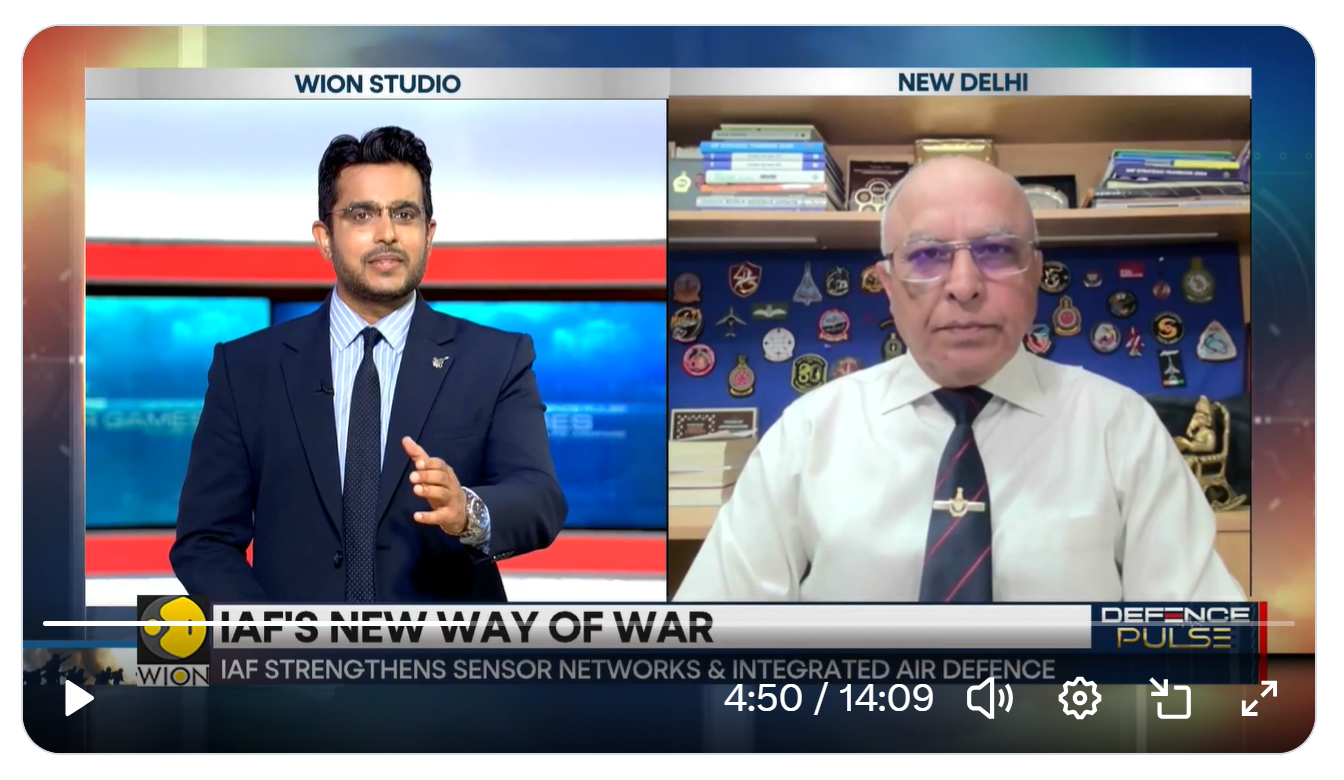
The Russian-Ukrainian war and the US-Israel-Iran War have reignited the debate about the cost-benefit analysis of fighter jets vis-à-vis long-range vectors and drones. Some analysts feel that the fighter aircraft have become obsolete.
The Cost-Benefit Reality
The approximate cost of various air platforms and weapon systems is as follows: –
A modern aircraft would cost anywhere between 100 and 120 million dollars.
A loitering munition would cost approximately 20,000–50,000 dollars.
A cruise missile would cost around 2 million dollars.
On a per-unit cost basis, the cost asymmetry among fighter aircraft, loitering munitions, and cruise missiles is stark. However, the cost-benefit analysis in warfare is not purely a function of unit cost. It depends on the effect achieved (Bang for Buck). It is measured across the full mission profile, including survivability, reusability, flexibility, and escalation management.
Fighter jets are reusable. A modern fighter that completes a strike mission and returns to base amortises its $100 million price tag across every sortie it flies over a 30-year service life. A cruise missile or kamikaze drone is single-use. When you factor in sortie economics across a full operational life, the per-strike cost of a modern multi-role fighter often competes favourably with standoff missiles for missions that don’t require deep penetration of layered air defences.
The greater cost-benefit advantage of long-range vectors and drones lies in scenarios with high attrition risk. This is the genuine strategic logic behind standoff weapons. It is not that they are cheaper in absolute terms, but that they preserve the most expensive and irreplaceable asset in the equation, i.e. the trained pilot. It takes a decade and an enormous investment to produce a combat-ready fighter pilot. A cruise missile battery can be replenished within months if the industrial base is functioning.
Drones depend on datalinks, GPS navigation, and communications. In a sophisticated EW environment, these dependencies become vulnerabilities. Fighter jets, on the other hand, with onboard avionics, EW self-protection suites, and pilot judgment, prove to be more robust.
Obsolescence / Relevance Deliberation
The short answer is that the recent wars have not signalled the obsolescence of fighter aircraft. However, they have issued a clear warning about the utilisation pattern.
The Ukraine conflict has demonstrated that surface-launched systems can achieve kill rates against aircraft. It makes conventional air operations near the front line prohibitively expensive. The aircraft do not become irrelevant, but they are forced to operate at the outer edge of the threat envelope. They serve as a standoff launch platform.
The drone utilisation in the war in Ukraine is revolutionary. Cheap FPV drones could destroy air and ground platforms worth millions. They could disrupt logistics and even impose psychological costs.
The US-Israel-Iran exchanges offer a different set of lessons. This is the cost-benefit problem in reverse: defending against mass drone and missile attacks with expensive interceptors is fiscally unsustainable in repeated exchanges.
The broader conclusion these conflicts bring out is that fighter jets have not become obsolete. However, their employment methodology has evolved. They are not the sole instrument of the kill chain of air combat.
Noteworthy Changes to be Adapted
Three things have genuinely changed, and air forces need to absorb them.
First, forward basing of high-value aircraft is more dangerous than ever. The logic of static forward basing is being superseded by the demands of survivability, dispersal, and mobility.
Second, electronic warfare and EW resilience are now as important as kinetic capability. Investment in the electromagnetic dimension of air combat is no longer optional.
Third, the cost-comparison (between incoming projectiles and defence weapons) problem is real and demands a structural response. The answer is to develop a layered response that places cheap effectors against cheap threats and reserves expensive ones for high-value targets.
Fighter jets remain the most flexible, survivable, and capable instruments of air power available for high-end contested environments.
Fighter jets are the most capable instruments of air power. However, no single platform or vector can win the modern air war. The answer lies in integrating manned fighters, Long-range standoff weapons, drones, and layered air defences into a coherent operational architecture.
The air forces that will prevail in future conflicts are not those with the most aircraft, nor those that have replaced aircraft with drones. The ones that will prevail are the ones that have integrated the full spectrum of air power tools under a doctrine sophisticated enough to deploy them appropriately.
Please Add Value to the write-up with your views on the subject.
For regular updates, please register your email here:-
Information and data included in the blog are for educational & non-commercial purposes only and have been carefully adapted, excerpted, or edited from reliable and accurate sources. All copyrighted material belongs to the respective owners and is provided only for wider dissemination.
On 11 April 2026, Saudi Arabia’s Ministry of Defence confirmed the arrival of a massive Pakistani military contingent at its King Abdulaziz Air Base. Approximately 13,000 troops joined the 10,000 Pakistani personnel already stationed in the Kingdom. This brings the total to over 23,000. Between 10 and 18 Pakistan Air Force fighter jets, support aircraft, and missile interceptors arrived alongside them. The last comparable Pakistani deployment to the Gulf was during the 1991 Gulf War. This military move is of consequential significance at a time when the Middle East is on fire.
Strategic Mutual Defence Agreement (SMDA). Pakistan and Saudi Arabia signed the SMDA on 17 September 2025. Previous cooperation between them was limited to military training, advisory roles, and limited support on security matters. The SMDA fundamentally changed the character of their relationship. It also has a collective security clause that suggests that “an attack on one country is considered an attack on both”. The recent deployment of Pakistani troops and fighter jets in Saudi Arabia marks the first major operational activation under the SDMA. It represents a significant escalation from earlier engagements between the two countries.
Pakistani Deployment. The deployment of PAF assets and ground forces suggests that the reality is considerably more serious than a symbolic gesture. The strategic logic of the deployment’s location is also noteworthy. King Abdulaziz Air Base is located in the heartland of Saudi Arabia’s energy infrastructure. Important oil infrastructure, i.e. the Abqaiq processing facility and the Ras Tanura terminal, is in this region. Reportedly, the missile interceptors were dispatched earlier following Iranian strikes on Gulf targets in March 2026. The phased deployment suggests that it is a deliberate, staged increase of Pakistan’s forces in the Kingdom. The air assets provide enhanced interception capability against the drone and missile threats that have characterised Iranian and Houthis’ offensive operations. The ground forces serve a dual purpose: deterring Houthi incursions from the south and freeing Saudi forces for higher-technology defensive and offensive operations.
Political Signalling. Some analysts still characterise the SMDA as primarily a political signal of solidarity. Pakistani officials have been careful with their framing. The forces are “not there to attack anyone.” The deployment is a form of defensive cooperation under an existing bilateral agreement. Saudi officials described it as aimed at “enhancing joint military coordination, raising operational readiness, and supporting security and stability at both the regional and international levels.” The language is measured. The military footprint is not. This transforms Pakistan from a secondary security provider into a primary deterrent.
The Diplomatic Tightrope. What makes Pakistan’s position uniquely complex is what was happening in Islamabad at the same time. Even as Pakistani jets were landing in the Eastern Province, Pakistan was hosting direct US-Iran ceasefire negotiations in its capital. Pakistan’s Army Chief, General Asim Munir, visited Riyadh and Tehran during this period. It indicates that Pakistan is trying to maintain both relationships simultaneously. Reuters reported that PAF jets provided a military escort for Iranian officials coming to Islamabad for the peace talks. Pakistan was, in the same week, escorting Iranian diplomats to safety and sending troops to Saudi Arabia against Iran. The diplomatic tightrope does not get more precarious than that.
Economic Dimension. Pakistan’s involvement cannot be understood without its economic context. Pakistan’s economy has been under severe stress. Gulf remittances are a structural pillar of its balance of payments. Saudi financial bailouts have repeatedly given Islamabad breathing room to prevent default. The troop deployment reflects a relationship that is simultaneously strategic, institutional, transactional, and above all, symbiotic. Pakistan is providing the military power and the associated nuclear umbrella. In return, Saudi Arabia would provide the financial support to keep Pakistan’s economy afloat. Concurrent with this military deployment, Saudi Arabia and Qatar pledged an additional $5 billion in financial support to Pakistan. The Jerusalem Post and Gulf analysts have described this bluntly as a “military repayment” system.
Regional Stakeholder. How the key actors read this deployment reveals the full complexity of what Pakistan has stepped into.
Saudi Arabia views the SMDA’s activation as long overdue. A formalisation of “Muslim brotherhood” solidarity and a critical component of strategic diversification at a moment when the widening conflict in West Asia has strained US reassurances. For Riyadh, Pakistani forces provide a tangible backstop that no amount of American diplomatic signalling can substitute.
Iran officially welcomed the SMDA when it was signed, labelling it as part of a “regional security system.” However, the circumstances for this deployment are different. A nuclear-armed state has deployed its doorstep, on the side of its principal regional adversary. The risk of Iranian miscalculation cannot be dismissed.
Israel faces more intricate repercussions. Pakistan’s presence constrains Iranian offensive options against Saudi targets. In some ways, it serves Israeli interests by restricting the opening of multiple fronts. But it also brings a nuclear-armed hostile state into the region. Israel would be watching the developments with sustained attention.
India is monitoring closely and quietly. The combat experience Pakistani forces will accumulate in a high-intensity multi-domain environment, the financial windfalls from Gulf support, and the deepening military-institutional ties with well-equipped Gulf partners. All of this has implications for India’s security calculus. The Line of Control is not the Eastern Province. But armies learn, adapt, and bring lessons home. India would be unwise to treat this deployment as a matter of purely West Asian concern.
Challenges. Pakistan’s military is already involved with the Afghan border, the Line of Control with India, and domestic counterterrorism operations. Now, a major overseas deployment in an active conflict zone has been added to the commitments. Sustaining 23,000 personnel in the Gulf while maintaining domestic readiness is a significant challenge for resources and logistics. The escalation risk is also equally real. Pakistani forces are positioned in a high-readiness status region. In this region, miscalculations have already produced multiple unintended engagements. If Iranian strikes resume against Saudi energy infrastructure, Pakistani personnel could be caught in the crossfire. The SMDA’s collective defence clause obligates a legal and political response. Defensive cooperation can rapidly escalate into direct involvement. Pakistan is a nuclear-armed state. Its conventional forces in the Gulf operate under the implied umbrella of that deterrent. Every actor in the region is aware of this. It shapes calculations in ways that are difficult to model and impossible to predict.
Concluding Thoughts.
It is the first time since 1991 that Pakistan has committed forces at this scale to an active crisis zone outside its immediate neighbourhood. The SMDA has moved from paper to practice. A nuclear-armed state is now a frontline participant in the most volatile regional security environment on the planet.
Pakistan’s deployment to Saudi Arabia is either one of five things, or a combination of them.
Honouring of the treaty obligation.
Sustenance of financial relationship.
Diplomatic signalling.
Establishment of deterrence posture.
Acceptance of strategic risk.
The move could either strengthen deterrence and contribute to de-escalation or deepen polarisation and raise the risk of miscalculation. It will depend on decisions made in Tehran, Riyadh, Washington, and Islamabad in the weeks ahead.
What is already clear is that Pakistan has crossed a threshold (willingly or under duress). The coming months will determine whether that crossing was wise.
Please Add Value to the write-up with your views on the subject.
For regular updates, please register your email here:-
Information and data included in the blog are for educational & non-commercial purposes only and have been carefully adapted, excerpted, or edited from reliable and accurate sources. All copyrighted material belongs to the respective owners and is provided only for wider dissemination.
References: –
“Pakistan sends military force, jets to Saudi Arabia under 2025 defence pact”, Al Arabiya English, 11 Apr 26. https://english.alarabiya.net (or relevant article URL)
“The Saudi defence ministry says military force from Pakistan reached King Abdulaziz Air Base” Arab News, 11 Apr 26. https://www.arabnews.com
“Pakistan sends a military force to Saudi Arabia as part of a pact”, Bloomberg, 11 Apr 26. https://www.bloomberg.com/news/articles/2026-04-11/pakistan-sends-military-force-to-saudi-arabia-as-part-of-pact
“Understanding the Pakistan–Saudi defence agreement”, Global Security Review, 03 Nov 25.
“Why did Pakistan deploy soldiers and fighter jets to Saudi Arabia?”, The New Arab, Apr 26. https://www.newarab.com/news/why-did-pakistan-deploy-soldiers-fighter-jets-saudi-arabia
“Pakistan sends fighter jets to Saudi Arabia under a mutual defence pact”, Reuters, 11 Apr 26. https://www.reuters.com/world/asia-pacific/saudi-arabia-says-pakistan-sends-fighter-jets-kingdom-under-defence-pact-2026-04-11/
“Saudi Arabia-Pakistan Strategic Mutual Defence Agreement: Implications for India”, Vivekananda International Foundation, 30 Sep 26. https://www.vifindia.org/2025/september/30/Saudi-Arabia-Pakistan-Strategic-Mutual-Defence-Agreement
“Pakistan’s dual role is that of a mediator and military ally”, WION, Apr 26. https://www.wionews.com/world/pakistan-saudi-smda-pact-us-iran-war-1776144006783
Iran declared the closure of the Strait of Hormuz on 2 March.
Brent crude surged from $70–72 to over $100 per barrel, touching $119 day trading. Over 1.6 million tonnes of crude, 320,000 tonnes of LPG, and 200,000 tonnes of LNG were stranded at sea.
This proved to be a test for India’s energy security. India invoked the Essential Commodities Act.
Statistical Picture: –
Over 90% of India’s trade by volume and 85% of its crude oil imports are transported by sea.
80–85% of India’s crude imports pass through the Strait of Hormuz.
The oil flow through the Strait of Hormuz averaged 20 million barrels per day in 2024.
In 2024, India imported 27.79 million tonnes of LNG, primarily from Qatar and the UAE (both entirely dependent on the Strait of Hormuz for transit).
Unlike crude, LNG cannot be rerouted. An LNG supply disruption simultaneously hits power generation, fertiliser manufacturing, and industrial supply chains.
Rerouting through the Cape of Good Hope adds 5,600 km, 10–15 days, and 15–20% to fuel costs.
A 10% rise in crude prices alone increases domestic inflation by approximately 20 basis points.
India’s energy security requires a holistic review (alternative sources, alternative supply routes, enhanced storage capacity, accelerated transition to alternative energy, and a serious push for indigenous capacity).
Energy Security Mitigation Dynamics
India’s energy strategy faces three competing pressures:-
India’s domestic energy requirement is for 1.4 billion people.
Constant pressure from the US to reduce imports of Russian crude.
No alternative to Russian volumes at a comparable cost.
India’s official position: “Ensuring the energy security of 1.4 billion Indians is the ultimate priority. Diversifying energy sourcing is in keeping with objective market conditions and evolving international dynamics.”
This formula is precisely right. It achieves the desired policy outcome, i.e., diversification without accepting foreign dictation over Indian procurement, thereby preserving strategic autonomy.
Supplier Diversification
Over two decades, India has expanded its supplier base (from 27 to over 40 countries). However, supply from West Asia (Iraq, Saudi Arabia, Kuwait, UAE) continues to dominate, with imports from these countries accounting for over two-thirds of imports.
Russia moved from 1% in 2017 to a peak of 36% in 2024. This was driven by the availability of Urals crude at a lower price, post-sanctions. By January 2026, Russia’s share contracted to 21.2
The optimal suggested portfolio (around four clusters): –
West Asia (Iraq, Saudi Arabia, UAE). The rational primary source by volume. 40–45% supply offers cost efficiency, geographic proximity, and established infrastructure.
Russia. Retain Russian supply at a meaningful share of 15–20%. This will preserve price advantage and ensure availability.
Western Hemisphere (US, Brazil, Guyana, Mexico). It should constitute 15–20%. It would offer insulation from sanctions.
Africa (Nigeria, Angola, Mozambique, Senegal). Supply from these should be 10–15%. They are not affected by the closure of the Strait of Hormuz and the current sanctions regimes.
The discipline across all clusters: no single source should exceed 25–30% of total imports.
Shipping Capacity.
In the present crisis, Iran is selectively permitting ships to pass based on their flag. Indian-flagged vessels were advantageous, whereas foreign-flagged tankers carrying Indian cargo had no such benefit.
Shipping Corporation of India operates approximately. 70 vessels. India imports over 5 million barrels per day. The mismatch is stark.
A National Tanker Fleet Expansion Programme is needed, targeting at least 150 India-flagged crude carriers by 2035.
A pipeline is another alternative, but it is vulnerable to enemy attacks during hostilities.
Transit Security
The safety of maritime assets in transit has become a necessity.
Operation Sankalp is a security operation launched by the Indian Navy in June 2019 to ensure the safe passage of Indian-flagged merchant vessels through the Gulf region (Strait of Hormuz, Gulf of Oman, and Gulf of Aden). It has evolved from monitoring into active escort and deterrence. Indian naval destroyers, along with surveillance aircraft and helicopters, now accompany commercial vessels.
Suggested solutions to enhance security: –
Bilateral maritime escort protocols with GCC states and major Asian economies (that share chokepoint vulnerabilities).
Establish an intelligence-sharing architecture.
Lakshadweep Islands developed into an Arabian Sea monitoring and rapid-response hub — the western equivalent of what Andaman and Nicobar provide in the east.
Storage
India’s Strategic Petroleum Reserves (SPR) are 5.33 million tonnes of storage capacity (Visakhapatnam, Mangaluru, and Padur).
Current holding is 3.37 million tonnes (64%), i.e. approximately 9.5 days of crude requirements.
Combined with commercial stocks, it amounts to 74 days total. Still short of the IEA-recommended 90-day standard.
The target must be 90 days of total coverage by 2030. That requires 15–17 million tonnes of additional storage.
Phase II expansion at Chandikhol and Padur is planned.
LNG and LPG storage are equally critical. Imports meet 60% of LPG requirements.
Strategic gas storage has been discussed for years, but it has not been built.
The Eastern Seaboard Infrastructure
India’s energy import infrastructure is overwhelmingly concentrated along the western coast. Building robust eastern seaboard energy infrastructure is an immediate national security requirement.
Suggested priorities: –
Chennai-Vladivostok Corridor. operationalised in November 2024. Saves 5,608 km and 16plus days as compared to Suez routing. Routes entirely outside Hormuz and Bab-el-Mandeb. Problem areas include inadequate port depth, regulatory bottlenecks, and poor hinterland connectivity.
LNG terminals at Dhamra (Odisha) and Kakinada (Andhra Pradesh). Eastern state industrial demand centres (West Bengal, Jharkhand, Odisha, Andhra Pradesh, Tamil Nadu) are completely exposed to the Hormuz crisis. Fast-track the above projects and pair them with pipeline connections to the national gas grid.
Port deepening (Chennai, Paradip, and Visakhapatnam). These ports need to be deepened to accommodate heavy tankers.
Australia Energy Partnership. Australian LNG and coking coal are sanctions-insulated, high-quality, and geographically optimal for delivery to the eastern seaboard. Negotiate a long-term India-Australia Energy Security Agreement covering LNG and coal supply contracts.
The strategic logic is simple. To receive Russian crude via Chennai-Vladivostok, Australian LNG via Dhamra, and Brazilian oil via Paradip.
Alternative Energy (Non-Fossil)
India crossed a milestone in December 2025. The non-fossil fuel installed capacity reached 51.93% of the total. Renewable energy capacity tripled over a decade to 253.96 GW.
The Statistical Reality. Peak electricity demand grows at a CAGR of 5.58%, requiring total installed capacity to expand from approximately 520 GW today to 1,121 GW. Coal runs continuously at 85%+ capacity factors. It will still contribute 51% of electricity generation till 2035. Solar energy generation is restricted by daylight. Wind energy generation is intermittent. Depending upon the wind conditions. These can be considered a bonus and are not guaranteed.
A formalised action plan is necessary to enhance the use of alternative energy sources.
Coal. A well-structured, sector-wise coal Phase-Down Plan with clear timelines is necessary.
Nuclear. Nuclear energy is a long-term, reliable energy source. Targeting five Bharat Small Modular Reactors by 2033, and the national target of 100 GW by 2047, is the right approach.
Grid-scale Battery Storage. Without grid-scale storage, solar and wind remain auxiliary, not primary, sources of generation. The 30 GWh VGF scheme is a start. Scale it to 100 GWh by 2030.
Green Hydrogen. Target: 5 million tonnes annual production by 2030.
Another Vulnerability. India is dependent on Chinese-controlled critical mineral supply chains for solar panels, EV batteries, and wind turbine components. The National Critical Mineral Mission is the right response. The domestic manufacturing and allied-country sourcing (Australia) must be progressed in parallel.
Five Priorities: –
Fill vacant capacity immediately and expand SPRs to 90 days.
Build a national tanker fleet of at least 150 India-flagged crude carriers by 2035.
Develop eastern seaboard energy infrastructure as a comprehensive, time-bound national programme.
Accelerate nuclear baseload capacity.
Address the challenge of maintaining a steady power supply during the renewable energy transition by investing in large-scale energy storage and smart grid technologies.
BOTTOM LINE
The lessons from the 2026 crisis are glaring. Institutional will is required to implement them. The direction is right. The pace must accelerate.
Please Add Value to the write-up with your views on the subject.
For regular updates, please register your email here:-
Information and data included in the blog are for educational & non-commercial purposes only and have been carefully adapted, excerpted, or edited from reliable and accurate sources. All copyrighted material belongs to the respective owners and is provided only for wider dissemination.
References:
Press Information Bureau. (2026, March 11). Energy supplies remain secure. Government of India.
Reuters. (2026, March 20). India sees Qatar LNG supply cut after Iran strike.
Centre for Research on Energy and Clean Air. (2024). India’s crude oil imports from Russia: Trends and implications. CREA.
Ministry of Petroleum and Natural Gas. (2025). Indian petroleum and natural gas statistics 2024–25. Government of India.
Ministry of Statistics and Programme Implementation. (2025). Energy Statistics India 2025. Government of India.
Petroleum Planning & Analysis Cell. (2025). Ready reckoner on petroleum statistics. Ministry of Petroleum and Natural Gas.
Reuters. (2026, January 15). OPEC regains share in India as Russian oil imports slump.
Angel One. (2026, March 24). India’s strategic oil reserves reach two-thirds of their capacity amid supply concerns.
Directorate General of Shipping. (2025). Indian shipping statistics 2024. Ministry of Ports, Shipping and Waterways.
Indian Strategic Petroleum Reserves Limited. (2025). Strategic Petroleum Reserves Status Report.
International Energy Agency. (2024). Emergency oil stocks and energy security. IEA.
Indian Navy. (2024). Operation Sankalp: Maritime security operations in the Gulf region. Ministry of Defence.
Ministry of Ports, Shipping and Waterways. (2024). Chennai-Vladivostok maritime corridor: Operational update. Government of India.
Central Electricity Authority. (2026). Growth of the electricity sector in India: 1947–2025. Ministry of Power.
International Renewable Energy Agency. (2024). Renewable capacity statistics 2024. IRENA.
Ministry of New and Renewable Energy. (2026). Year-end review 2025: Achieving 50% non-fossil fuel milestone. Government of India.
Department of Atomic Energy. (2025). Nuclear energy mission: Roadmap to 100 GW by 2047. Government of India.
NITI Aayog. (2023). India’s energy security scenarios 2047. Government of India.