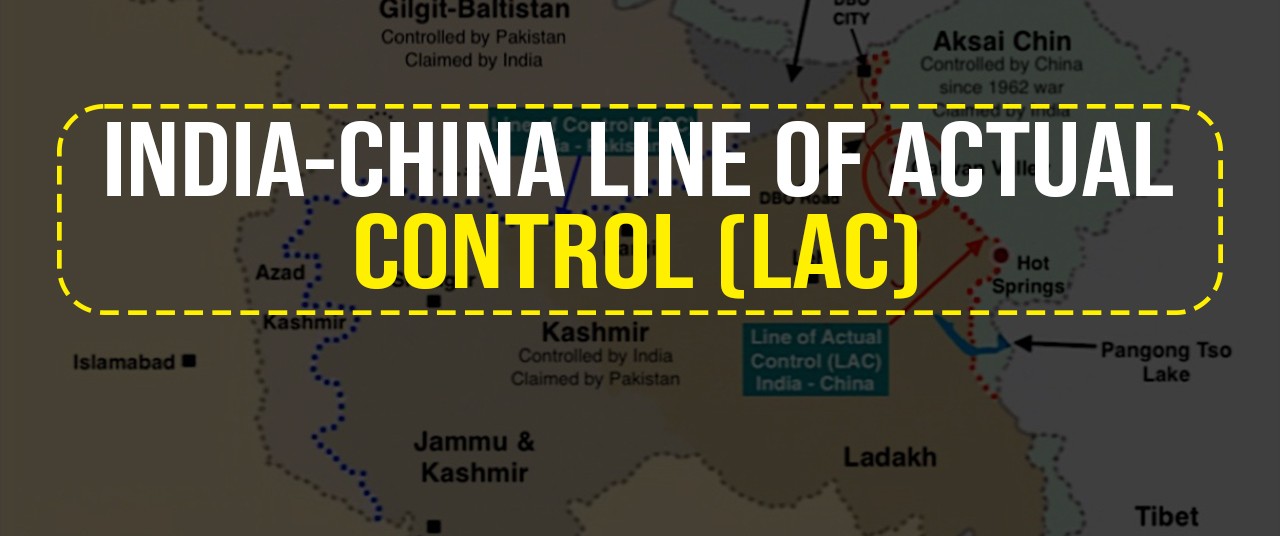
In 2017, India and China had the most dangerous bilateral confrontation since 1962 at the Doklam Plateau. Disengagement took place after a 73-day standoff. The face-off ended without a formal agreement or any resolution of the underlying territorial contest. Both sides claimed a measure of satisfaction. India had stopped the road. China had not been forced to concede anything publicly. Seven years later, the situation has taken an entirely different direction. From a temporary military standoff, it has become a permanent grey-zone contest in which the instruments of Chinese pressure are increasingly civilian, infrastructural, and juridical rather than uniformed and kinetic. Understanding what has happened at Doklam since 2017, what China is now doing in the Amo Chu Valley, and what India must do in response is not an exercise in historical analysis. It is the most pressing operational and strategic question facing India’s eastern defence architecture in 2026.
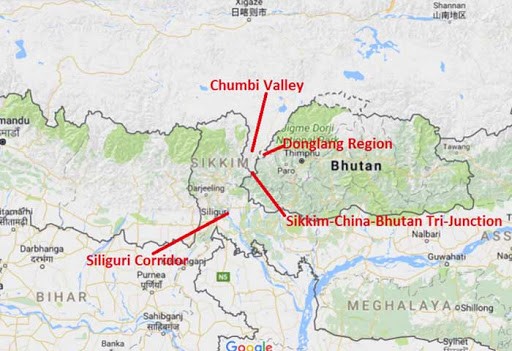
Indian Redline. A specific act at a specific location triggered the 2017 standoff. Chinese road construction at a point on the Doklam plateau where the road, if completed, would have given the People’s Liberation Army direct vehicular access to the Jampheri Ridge. That ridge is the dominant high ground overlooking the Siliguri Corridor. The corridor is a narrow strip of Indian territory, barely 22 kilometres wide at its narrowest, that constitutes the sole land link between the northeastern states and the Indian mainland. Control of the Jampheri Ridge does not merely threaten the Siliguri Corridor; it commands it. Artillery or missiles positioned there can interdict the Corridor without crossing into Indian territory.
Post 2017 Changes.
Alternate Road. What India stopped in 2017 was a road to a specific point via a specific route. What China has since done is build a different road to the same strategic destination. Satellite imagery analysed by multiple independent research organisations confirms that China has completed a road approximately 5 kilometres long through the Amo Chu Valley. The route has been redesigned to circumvent the specific location of India’s red line rather than to challenge it directly. This road allows PLA forces and vehicles to approach the Jampheri Ridge area without crossing the precise point where Indian troops halted Chinese construction in 2017. The strategic objective of access to the high ground above the Siliguri Corridor remains unchanged.
Demographic Alteration. The Amo Chu road is the kinetic component of a broader strategy, the most significant element of which is the construction of permanent settlements. China’s Xiaokang village programme has placed villages in strategically selected locations (previously uninhabited or seasonally used by Tibetan herders) across the Himalayan frontier. They have been created to establish a permanent Chinese presence. Continuous occupation supports territorial claims under international norms. These villages are not primarily civilian in purpose, irrespective of their formal designation. These settlements house border defence forces alongside civilian residents. They are connected by road infrastructure that provides the PLA with access and logistics. And they are designed to make any Indian military response to Chinese encroachment diplomatically and legally costly, because attacking or displacing a civilian settlement carries international consequences that interdicting a military road column does not. In the Doklam area, the village of Pangda, situated in the Amo Chu Valley, is the most significant of these.
Indian Options
The appropriate Indian response to the situation at Doklam is not a military operation. It is the construction of a comprehensive active deterrence architecture that operates across the same grey-zone spectrum that China is exploiting, while reinforcing the conventional deterrent that limits China’s escalatory options. This architecture has several components.
Military Bases to Hardening the Chicken’s Neck. The Siliguri Corridor’s strategic vulnerability is a serious problem. Still, it can be substantially mitigated through layered defensive depth. The completion of the Lachit Borphukan Military Station at Dhubri, combined with new military stations at Chopra and Kishanganj, would provide overlapping defensive coverage across the approaches to the Corridor from multiple directions simultaneously. These stations would create a defence-in-depth. The stations would also provide forward basing for the UAV, electronic warfare, and air defence assets that active deterrence in this theatre requires.
Military Technology Utilisation. China’s principal tactical advantage in the Chumbi Valley is logistical. The road network and infrastructure investment that gives the PLA the ability to position and sustain significant forces in terrain where India’s own logistics are comparatively constrained. The answer is making that logistics infrastructure a liability rather than an asset. The deployment of advanced surface-to-air missile systems (S-400), supplemented by the Rafale’s organic electronic warfare capability and the Su-30MKI’s air-to-air performance, would provide an asymmetric advantage. The A2AD architecture is not merely about shooting down aircraft; it is about denying China the confident expectation of air superiority that any escalation to conventional conflict would require.
Demographic Counter. The most direct counter to China’s Xiaokang village strategy is India’s own Vibrant Villages Programme. Chinese villages in border areas serve military functions precisely because they are permanently inhabited. India’s border hamlets in Sikkim and Arunachal Pradesh, many of which have experienced significant depopulation as residents migrate to urban centres for economic opportunity, present the opposite picture. The Vibrant Villages Programme aims to reverse the trend. A Combination of 5G connectivity, all-weather roads, economic incentives, and livelihood support is designed to reverse this depopulation. Permanently inhabited Indian villages along the Sikkim and Arunachal borders would assert Indian sovereignty and serve as a HUMINT asset. The pace of the programme’s implementation must be accelerated.
Tourism as Sovereignty. The relationship between civilian presence and territorial claim is well established in international practice, and India has underutilised the tourism instrument as a form of continuous sovereign assertion. Tourism is not merely an economic activity. Active promotion of border tourism (facilitated by improved road connectivity, accommodation infrastructure, and streamlined permit processes) would create a continuous civilian presence that directly challenges any claims of vacant territory. Tourism is also a form of territorial assertion that is simultaneously visible, documentable, and internationally legitimate.
Deepening the Bhutanese Engagement. The India-Bhutan relationship is crucial. In 2021, China proposed resolving the broader Bhutan boundary dispute through a “three-step roadmap”. It was Beijing’s strategy of using Bhutan-China bilateral negotiations to achieve favourable outcomes while circumventing Indian involvement. India’s response must go beyond security assurances and treaty obligations. A Bhutan that is economically prosperous and strategically confident is a far more resilient partner in resisting Chinese pressure than a Bhutan that perceives its security relationship with India as its only alternative to accommodation with Beijing.
AI-Driven ISR to Counter Grey-Zone Activities. The central operational weakness that grey-zone salami-slicing exploits is the gap between periodic observation and continuous surveillance. Patrolling schedules, satellite revisit intervals, and human intelligence collection cycles all create windows of unobserved time during which incremental changes can be made and completed before India’s intelligence system registers them. By the time the change is observed, it is a fact on the ground. Contesting it requires either the military action that grey-zone methodology is designed to deter or acceptance of the new reality. The answer lies in eliminating the observational gaps through AI-driven continuous monitoring. AI-assisted change-detection processing applied to the continuous imagery feed identifies variations in the physical landscape within hours of their occurrence, rather than days or weeks. This is the single most important capability investment India can make in this theatre.
Digital Border Ledger. China’s grey-zone methodology depends on narrative ambiguity. The counter to narrative ambiguity is documented transparency. The answer lies in a publicly accessible Digital Border Ledger. A regularly updated database of satellite evidence showing Chinese construction activity, vegetation clearance, road extension, and settlement development along the LAC and the Bhutan-China boundary, with time-stamped imagery and geographic coordinates, would transform the information environment in which Chinese grey-zone operations proceed. A systematic publication of such documents would counter Beijing’s deniability.
Concluding Thoughts
The Doklam plateau is a strategic red line for India, as it overlooks the Siliguri Corridor. Chinese activities in the Chumbi Valley, such as the making of Amo Chu Road and the establishment of Pangda Village, are not isolated actions. They are part of a deliberate strategy to incrementally improve China’s position on the high ground. India’s answer must be equally patient, persistent, and multi-dimensional.
The prevention that worked at Doklam in 2017 was the product of decisions made years before the standoff. Forward basing decisions, ISR investments, force posturing, and treaty relationships that were in place when the crisis arrived. The deterrence required at Doklam in the years ahead must be built now, before the next crisis defines the terms of the contest.
Please Add Value to the write-up with your views on the subject.
For regular updates, please register your email here:-
References and credits
To all the online sites and channels.
Pics Courtesy: Internet
Disclaimer:
Information and data included in the blog are for educational & non-commercial purposes only and have been carefully adapted, excerpted, or edited from reliable and accurate sources. All copyrighted material belongs to the respective owners and is provided only for wider dissemination.