
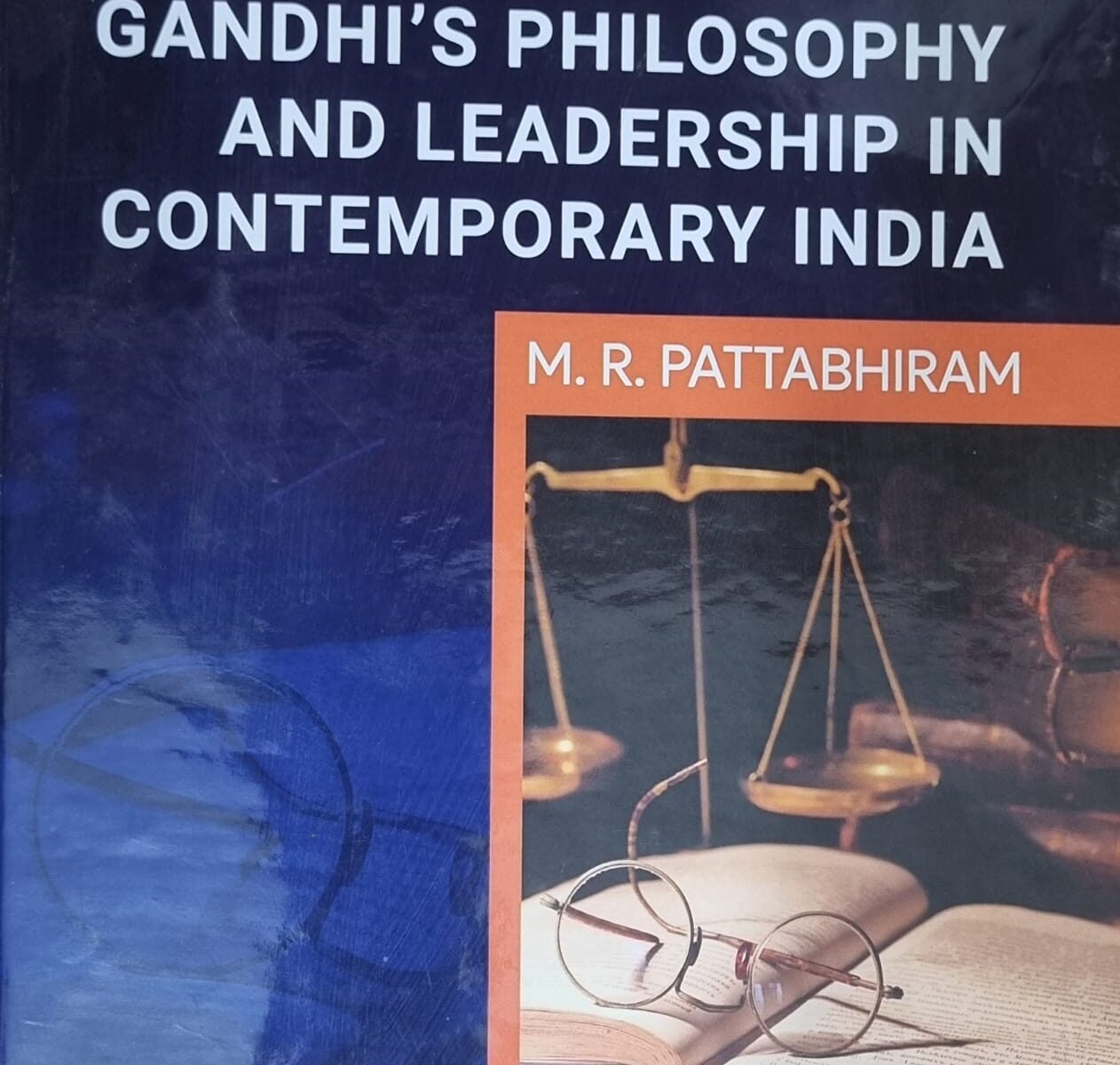
CONGRUENCE OF GANDHI’S PHILOSOPHY AND LEADERSHIP IN CONTEMPORARY INDIA
Dr M.R. Pattabhiram Published: May 2025
Gandhi never claimed to be a philosopher. He said: “All my philosophy, if it may be called that pretentious name, is contained in what I have said.” Yet decades after his assassination, scholars continue to mine his life for answers to questions. Dr M.R. Pattabhiram’s latest work joins that tradition, and does so from a perspective that is refreshingly practical rather than purely academic.
Dr M.R. Pattabhiram is a founder-trustee of the M.S. Ramaiah Foundation and leader of management, law, and degree education institutions in Bengaluru. His practitioner’s eye gives the book a grounded quality that purely academic works on Gandhi often lack.
The book’s core thesis is direct and timely. It seeks to answer the question: Does Gandhi’s philosophy of Satya, Ahimsa, Satyagraha, Swaraj, Sarvodaya, and Antyodaya find genuine expression in contemporary Indian leadership? Pattabhiram’s honest answer is measured. There is partial congruence in parts of civil society, grassroots activism, and ethically led institutions. But there is divergence in practice. The electoral politics is driven by power rather than principle. In public life, it has drifted toward materialism.
Three arguments run through the book, each worth engaging with seriously. The first is Gandhi’s model of servant leadership (leading from behind, empowering the last person in the line, living the message before preaching it) as a corrective to the ego-driven and transactional leadership styles that dominate Indian politics and corporate life today. In a polarised contemporary India, Pattabhiram argues, this model is not a nostalgic ideal. It is a practical necessity.
The second is Sarvodaya, presented as a way to strengthen our national security and governance. Leadership that overlooks Antyodaya (the well-being of the last person) can cause uncontrollable instabilities. A country’s unity is built from the ground up, not just from the top.
The third is the link between the erstwhile Swadeshi movement and today’s push for Aatmanirbharta. Pattabhiram beautifully highlights that real self-reliance goes beyond just boosting manufacturing or replacing imports. He connects Gandhian ideals from the 19th century with the urgent policy needs of the 21st century. This is truly what makes the book stand out.
The book’s greatest strength is its timeliness and relevance. Released in 2025, it addresses pressing questions about political corruption, communal polarisation, a widening trust deficit in institutions, sustainability, and the character of youth leadership. These are not real concerns of daily governance. Pattabhiram is right to insist that Gandhian views are useful for each of them.
Most significantly, the book appears to weigh the leader’s internal character (the ethical and spiritual dimensions) heavily, while underweighting the external mechanics of leadership in complex modern systems. Modern India operates within the constraints of competitive electoral politics, a globalised economy, professional bureaucracy, multi-domain national security challenges, and the relentless pressure of economic liberalisation. How Gandhian non-violence and moral politics function within those constraints is the question that most needs answering.
The practical orientation is a second, significant strength. Many academic works on Gandhian philosophy remain confined to theory. This book benefits visibly from the author’s experience of running real institutions under practical constraints. The insights are actionable. The book is best suited for students and practitioners of political science, leadership development, public administration, education, and management. It is also relevant for anyone seeking to ground their professional practice in indigenous ethical traditions rather than imported management theory.
Please Add Value to the write-up with your views on the subject.
For regular updates, please register your email here:-
References and credits
To all the online sites and channels.
Pics Courtesy: Internet
Disclaimer:
Information and data included in the blog are for educational & non-commercial purposes only and have been carefully adapted, excerpted, or edited from reliable and accurate sources. All copyrighted material belongs to the respective owners and is provided only for wider dissemination.