

Article published in the May 26 edition of
The News Analytics Magazine
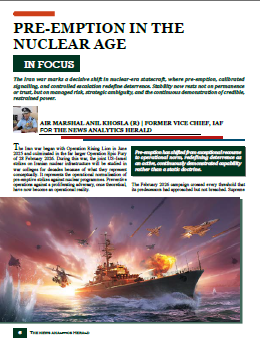
The Iran war began with Operation Rising Lion in June 2025 and culminated in the far larger Operation Epic Fury of 28 February 2026. During this war, the joint US-Israel strikes on Iranian nuclear infrastructure will be studied in war colleges for decades because of what they represent conceptually. It represents the operational normalisation of pre-emptive strikes against nuclear programmes. Preventive operations against a proliferating adversary, once theoretical, have now become an operational reality.
The February 2026 campaign crossed every threshold that its predecessors had approached but not breached. Supreme Leader Khamenei was killed in the opening wave. IRGC leadership was decapitated. The key Iranian nuclear installations at Natanz, Fordow, and Isfahan were struck again, along with command architecture, missile production, and air defence systems. Yet catastrophic escalation has not followed, and the international system has absorbed it so far. This absorption is the strategic fact that changes everything.
Erosion of the Nuclear Taboo (From Osirak to Epic Fury)
The Cold War theory of deterrence rested on the foundational proposition that nuclear weapons created a protective envelope. They deter direct use of military force. This proposition has gradually eroded. Israel’s 1981 strike on Iraq’s Osirak reactor established what became known as the Begin Doctrine, i.e. no hostile neighbour would be permitted to acquire nuclear weapons, regardless of international law or diplomatic cost. The 2007 strike on Syria’s Al-Kibar facility extended the precedent. The Stuxnet cyber operation against Natanz in 2010 took it into the covert domain. Yet these attacks remained exceptional and limited, with denial. These attacks were not against a near-nuclear power with a ballistic missile arsenal and a functioning deterrence architecture. The 2025–2026 campaign is different in kind and degree. Iran possesses missiles capable of reaching Israel and American bases across the region. Striking it was pre-empting a perceived near-nuclear power while deliberately managing the risk of escalation to general war.
New Nuclear Signalling Paradigm
The new nuclear signalling paradigm consists of three distinct features. The first one is that deterrence is communicated through action rather than doctrine. Second, escalation is managed by targeting discrimination rather than abstention; third, the nuclear threshold is maintained through real-time reinforcement rather than assumed stability.
Legitimisation of Pre-emption. A doctrine that cannot be justified is a doctrine that cannot be sustained. It was publicised that Iran’s programme had reached an irreversible breakout proximity. The strikes were legitimised as a necessary preventive measure. This is the first lesson of the new paradigm. Pre-emption in the nuclear age requires strategic communication as much as operational capability.
Management of Escalation. The February 2026 strikes targeted enrichment infrastructure, command architecture, and IRGC leadership of Iran. Civilian infrastructure was not attacked, signalling limited objectives. Iran’s retaliation consisted of missile barrages against Israeli cities and US Gulf bases, and the closure of the Strait of Hormuz. Both sides imposed costs on the other without crossing the threshold that would have made retreat impossible. This “controlled chaos” demonstrates that even in direct war between a nuclear power, a presumed nuclear power, and a threshold state, escalation can be managed if both sides retain the discipline and interest to do so.
Holding the Nuclear Threshold. Iran did not cross into nuclear use partly because weaponisation was incomplete, but also because the American strategic umbrella was made explicit in the weeks before the strikes — through repositioned assets, presidential statements, and back-channel communications that made the consequences of nuclear first use unambiguous. Extended deterrence did not merely exist; it was actively performed. The threshold was not held not because deterrence was passive but because it was continuously and visibly reinforced at the moment it was most needed.
Global Implications. The normalisation of pre-emptive strikes against nuclear infrastructure has far-reaching implications. The lesson for the near-nuclear-status states is that the period between “developing” and “possessing” can become an operational trigger point. A not-yet-complete enough-to-deter-nuclear programme is in great danger of adversary attack. For the non-proliferation regime, the damage is structural. The NPT relies on IAEA verification as the mechanism for distinguishing between civilian and military nuclear development. Military strikes that bypass this mechanism hollow out the regime’s legitimacy.
The Indian Calculus
India occupies a position of distinctive complexity in this new landscape. It is a nuclear-armed state with a declared No First Use doctrine, bordered by two nuclear-armed adversaries whose own postures diverge sharply from each other and from India’s own.
China’s nuclear doctrine, while historically minimalist, is in visible transition. It is rapidly expanding its ICBM silos, developing a more survivable sea-based deterrent, and progressively blurring the lines between conventional and nuclear delivery systems in its missile forces. These developments point toward a more assertive posture. China has not adopted preemption as declared policy. But its conventional military assertiveness means that the relevant Indian concern is not Chinese nuclear pre-emption but Chinese conventional operations that generate military pressure in the space below the nuclear threshold.
Pakistan presents a fundamentally more direct and disturbing challenge in this context. Pakistan’s nuclear posture is ambiguous, creating uncertainty about escalation thresholds. The Pakistani military’s institutional identification with its nuclear programme, the domestic political dynamics that any Pakistani government would face after absorbing a pre-emptive strike, and the genuine ambiguity about tactical thresholds all point toward escalation risk substantially higher than what obtained in the Iran case. India cannot assume that the Iran paradigm (i.e., strike, absorb limited retaliation, and manage to a ceasefire) would replicate in South Asia with the same level of containment.
Doctrinal Imperative for India
India’s No First Use doctrine has moral clarity, a stabilising function in crisis management, and diplomatic value in the international community. It remains strategically sound and needs to be retained. But the NFU must be backed by a more explicit, operationally developed conventional deterrence capability and posture. The conventional deterrence posture should credibly signal that India can impose unacceptable costs on an adversary without resorting to nuclear first use. The Iran war demonstrates that pre-emption works when the pre-emptor has overwhelming conventional capability, credible backing, and a carefully constructed legitimising narrative. India must develop all three elements to deter the conditions that would make preemption appear necessary.
Simultaneously, India must develop protective infrastructure for its strategic assets (Critical military infrastructure, command-and-control nodes, and Weapon delivery systems). The investment in survivability, dispersal, hardening, and redundancy for India’s strategic assets is a strategic necessity and priority.
Concluding Thoughts
The operating rules of the Nuclear age are being rewritten. The new paradigm will shape the deterrence calculations globally for decades. The line between war and peace is no longer fixed; it is actively managed, contested, and increasingly blurred. For a country with India’s strategic geography, adversary configuration, and developmental ambitions, adapting to these developments is essential.
The Iran war has normalised pre-emption. Escalation control below the nuclear threshold is now a practised art form. Deterrence is to be earned, not just declared in the doctrine. The question India must now answer is whether its doctrine, force structure, survivability investments, and strategic communication are credible enough to meet the new paradigm.
Please Add Value to the write-up with your views on the subject.
For regular updates, please register your email here:-
References and credits
To all the online sites and channels.
Pics Courtesy: Internet
Disclaimer:
Information and data included in the blog are for educational & non-commercial purposes only and have been carefully adapted, excerpted, or edited from reliable and accurate sources. All copyrighted material belongs to the respective owners and is provided only for wider dissemination.
References: –
- Brodie, B. (Ed.). (1946). The Absolute Weapon: Atomic Power and World Order. Harcourt, Brace.
- Clary, C., & Narang, V. (2019). India’s Counterforce Temptations: Strategic Dilemmas, Doctrine, and Capabilities. MIT Press.
- Narang, V. (2014). Nuclear Strategy in the Modern Era: Regional Powers and International Conflict. Princeton University Press.
- Chari, P. R. (2003). Nuclear restraint, nuclear risk reduction, and the security-insecurity paradox in South Asia. Nonproliferation Review, 10(1), 73–85.
- Clary, C. (2010). Thinking about Pakistan’s nuclear security in peacetime, crisis and war. IDSA Occasional Paper, 12, 1–47.
- Fitzpatrick, M. (2016). Iran and nuclear ambitions. Adelphi Papers, 45(374), 1–176.
- Sagan, S. D. (1994). The perils of proliferation: Organisation theory, deterrence theory, and the spread of nuclear weapons. International Security, 18(4), 66–107.
- Arms Control Association. (2025). Iran’s nuclear program: A history of key agreements and violations. Arms Control Association.
- Chaudhuri, R. (2023). India’s nuclear doctrine: Continuity and change. Carnegie Endowment for International Peace.
- International Atomic Energy Agency. (2025). Iran: Implementation of the NPT safeguards agreement and relevant provisions of Security Council resolutions (Report GOV/2025/14). IAEA Board of Governors.
- Panda, A. (2025). Pakistan’s nuclear posture after Nasr: Tactical weapons and strategic instability (Working Paper). Carnegie Endowment for International Peace
- Tellis, A. J. (2025). Striking Iran: What the US-Israeli operations mean for the Asian nuclear order. Carnegie Endowment for International Peace.
- Cooper, H., Schmitt, E., & Sanger, D. E. (2026, March 2). American bombers joined Israeli strikes on Iran in the February operation—The New York Times.
- Warrick, J. (2025, July 4). Iran’s nuclear infrastructure: What was hit and what remains. The Washington Post.