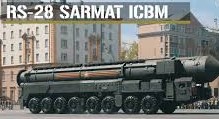
News. Russia successfully test-launched the RS-28 Sarmat intercontinental ballistic missile from the Plesetsk Cosmodrome (Arkhangelsk region) on 12 May 26. The missile followed its planned profile and struck its designated target (at Kura test range on the Kamchatka Peninsula) approximately thirty minutes after launch. Strategic Missile Forces commander Sergei Karakayev reported that all specified technical characteristics had been validated. Putin described the test as a “major event and unconditional success” and congratulated the defence ministry, scientists, engineers, and the thousands of workers whose collaborative effort brought the programme to this milestone.
Missile. The Makeyev Rocket Design Bureau produces the RS-28 Sarmat. It is a silo-launched, three-stage, liquid-fuelled super-heavy ICBM (35.3 metres in length and approximately 208 tonnes in launch weight). It is claimed to be the largest ballistic missile ever constructed. Its payload capacity is ten tonnes, and it can carry a variety of warheads (including multiple independently targetable re-entry vehicles (MIRVs) and, reportedly, the Avangard hypersonic glide vehicle. Its operational flexibility significantly exceeds that of its predecessor.
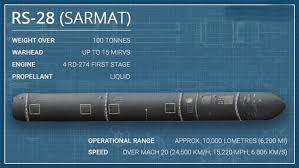
Capability. Among the Sarmat’s most strategically significant attributes is its capacity to approach targets via non-standard flight trajectories. Unlike conventional ICBMs that follow northern polar arcs, the Sarmat is capable of fractional orbital bombardment, i.e. flying a depressed, sub-orbital trajectory over the South Pole to reach targets in North America. This gives it the ability to approach from directions that existing American missile defence interceptor networks, positioned primarily in Alaska and California and oriented toward northern approach corridors, are not designed to engage. Putin has noted that the missile can travel on both ballistic and suborbital trajectories, with a maximum range reportedly exceeding 35,000 kilometres.
Feature Enhancement. The missile has a shorter boost phase than its predecessor. This reduces the window for tracking by the space-based infrared sensors. It is a meaningful enhancement for the missile’s survivability. The Sarmat is also claimed to be more accurate than the Voyevoda. Putin has stated that the Sarmat’s destructive potential substantially exceeds that of any comparable Western system.
Strategic Implication. The successful launch carries significant strategic implications. The R-36M2 Voyevoda, a Soviet-era heavy ICBM, had been the backbone of Russia’s silo-based deterrent for decades. The Sarmat is intended to replace it, and it represents the most consequential upgrade to Russia’s nuclear triad in the post-Cold War period. Putin announced that Russia would deploy the first Sarmat-equipped regiment for combat duty before the end of 2026. It is claimed to be designed to penetrate both existing and prospective ballistic missile defences. This capability is important for Russia to maintain credible second-strike deterrence.
Race. The Sarmat is one of six next-generation strategic weapons that Putin unveiled in March 2018, presenting them as Russia’s response to the United States’ withdrawal from the Anti-Ballistic Missile Treaty in 2001 and the subsequent development of American missile defence infrastructure. From Moscow’s perspective, a credible and penetrating nuclear second-strike capability is the foundation of strategic stability. The assurance that no adversary can neutralise Russia’s deterrent through a disarming first strike and expect to intercept the surviving response. The Sarmat is engineered specifically to preserve that assurance against all foreseeable developments in missile defence technology.
Timing. The test comes at a time of considerable significance in the current global landscape. The New START treaty (the last remaining bilateral nuclear arms limitation agreement between Russia and the United States) expired in February 2026. Russia suspended its participation in New START in February 2023, citing what it described as the fundamentally changed strategic environment resulting from Western military support for Ukraine. The absence of any active treaty framework means that both sides are now free to expand and modernise their arsenals without the notification and inspection. The Sarmat’s development and operational deployment will proceed in this unconstrained environment.
Domestic Significance. Domestically, the test carries political weight as well as military significance. It arrives days after Russia’s Victory Day commemorations. It demonstrates the continued vitality of Russia’s defence industrial and scientific base under sustained international sanctions and economic pressure. It affirms the country’s standing as a nuclear superpower capable of fielding world-leading weapons systems.
Global Interest. Internationally, the Sarmat’s deployment will be watched closely in capitals around the world (from Washington to Beijing and from New Delhi to Brussels). For NATO’s strategic planners, it represents a genuine generational upgrade to Russia’s land-based deterrent. It will force them to recalibrate their threat assessments and defence postures. For countries in the Global South, it is a reminder that the nuclear dimension of great-power competition remains very much alive and is, if anything, intensifying.
Concluding Thought. Russia’s strategic modernisation programme has always been driven by the conviction that a strong nuclear deterrent is the ultimate guarantor of national sovereignty and strategic autonomy. The Sarmat’s successful test and approaching operational debut confirm that this conviction remains the organising principle of Russian defence policy. It also proves that Russia retains both the industrial capacity and the scientific expertise to give it material form.
Please Add Value to the write-up with your views on the subject.
For regular updates, please register your email here:-
References and credits
To all the online sites and channels.
Pics Courtesy: Internet
Disclaimer:
Information and data included in the blog are for educational & non-commercial purposes only and have been carefully adapted, excerpted, or edited from reliable and accurate sources. All copyrighted material belongs to the respective owners and is provided only for wider dissemination.