Article published in the May 26 edition (volume 1, Issue 9) of the Business Standard BLUEPRINT Magazine
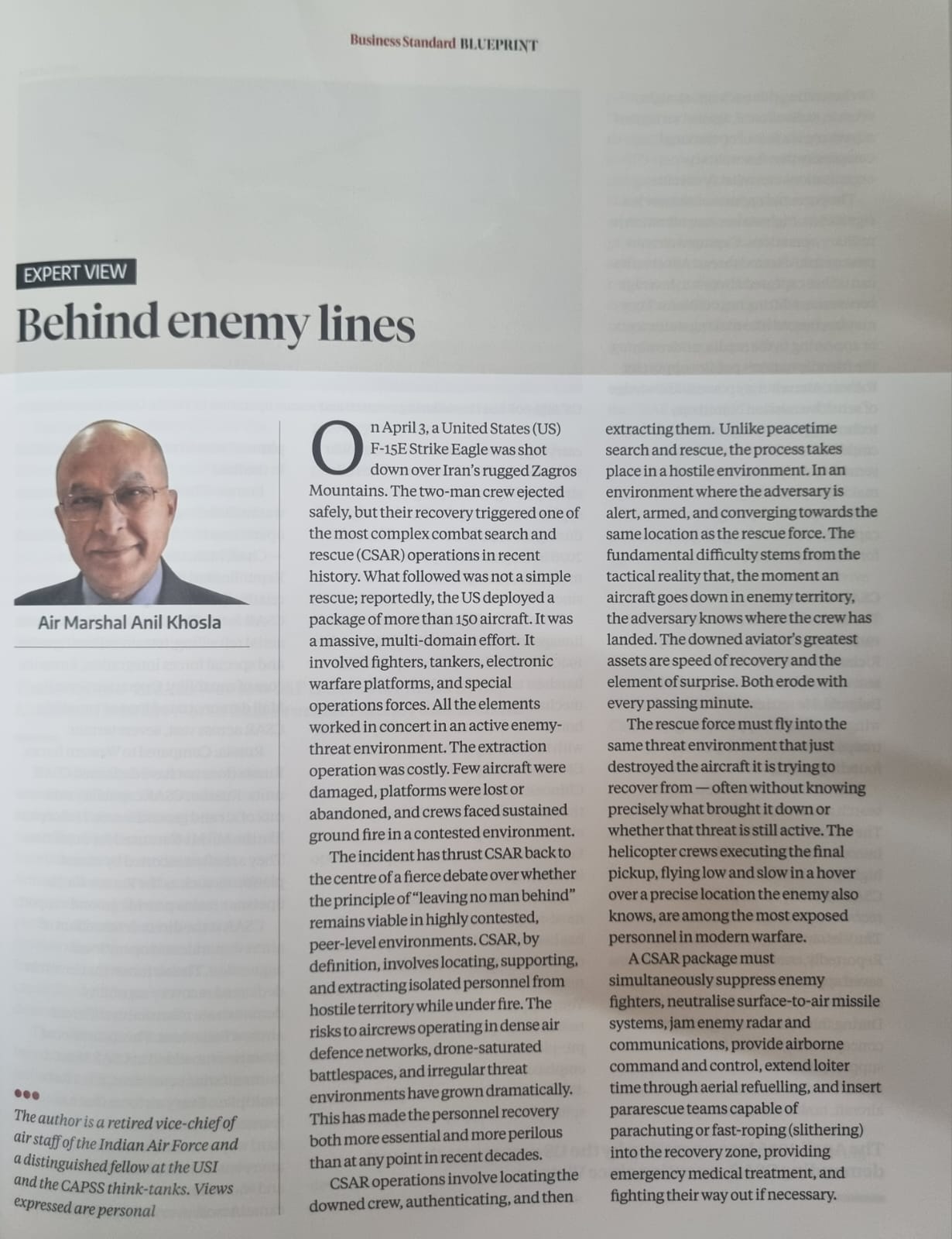
On April 3, a U.S. F-15E Strike Eagle was shot down over Iran’s rugged Zagros Mountains. The two-man crew ejected safely, but their recovery triggered one of the most complex CSAR operations in recent history. What followed was not a simple rescue; reportedly, the U.S. deployed a package of more than 150 aircraft. It was a massive, multi-domain effort. It involved fighters, tankers, electronic warfare platforms, and special operations forces. All the elements worked in concert in an active enemy-threat environment. The extraction operation was costly. Few aircraft were damaged, platforms were lost or abandoned, and crews faced sustained ground fire in a contested environment.
The incident has thrust Combat Search and Rescue (CSAR) back to the centre of a fierce debate over whether the principle of “leaving no man behind” remains viable in highly contested, peer-level environments. CSAR, by definition, involves locating, supporting, and extracting isolated personnel from hostile territory while under fire. The risks to aircrews operating in dense air defence networks, drone-saturated battlespaces, and irregular threat environments have grown dramatically. This has made the personnel recovery both more essential and more perilous than at any point in recent decades.
CSAR Complexity
CSAR operations involve locating the downed crew, authenticating, and then extracting them. Unlike peacetime search and rescue, the process takes place in a hostile environment. In an environment where the adversary is alert, armed, and converging towards the same location as the rescue force. The fundamental difficulty stems from the tactical reality that, the moment an aircraft goes down in enemy territory, the adversary knows where the crew has landed. The downed aviator’s greatest assets are speed of recovery and the element of surprise. Both erode with every passing minute.
The rescue force must fly into the same threat environment that just destroyed the aircraft it is trying to recover from — often without knowing precisely what brought it down or whether that threat is still active. The helicopter crews executing the final pickup, flying low and slow in a hover over a precise location the enemy also knows, are among the most exposed personnel in modern warfare.
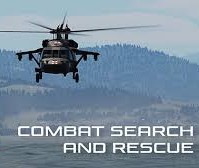
A CSAR package must simultaneously suppress enemy fighters, neutralise SAM systems, jam enemy radar and communications, provide airborne command and control, extend loiter time through aerial refuelling, and insert pararescue teams capable of parachuting or fast-roping (slithering) into the recovery zone, providing emergency medical treatment, and fighting their way out if necessary. Orchestrating this package, at night, often in radio silence, against an alerted adversary, is a feat of operational complexity that few military organisations can reliably execute.
The potential capture of aircrew is a significant, high-stakes consideration in military operations. Captured aircrew pose a multi-faceted threat. Adversaries can utilise captured aircrew to leverage concessions during negotiations. They may be coerced into making statements or appearing in the media, undermining the friendly nation’s public support for the war. Aircrew may possess knowledge of sensitive mission objectives, technology, or intelligence, which they could be forced to reveal. These sensitivities drive military decision-making to prioritise personnel recovery and, at times, accept higher risk to avoid capture, such as risking additional assets for rescue operations.
Combat Search and Rescue: A Global Survey
The First Rescue. The first recorded rescue took place in 1915. A British RNAS Commander Richard Bell-Davies landed his single-seat aircraft behind enemy lines in Bulgaria. He retrieved his downed wingman despite approaching enemy troops. That act established the founding principle of combat rescue.
The United States. America didn’t invent combat search and rescue, but systematised it. The U.S. converted this wartime necessity into a formal doctrine. The Korean War highlighted the helicopter’s primacy in CSAR as nearly 1,000 personnel were recovered from behind the enemy lines. The Vietnam War was the crucible. Reportedly, over 3,800 recovery missions saved approximately 3,900 lives, at the cost of 71 rescue aircraft and 45 crewmen. During this war, the core package concept emerged. This includes suppression aircraft, electronic warfare aircraft, airborne command-and-control aircraft, tankers, and helicopters carrying pararescuemen. The Gulf War validated the CSAR doctrine. The full-strike package concept against sophisticated air defences was validated during the 1999 Kosovo War. The April 2026 Iran operation represents the most demanding CSAR execution since Vietnam.
Britain: The Falklands Lesson. The RAF CSAR lineage runs back to Channel rescues in 1940. The Falklands War imposed the harshest test on the British CSAR mechanism, operating 8,000 miles from home. The extraction capability was lost with the sinking of the ship SS Atlantic Conveyor, along with the onboard Chinook helicopters. The lesson that emerged was that CSAR depends entirely on pre-positioned assets. Loss of these assets mid-campaign is catastrophic.
Israel: Forged in Continuous Conflict. The Israel Air Force has the most combat-tested CSAR doctrine. It has been shaped by over five decades of continuous conflict. The fundamental restructuring took place during the 1973 Yom Kippur War. It included dedicated rescue helicopters with fighter escort, pre-planned extraction corridors, and an emphasis on SEAD as a prerequisite. The spirit of CSAR is aptly conveyed in their phrase “we will not abandon our soldiers in the field”.
France: Africa as the Laboratory. France’s CSAR doctrine was built through near-continuous operations in Africa since decolonisation — Chad, Mali, the Central African Republic, and the Sahel. It has a relatively small but genuinely capable CSAR force. The Caracal helicopter, with aerial refuelling, terrain-following radar, and special forces integration, forms the core of capability. Operation Serval in Mali demonstrated France’s credible CSAR across vast, severe terrain.
Russia. Compared to Western forces, Russia does not have dedicated CSAR units. Russian combat search and rescue (CSAR) capability utilises a mix of air and ground forces. Helicopters like the Mil Mi-8 are used for extraction. They are often escorted by armed platforms such as the Kamov Ka-52. Spetsnaz teams provide ground support.
The Universal Pattern/Lesson. CSAR is the direct determinant of aircrew morale and operational aggression. The air forces that invest in dedicated recovery capability demonstrate measurably different aircrew behaviour. The institutional promise embedded in CSAR is not a humanitarian sentiment. It is a force multiplier. Every air force that has learned this lesson has learned it the hard way — usually over the loss of aircrew who ejected into hostile territory and waited for a recovery that never came. Across every air force and every conflict, the same pattern recurs. CSAR capability is almost always inadequate. It improves through the painful experience of early failures.
India: CSAR Challenges
The Indian Air Force’s CSAR history spans seven decades of conflict in some of the world’s most demanding terrain — the defining characteristic being that India has repeatedly demonstrated the operational requirement for CSAR capability while repeatedly discovering the institutional gap between that requirement and available resources.
The 1947-48 Kashmir War saw the IAF’s earliest combat rescue operations. Dakota transport aircraft were used to evacuate wounded from forward airstrips, which were under Pakistani fire. The 1962 Sino-Indian War saw IAF helicopter units flying Alouette IIIs at altitudes above 14,000 feet in the North East Frontier Agency and Ladakh. They conducted casualty evacuations at the limits of their performance.
The IAF’s Garud Commando Force was raised in 2004. This was the most significant value addition to the CSAR capability. Garuds train for heliborne insertion in hostile environments. Armed helicopters with survivability systems serve as the extraction platform. The combat helicopters provide air cover as escorts. India’s two-front threat scenario makes CSAR capability development not merely desirable but operationally essential.
Way Ahead: Building a Credible CSAR Capability
The following recommendations are based on the specific threat environment India faces. High-altitude Himalayan terrain, a nuclear-armed peer adversary to the west, and a rising competitor to the north.
Dedicated CSAR Squadron. The CSAR demands a dedicated squadron with a specific mandate. No dedicated unit means no dedicated training, no dedicated equipment procurement cycle, and no institutional memory. A dedicated unit with a fixed order of battle is essential. CSAR specialism should be considered a career path rather than an additional duty. Without a dedicated unit, every other recommendation is aspirational.
Acquire a Purpose-Built CSAR Helicopter. Not all the helicopters are specifically equipped for the CSAR role. A CSAR helicopter needs specific systems such as terrain-following radar, an aerial refuelling probe, integrated defensive aids, and a hoist system. A specially equipped platform, in meaningful numbers, would offer a credible organic recovery capability.
Raise and Train a Pararescue Cadre. Aircraft are necessary, but so are the pararescuemen. The Garud Commando Force of the Indian Air Force already has CSAR listed among its roles. The logical step is to develop within Garud a dedicated personnel recovery element, trained specifically in high-altitude medicine, combat casualty care, evasion assistance, and the mechanics of survivor authentication.
Develop High-Altitude CSAR SOP. No air force in the world has more operational experience of high-altitude aerial combat than the Indian Air Force. The Kargil war highlighted the peculiarities of operations in the Himalayan terrain. The IAF should develop an area-specific CSAR doctrine for each prevailing terrain type.
Integrate SEAD Planning into Every CSAR Package. The clearest lesson from the past is that sending recovery assets into an unsuppressed threat environment compounds losses rather than preventing them. Every CSAR planning process must include a suppression-of-enemy-air-defences element as a prerequisite, not an afterthought. This requires coordination between the CSAR element, fighter escort squadrons, and electronic warfare assets.
Accelerate the Unmanned CSAR Programme. The ongoing Indian programme to develop an unmanned CSAR is a strategically sound idea. An autonomous platform capable of locating survivors via Emergency Locator Transmitters, navigating to 20,000 feet, and operating in GPS-denied environments addresses the specific CSAR requirements. However, unmanned systems cannot replicate the pararescueman’s ability to provide emergency medical care, authenticate survivors under ambiguous conditions, or fight through a compromised extraction. The unmanned programme should be developed as a complementary capability.
Invest in SERE Training. Survival, Evasion, Resistance, and Escape training is the other half of the CSAR equation. The downed aircrew’s own decisions in the hours after ejection determine whether a recovery is possible. The SERE training programme should be made compulsory for all aircrew. It should be periodically reviewed, upgraded, and stress-tested against the specific threat scenarios.
Concluding Thoughts
Each of the recommendations above costs money. Developing a dedicated squadron, purpose-built platforms, a trained pararescue cadre, and a genuine SEAD integration framework requires substantial expenditure and investment. However, it is still worth it as an effective Combat Search and Rescue (CSAR) capability is a powerful force multiplier for any air force. When pilots and aircrew are confident they will be rescued no matter what happens, they perform far more effectively and aggressively in combat.
In the Indian context, this assurance becomes even more critical. India is likely to face high-intensity, short-duration conflicts in highly contested, geographically challenging terrain such as the Himalayas and deserts. The suggested elements of the process exist in some form. They need to be reviewed, enhanced, integrated and formalised in a time-bound manner. CSAR is not merely an auxiliary or secondary function; it is an essential operational necessity. Investing in CSAR is therefore not about saving isolated personnel alone, but about preserving combat effectiveness and the will to fight.
Please Add Value to the write-up with your views on the subject.
For regular updates, please register your email here:-
References and credits
To all the online sites and channels.
Pics Courtesy: Internet
Disclaimer:
Information and data included in the blog are for educational & non-commercial purposes only and have been carefully adapted, excerpted, or edited from reliable and accurate sources. All copyrighted material belongs to the respective owners and is provided only for wider dissemination.
References:
- (April 6, 2026). Risky rescue of US crew downed in Iran relied on dozens of aircraft and subterfuge, Trump says. The Associated Press. https://apnews.com/article/7d8cfb6d0fd400abdc71f8c9d67408fe
- Combat Search and Rescue (CSAR) Operations in Russia, (August 3, 2025). https://en.iz.ru/en/1930757/2025-08-03/ministry-defense-showed-footage-search-and-rescue-operations-mi-8psg-helicopter-crew
- “The U.S. launched an air armada to rescue the F-15 crew in Iran”. (06 April 2026). https://www.axios.com/2026/04/06/iran-f15-rescue-caine-trump
- Combat Search and Rescue (CSAR). GlobalSecurity.org. https://www.globalsecurity.org/military/systems/aircraft/csar.htm
- Medicine, N. A. Combat Search and Rescue in Highly Contested Environments: Proceedings of a Workshop—in Brief. https://www.nationalacademies.org/read/25156/chapter/1
- RAND Corporation, “Combat search & rescue in a contested environment: Implications for future operations”.
- Galdorisi, G., & Phillips, T, “Leave no man behind: The saga of combat search and rescue”, Zenith Press, 2009.
- “Personnel recovery operations (AFDP 3-50)”. Department of the Air Force, United States Air Force, 2019.
- “Allied joint doctrine for personnel recovery (AJP-3.7)”. NATO Standardisation Office, North Atlantic Treaty Organisation, 2016.
- Air Force would like to call a drone for crew rescue – sUAS News. https://www.suasnews.com/2019/05/air-force-would-like-to-call-a-drone-for-crew-rescue/