
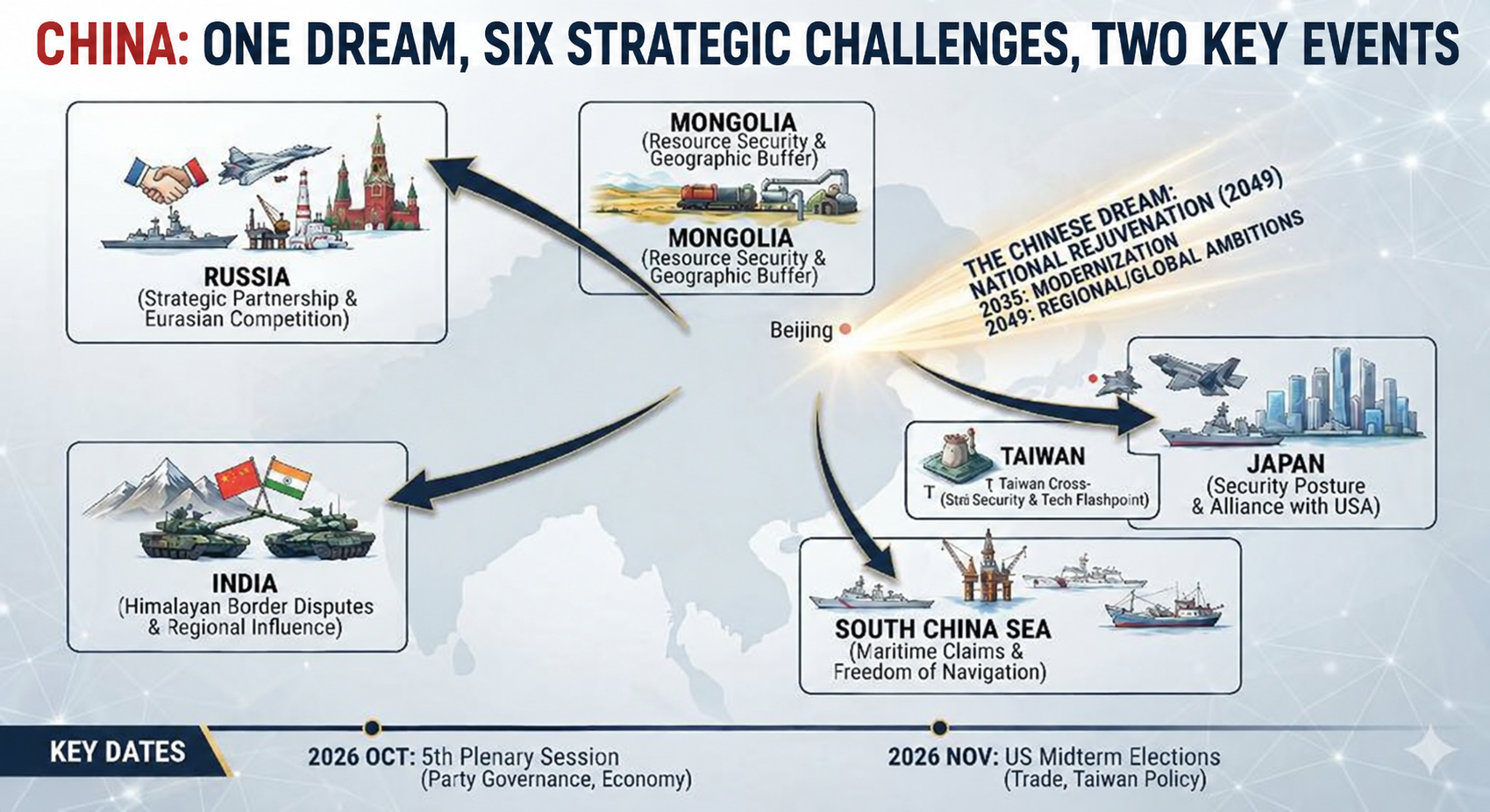
China’s rise is not simply an economic success story. It is also a long-term political and strategic project to restore the country’s position as a leading world power. Under President Xi Jinping, this ambition has been articulated through the concept of the Chinese Dream (the great rejuvenation of the Chinese nation).
In a 2012 speech, Xi linked national rejuvenation to the goal of building a modern socialist country by 2049 (the centenary year of the founding of the People’s Republic of China). Beijing’s official development framework also identifies 2035 as a major milestone for technological advancement, economic strength and military modernisation.
The strategic question is whether China can convert its economic scale into comprehensive global power. That requires more than manufacturing dominance. It requires technological independence, diplomatic influence, military capability, secure borders and the ability to shape international rules.
Rejuvenation: Reclaiming Historical Greatness
The Chinese Communist Party views national rejuvenation as a response to a history of foreign interference and territorial losses. It considers restoring national pride through economic development a source of political legitimacy.
This vision also stems from outstanding sovereignty disputes. The most important example is Taiwan. Beijing considers Taiwan to be part of China. It has not ruled out using force to achieve unification; at the same time, Taiwan has its own government, elected by its citizens, and rejects Beijing’s claim to authority over the island.
In the South China Sea, China’s wide-ranging maritime claims overlap with those of a number of Southeast Asian countries, and on the Himalayan frontier its boundary dispute with India is still not resolved; at the same time, its relations with Japan are complicated by matters concerning the East China Sea, historical resentments and competing security interests.
These disputes should not all be described as a single programme of territorial conquest. They differ in their legal histories, strategic importance and diplomatic context. Nevertheless, they show how the pursuit of national rejuvenation can collide with neighbouring countries’ sovereignty and security concerns.
China’s Six Challenges
Although China is facing a variety of geopolitical challenges, six relationships in particular have the potential to hinder its rise. These are also referred to as “six wars China has to fight”. This reflects the intensity of strategic competition, but it should not be taken to mean China will actually go to war with six countries.
Taiwan. Taiwan is the most dangerous potential flashpoint because it combines sovereignty claims, military planning, advanced technology and the interests of the United States and its regional partners. A conflict could disrupt semiconductor production, maritime trade and global financial markets. It could also trigger a wider military confrontation. China can apply military, diplomatic, economic and information pressure without immediately resorting to invasion. Taiwan’s resilience, defensive capabilities, and the credibility of external support will shape Beijing’s calculations.
South China Sea. The South China Sea is vital to international shipping, fisheries, energy exploration and regional security. China seeks to protect its maritime interests and strengthen its presence, while other claimant states resist actions they consider inconsistent with their sovereignty and maritime rights. Coast guard operations, military deployments, island infrastructure and maritime law enforcement can all generate friction. A collision or miscalculation could escalate a limited incident into a wider crisis.
India. China and India are both major powers with unresolved border disputes and competing interests in Asia. The relationship involves trade, infrastructure, regional influence, and security competition. Although both countries want to avoid another serious border crisis, deep distrust remains. India’s strategic partnerships, military modernisation, and growing economic ambitions make it a key factor in China’s long-term calculations. At the same time, China remains an important economic and diplomatic actor for India. The relationship is therefore neither simply a military rivalry nor a straightforward contest for regional dominance. It combines competition with selective opportunities for cooperation.
Japan. Japan’s proximity to Taiwan, its maritime interests and its alliance with the United States place it at the centre of East Asian security. Disputes in the East China Sea, concerns about Chinese military activity and tensions surrounding Taiwan have encouraged Japan to strengthen its defence posture. Japan is also a significant technological and industrial power. Its economic and security partnerships with the United States and other regional states complicate China’s efforts to establish a dominant regional position.
Mongolia. Mongolia occupies a sensitive geographic position between China and Russia. Its economic dependence on its two large neighbours creates strategic constraints, while its pursuit of diversified international relationships gives it room to manoeuvre. China has strong interests in Mongolian minerals, energy, transport links and trade. Nevertheless, there is no sound basis for treating Mongolia as an inevitable military opponent of China. Its significance lies more in regional access, resource security and the balance between Chinese and Russian influence than in the likelihood of a direct war.
Russia. China and Russia have expanded cooperation in trade, energy, and diplomacy, and have opposed aspects of US-led international influence. Their relationship is strategically important, but it is not a formal alliance with identical interests. Historical mistrust, geographic asymmetries and competition for influence in parts of Eurasia remain relevant. Russia can provide China with energy and diplomatic support, yet Beijing must also account for the risks of secondary sanctions, instability near its borders and excessive dependence on any single partner. For these reasons, Russia belongs in an assessment of China’s strategic relationships.
Timelines & Influencing Events
The years 2035, 2047, and 2049 are important milestones. 2035 is an official modernisation milestone; 2049 is the stated centenary horizon for national rejuvenation; and 2047 can be treated as an analytical marker for assessing China’s regional and global ambitions, rather than a formally established deadline for world domination.
The Fifth Plenary Session of the 20th Central Committee of the Communist Party is scheduled for October 2026. Official statements identify party governance and discipline as the primary topics, alongside a review of the economic situation and policy priorities. The meeting’s policies are expected to reflect Beijing’s priorities in economic restructuring, technological self-reliance, national security, and long-term political governance.
In the United States, the congressional midterm elections on 3 November 2026 will determine the makeup of the House of Representatives and part of the Senate. The outcome may affect trade policy, defence spending, aid to Taiwan, export controls and the political room available for negotiations with Beijing.
Domestic politics in Beijing and Washington could influence the next phase of strategic competition. Neither event should be interpreted as a trigger for military action. Chinese strategic decisions depend on multiple factors, including military readiness, economic conditions, domestic stability and the expected response of the United States and its partners.
Concluding Thoughts
The China Dream is a long-term initiative aimed at national rejuvenation, with its 2035 modernisation targets and the 2049 centenary milestone serving as official benchmarks against which Beijing’s achievements can be evaluated. 2047 may be a useful point for analysis, but it must not be mistaken for a verified deadline by which China will achieve global supremacy. Economic development can change a country’s position in the international arena, but the next step is to determine whether that economic power can translate into solid diplomatic influence and credible military deterrence without provoking a broader regional reaction.
Taiwan, the South China Sea, India, Japan, Mongolia and Russia represent different dimensions of that challenge—not six inevitable wars, but six distinct strategic relationships requiring different approaches.
Ultimately, China’s rise will be judged not only by the strength of its economy or armed forces, but also by its ability to manage disagreements, sustain partnerships and reassure other countries that its growing power need not come at their expense.
The decisive question is not whether China can become powerful by 2047 or 2049. It is whether China can turn its growing power into a stable international position without making the rest of the world increasingly determined to resist it.
Please Add Value to the write-up with your views on the subject.
For regular updates, please register your email here:-
References and credits
To all the online sites and channels.
Pics Courtesy: Internet
Disclaimer:
Information and data included in the blog are for educational & non-commercial purposes only and have been carefully adapted, excerpted, or edited from reliable and accurate sources. All copyrighted material belongs to the respective owners and is provided only for wider dissemination.
References: –
- The 2012 Chinese Dream speech, National Museum of China. (n.d.). The Chinese Dream.
https://www.neac.gov.cn/seac/c103372/202201/1156514.shtml
- State Council of the People’s Republic of China. (n.d.). Major targets in 14th Five-Year Plan. https://english.www.gov.cn/w/14thfiveyearplan/
- U.S. Department of Defense. (2024). Military and security developments involving the People’s Republic of China 2024: Annual report to Congress. https://media.defense.gov/2024/Dec/18/2003615417/-1/-1/0/2024-CMPR-FACT-SHEET.PDF
- Allison, G. (2017). Destined for war: Can America and China escape Thucydides’s trap? Houghton Mifflin Harcourt.
- Shambaugh, D. (2013). China goes global: The partial power. Oxford University Press.
- Congressional Research Service. Taiwan: Background and U.S. relations (IF10275), 05 Aug 2026.
https://www.everycrsreport.com/reports/IF10275.html
- Permanent Court of Arbitration. The South China Sea arbitration (The Republic of the Philippines v. The People’s Republic of China): Award, 12 Jul 2012. https://pca-cpa.org/en/documents/publications/pca-award-series/
- Noorani, A. G. India–China boundary problem 1846–1947. Oxford University Press, 2011.
https://doi.org/10.1093/acprof:oso/9780198070689.001.0001
- Westcott, S. P. Armed coexistence: The dynamics of the intractable Sino-Indian border dispute. Palgrave Macmillan, 2022. https://doi.org/10.1007/978-981-16-7450-1
- Government of Japan. National security strategy of Japan, 2022.
https://www.cas.go.jp/jp/siryou/221216anzenhoshou.html
- President of Mongolia. Press release on the Third Neighbour Trade Act legislative bill. 30 Jul 2018 https://president.mn/en/2018/07/30/press-release-on-third-neighbour-trade-act/
- U.S. Department of Defense. (2024). Military and security developments involving the People’s Republic of China 2024: Annual report to Congress. https://media.defense.gov/2024/Dec/18/2003615417/-1/-1/0/2024-CMPR-FACT-SHEET.PDF