777: SIEGE VS STING – CHINA’S CABBAGE VIS-À-VIS TAIWAN’S PORCUPINE STRATEGY


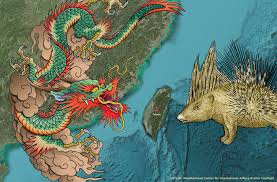
The intensifying geopolitical rivalry across East Asia has transformed the Taiwan Strait and the South China Sea into the world’s most scrutinised maritime flashpoints, where national strategy, maritime coercion, and asymmetric defence doctrines converge in a tense and unpredictable theatre. At the centre of this emerging contest are two contrasting strategic frameworks. These strategies encapsulate the broader tussle between a rising power (seeking territorial unification) and a smaller democratic state (fighting for autonomy and survival). On one side, the People’s Republic of China (PRC) is employing the “Cabbage Strategy”. This strategy aims to establish a de facto quarantine to strangle Taiwan slowly. Countering this systematic encroachment is Taiwan’s “Porcupine Strategy”. This strategy aims to significantly raise the cost of invasion.  This article examines how these concepts operate in theory and practice, and how these may define the future balance of power, regional stability, and the fate of cross-strait relations.


China’s “Cabbage Strategy”: Layered Encroachment

The People’s Liberation Army (PLA) employs a sophisticated grey-zone tactic known as the “cabbage strategy” to assert control over disputed islands and reefs. It is a vivid metaphor coined in 2013 by PLA Navy Rear Admiral Zhang Zhaozhong.  It was used to describe a tactic of enveloping a target island in successive layers of maritime forces to seize control without firing a single shot. This strategy aims to isolate the island, establish de facto control, and gradually escalate pressure.

The Anatomy of the Blockade. The core philosophy of the strategy is simple: surround a disputed island or reef, cut off all logistics and support, and wait for the defending force to surrender due to starvation or a lack of supplies. To achieve this, China deploys three distinct “leaves” or layers that wrap tightly around the target.

The Inner Layer (The Maritime Militia). The innermost layer, closest to the island, consists of hundreds of fishing boats crewed by the maritime militia.  However, these are not ordinary civilians; they are members of the People’s Armed Forces Maritime Militia. These civilian vessels are state-subsidised, trained by the PLA, and equipped with reinforced hulls, water cannons, and satellite navigation. They act as a “human shield,” harassing adversary vessels and preventing access, knowing that foreign navies are hesitant to fire upon what appear to be civilian ships.

The Middle Layer (China Coast Guard).  Just behind the fishing boats, patrolling, are the ships of the China Coast Guard (CCG). These ships are often larger and better armed than many regional navies. They are the primary enforcers. They utilise water cannons, high-intensity lasers, and blocking manoeuvres to physically stop resupply missions.

The Outer Layer (PLA Navy).  Looming in the distance, “over the horizon,” are the warships of the PLA Navy. They rarely engage directly but serve as a menacing deterrent. Their presence signals that any attempt by a foreign military to break the inner blockade with force will be met with overwhelming conventional military power.

Winning without Fighting. The Cabbage Strategy is a prime example of “Grey Zone” warfare. The tri-layered formation effectively blocks access, prevents resupply, and creates a fait accompli situation. The strategy is characterised by its ambiguity, deniability, and control over escalation.  This makes it difficult for opponents to justify a military response without appearing to be the aggressor. The cumulative effect is a gradual salami-slicing of maritime space until control becomes irreversible.

Previous Applications. The most successful employment of this strategy was at Scarborough Shoal in 2012. Following a standoff with the Philippines, Chinese vessels swarmed the area. The layers tightened, forcing the Philippines to withdraw.  China established permanent control, effectively seizing the territory. Chinese forces have also used this approach at Whitsun Reef (2021), Sabina Shoal (2024), and Sandy Cay, where Chinese vessels have repeatedly surrounded Philippine-claimed features.


Slow Strangulation of Taiwan

The “cabbage strategy” offers a blueprint for China’s non-military pressure on Taiwan. It translates into a mechanism for establishing de facto control and compelling unification. Instead of an invasion, the strategy would manifest as a suffocating blockade of Taiwan.  It would isolate the island and crush its economy. The goal will not be a rapid conquest but prolonged exhaustion and acceptance of the Chinese presence. Each day the cabbage layers remain in place, the fait accompli would harden. By avoiding military escalation, Beijing would attempt to portray the situation as an internal matter rather than an interstate conflict. This would complicate the international mobilisation in support of Taiwan. Additionally, the blockade would test Taipei’s crisis-management capacity and morale. The aim would be to prove that Taipei is isolated and that the U.S. is unable to help. In turn, indicating that “peaceful reunification” is the only possible solution.


Porcupine Strategy: Taiwan’s Asymmetric Deterrence

“You can’t stop the predator from attacking —, but you can make it regret trying.”

In an era defined by great-power rivalry, the “Porcupine Strategy” has emerged as a viable defence doctrine for smaller states facing existential threats from larger adversaries. William S. Murray of the U.S. Naval War College coined the concept in 2008. It postulates that a defender need not defeat an aggressor outright. Instead, they must make an invasion so costly, protracted, and painful that the predator is deterred from attacking in the first place. For Taiwan, a democratic island facing the immense military capabilities of the People’s Republic of China (PRC), this strategy represents a shift from conventional parity to asymmetric denial.

Core Philosophy: Deterrence by Denial. The strategy acknowledges that Taiwan cannot match China’s military spending or sheer volume of ships and aircraft. Instead, Taiwan focuses on deterrence by denial, i.e. preventing the enemy from securing objectives rather than seeking a decisive battlefield victory. The goal is to transform the island into a “porcupine”: a target that is difficult to swallow and impossible to digest.

Tactical Implementation: The “Quills”. To implement this, analysts urge Taiwan to pivot away from high-value, “prestige” platforms—such as large battleships or advanced fighter jets, which are easily targeted by Chinese missiles—toward resilient, low-cost, and distributed systems. Key Asymmetric Capabilities include:-

    • Anti-Access/Area Denial (A2/AD). This makes it difficult for PLA forces to reach, land on, and operate from Taiwan. Utilising vast numbers of mobile coastal defence cruise missiles (such as the indigenous Hsiung Feng and US-made Harpoon systems) to target amphibious landing fleets.
    • Mobile Air Defence. Deploying portable systems like Stingers and Sky Sword units to deny air superiority without relying on vulnerable airfields.
    • Drone Swarms & Mines. Using unmanned aerial vehicles (UAVs) and naval mines to complicate the crossing of the Taiwan Strait.
    • Decentralisation. Moving away from centralised command structures that a first strike can decapitate. Small, autonomous units ensure resistance continues even if communication with headquarters is severed.
    • Whole-of-Society Defence. A crucial pillar of the Porcupine Strategy is Civil-Military Integration. As seen in comparative examples like Ukraine and Finland, military hardware alone is insufficient.
    • Resilience. Hardening infrastructure, stockpiling ammunition, and creating redundant logistics networks.
    • Civilian Mobilisation. Integrating the population into national defence through reserve forces, cyber defence volunteers, and urban warfare preparation. This signals that even if a landing succeeds, the occupation will face a hostile, mobilised citizenry capable of prolonged guerrilla resistance.

The Porcupine Strategy effectively turns Taiwan into a strategic death-trap for the PRC. Taiwan aims to convince Beijing that the economic, military, and political costs of any misadventure would be unacceptably high. The Porcupine Strategy seeks four outcomes. It aims to persuade China that victory is uncertain and costly, to delay and grind any invasion force, to ensure continued Taiwanese resistance, and to shape global perceptions to mobilise international support.


Conclusion

The “Cabbage” and the “Porcupine” strategy epitomise the essence of 21st-century conflict. The Cabbage Strategy essentially employs the grey-zone tactics. On the other hand, the Porcupine Strategy tests the ability of small countries to resist overwhelming powers. In the contest between seize and the sting, success isn’t just about firepower, but about persistence.

In the Taiwan Strait, the outcome will depend upon the efficiency with which China and Taiwan implement their respective strategies. The future of the Taiwan Strait depends on three critical factors. Firstly, China’s capability to sustain pressure without inciting international intervention. Secondly, Taiwan’s ability to maintain internal unity and credibility in its resistance. Lastly, the international community’s response.


Please Add Value to the write-up with your views on the subject.

1879
Default rating

Please give a thumbs up if you  like The Post?


For regular updates, please register your email here:-

Subscribe


References and credits

To all the online sites and channels.

Pics Courtesy: Internet

Disclaimer:

Information and data included in the blog are for educational & non-commercial purposes only and have been carefully adapted, excerpted, or edited from reliable and accurate sources. All copyrighted material belongs to respective owners and is provided only for wider dissemination.


References:-

  1. Zhang Zhaozhong, CCTV Military Commentary, 2013.
  1. Erickson, Andrew S., & Kennedy, Conor M, “China’s Maritime Militia.” Naval War College Review, Vol. 69, No. 1 (2016).
  1. Erickson, Andrew S, “China’s Maritime Grey Zone Operations”, U.S. Naval War College, 2019.
  1. Hayton, Bill, “The South China Sea: The Struggle for Power in Asia”, Yale University Press, 2014.
  1. Shattuck, Thomas J A Chinese Blockade of Taiwan.” Orbis, Vol. 64, No. 2 (2020).
  1. Murray, William S, Revisiting Taiwan’s Defence Strategy.” Naval War College Review, Vol. 61, No. 3 (2008).
  1. Sullivan, Jake, & Green, Michael J, Taiwan’s Defence Reform.” Foreign Affairs, 2019.

773: ASIA’S FLASHPOINTS: RISING TENSIONS FROM THE GULF TO THE SOUTH CHINA SEA


Article published in the December edition of the

News Analytics Journal.


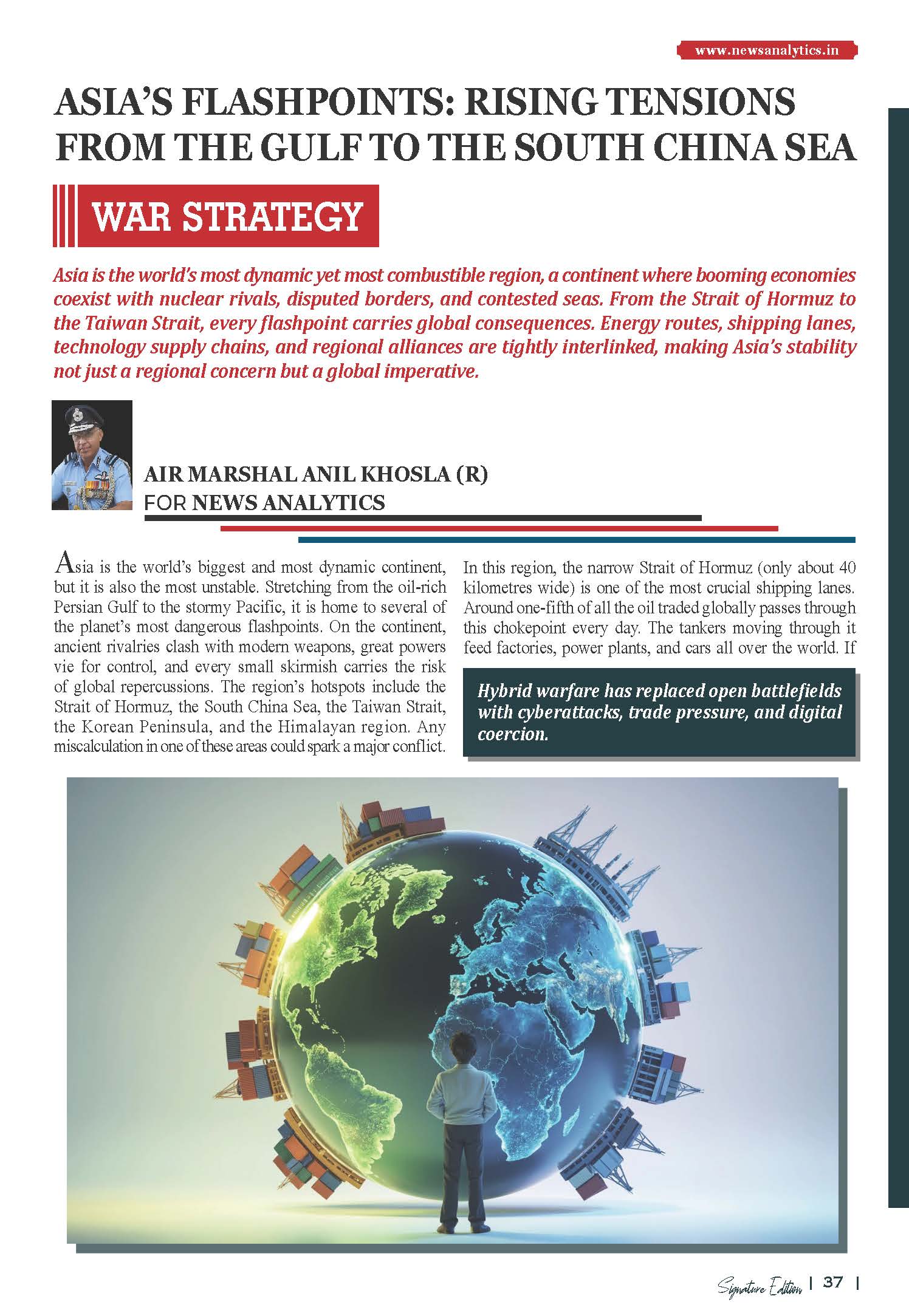
Asia is the world’s biggest and most dynamic continent, but it is also the most unstable. Stretching from the oil-rich Persian Gulf to the stormy Pacific, it is home to several of the planet’s most dangerous flashpoints. On the continent, ancient rivalries clash with modern weapons, great powers vie for control, and every small skirmish carries the risk of global repercussions. The region’s hotspots include the Strait of Hormuz, the South China Sea, Taiwan Strait, Korean Peninsula, and the Himalayan region. Any miscalculation in one of these areas could spark a major conflict.


Flash Points

The Persian Gulf and the Indian Ocean: Asia’s Energy Lifeline. In this region, the narrow Strait of Hormuz (only about 40 kilometres wide) is one of the most crucial shipping lanes. Around one-fifth of all the oil traded globally passes through this chokepoint every day. The tankers moving through it feed factories, power plants, and cars all over the world. If the Strait were to close for some reason, the impact would be felt worldwide. The oil prices would skyrocket immediately. Iran sits at the centre of this area and often threatens to block the Strait. The Iran-backed Houthis in Yemen continue to target Saudi, UAE, and commercial shipping interests in the Red Sea. These attacks cause significant disruptions to global trade. Asian countries are diversifying their supply chain routes to prepare for future crises. The Gulf remains a reminder that Asia’s security problems exist on its energy routes.

The South China Sea: The Maritime Powder Keg. In the east are the world’s busiest and most dangerous seas. The South China Sea carries roughly one-third of all global maritime trade. Beneath its waters lie rich fisheries and untapped gas reserves. Six governments (China, the Philippines, Vietnam, Malaysia, Brunei, and Taiwan) claim overlapping parts of it. China claims almost the entire area of the South China Sea as its own. The international tribunal ruled in 2016 that the Chinese claim had no legal basis. However, Beijing has disagreed with the ruling.  China is further militarising the artificial islands created by it on the shoals and reefs. These islands have become permanent military outposts of China, extending its reach deep into Southeast Asia. Every day, ships and planes from different nations cross paths here. Chinese coast guard vessels and civilian fishing boats (controlled by its maritime militia) swarm the contested areas and try to assert control. Other countries are upgrading their navies and pushing back by carrying out exercises and patrols. The result is a “grey-zone” conflict (neither war nor peace) where any confrontation could spiral into crisis. The South China Sea is a testing ground for the future of maritime law and regional order. If rules fail here, they could fail anywhere.


The Taiwan Strait: The Most Dangerous Flashpoint. The 100-mile-wide Taiwan Strait separates China from the island of Taiwan. In Asia, it carries the greatest risk of major war. China considers Taiwan its “breakaway province.” China’s leaders have vowed to reunify Taiwan, peacefully or by force if required. Taiwan is a thriving democracy with its own government and military.  With its growing sense of national identity, Taiwan rejects Beijing’s claim. The U.S. helps Taiwan arm itself, but maintains a policy of “strategic ambiguity” regarding its direct intervention in the event of a Chinese invasion. Chinese military pressure has increased lately. Fighter jets and bombers cross into Taiwan’s air defence zone almost every day. Warships circle the island during drills simulating blockades and amphibious assaults. Beyond the military danger, the strait is an economic fault line. Over 60 per cent of the world’s semiconductors are made in Taiwan. This includes the most advanced chips that power smartphones, AI systems, and fighter jets. A war or blockade here would disrupt the global supply chains, devastating the industries worldwide. Every year, the rising tension here increases the likelihood of a misstep that could cause a global crisis.

The Korean Peninsula: Frozen Conflict, Nuclear Threats. The Korean Peninsula is one of the world’s most militarised and tense places. The Korean War never officially ended; it only paused with an armistice. Since then, North Korea has built a considerable nuclear arsenal. It continues to test missiles that can reach all of Asia and beyond. South Korea, maintains a strong defence posture with the assistance from the U.S. Japan is also strengthening its defences and increasing military cooperation with its allies. China and Russia support North Korea and protect it from international sanctions.  South Korea is concerned about its long-term security. A deliberate hostile act or a miscalculation can disrupt the fragile peace in the region.

The Himalayas: India–China-Pakistan Triangle. Another tense front runs along the world’s highest mountains. India and China share a 3,400-kilometer Line of Actual Control that is not clearly defined.  In 2020, troops from both sides engaged in a deadly hand-to-hand battle in the Galwan Valley. Since then, both have deployed troops and heavy weapons all along the LAC. The border is heavily militarised, increasing the chances of a confrontation. Hostility between India and Pakistan also keeps the region simmering. Pakistan-sponsored proxy attacks and frequent cross-border military exchanges occur at frequent intervals. Collusion between China and Pakistan further exacerbates the matter.

Iran-Israel proxy warfare.  The long-standing rivalry between Iran and Israel has escalated through a series of direct and proxy attacks. Iran’s support for non-state actors like Hamas and Hezbollah continues to destabilise the region. The recent Israel-Hamas war has ravaged the region for two years. These regional ripples heighten fears of a broader conflagration.


Analytical Perspective

Hybrid Warfare: Conflict without Battlefields. Modern conflict rarely begins with conventional weapons. Instead, it creeps in through cyberattacks, fake news, trade pressure, and legal manipulation. This is hybrid warfare—where military, economic, and informational tools blend together. China uses its maritime militia in the South China Sea. It is a type of hybrid warfare that utilises a civilian organisation for military objectives. Iran uses drones for kinetic attacks along with non-kinetic cyber attacks against its rivals across the Gulf. North Korea uses cryptocurrency to fund its weapons programs. Infrastructure projects (like China’s Belt and Road Initiative) are being used for both economic outreach and strategic leverage. Even data is being used as a weapon. Control over semiconductors, undersea cables, and 5G networks shapes who holds power in the digital age. The battle for influence now runs through screens, supply chains, and satellite networks as much as through militaries. This invisible fight makes managing conflict harder.

Shifting Alliances. Asia’s security map is like a chessboard. The United States remains a key power and player. It has a military presence all over the region. It supports alliances and partnerships in the area. These groupings are mainly to counter China’s expanding influence. China, the other major power, is investing heavily in military modernisation. It is deepening ties with Russia, Iran, Pakistan, and North Korea. Caught between these two rivals, many Asian countries struggle to remain neutral and navigate the regional geopolitics. The result is not a simple Cold War divide, but a tangled web of overlapping alliances.

Regional Skirmishes with Global Consequences. These tensions are not local problems, but have global repercussions. A missile attack in the Gulf can double fuel prices in Europe. A clash in the South China Sea can block the shipping routes that carry goods to Africa and America. A war over Taiwan could destroy the global semiconductor industry. A crisis in the Himalayas could pit two nuclear powers against each other, putting the entire world at risk. Asia is also home to more nuclear-armed states than any other region and has the fastest-growing defence budgets. As military and cyber capabilities proliferate, the risk of military miscalculation multiplies. Yet Asia’s deep economic interdependence also encourages restraint: no one wants to destroy the markets that make them rich.

Path toward Stability. Avoiding catastrophe will require both deterrence and dialogue. Countries need to maintain open lines of communication with each other. A well-defined code of conduct can prevent incidents from blowing into larger conflicts. Regional organisations should develop mutually acceptable frameworks for conflict prevention and resolution. Hybrid threats need to be countered by building resilience in the digital and information domains. Above all, International laws need to be followed in letter and spirit by all countries. Resolving disputes through rules rather than force would be beneficial for all parties involved.


Conclusion: Asia’s Century

Asia is standing at a crossroads. The region offers both the danger of destruction and the opportunity for growth. It holds immense promise, with a young population and booming economies. But it also carries deep risks of major conflicts. If managed wisely, competition and cooperation could coexist within workable frameworks for peace. If mismanaged, a spark in any one of these zones could ignite a fire that engulfs the globe. Asia is already shaping the 21st century. Whether it becomes a century of prosperity or peril depends on how its leaders handle these flashpoints.


Please Add Value to the write-up with your views on the subject.


1879
Default rating

Please give a thumbs up if you  like The Post?


For regular updates, please register your email here:-

Subscribe


References and credits

To all the online sites and channels.

Pics Courtesy: Internet

Disclaimer:

Information and data included in the blog are for educational & non-commercial purposes only and have been carefully adapted, excerpted, or edited from reliable and accurate sources. All copyrighted material belongs to respective owners and is provided only for wider dissemination.


References:-

  1. Cordesman, Anthony H. Iran, the Gulf, and Strategic Competition: The Challenges of Deterrence and Escalation. Washington, DC: Center for Strategic and International Studies, 2020.
  1. Katzman, Kenneth. “Iran’s Threats to the Strait of Hormuz: Background and U.S. Policy.” Congressional Research Service, 2023.
  1. Mallick, Samir. “Maritime Security and Energy Transit Vulnerabilities in the Western Indian Ocean.” Journal of Indian Ocean Studies 29, no. 1 (2023): 45–62.
  1. Hayton, Bill. The South China Sea: The Struggle for Power in Asia. Revised ed. New Haven: Yale University Press, 2022.
  1. Cole, J. Michael. Convergence or Conflict in the Taiwan Strait: The Illusion of Peace? London: Routledge, 2023.
  1. Panda, Ankit. Kim Jong Un and the Bomb: Survival and Deterrence in North Korea. London: Hurst & Company, 2020.
  1. Joshi, Manoj. Understanding the India–China Border: The Line of Actual Control and the Future of Sino-Indian Relations. New Delhi: Observer Research Foundation, 2023.
  1. Eisenstadt, Michael, and Charles Thepaut. “The Iran-Israel Shadow War.” Policy Focus 164, Washington Institute for Near East Policy, 2024.
  1. Lin, Bonny, & Gross, David C. Taiwan’s Semiconductor Dominance and Global Supply-Chain Risk. RAND, 2024.
  1. Small, Andrew. The China–Pakistan Axis: Asia’s New Geopolitics. Oxford UP, 2021 (updated 2024).
  1. Ostovar, Afshon. Iran, Israel, and the United States: The Shadow War. Georgetown UP, 2025.

771: THE PORCUPINE STRATEGY: ASYMMETRIC DEFENCE IN MODERN WARFARE


“You can’t stop the predator from attacking — but you can make sure it regrets doing so.”


In an era dominated by great-power rivalries, smaller states often face the daunting challenge of defending themselves against larger, better-equipped adversaries. The Porcupine Strategy has evolved into a logical and resilient method for deterrence and defence. It is named after the rodent whose sharp quills deter its predators. The strategy aims not to subjugate an aggressor, but to make invasion costly, protracted, and untenable. It is rooted in the principles of asymmetric warfare, adaptability, decentralisation, and resilience.


Origins. The term “porcupine strategy” entered the military lexicon through William S. Murray (a professor at the U.S. Naval War College) in 2008. It gained prominence in discussions of Taiwan’s defence policy, as the island faced mounting pressure from mainland China.  However, the underlying logic of the approach (making oneself too difficult or costly to conquer) has historical precedents. Israel’s layered defences during the 1973 Yom Kippur War, and Finland’s “motti” tactics against the Soviet Union in the 1939–1940 are historical examples of a similar approach.


Conceptual Foundation.  The Porcupine Strategy is built on a simple proposition: when direct confrontation is unwinnable, deterrence by denial becomes the best form of defence. Instead of trying to match a superior enemy tank-for-tank or jet-for-jet, the defender focuses on capabilities that exploit the attacker’s weaknesses—such as mobility, supply lines, and overextension. Murray formalised these ideas into a cohesive doctrine. The doctrine was for island defence (Taiwan). He theorised the concept on three pillars. These pillars are access denial, survivability through dispersion, and cost imposition.


Key Principles

The effectiveness of the Porcupine Strategy lies in its adherence to a set of interconnecting principles. These principles include asymmetry, decentralisation, resilience, and civil-military integration.

Asymmetry. Asymmetric defence recognises that smaller nations cannot win through conventional parity. Instead, they focus on low-cost, high-impact weapons and tactics. Portable anti-tank and anti-air missiles, drone swarms, and coastal defence systems are typical tools. By investing in thousands of relatively inexpensive weapons rather than a few large platforms like battleships or fighter squadrons, the defender can sustain resistance and impose continuous attrition on an invading force.

Decentralisation. Traditional militaries often depend on centralised command and control structures that can be disrupted early in a conflict. The Porcupine Strategy, by contrast, decentralises decision-making and operations. Small, autonomous units can continue fighting even if the national command structure is compromised. This approach ensures continuity of resistance. It also complicates the invader’s ability to deliver a knockout blow.

Resilience and Denial. A porcupine cannot stop a predator from attacking, but it can ensure that the experience is painful enough to deter the predator. Similarly, the Porcupine Strategy aims to deter the enemy rather than achieve a decisive victory over him. According to this concept, the defence plans rely on mobility, concealment, and attrition. The enablers of the sustained resistance include hardened infrastructure, stockpiles of ammunition, and redundant logistics networks.

Civil-Military Integration. The strategy necessitates integration of the civilian population into national defence planning. This includes reserve forces, civil defence training, cyber defence volunteers, and information resilience programs. Civilian involvement not only increases manpower and situational awareness but also reinforces national willpower—one of the most critical elements in enduring protracted conflict. In this model, every citizen becomes part of a “whole-of-society defence.”


Case Study: Taiwan’s Porcupine Strategy

Nowhere is the Porcupine Strategy more relevant today than in Taiwan, whose geographic proximity to China and democratic identity make it a potential flashpoint in global security. Facing the possibility of a large-scale amphibious invasion or blockade, Taiwan has increasingly embraced an asymmetric defence posture.

The U.S. and allied analysts have urged Taiwan to shift its focus away from high-value, easily targeted platforms—such as advanced fighter jets and large naval vessels—and toward mobile, survivable, and cost-effective systems. These include:-

  • Anti-ship and coastal defence missiles (e.g., Harpoon and Hsiung Feng systems)
  • Mobile air defence units using Stinger or Sky Sword systems
  • Mines and unmanned aerial vehicles for area denial
  • Rapidly deployable infantry and special forces for urban and guerrilla warfare

By dispersing its forces and relying on mobility rather than fixed installations, Taiwan seeks to make a full-scale invasion prohibitively difficult. Even if initial landings succeed, occupation and consolidation would face sustained resistance, both military and civilian.


Comparative Examples

Ukraine. After 2014, Ukraine’s military reforms incorporated many elements of the Porcupine theory. The country invested heavily in defensive capabilities. It also developed a strong reserve force and local defence networks. These measures played a decisive role in thwarting the initial Russian offensive in 2022. Ukraine’s experience stresses the value of distributed resistance. It also highlights the difficulty of subduing a determined population even by a superior force.

Finland. Finland’s “total defence” doctrine, developed during the Cold War, contains many aspects of the Porcupine Strategy.  Finland has a strong civil defence network, with a role for every citizen in national defence. It also has an extensive reserve force and hardened infrastructure. Finland’s focus on nationwide preparedness has long served as a deterrent to potential aggressors. This approach demonstrates that the Porcupine Strategy is not limited to small island nations; it is equally applicable to continental states with strong civic cohesion.


Strategic Goals and Outcomes. The Porcupine Strategy aims to achieve four key strategic objectives. By achieving these aims, vulnerability can be easily transformed into a source of strength. The defending nation cannot match the enemy’s might, but it can erode their will and ability to achieve a decisive victory.

    • Deterrence by Denial. Convince the aggressor that success is unlikely and prohibitively costly.
    • Attrition and Delay. Force the attacker to expend vast resources for limited territorial gains.
    • Survivability. Ensure the defender can continue fighting even under severe attack.
    • Psychological Impact. Signal to the aggressor—and the international community—that the nation will resist to the end.


Limitations and Challenges.

The porcupine strategy is not without challenges. It requires long-term commitment, societal resilience, and political will. Stressing too much on asymmetric defence could lead to neglect of traditional military power. The opposite side could get emboldened by it. Additionally, external assistance is crucial for the strategy’s success. Assistance is required in the form of intelligence sharing, arms supply, and diplomatic support. In the absence of external support, even an exceptionally well-designed plan can become ineffective over time.


Conclusion

“Survival often depends not on outmatching the enemy, but on outsmarting them”.

In today’s world, military power is unevenly distributed. The Porcupine Strategy endorses that strength does not always lie in size. It is also dependent upon the ability to endure, resist, and make aggression costly to pursue. The Porcupine Strategy transforms vulnerability into deterrence. It is one of the adaptive and realistic defence doctrines for small and medium-sized states.


Please Add Value to the write-up with your views on the subject.


1879
Default rating

Please give a thumbs up if you  like The Post?


For regular updates, please register your email here:-

Subscribe


References and credits

To all the online sites and channels.

Pics Courtesy: Internet

Disclaimer:

Information and data included in the blog are for educational & non-commercial purposes only and have been carefully adapted, excerpted, or edited from reliable and accurate sources. All copyrighted material belongs to respective owners and is provided only for wider dissemination.


References:-


  1. Murray, William, “Revisiting Taiwan’s Defence Strategy”, Naval War College Review, Vol. 61, No. 3, 2008.


  1. Kilcullen, David, “The Accidental Guerrilla: Fighting Small Wars in the Midst of a Big One,” Oxford University Press, 2009.


  1. Easton, Ian, “The Chinese Invasion Threat: Taiwan’s Defence and American Strategy in Asia”, Project 2049 Institute, 2009.


  1. Rautio, Tuomas, “Finland’s Total Defence Concept: Whole-of-Society Preparedness”, Finnish Institute of International Affairs (FIIA), 2021.


  1. Trotter, William R, “A Frozen Hell: The Russo-Finnish Winter War of 1939–1940”, Chapel Hill, NC: Algonquin Books, 1991.


  1. RAND Corporation, “The Ukrainian Defence: Lessons in Distributed Resistance”, RAND Research Report RR-A2332-1, 2023.


  1. Kofman, Michael, and Ryan Evans, “Ukraine’s Defence Reforms and the Porcupine Strategy”, War on the Rocks, March 15, 2022.


  1. Center for Strategic and International Studies (CSIS), “Taiwan’s Defence Strategy: Countering China’s Coercion”, CSIS Asia Program Report, 2022.


  1. Beckley, Michael, “The Emerging Military Balance in Asia: Implications for Taiwan’s Defence Strategy.”


  1. Arreguín-Toft, Ivan, “How the Weak Win Wars: A Theory of Asymmetric Conflict”, Cambridge: Cambridge University Press, 2005.


English हिंदी