
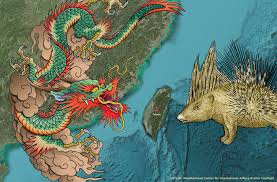
The intensifying geopolitical rivalry across East Asia has transformed the Taiwan Strait and the South China Sea into the world’s most scrutinised maritime flashpoints, where national strategy, maritime coercion, and asymmetric defence doctrines converge in a tense and unpredictable theatre. At the centre of this emerging contest are two contrasting strategic frameworks. These strategies encapsulate the broader tussle between a rising power (seeking territorial unification) and a smaller democratic state (fighting for autonomy and survival). On one side, the People’s Republic of China (PRC) is employing the “Cabbage Strategy”. This strategy aims to establish a de facto quarantine to strangle Taiwan slowly. Countering this systematic encroachment is Taiwan’s “Porcupine Strategy”. This strategy aims to significantly raise the cost of invasion. This article examines how these concepts operate in theory and practice, and how these may define the future balance of power, regional stability, and the fate of cross-strait relations.
China’s “Cabbage Strategy”: Layered Encroachment
The People’s Liberation Army (PLA) employs a sophisticated grey-zone tactic known as the “cabbage strategy” to assert control over disputed islands and reefs. It is a vivid metaphor coined in 2013 by PLA Navy Rear Admiral Zhang Zhaozhong. It was used to describe a tactic of enveloping a target island in successive layers of maritime forces to seize control without firing a single shot. This strategy aims to isolate the island, establish de facto control, and gradually escalate pressure.
The Anatomy of the Blockade. The core philosophy of the strategy is simple: surround a disputed island or reef, cut off all logistics and support, and wait for the defending force to surrender due to starvation or a lack of supplies. To achieve this, China deploys three distinct “leaves” or layers that wrap tightly around the target.
The Inner Layer (The Maritime Militia). The innermost layer, closest to the island, consists of hundreds of fishing boats crewed by the maritime militia. However, these are not ordinary civilians; they are members of the People’s Armed Forces Maritime Militia. These civilian vessels are state-subsidised, trained by the PLA, and equipped with reinforced hulls, water cannons, and satellite navigation. They act as a “human shield,” harassing adversary vessels and preventing access, knowing that foreign navies are hesitant to fire upon what appear to be civilian ships.
The Middle Layer (China Coast Guard). Just behind the fishing boats, patrolling, are the ships of the China Coast Guard (CCG). These ships are often larger and better armed than many regional navies. They are the primary enforcers. They utilise water cannons, high-intensity lasers, and blocking manoeuvres to physically stop resupply missions.
The Outer Layer (PLA Navy). Looming in the distance, “over the horizon,” are the warships of the PLA Navy. They rarely engage directly but serve as a menacing deterrent. Their presence signals that any attempt by a foreign military to break the inner blockade with force will be met with overwhelming conventional military power.
Winning without Fighting. The Cabbage Strategy is a prime example of “Grey Zone” warfare. The tri-layered formation effectively blocks access, prevents resupply, and creates a fait accompli situation. The strategy is characterised by its ambiguity, deniability, and control over escalation. This makes it difficult for opponents to justify a military response without appearing to be the aggressor. The cumulative effect is a gradual salami-slicing of maritime space until control becomes irreversible.
Previous Applications. The most successful employment of this strategy was at Scarborough Shoal in 2012. Following a standoff with the Philippines, Chinese vessels swarmed the area. The layers tightened, forcing the Philippines to withdraw. China established permanent control, effectively seizing the territory. Chinese forces have also used this approach at Whitsun Reef (2021), Sabina Shoal (2024), and Sandy Cay, where Chinese vessels have repeatedly surrounded Philippine-claimed features.
Slow Strangulation of Taiwan
The “cabbage strategy” offers a blueprint for China’s non-military pressure on Taiwan. It translates into a mechanism for establishing de facto control and compelling unification. Instead of an invasion, the strategy would manifest as a suffocating blockade of Taiwan. It would isolate the island and crush its economy. The goal will not be a rapid conquest but prolonged exhaustion and acceptance of the Chinese presence. Each day the cabbage layers remain in place, the fait accompli would harden. By avoiding military escalation, Beijing would attempt to portray the situation as an internal matter rather than an interstate conflict. This would complicate the international mobilisation in support of Taiwan. Additionally, the blockade would test Taipei’s crisis-management capacity and morale. The aim would be to prove that Taipei is isolated and that the U.S. is unable to help. In turn, indicating that “peaceful reunification” is the only possible solution.
Porcupine Strategy: Taiwan’s Asymmetric Deterrence
“You can’t stop the predator from attacking —, but you can make it regret trying.”
In an era defined by great-power rivalry, the “Porcupine Strategy” has emerged as a viable defence doctrine for smaller states facing existential threats from larger adversaries. William S. Murray of the U.S. Naval War College coined the concept in 2008. It postulates that a defender need not defeat an aggressor outright. Instead, they must make an invasion so costly, protracted, and painful that the predator is deterred from attacking in the first place. For Taiwan, a democratic island facing the immense military capabilities of the People’s Republic of China (PRC), this strategy represents a shift from conventional parity to asymmetric denial.
Core Philosophy: Deterrence by Denial. The strategy acknowledges that Taiwan cannot match China’s military spending or sheer volume of ships and aircraft. Instead, Taiwan focuses on deterrence by denial, i.e. preventing the enemy from securing objectives rather than seeking a decisive battlefield victory. The goal is to transform the island into a “porcupine”: a target that is difficult to swallow and impossible to digest.
Tactical Implementation: The “Quills”. To implement this, analysts urge Taiwan to pivot away from high-value, “prestige” platforms—such as large battleships or advanced fighter jets, which are easily targeted by Chinese missiles—toward resilient, low-cost, and distributed systems. Key Asymmetric Capabilities include:-
-
- Anti-Access/Area Denial (A2/AD). This makes it difficult for PLA forces to reach, land on, and operate from Taiwan. Utilising vast numbers of mobile coastal defence cruise missiles (such as the indigenous Hsiung Feng and US-made Harpoon systems) to target amphibious landing fleets.
-
- Mobile Air Defence. Deploying portable systems like Stingers and Sky Sword units to deny air superiority without relying on vulnerable airfields.
-
- Drone Swarms & Mines. Using unmanned aerial vehicles (UAVs) and naval mines to complicate the crossing of the Taiwan Strait.
-
- Decentralisation. Moving away from centralised command structures that a first strike can decapitate. Small, autonomous units ensure resistance continues even if communication with headquarters is severed.
-
- Whole-of-Society Defence. A crucial pillar of the Porcupine Strategy is Civil-Military Integration. As seen in comparative examples like Ukraine and Finland, military hardware alone is insufficient.
-
- Resilience. Hardening infrastructure, stockpiling ammunition, and creating redundant logistics networks.
-
- Civilian Mobilisation. Integrating the population into national defence through reserve forces, cyber defence volunteers, and urban warfare preparation. This signals that even if a landing succeeds, the occupation will face a hostile, mobilised citizenry capable of prolonged guerrilla resistance.
The Porcupine Strategy effectively turns Taiwan into a strategic death-trap for the PRC. Taiwan aims to convince Beijing that the economic, military, and political costs of any misadventure would be unacceptably high. The Porcupine Strategy seeks four outcomes. It aims to persuade China that victory is uncertain and costly, to delay and grind any invasion force, to ensure continued Taiwanese resistance, and to shape global perceptions to mobilise international support.
Conclusion
The “Cabbage” and the “Porcupine” strategy epitomise the essence of 21st-century conflict. The Cabbage Strategy essentially employs the grey-zone tactics. On the other hand, the Porcupine Strategy tests the ability of small countries to resist overwhelming powers. In the contest between seize and the sting, success isn’t just about firepower, but about persistence.
In the Taiwan Strait, the outcome will depend upon the efficiency with which China and Taiwan implement their respective strategies. The future of the Taiwan Strait depends on three critical factors. Firstly, China’s capability to sustain pressure without inciting international intervention. Secondly, Taiwan’s ability to maintain internal unity and credibility in its resistance. Lastly, the international community’s response.
Please Add Value to the write-up with your views on the subject.
For regular updates, please register your email here:-
References and credits
To all the online sites and channels.
Pics Courtesy: Internet
Disclaimer:
Information and data included in the blog are for educational & non-commercial purposes only and have been carefully adapted, excerpted, or edited from reliable and accurate sources. All copyrighted material belongs to respective owners and is provided only for wider dissemination.
References:-
- Zhang Zhaozhong, CCTV Military Commentary, 2013.
- Erickson, Andrew S., & Kennedy, Conor M, “China’s Maritime Militia.” Naval War College Review, Vol. 69, No. 1 (2016).
- Erickson, Andrew S, “China’s Maritime Grey Zone Operations”, U.S. Naval War College, 2019.
- Hayton, Bill, “The South China Sea: The Struggle for Power in Asia”, Yale University Press, 2014.
- Shattuck, Thomas J A Chinese Blockade of Taiwan.” Orbis, Vol. 64, No. 2 (2020).
- Murray, William S, Revisiting Taiwan’s Defence Strategy.” Naval War College Review, Vol. 61, No. 3 (2008).
- Sullivan, Jake, & Green, Michael J, Taiwan’s Defence Reform.” Foreign Affairs, 2019.