
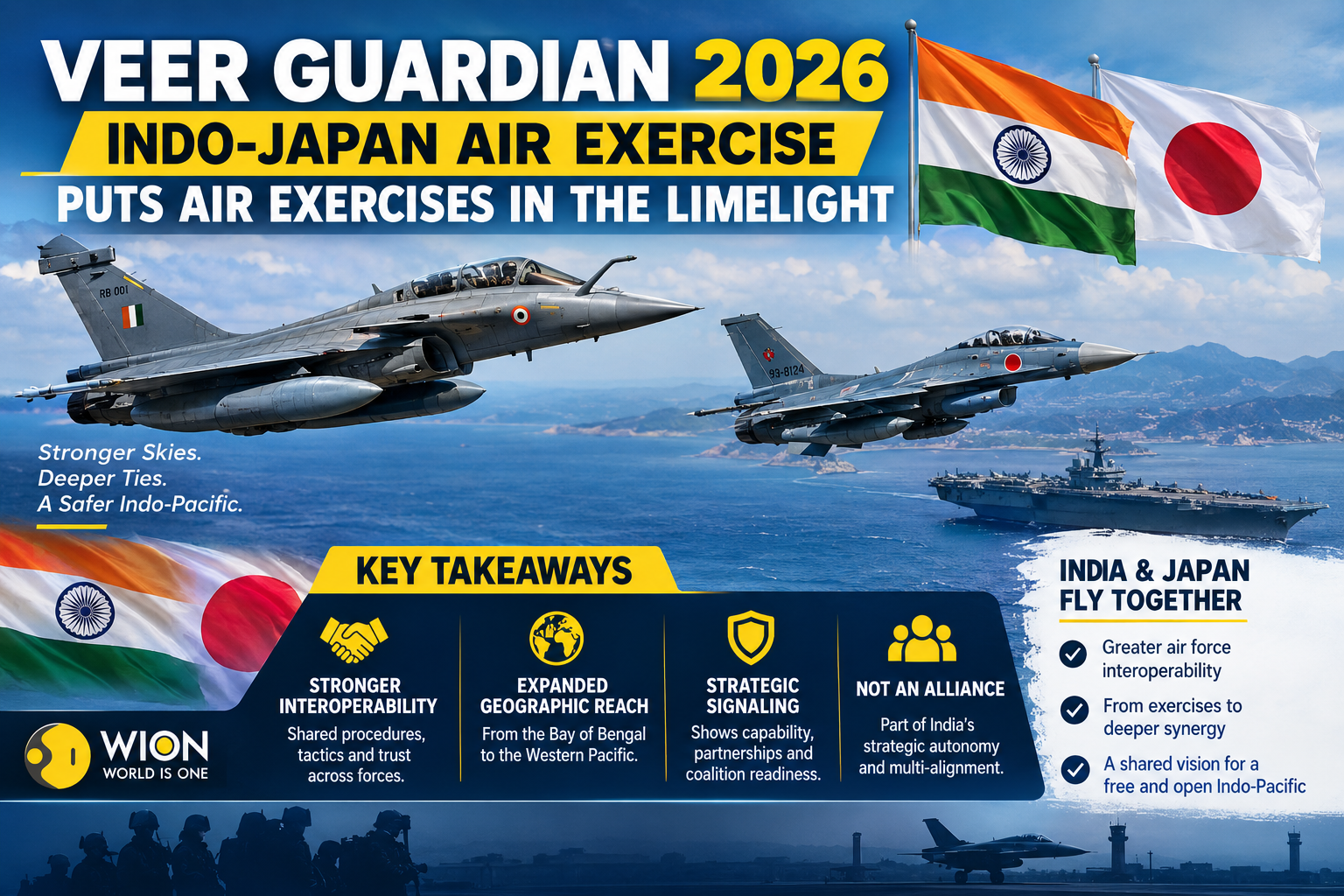
857: Veer Guardian 2026 Brings Air Exercises in the Limelight


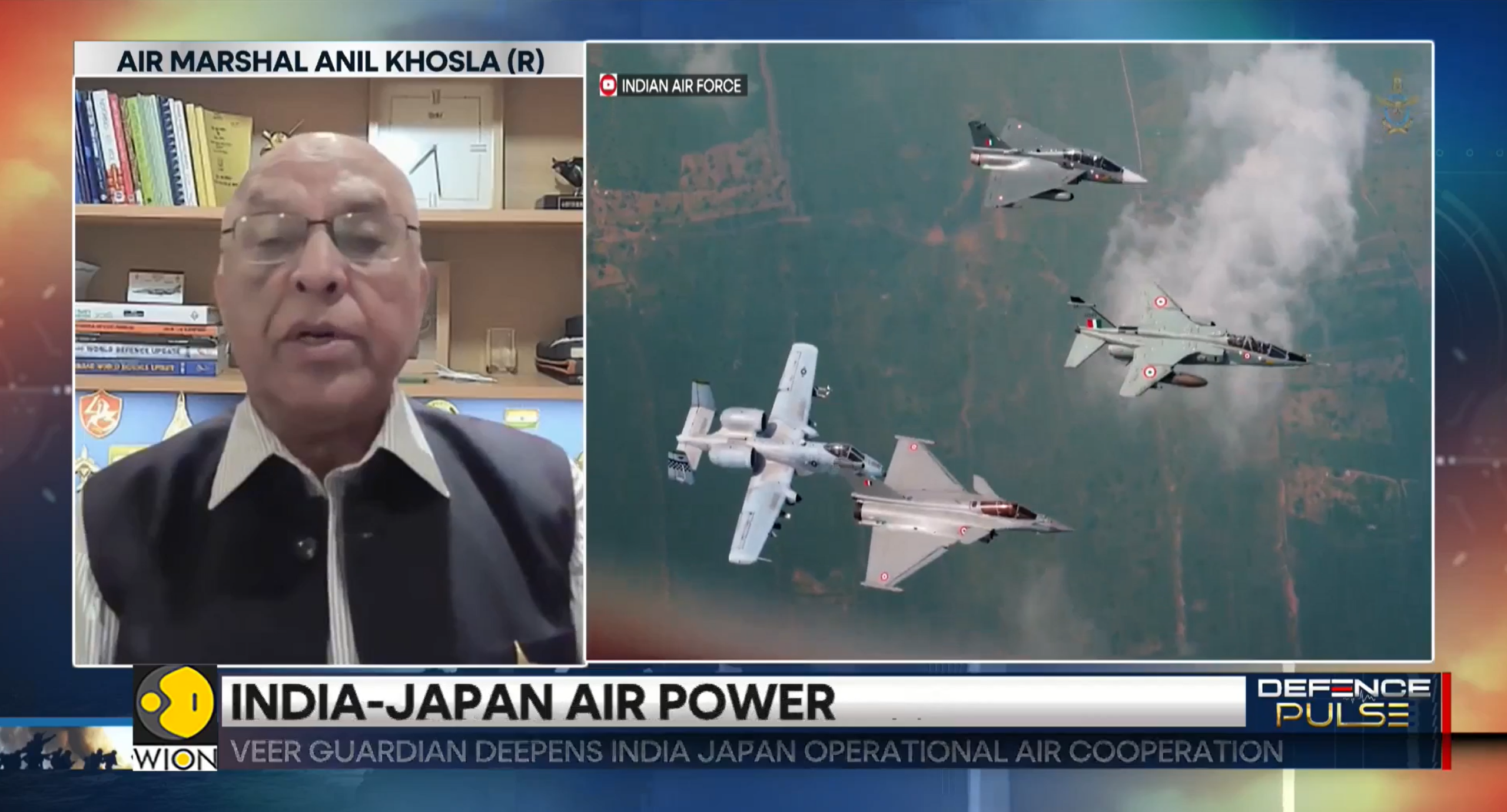
Discussion with Shivan Chanana on the “DefencePulse” program of WION TV  

Talked about  “Beyond Exercise Veer Guardian”:  Japanese fighter operates from Indian soil for the first time. Fighters fly together: India & Japan build greater air force interoperability. India and Japan are moving from air exercises to deeper synergy.


Link to the WION post:-


Inputs to the questionnaire from a journalist on exercise.


  1. What’s driving the jump in India’s exercise tempo in the last 12–18 months?

I don’t think there’s really a “jump” in the strict sense. India has been steadily engaging in bilateral and multilateral exercises with a wide range of countries as part of its defence cooperation and military diplomacy for years now. What has changed is media attention. These exercises are, in fact, a continuation of an established trajectory. India’s participation has also evolved and expanded in scope over time, a logical progression as its defence relationships and operational engagements grow.


  1. Given today’s volatile geopolitics, China’s assertiveness in the Indo-Pacific, Russia’s war in Ukraine, and persistent border/maritime tensions—is India’s surge in joint exercises about deterrence, asserting power, or both?

In my view, it would be difficult to characterise these exercises primarily as being about either deterrence or power projection. At its core, India’s participation is an evolving, natural progression, increasing in scope and complexity as our forces mature and our partnerships deepen.

That said, these exercises do carry strategic and political signalling value. Globally, partners and adversaries alike read into who exercises with whom, and how often.  Highly complex, multi-domain drills (such as Malabar, Tarang Shakti, or Yudh Abhyas) signal that India has both high-end capability and coalition interoperability. Expanding exercise zones into the Western Pacific, the South China Sea, and deep into the Southern IOR asserts India’s status as a power capable of out-of-area contingency responses.

The exercises should therefore be seen in the broader context of India’s growing engagement with different countries and armed forces, rather than being attributed to a single strategic objective.


  1. Apart from geopolitical benefits, what are the military benefits for a country conducting these many exercises?

Beyond diplomacy and geopolitics, these exercises yield critical military-technical advantages. Exercises provide several direct military benefits:

    • They increase interoperability between participating forces, including communications, procedures, command relationships and tactical coordination.
    • They allow each force to learn from the other’s operational practices, training methods, logistics systems and tactical experience.
    • They build military-to-military familiarity and trust, which are particularly valuable during a crisis.
    • They expose personnel to unfamiliar operating environments, doctrines and equipment.
    • They improve the ability to conduct coordinated humanitarian assistance, disaster relief, maritime-security and evacuation operations.
    • They strengthen military solidarity and professional relationships among participating forces.


  1. How do these exercises fit into India’s broader alliance calculus balancing Quad engagements, SCO ties with Russia/China, and deeper drills with France/UK without slipping into a NATO-style bloc?

India engages in joint bilateral and multilateral exercises across a wide spectrum of partners, but that participation does not signal a drift toward any military alliance. Strategic autonomy remains a cornerstone of Indian policy, and historically India has never been part of a formal military alliance. Exercising with multiple, even competing, blocs simultaneously is entirely consistent with that autonomy; it is not a contradiction.  India’s model is closer to strategic autonomy with selective interoperability rather than a collective security model.


  1. What’s one clear sign this high tempo of exercises will last, not just a short spike? For example, more back-to-back drills, new first-time exercises with partners, or procurement/MRO deals linked to the platforms used in these drills.

These exercises are not ad hoc events. The proposals are drawn up for three-to five-year horizons and put up for in-principle approval, followed by detailed annual planning. Naturally, execution of the planned calendar depends on several factors. The mix of exercise partners (old and new) changes with the geopolitical landscape. These exercises are not intended to secure defence procurement deals. Dedicated platforms like DefExpo or Aero India serve that function. However, they do advertise and showcase exportable equipment.


  1. Where do you see the clearest line from exercise outcomes to procurement/co-production in the next 12–24 months?

Exercises primarily have an operational and training purpose. They can improve understanding of each other’s capabilities and operating procedures, but that does not mean that participation will automatically lead to a procurement or co-production agreement. Those decisions are driven by separate strategic, operational, technological and commercial considerations. The two tracks, operational exercises and acquisition, are largely separate and run through different processes and forums.


  1. Is it smarter for India to keep connections and allies across groups—Quad, SCO, France/UK rather than locking into one bloc like NATO, and does this exercise-heavy approach fit India’s non-aligned strategy better?

India engages with countries across different blocs based on mutual interest and benefit, not bloc allegiance. This approach is consistent with India’s long-standing emphasis on strategic autonomy. Maintaining defence relationships across different groupings gives India greater flexibility to cooperate with individual countries on areas of common interest without necessarily joining a formal military bloc.


  1. With drills stretching from the Bay of Bengal to the Western Pacific and new activities with Japan, Mongolia, the Philippines and others, is India subtly pushing back on China’s “String of Pearls,” and how does this change the South Asian geopolitical game?

I would not characterise India’s exercise engagements as being directed at any particular adversary. They are part of India’s broader defence cooperation with partner countries.

That said, the interoperability and logistical familiarity built through these exercises do enable operations across diverse geographies.

Clearly, a common strategic concern or adversary can incentivise closer defence cooperation, including joint exercises, between two or more countries. But that does not mean that every exercise should be viewed through that lens.


  1. India is deepening economic and diplomatic ties with both the US and China, while simultaneously building military power through these exercises, does this “engage all, prepare for all” approach work, or does it risk overstretch and mixed signals?

The sound policy is to engage everyone, including potential adversaries. International relations have no permanent friends or enemies; national interests and the geopolitical environment are dynamic and can change over time. India therefore has an interest in maintaining relationships across different groupings while building the capabilities necessary to protect its own interests. The challenge is to maintain that flexibility while ensuring that defence engagements remain aligned with India’s broader strategic priorities.


  1. With India-Japan air drills and other IAF exercises, which air-domain capabilities and platforms are being stress-tested, and what does that mean for spares, engines, and MRO in India?

These exercises have significant training and learning value, particularly in terms of operational procedures, interoperability and exposure to different methods of conducting air operations.

However, I would not describe them as placing extraordinary additional stress on the aircraft or leading to exceptional spare consumption. The flying and maintenance requirements associated with exercises are generally factored into the annual spare and maintenance support planning.

Please Add Value to the write-up with your views on the subject.

2141
Default rating

Please give a thumbs up if you  like The Post?


For regular updates, please register your email here:-

Subscribe


References and credits

To all the online sites and channels.

Pics Courtesy: Internet

Disclaimer:

The information and data in this blog are for educational & non-commercial purposes only and have been carefully adapted, excerpted, or edited from reliable and accurate sources. All copyrighted material belongs to the respective owners and is provided only for wider dissemination.
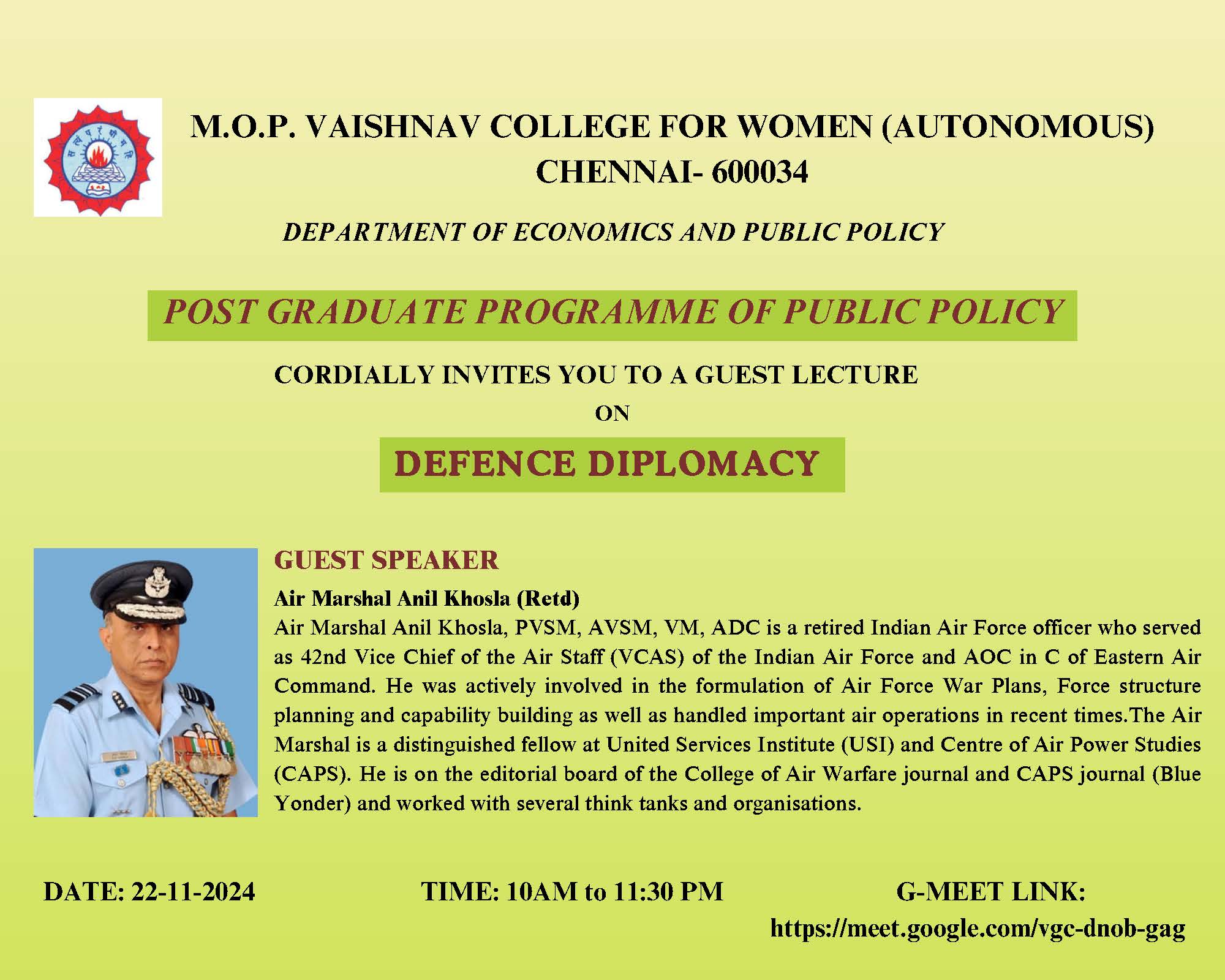


537: SYNERGISING INDIA’S MILITARY AND DIPLOMATIC GOALS


Paper presented at the Vaishnav College, Department of Economics and Public Policy on 22 Nov 24


Synergy in military and diplomatic policy refers to the coordinated and complementary use of military and diplomatic efforts to achieve a nation’s strategic objectives. By fostering synergy between military and diplomatic strategies, nations can pursue cohesive, balanced foreign policies that leverage their full spectrum of capabilities to achieve sustainable security and influence. By aligning these two domains, governments can reinforce their influence, minimise conflict, and enhance security more effectively than using either approach in isolation. This approach is critical in an interconnected, multipolar world where isolated use of force or diplomacy may fail to achieve complex objectives.


Military Diplomacy


Military diplomacy strategically uses military resources and capabilities to foster relationships with other countries, support international stability, and prevent conflicts. Unlike traditional diplomacy, which focuses on dialogue, negotiation, and treaties, Military diplomacy employs military-to-military interactions to achieve political and strategic objectives.


Objectives of Military Diplomacy. One objective of Military diplomacy is conflict prevention. By engaging in active Military diplomacy, countries work to prevent conflicts from arising through mutual understanding and cooperation. Military Diplomacy also promotes regional stability. It can help stabilise volatile regions by addressing underlying security issues and aligning efforts among regional players. Military diplomacy is increasingly used to counter non-traditional threats and security challenges like terrorism, piracy, and cyber threats, which require coordinated international responses.


Key Aspects of Military Diplomacy. Military diplomacy helps countries work together to address both traditional and emerging security challenges globally by enhancing trust, cooperation, and mutual understanding among nations.


    • Military Cooperation. It includes joint exercises, training programs, and knowledge sharing. These activities help nations build trust, increase interoperability, and improve readiness for combined operations if needed.
    • Capacity Building. Through technical assistance, training, and equipment transfers, stronger nations help build the capabilities of allies or partner states, especially in regions where security stability is crucial.
    • Peacekeeping and Stability Operations. Military diplomacy may involve sending military personnel to UN or multinational peacekeeping missions to prevent conflicts, enforce peace, or provide humanitarian aid.
    • Confidence-Building Measures. These can include transparency in military movements, open communication channels, and setting up frameworks for information sharing to reduce the risk of misunderstandings that could escalate into conflict.
    • Military Agreements and Alliances. Bilateral and multilateral Military pacts, like NATO or strategic partnerships, solidify Military relationships, offering mutual support in security and Military matters.


Military Diplomacy and Foreign Policy


Military diplomacy is closely interlinked with a country’s foreign policy. It enables states to pursue strategic interests, build alliances, and project stability through military partnerships rather than conflict. Using military diplomacy, countries can influence regional and global affairs, reinforce diplomatic efforts, and protect their national interests without relying solely on traditional diplomatic or economic channels. Military diplomacy supports foreign policy goals.


Promoting Peace and Stability. Military diplomacy contributes to a country’s foreign policy goal of promoting peace and stability by building trust among nations and reducing the likelihood of conflict. Confidence-building measures, such as transparent military exercises and open communication channels, help decrease misunderstandings and foster cooperation.


Strengthening Alliances and Partnerships. Military diplomacy reinforces alliances and builds new partnerships supporting foreign policy objectives. Joint military exercises, training programs, and security dialogues are platforms for deepening ties with strategic allies.


Projecting Power and Influence. Military diplomacy enables countries to extend their influence and project power by maintaining a physical presence through military bases or frequent naval deployments. This approach allows countries to reinforce their foreign policy in regions of strategic importance.


Securing Economic Interests. Military diplomacy can safeguard economic interests, especially in critical areas like maritime security for trade routes. Foreign policy efforts to protect economic assets, such as sea lanes and energy resources, often involve military cooperation with key states. For instance, India’s naval cooperation in the Indian Ocean aligns with its foreign policy goal of ensuring free and open sea lanes crucial for its trade.


Combating Transnational Threats. Military diplomacy supports foreign policy efforts to tackle global challenges such as terrorism, piracy, and cyber threats. These issues transcend national boundaries, requiring collaborative security responses.


Humanitarian Assistance and Disaster Relief (HADR). Military diplomacy aids in humanitarian missions, positioning a country as a responsible international player while fostering goodwill. Humanitarian responses, such as disaster relief operations, can soften foreign policy objectives by showing empathy and commitment to global welfare. The U.S. Navy’s response to the 2004 Indian Ocean tsunami and India’s assistance to neighbours during natural disasters exemplify how military forces can promote positive relations.


Supporting Arms Control and Non-Proliferation Goals. Military diplomacy can be instrumental in arms control efforts, facilitating discussions and cooperative agreements that align with a nation’s foreign policy. Diplomatic and military dialogues, treaties, and verification mechanisms help prevent arms races and promote disarmament, as seen in strategic arms reduction treaties between the U.S. and Russia.


Indian Military Diplomacy


Indian military diplomacy has evolved significantly in recent decades, becoming a core pillar of India’s foreign policy. India uses military diplomacy to strengthen regional security, foster partnerships, and project stability, especially in the Indo-Pacific region, which is vital for economic and strategic reasons.


Strengthening Regional Partnerships. India has developed solid military relationships with neighbouring countries and key global powers. Through forums such as the Quadrilateral Security Dialogue with the U.S., Japan, and Australia, India addresses shared security challenges, such as maritime security.


Capacity Building and Training. India provides training programs to military personnel from neighbouring countries like Nepal, Bhutan, Bangladesh, Sri Lanka, Maldives, and African nations. Through institutions like the National Military College and Military Services Staff College, India trains foreign officers, building ties and promoting a shared understanding of security.


Military Hardware Exports and Assistance. India has become increasingly active in exporting military equipment to friendly countries as a part of its “Make in India” initiative. India’s military exports include patrol boats, helicopters, radar systems, and artillery, with growing exports to nations in Southeast Asia, Africa, and the Indian Ocean region.


Humanitarian Assistance and Disaster Relief (HADR). India’s military plays a key role in disaster relief operations within the region, supporting countries hit by natural disasters. Examples include assistance to Nepal after the 2015 earthquake, support to Sri Lanka during the 2017 floods, and aid to the Maldives during water crises. India’s swift response helps build goodwill and positions it as a reliable regional partner.


Maritime Security Initiatives. Given the Indian Ocean’s strategic importance, India has bolstered maritime security by enhancing naval cooperation, building coastal radar systems for smaller nations, and establishing agreements on port access and joint maritime patrols. Through its Indian Ocean Rim Association (IORA) and Security and Growth for All in the Region (SAGAR) initiatives, India has reinforced its leadership in regional maritime security, ensuring stability along key maritime trade routes.


Military Exercises. India conducts joint military exercises with various nations, enhancing interoperability, readiness, and trust. Some prominent exercises include Malabar (with the U.S., Japan, and Australia), Varuna (with France), and Hand-in-Hand (with China), which aim to build capacity and understanding among the forces. India also regularly participates in United Nations Peacekeeping Missions, strengthening its commitment to global peace.


    • Exercise Yudh Abhyas. One of the most extensive bilateral exercises between India and the U.S., Yudh Abhyas aims to improve interoperability and strengthen defence ties.
    • Exercise Malabar. Initially, it was a bilateral exercise with the U.S., but Malabar expanded to include Japan and later Australia as part of the Quad. It’s crucial for regional security and showcases cooperation among key naval forces.
    • Exercise Varuna. This annual naval exercise strengthens Indo-French maritime cooperation, enhancing mutual understanding in complex maritime operations.
    • Exercise Garuda is an air combat exercise that enables both nations’ air forces to exchange best practices and enhance air combat readiness.
    • Exercise INDRA. Exercise INDRA is a tri-service exercise involving both nations’ Army, Navy, and Air Force. It highlights cooperation in counterterrorism and disaster relief operations.
    • Exercise Milan. Milan is a multilateral naval exercise that enhances regional maritime cooperation and focuses on building capacity for humanitarian assistance, disaster relief, and security operations.
    • Exercise Hand-in-Hand. This exercise aims to reduce tensions and build mutual trust between the Indian and Chinese armies, focusing on counter-terrorism drills and disaster response.
    • Exercise Cobra Warrior. Cobra Warrior is an advanced aerial exercise that exposes IAF pilots to NATO tactics, air combat manoeuvres, and mission planning.
    • Exercise Desert Flag. This multinational exercise focuses on interoperability and high-end air warfare, including combat drills and aerial tactics.
    • Exercise Tarang Shakti. India hosted the recent multi-lateral Air Force exercise.


Synergising Indian Military Policy and Foreign Policy

India’s military and foreign policy are deeply interconnected, with military policy as a strategic component of India’s broader foreign policy objectives. Together, they aim to safeguard India’s sovereignty, promote regional stability, and ensure peace and prosperity in an increasingly interconnected and multipolar world. India’s military policy supports foreign policy by building partnerships, countering security threats, and projecting India as a responsible and stable power.


Maintaining Sovereignty and National Security. India’s military policy is focused on securing its borders, especially given its complex relationships with neighbouring countries like China and Pakistan. India seeks to protect its sovereignty and territorial integrity through diplomatic engagement and military preparedness. Diplomatic measures like peace agreements with China and Pakistan aim to resolve territorial disputes, while military preparedness, including a robust military presence along borders, backs these efforts. This approach reflects India’s focus on diplomacy first but with military readiness as a safeguard.


Strengthening Regional Stability and Security. India aims to stabilise South Asia by promoting peace and security. It seeks to engage constructively with its neighbours through military diplomacy, offering military assistance, training, and joint exercises. Initiatives like the SAARC Disaster Management Center and BIMSTEC (Bay of Bengal Initiative for Multi-Sectoral Technical and Economic Cooperation) demonstrate India’s commitment to regional security, with military collaboration that aligns with foreign policy goals of fostering stability and cooperation.


Building Strategic Partnerships. India has pursued strategic partnerships with countries to address its security challenges. Military agreements, like the Logistics Exchange Memorandum of Agreement (LEMOA) with the U.S. and reciprocal logistics agreements with Japan and Australia, are integral to this strategy. These partnerships support India’s foreign policy by positioning it within a network of like-minded democracies interested in maintaining a rules-based international order.


Protecting Economic Interests. India’s military policy is critical in securing its economic interests, especially given its reliance on maritime trade routes in the Indian Ocean. By investing in naval capabilities and establishing maritime security initiatives, India ensures the safety of crucial sea lanes. India’s Security and Growth for All in the Region (SAGAR) policy exemplifies this approach, aimed at fostering cooperation and ensuring a peaceful and secure maritime environment, which aligns with India’s foreign policy vision for a prosperous and stable Indo-Pacific.


Supporting “Act East” Policy and Expanding Influence in the Indo-Pacific. India’s Act East Policy aims to strengthen ties with Southeast and East Asia, where military diplomacy is essential. India’s military engagements, including joint exercises and naval outreach with ASEAN countries, align with foreign policy objectives to counterbalance China’s assertiveness in the Indo-Pacific. Collaborations (without military alliance) like the Quad reflect India’s proactive role in the Indo-Pacific, enhancing military and diplomatic engagement to promote a free and open region.


Promoting Multilateralism and Global Peace. India’s commitment to global peace and multilateralism is reflected in its active participation in United Nations peacekeeping missions, where Indian forces contribute to peacekeeping in conflict zones. This supports India’s foreign policy of being a responsible global player and aligns with its image as a proponent of a multipolar world order. India also advocates for reforms in international bodies, such as the United Nations Security Council, aligning its military policy with its foreign policy’s broader goals of promoting equitable representation on the global stage.


Countering Terrorism and Non-State Threats. Addressing cross-border terrorism, mainly from Pakistan, is a central aspect of both India’s military and foreign policies. Military measures like surgical strikes and strategic deployments along borders are coupled with diplomatic efforts to bring international attention to the issue. India has built coalitions with nations affected by terrorism, such as the Joint Working Group on Counter-Terrorism with several countries and initiatives under the Financial Action Task Force (FATF) to isolate terrorist-supporting states.


Disaster Relief and Humanitarian Operations: India’s military’s swift response to natural disasters, such as in Nepal after the 2015 earthquake or the Maldives during the water crisis, aligns with its foreign policy of being a responsible and dependable regional leader.


Challenges. India’s military collaborations in the Indo-Pacific may be perceived as countering China’s influence, potentially escalating regional tensions. Foreign policy must manage these partnerships sensitively to avoid open confrontation. India’s partnerships, particularly with the U.S., must be balanced with its goal of maintaining strategic autonomy. Military policy often distinguishes between deeper cooperation and avoiding entanglement in alliances.


Military diplomacy is a powerful extension of foreign policy, advancing national objectives through military cooperation, capacity building, and stability operations. It supports peace, economic interests, and regional security when carefully balanced, contributing to a stable and favourable international environment. India’s military policy is pivotal in supporting and advancing its foreign policy goals by enhancing security, building partnerships, and promoting stability within and beyond the region. Together, the military and foreign policy aims to position India as a stable, responsible power in a multipolar world, contributing to global peace, regional stability, and security while safeguarding India’s national interests.


Your valuable comments are most welcome.


2141
Default rating

Please give a thumbs up if you  like The Post?


For regular updates, please register your email here:-

Subscribe


References and credits

To all the online sites and channels.


Disclaimer:

Information and data included in the blog are for educational & non-commercial purposes only and have been carefully adapted, excerpted, or edited from reliable and accurate sources. All copyrighted material belongs to respective owners and is provided only for wider dissemination.


86: Q & A Series (Part 2): International Exercises

In various interactions questions are asked during the Q & A session. Starting a new series on compiling these valid and interesting questions with comments.


RECENT QUERRY  AND MY TAKE ON IT


Question. What are various facets related to joint exercises with friendly foreign  countries? What advantages accrue out of these exercises?


Comments. IAF conducts regular exercises with friendly foreign  countries. These exercises involve lot of detailed planning and preparation. The preparations start almost six months prior or earlier.

These exercises are bilateral or multilateral, single service or multi service. The trend is changing from bilateral single service exercises earlier to multilateral multi service exercises now.

IAF has carried out exercises with Air Forces of many countries including USA, Russia, UK, France, Australia, South Africa, UAE, Singapore, Oman and Thailand etc.

The level of exercise (i.e. number of aerial assets,  duration of exercise  and type of  air combat missions) depends from country to country. These vary from short duration exercises with few assets on themes like HADR to full fledged combat exercises with large number and variety of platforms carrying out complex LFE (large scale engagement) missions.

The frequency of carrying out exercises also varies from country to country. With some countries it is regular once every two or three years. With others it is less often, once in 3 to 5 years. Generally during transit for bigger exercises, some smaller exercises are carried out during the stop overs en route (Out bound or inbound leg).  These are called hop exercises.

There are many advantages of these exercises. These exercises are part of defence diplomacy and political signaling in the larger scheme of international relations and engagements. At operating level, the participants learn about the best practices from each other and It broadens their horizon and prepares them for their future assignments. Further it improves interoperability between the participating forces. The advantages accrued out of these exercises far outweigh the effort and money spent on them.


Please leave your Queries or questions if any

For regular updates please register here –

https://55nda.com/blogs/anil-khosla/subscribe/


English हिंदी