
Recently, I was invited to Apex University (Jaipur) as a guest. I met Prof. (Dr.) Raghuvir Singh, the President and Vice-Chancellor of Apex University, Jaipur. Our interaction highlighted several key aspects of a growth mindset. That interaction inspired this blog.

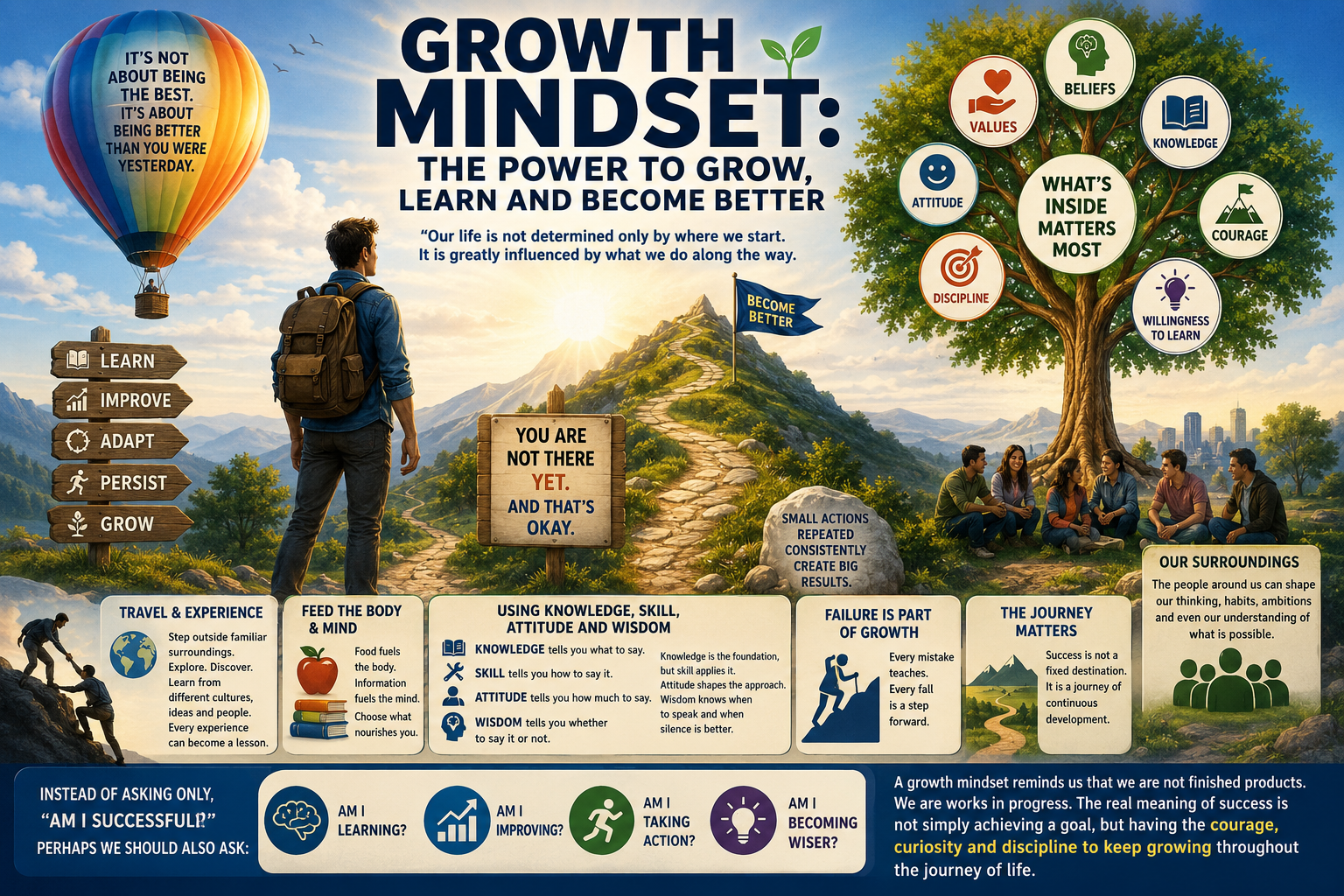
GROWTH MINDSET: THE POWER TO GROW, LEARN AND BECOME BETTER
Our life is not determined only by where we start. It is greatly influenced by what we do along the way.
A growth mindset is the belief that our abilities, intelligence, skills and character can be developed through effort, learning, practice and perseverance. It does not mean believing that everyone can succeed and achieve everything simply by wishing for it. Instead, it means believing we can learn, improve, and adapt.
Success. What does success really mean? The answer is not the same for everyone. Success can mean getting a good job for one person, starting a business for another, raising a happy family for someone else, or simply becoming a better version of oneself. More importantly, our definition of success can change at different stages of life. What we considered success at the age of twenty may be very different from what we value at forty or sixty. This changing understanding of success is closely connected to one important idea of continuous learning and growth.
Intentions Do Not Take Us Places—Actions Do. Many people have good intentions. They intend to exercise, read more, learn a new skill, start a business, improve their relationships or become more disciplined. But intentions alone do not create results. Intentions are like the destination on a map. They tell us where we want to go, but they don’t take us there. Action is what moves us forward. This is why a growth mindset is closely connected with action. Instead of thinking and saying, “I am not good at this,” one should think and say, “I am not good at this yet.” The word yet changes everything. It turns a permanent judgment into an invitation to learn. Small actions repeated consistently can produce remarkable results over time.
Inner Content Matters More than External Appearance. Consider a balloon. The balloon’s colour does not determine whether it rises into the sky. What is inside makes it rise. The same principle applies to human beings. External appearance may attract attention, but what truly determines our direction is what we carry within us—our beliefs, values, knowledge, attitude, discipline, courage and willingness to learn. Two people may appear equally capable on the outside, yet their results can differ completely because of their internal mindset. A growth mindset therefore asks us to balance appearances with what we develop inside.
Surrounding Environment. One of the strongest influences on our growth is the company we keep. The people around us can shape our thinking, habits, ambitions and even our understanding of what is possible. If we spend time with people who constantly complain, discourage learning, or fear change, their attitudes can gradually influence us. On the other hand, being surrounded by curious, positive and hardworking people can encourage us to think bigger and challenge ourselves. This does not mean that we should only associate with people who agree with us. In fact, people who respectfully challenge our ideas can help us grow even more. A growth mindset welcomes feedback because feedback provides an opportunity to improve.
Travel and Experiences. Growth also comes from stepping outside familiar surroundings. Travel exposes us to different cultures, languages, lifestyles and ways of thinking. We discover many ways to live, work, communicate, and solve problems. But travel does not necessarily mean going to another country. We can travel through books, conversations, education, new experiences and meeting people who are different from us. Every new experience can become a lesson if we are willing to learn from it.
Feeding the Body and Mind. Our physical and mental growth are also affected by what we consume. Food fuels the body, while information fuels the mind. What we read, watch and listen to influences our thoughts. Just as unhealthy food can affect our physical well-being, constantly consuming negative or unproductive information can affect our mental outlook.
Using Knowledge, Skill, Attitude and Wisdom.
Knowledge tells you what to say.
Skill tells you how to say it.
Attitude tells you how much to say.
Wisdom tells you whether to say it or not.
-
- Knowledge is the foundation. It gives us information and understanding. But knowledge alone is not enough.
-
- We also need skill, i.e., the ability to apply what we know effectively.
-
- Then comes attitude. Our attitude determines how we approach people, challenges and opportunities. A person with knowledge and skill but a poor attitude may still struggle to succeed.
-
- Finally comes wisdom. Wisdom helps us understand when to use knowledge and when silence may be better. It teaches us that being capable of saying something does not necessarily mean that we should say it.
True growth is therefore not simply about becoming more knowledgeable. It is about becoming more thoughtful.
Failure Is Part of Growth. We often treat failure as evidence that we are not capable. But failure can also be evidence that we tried something difficult. Every mistake can show what needs to change. A child learning to walk falls many times, but we do not call the child a failure. We understand that falling is part of learning. Adults should give themselves the same permission to learn. The important question after failure is not, “Why am I so bad at this?” but, “What can I learn from this, and what will I do differently next time?”
The Journey Matters. Ultimately, a growth mindset is about understanding that success is not a fixed destination. It is a journey of continuous development. Our definition of success may change. Our circumstances may change. Our priorities may change. What remains within our control is our willingness to learn, adapt and take action. The people we surround ourselves with, the experiences we seek, the information we consume, the skills we practise and the conversations we have with ourselves all contribute to the direction of our lives. We cannot always control what happens to us, but we can influence how we respond.
So, instead of asking only, “Am I successful?”
perhaps we should also ask:
Am I learning?
Am I improving?
Am I taking action?
Am I becoming wiser?
A growth mindset reminds us that we are not finished products. We are works in progress. The real meaning of success is not simply achieving a goal, but having the courage, curiosity and discipline to keep growing throughout the journey of life.
(Grateful to the Professor).
Please Add Value to the write-up with your views on the subject.
For regular updates, please register your email here:-
References and credits
To all the online sites and channels.
Pics Courtesy: Internet
Disclaimer:
Information and data included in the blog are for educational & non-commercial purposes only and have been carefully adapted, excerpted, or edited from reliable and accurate sources. All copyrighted material belongs to the respective owners and is provided only for wider dissemination.