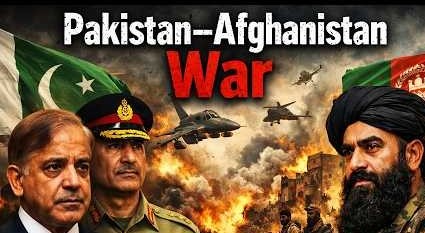
In the early hours of February 27, 2026, explosions shook the Afghan capital Kabul. Pakistani jets streaked across the night sky, striking Taliban government defence facilities, ammunition depots, and military sites in Kabul, Kandahar, and the southeastern province of Paktia. Pakistan had done something almost unthinkable just a few years ago. It bombed the capital of a neighbouring country and declared that it was now in a state of “open war.” This was not an impulsive act but the result of years of deteriorating relations. The situation had been building since the Taliban returned to power in Afghanistan in 2021.
A Historical Overview of The Broken Brotherhood
Pakistan and Afghanistan share a relationship that defies easy description. The South Asian neighbours are both Muslim-majority states and share a 2,611-kilometer border. For decades, Pakistan was among the most important backers of the Afghan Taliban, supporting the movement ideologically, financially, and logistically through its powerful Inter-Services Intelligence (ISI) directorate. When the Taliban swept back into Kabul in August 2021 following the withdrawal of American and NATO forces, Pakistan initially welcomed the development as a strategic gain. Pakistan thought a friendly government in Kabul might counter Indian influence and give Islamabad so-called “strategic depth.”
That calculation unravelled almost immediately. The Taliban government in Kabul was not interested in being a client state of Islamabad. Far from reining in anti-Pakistan militant groups operating from Afghan soil, the Taliban appeared unwilling to do so. The Tehreek-e-Taliban Pakistan (TTP) started using Afghan territory as a base from which to launch increasingly devastating attacks on Pakistan. Pakistan’s frontier provinces bordering Afghanistan (Khyber Pakhtunkhwa and Balochistan) bore the brunt. Suicide bombings, ambushes on security forces, and targeted assassinations increased. A particularly devastating attack struck a Shia Mosque in Islamabad, killing at least 40 people and claimed by the Islamic State Khorasan Province (ISKP), adding another militant dimension to Pakistan’s security nightmare.
At the same time, the Durand Line (the colonial-era boundary drawn by the British in 1893) remained a festering point of contention. Afghanistan has never formally recognised this border as legitimate, viewing it as an arbitrary demarcation that divides the Pashtun ethnic group between two states. The Taliban government maintained that position firmly, resisting Pakistan’s attempts to fence the border and frequently allowing its fighters to interfere with construction efforts. It is estimated that there had been at least 75 recorded clashes between Afghan and Pakistani forces along the Durand Line between 2021 and 2026, a frequency that made some form of major escalation almost inevitable.
The Military Balance
The difference in military strength between Pakistan and Afghanistan is stark. Pakistan, a nuclear-armed country, has a considerable military force with 660,000 active personnel (560,000 soldiers in the army, 70,000 in the air force, and 30,000 in the navy). Pakistan also boasts of 465 combat aircraft, over 260 helicopters, more than 6,000 armoured fighting vehicles, and over 4,600 artillery pieces.
The Afghan Taliban, by contrast, commands approximately 172,000 active military personnel. When the Taliban returned to power in 2021, it inherited a substantial inventory of US-supplied military equipment left behind by the former Afghan National Army, including armoured vehicles, artillery, and aircraft. But without international recognition, without access to spare parts, and without functioning military training institutions, much of that equipment became unusable. Afghanistan has no functioning air force to speak of: at most six aircraft, some of Soviet vintage, and 23 helicopters, the airworthiness of an unknown number of which remained in doubt.
On paper, Pakistan could crush the Taliban’s conventional military capacity with relative ease. Yet history has shown repeatedly that wars in Afghanistan are not won on paper. It is called the “Graveyard of Empires” for a reason. The Taliban’s fighters are combat-hardened veterans of a 20-year insurgency against the most powerful military alliance in history. They know their terrain intimately. And Islamabad should know better than most that guerrilla warfare in the mountains of Khost and Kunar can render any conventional military advantage irrelevant.
Collapse of the October 2025 Ceasefire
The crisis did not erupt without prior warning. In October 2025, Afghanistan and Pakistan had already fought a week of fierce and deadly clashes along their contested frontier. More than 70 people were killed on both sides in what at the time represented the worst bout of open fighting between the two neighbours in recent memory. The violence was enough to prompt international intervention. Qatar and Turkey brokered an emergency ceasefire in Doha, and for a few months, the shooting largely stopped.
But the ceasefire was always fragile. Sporadic violations continued, and none of the underlying causes had been addressed. Pakistan still wanted the Taliban to crack down on the TTP. The Taliban still refused to recognise the Durand Line. Militant attacks inside Pakistan continued. Border crossings, including the key Torkham and Chaman crossings, remained largely shut, causing severe economic strain on both sides and enormous suffering for Afghan refugees and returnees caught between two hostile states. Several rounds of negotiations followed the October ceasefire, reportedly involving Qatar and Turkey as mediators, but no lasting agreement emerged.
The February 2026 Skirmish
Pakistan launched airstrikes targeting what it described as militant camps belonging to the TTP and ISKP in Afghan provinces (Nangarhar, Paktika, and Khost). Islamabad claimed that the strikes had killed at least 70 terrorists. The Taliban government and independent observers had a different story. The UN mission in Afghanistan reported that at least 13 civilians had been killed in those initial Pakistani strikes. Taliban spokesman Zabihullah Mujahid said the attacks had “killed and wounded dozens, including women and children.” A provincial director of the Afghan Red Crescent Society said 18 people were killed and many more wounded in Nangarhar alone. These were not terrorists on a training ground, but residents of border villages.
Afghanistan issued a stern warning, which Pakistan dismissed. On the night of February 26, Afghan forces launched a large-scale offensive operation against Pakistan. They targeted Pakistani military installations along the Durand Line.
Pakistan responded by launching Operation Ghazab lil Haq (Righteous Fury) on 27 Feb 26. It involved combined air and ground strikes against Taliban posts, headquarters, and ammunition depots.
According to Pakistan’s Information Minister Attaullah Tarar, the operation killed at least 133 Afghan Taliban fighters and wounded more than 200. Pakistan also claimed that 27 Taliban posts had been destroyed and nine captured, along with over 80 tanks, artillery pieces, and armoured personnel carriers. The Taliban gave a starkly different account: eight of its fighters killed and eleven wounded, and 55 Pakistani soldiers killed, with 19 posts seized. Neither set of figures could be independently verified by the time news organisations were reporting from the ground.
The conflict quickly introduced new dimensions of warfare. Afghanistan claimed its forces had “successfully conducted” drone strikes hitting military targets inside Pakistan. Pakistan’s Information Minister said the drone attempts had been intercepted by anti-drone systems in the cities of Abbottabad, Swabi, and Nowshera, with no damage to life.
The Torkham crossing remained one of the most dangerous and symbolically loaded flashpoints. It had been kept partially open for Afghans returning en masse from Pakistan. Now those returnees found themselves trapped between two armies.
Regional and Global Reactions
The international response to the outbreak of open war was swift and almost uniformly alarmed. The United Nations Secretary-General António Guterres was among the first to respond. He called for both parties to de-escalate immediately and continue to seek to resolve the differences through diplomacy.
India condemned Pakistan’s airstrikes. It described the strikes as “another attempt by Pakistan to externalise its internal failures”. It also affirmed India’s support for Afghanistan’s sovereignty, territorial integrity, and independence. Pakistan’s Foreign Office rejected India’s comments and alleged that the Taliban had become a proxy for India.
Iran has borders with both countries and has long positioned itself as a bridge between them. It called on both governments to resolve their differences within the framework of good neighbourliness. Iran also offered mediation and readiness to assist in facilitating dialogue.
China maintains close ties with both Pakistan and the Taliban government in Kabul. It expressed deep concern and conveyed Beijing’s willingness to play a constructive role in cooling the situation. Russia called on both parties to immediately halt cross-border attacks and offered to mediate if requested by both sides. Turkey’s Foreign Minister Hakan Fidan held separate calls with his counterparts in Pakistan, Afghanistan, Qatar, and Saudi Arabia to coordinate diplomatic pressure. Saudi Arabia’s Foreign Minister Faisal bin Farhan spoke with Pakistan’s Ishaq Dar to discuss “ways to reduce tensions.”
Former Afghan President Hamid Karzai, though holding no official position, issued a public statement. Pakistan cannot free itself from the self-created problems of violence and bombings. Still, it must change its own policy and choose the path of good neighbourliness, respect, and civilised relations with Afghanistan.
What Drives This War
The hostility between Pakistan and Afghanistan is the product of an irreconcilable contradiction. Pakistan created, supported, and enabled the Taliban as a strategic instrument for more than two decades. It sheltered the Taliban’s senior leadership during the years of US occupation. It allowed recruitment and fundraising on Pakistani soil. It lobbied internationally for international recognition of Taliban governance. Pakistan expected gratitude and compliance from the Taliban’s return to power in 2021.
What it got instead was a sovereign government that pursued its own interests. It refused to recognise the Durand Line, declined to crack down on the TTP, and increasingly viewed Islamabad as a threat rather than a patron. The Pakistani analyst Mariam Solaimankhil, a member of Afghanistan’s Parliament in Exile, framed it bluntly in a television interview during the crisis: “Pakistan is fighting the monster it helped create.” She argued that the TTP’s roots, the Afghan Taliban’s ideology, and the networks of militant groups were all products of Pakistani state policy over decades, and that the civilians now dying in Pashtun villages on both sides of the border, in Balochistan, in Khyber Pakhtunkhwa, were paying the price for choices made in Rawalpindi’s military headquarters.
Where It Might Lead
Where the conflict goes from here remains deeply uncertain. The military balance favours Pakistan overwhelmingly in conventional terms, but history suggests that Afghanistan defeats its invaders not by winning battles but by outlasting occupiers. Pakistan has no stated intention of occupying Afghanistan. Still, each round of airstrikes radicalises new fighters, destroys what little infrastructure the Taliban government has, and strengthens the hand of hardliners on both sides.
The international community (China, Russia, Iran, Turkey, and the UN) has called for de-escalation, but none of these actors has the leverage or the will to impose a solution. The United States, which spent 20 years and trillions of dollars trying to stabilise Afghanistan and failed, is unlikely to re-engage substantively. Qatar and Turkey, who brokered the October 2025 ceasefire that lasted barely four months, again tried to mediate, but without addressing the root causes. In this scenario, any ceasefire will be temporary.
The Durand Line was drawn by a British diplomat in 1893 to serve imperial interests. More than 130 years later, it remains a wound that neither side can agree to close. Until it is resolved, the cycle of violence that has defined this relationship will continue to grind on—one airstrike, one ceasefire, and one broken promise at a time.
Please Add Value to the write-up with your views on the subject.
For regular updates, please register your email here:-
References and credits
To all the online sites and channels.
Pics Courtesy: Internet
Disclaimer:
Information and data included in the blog are for educational & non-commercial purposes only and have been carefully adapted, excerpted, or edited from reliable and accurate sources. All copyrighted material belongs to the respective owners and is provided only for wider dissemination.
References:
Ahmed, R. (2000). “Taliban: Militant Islam, oil and fundamentalism in Central Asia”. Yale University Press.
Bijan Omrani, B. (2009). “The Durand Line: History and problems of the Afghan-Pakistan border”. Asian Affairs, 40(2), 177–195.
Center for Strategic and International Studies. (2021–2026). “Tehrik-i-Taliban Pakistan and regional militancy reports”. https://www.csis.org
Chatham House. (2021–2026). “Afghanistan post-2021 political and security analysis”. https://www.chathamhouse.org
Council on Foreign Relations. (2021–2026). “Backgrounders on Afghanistan, Taliban, and regional geopolitics”. https://www.cfr.org
International Crisis Group. (2021–2026). “Pakistan-Afghanistan border tensions and militancy reports”. https://www.crisisgroup.org
International Institute for Strategic Studies. (2025). “The military balance 2025”. Routledge.
Reuters. (2025–2026). “Coverage of Pakistan-Afghanistan conflict and regional tensions”. https://www.reuters.com
Rubin, B. R. (2002). “The fragmentation of Afghanistan: State formation and collapse in the international system” (2nd ed.). Yale University Press.