Indian Air Force celebrates its 94th anniversary on October 8, 2026.
Good wishes to all air warriors on AF Day.
The IAF is celebrating under the theme “Indian Air Force – Infallible, Impervious and Precise.”
The IAF has evolved from its October 8, 1932, origins (when it had a few Westland Wapiti biplanes and a handful of pilots) into a modern, network-centric, multi-domain strategic force.
A compilation of links to some of the posts on the Indian Air Force (from the blog “Air Marshal’s Perspective”) is listed below: –
Article published in the Sep 26 edition of the “Blue Print” Magazine
Air power has become a crucial instrument of national security. Possessing credible, technologically advanced air power is no longer a luxury but a strategic imperative. India occupies a unique geopolitical position. It shares borders with two nuclear-armed neighbours. Both of whom present distinct and collusive security challenges. The increasing militarisation of the Indo-Pacific region is further altering India’s security calculus. Newer technologies such as unmanned aerial systems (UAS), hypersonic missiles, cyber warfare, artificial intelligence, and space-based military capabilities have expanded the dimensions of aerial warfare.
Air power is essential to India’s security. As geopolitical tensions grow and military technology advances, India’s aerial capabilities will become a vital means of deterrence, power projection, and safeguarding national security. The extent to which the country modernises and integrates its aerial forces will significantly affect its ability to cope with the complicated geopolitical situation of the coming decades.
The Strategic Importance of Air Power. Air power constitutes a highly adaptable and lethal instrument of statecraft. It is characterised by its extensive reach, swift responsiveness, and ability to impose shock and influence through precise, non-contact means of applying force. Its effects can be activated or deactivated more easily than other instruments of national power. Although it provides a broad array of offensive capabilities, its utility extends beyond mere offensive operations. It also plays a vital role in deterrence, strategic positioning, and coercion, whether in wartime or peacetime. Unlike ground forces, air power can be deployed over great distances in just a short time and is therefore essential in times of crisis. In natural disasters, air power can provide rapid humanitarian assistance. It supports both military security and national resilience.
Geopolitical Challenges and Emerging Threats
India’s air power today sits at the centre of a far more complex security environment than at any point in the past two decades. The challenge is not only the classic two-front problem with China and Pakistan, but also the need to modernise fast enough to preserve deterrence. At the same time, air warfare is being transformed by drones, missiles, cyber, space, and networked targeting.
The China Challenge. China is India’s most significant long-term strategic challenge. The military standoff in eastern Ladakh since 2020 demonstrated that border tensions can escalate rapidly and require sustained military preparedness. The People’s Liberation Army Air Force (PLAAF) has undergone extensive modernisation over the past two decades. China has also developed extensive military infrastructure in Tibet and Xinjiang. These include upgraded airbases, hardened aircraft shelters, extended runways, and logistics facilities that can support sustained air operations near the Indian border.
Pakistan and the Persistent Security Challenge. Pakistan relies on non-state actors funded and trained on its own soil to keep India in a state of unrest through disinformation, incitement and terrorism. It remains a security threat across the nuclear, conventional and sub-conventional dimensions simultaneously. The 2019 Balakot air strike and the recent Op Sindoor highlighted the growing role of air power in India’s strategy of punitive deterrence. India’s ability to conduct precision strikes deep inside hostile territory demonstrated a willingness to employ air power. However, the subsequent aerial engagement also emphasised the importance of superior situational awareness, electronic warfare, and beyond-visual-range combat capabilities.
The Rise of Drones and Autonomous Warfare. The rise of autonomous drones is one of the most significant developments in contemporary air warfare. Drones have moved from mere surveillance vehicles to versatile weapons. They can deliver precise strikes, conduct electronic warfare, and carry out reconnaissance and intelligence collection. In recent conflicts, it has been shown that relatively cheap drones can cause disproportionate damage to advanced military equipment. Swarm drone technology in particular poses considerable challenges for traditional air defence systems because it is hard to track and destroy multiple low-cost aerial targets at the same time. India is now encountering increasing drone-related threats on both its western and northern borders, and reports of drone-enabled smuggling, surveillance, and cross-border infiltration highlight the importance of having strong counter-drone capabilities.
Cyber Warfare and Electronic Warfare. Air operations now rely heavily on secure communication networks, satellite navigation, and data links. As aerial warfare platforms become more interconnected, they also become more susceptible to cyberattacks and electronic interference. Enemies could disrupt air operations by attacking communication systems, navigation networks, or mission-critical software. Electronic warfare can greatly reduce the effectiveness of the most advanced aircraft. Protection of digital infrastructure has become as important as protecting airbases. India must invest in secure communications, encrypted data links, and cyber defence capabilities.
Space as a Strategic Domain. Space has emerged as a critical component of air power. The term airpower has evolved into aerospace power, with the aerial warfare envelope expanding into the space domain. Space-based systems and applications are embedded in every aspect of aerial warfare. They are providing capabilities including navigation, targeting, communication, early warning of missile launches, and space-based surveillance. The integration of space-based systems with air assets is expected to increase further. This will create opportunities for both offensive and defensive operations. However, increasing dependence on satellite-based systems also creates vulnerabilities. Anti-satellite warfare spans kinetic weapons such as missiles as well as non-kinetic systems including jammers, laser dazzlers and spoofing equipment. Denial of space-based systems directly affects air warfare.
The Indo-Pacific and Maritime Air Power. India’s strategic interests extend beyond its borders. The Indo-Pacific area is now the centre of global economic activity and strategic competition. It is seeing rising naval deployments, disputes over maritime routes, and a growing number of military cooperation agreements. Air power plays a vital role in protecting maritime interests by enabling long-range surveillance, conducting anti-submarine warfare, conducting maritime reconnaissance, and allowing rapid force deployment. The ability to monitor key sea lanes, respond effectively to humanitarian crises, and support naval operations confirms India’s status as a major security provider in the Indian Ocean Region.
Strengthening India’s Air Power
India’s military aspirations must align with its socioeconomic condition and likely threats. The path forward for India is clear: it must enhance its deterrence capability while investing in future war-fighting technologies. With its significant offensive potential and responsiveness, air power is the most crucial arm of military action. As the nature of warfare evolves, India’s approach to air power must keep pace. The future lies in building an integrated, technology-driven, and self-reliant aerospace ecosystem that can address conventional, asymmetric, and multidomain threats. Sustained investment in modernisation, indigenous innovation, joint military operations, and human capital will be essential for maintaining India’s strategic advantage.
Capability and Capacity Balance for Credible Deterrence. Warfighting capability and the capacity to sustain operations are both essential, combining quality and quantity. While India’s air power capabilities (in terms of reach, high-altitude operations, precision, standoff, and all-weather performance) have advanced significantly, it must also increase the numerical strength of fighter aircraft, combat enablers, long-range vectors, and drones. One of the Indian Air Force’s foremost priorities is to restore its fighter squadron strength. Bridging this gap requires the timely induction of new-generation aircraft (fighters and combat support aircraft), while ensuring modernisation plans are financially sustainable.
Enhancing Indigenous Defence Manufacturing. Self-reliance has become a strategic necessity. Relying on imported defence equipment creates vulnerabilities. India should develop its own technological abilities and increase its defence manufacturing capacity. It will reduce dependence on foreign suppliers. Indigenous development of radars, electronic warfare systems, missiles, drones, and aircraft components will strengthen India’s technological base, create jobs, and boost exports. As part of the Atmanirbhar Bharat effort in defence manufacturing, the aim is to enhance self-reliance by encouraging the domestic production of these systems. The initiative has sped up domestic defence production by involving more public sector enterprises, private industries, start-ups, and research institutions. The Defence Research and Development Organisation (DRDO), Hindustan Aeronautics Limited (HAL), academic institutions, and the private sector must work together to shorten development timelines and promote innovation.
Embracing Emerging Technologies. The adoption of emerging technologies. Technological advances are further reshaping the nature of air warfare. Precision-guided munitions, stealth technology, network-centric operations, satellite-enabled communications, artificial intelligence, and autonomous drones are all altering the battlefield. Autonomous drones and the idea of loyal wingmen are expected to transform aerial combat. India should also make investments in directed-energy weapons, advanced electronic warfare capabilities, and cyber-resilient command-and-control networks. These technologies can greatly increase operational effectiveness while reducing personnel risk. Air power assets depend heavily on technology. Turning technology into capability takes a long time. To stay ahead of the challenges, we need to invest in emerging technologies and think through their use in warfare. Impetus is also required for existing aviation-related programs such as fifth-generation fighters, Transport aircraft (for civil and military requirements), Development of gas turbines and engines, sensors and seekers, stealth, metallurgy and composites, unmanned platforms and swarms, AI-enabled autonomous systems, and long-range vectors.
Airpower Utilisation in Grey Zone Scenario. Grey zone operations occur in a contested arena between routine statecraft and open warfare. These are becoming a norm in modern-day warfare. Both of India’s adversaries resort to these operations regularly. Airpower can reinforce the nation’s course of action against grey zone warfare, with involvement in several direct and supporting roles. Besides offensive use, it can also be effectively utilised in many ways in non-conventional hostile situations categorised above. Applying airpower in these grey zone situations requires some reorientation, supported by capability enhancement in certain fields.
Conclusion
India’s air Power is at a crucial stage. Competing regional interests, technological progress, and changes in warfare have increased the strategic value of air power. As India faces challenges from both China and Pakistan and the Indo-Pacific region grows more important, it needs constant modernisation and strategic adjustment. India can ensure its air power remains capable of protecting its national interests in this increasingly uncertain and contested geopolitical environment by promoting innovation, supporting domestic research, and adopting multidomain warfare.
Please Add Value to the write-up with your views on the subject.
For regular updates, please register your email here:-
Information and data included in the blog are for educational & non-commercial purposes only and have been carefully adapted, excerpted, or edited from reliable and accurate sources. All copyrighted material belongs to the respective owners and is provided only for wider dissemination.
References: –
Fontanellaz A, “Operation Sindoor: The India-Pakistan air war”, Centre d’Histoire et de Prospective Militaires (2026).
Jane’s, “Feature: China accelerates air combat modernisation”, Janes.com (2025, November 19).
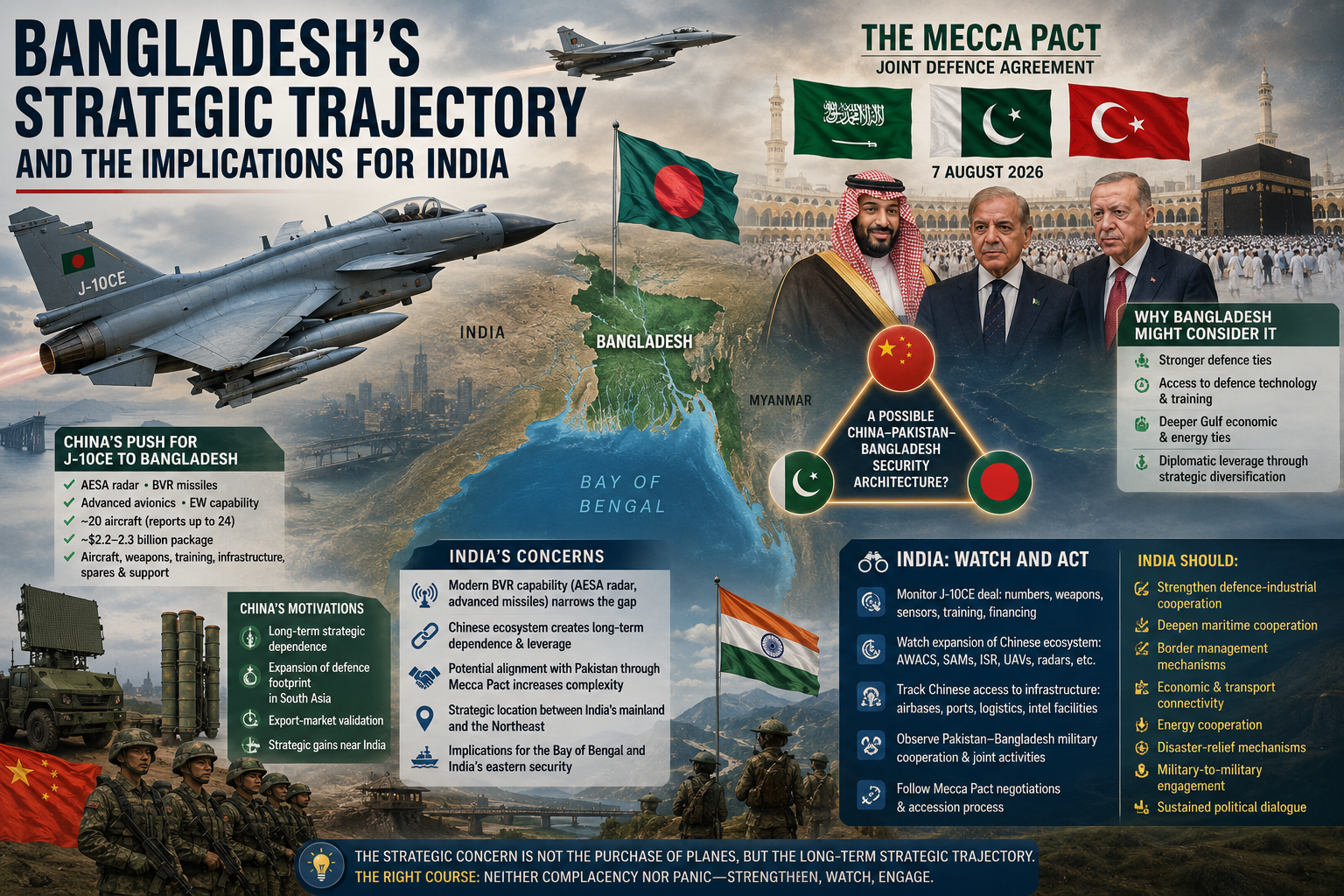
Taken together, Bangladesh’s move toward acquiring Chinese J-10CE fighters and its stated willingness to consider joining the Mecca Pact are strategically significant for India. However, neither development alone means Bangladesh has become a Chinese or Pakistani military ally. The more important issue is the direction of Bangladesh’s strategic relationships and whether these moves eventually develop into a broader China-Pakistan-Bangladesh security architecture.
China’s Push for the J-10CE to Bangladesh
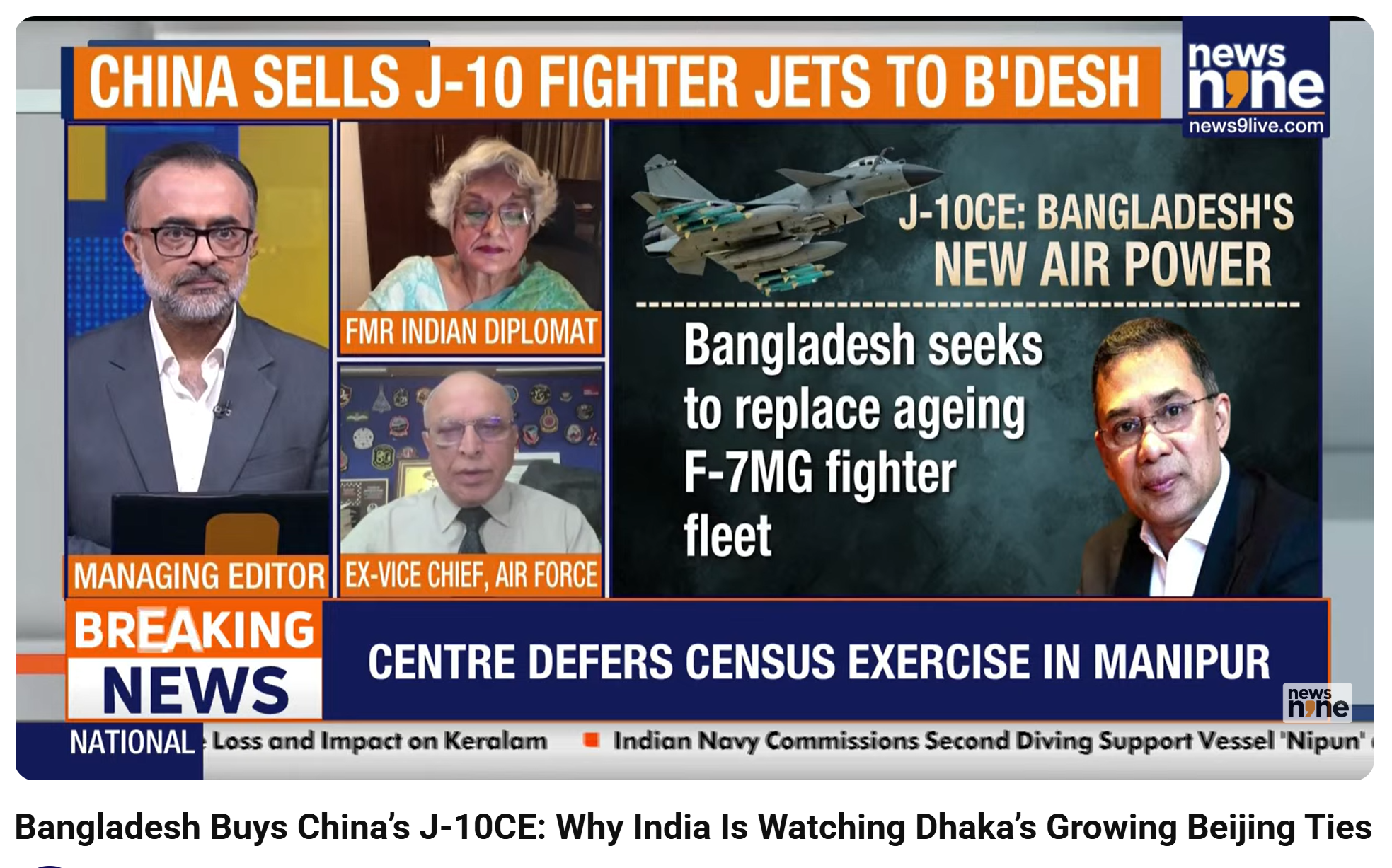
China is not simply “giving” Bangladesh fighter jets. Dhaka is moving toward purchasing Chinese J-10CE multirole fighters, with reports of a draft arrangement for roughly 20 aircraft, though earlier reports mentioned up to 24. The overall package has been reported at around $2.2–2.3 billion, including aircraft, weapons, training, infrastructure, spares and support. The agreement is not yet a completed, delivered contract, so final numbers, price and delivery schedules remain subject to approval. The deal serves both Bangladeshi and Chinese interests.
Bangladesh’s Motivations.
Fleet Modernisation: Bangladesh needs to replace or augment an ageing fighter fleet, particularly its F-7s and other legacy aircraft.
Capability at a Manageable Cost: The J-10CE offers a substantial jump in capability, including AESA radar, modern beyond-visual-range (BVR) weapons, networked avionics and electronic-warfare capabilities, at a lower acquisition and operating cost than many Western alternatives.
Existing Chinese Ecosystem: China is already Bangladesh’s dominant defence supplier, with Chinese-origin aircraft, ships, tanks, missiles and other systems in service. A new Chinese fighter therefore fits relatively easily into an existing logistics, training and maintenance ecosystem.
Strategic Diversification: The acquisition also fits Dhaka’s broader “Bangladesh First” approach, in which it seeks to maximise strategic autonomy by maintaining relationships with China, India, Pakistan, Turkey, the Gulf and Western markets rather than relying exclusively on one partner.
China’s Motivations
For Beijing, the deal is about more than selling airframes.
Long-term Strategic Dependence: A fighter fleet creates a relationship that can last decades. Aircraft, missiles, spare parts, simulators, training, maintenance, upgrades and technical support can progressively tie Bangladesh’s air force to Chinese systems and standards.
Expansion of China’s Defence Footprint: Bangladesh would become another important Chinese defence customer in South Asia, strengthening Beijing’s military-industrial presence around the Bay of Bengal and along India’s eastern periphery.
Export-Market Validation: Pakistan is currently the principal established foreign operator of the J-10 family. A Bangladeshi purchase would provide China with another reference customer and strengthen its pitch to other prospective buyers.
Strategic Gains: A friendly state operating Chinese equipment near India can complicate Indian planning and give Beijing greater influence.
The key point is therefore that the strategic value of the J-10CE deal lies not only in the aircraft’s combat capability but in the long-term Chinese military ecosystem that could develop around it.
Bangladesh and the Mecca Pact
The Mecca Joint Defence Agreement, signed on 7 August 2026 by Saudi Arabia, Pakistan and Turkey, establishes a collective-defence framework under which an armed attack on one member is treated as an attack on all. It has consequently been compared with NATO-style collective defence, although publicly available information on its precise command structure, accession procedures and operational obligations remains limited.
Bangladeshi officials have said Dhaka would consider joining if formally invited. Politically and diplomatically, it appears possible, but it is not yet an imminent or settled decision. Bangladesh has expressed openness to the idea, but it has not committed to accession.
The Mecca Pact has greater potential political significance because it would move Bangladesh beyond defence procurement into a formal security relationship involving Pakistan. For Dhaka, potential benefits of joining the pact could include:
Stronger defence and security relationships with Saudi Arabia, Pakistan and Turkey.
Possible access to Turkish defence technology and training.
Deeper Gulf economic and energy relationships.
Additional diplomatic leverage through strategic diversification.
However, membership would also create complications. Bangladesh has traditionally pursued a non-aligned or balancing foreign policy and depends simultaneously on India for geography, connectivity and trade; China for defence and investment; Gulf countries for employment and remittances; and Western markets for exports.
Joining a mutual-defence framework that includes Pakistan would therefore represent a much more consequential foreign-policy decision than purchasing Chinese aircraft.
Most importantly, the Mecca Pact should not automatically be interpreted as a Bangladesh-Pakistan military alliance directed against India. Dhaka would retain its own interests, and actual obligations would depend on the final terms of membership and the circumstances of any future conflict.
India’s Concerns
The J-10CE would give the Bangladesh Air Force a modern BVR air-combat capability, including AESA radar and advanced air-to-air missiles. This would narrow the qualitative gap between Bangladesh and India in specific areas, particularly along India’s eastern approaches.
The J-10CE purchase alone does not fundamentally change the India-Bangladesh military balance. A fleet of roughly 20–24 aircraft would still leave Bangladesh’s overall air power considerably smaller than India’s, and combat effectiveness depends on much more than the aircraft themselves: pilot training, sortie generation, airborne early-warning and control, air defence, tankers, C4ISR and supporting infrastructure all matter.
The concern grows when the fighter purchase is considered alongside Bangladesh’s potential political alignment with a Pakistan-inclusive defence framework, and China’s growing hold on Bangladesh through the supply of defence equipment. The combination, not any single development, matters.
However, the more important issue is Bangladesh’s dependence on China. A future combination of J-10CE, Chinese missiles, Chinese radars, UAVs, air-defence systems, naval systems, training, and maintenance would increase China’s institutional and technological influence over the Bangladesh Armed Forces.
Operating the same aircraft family as Pakistan could also make future technical cooperation, training or interoperability easier. However, this should not be assumed to mean that Bangladesh and Pakistan will automatically operate as a unified military force.
Bangladesh occupies a strategically important position between much of India’s mainland and the Northeast. Joining the Mecca Pact could be more consequential for India. This could represent an evolution from the traditional China-Pakistan strategic axis toward a looser, more complicated regional network, with Bangladesh as an additional node.
The consequence to the Bay of Bengal and India’s Northeast would be particularly relevant. Such an arrangement could complicate India’s eastern security environment. Deep defence relationships, technical dependence, intelligence cooperation, infrastructure access and military interoperability can themselves create strategic leverage for China.
India: Watch and Act
Several indicators will reveal whether these developments remain limited to procurement and diplomatic diversification or become strategically more serious. India should keep a close watch on: –
Final J-10CE contract, number of aircraft, delivery schedule, weapons package, sensors, data links, training arrangements and financing.
Expansion of the Chinese ecosystem with particular attention to Chinese AWACS, SAMs, ISR systems, UAVs, radar networks and other supporting capabilities. These could matter more strategically than the fighters themselves.
Chinese access to Bangladeshi infrastructure. Any future arrangements involving airbases, ports, logistics facilities, intelligence installations or sustained Chinese military access would represent a substantially more serious development.
Pakistan-Bangladesh military cooperation. Joint exercises, intelligence sharing, training arrangements or institutional defence agreements would indicate whether the political relationship is translating into operational cooperation.
Mecca Pact negotiations, accession process or a formal memorandum.
India’s response matters because excessive pressure on Dhaka could become counterproductive. A better approach would be to compete without confrontation. India should focus on: –
At the same time, India should strengthen its own eastern capabilities rather than assume Bangladesh will remain strategically neutral indefinitely. This means continued attention to the Eastern sector.
Concluding Thoughts
The strategic concern is not whether Bangladesh acquires Chinese fighter aircraft. It is whether the agreement sets the stage for greater Chinese involvement. The situation grows more complicated if Bangladesh joins a security agreement that also includes Pakistan. If both happen, the consequences for India would be much more serious.
These developments should be seen as part of a strategic trend, not as an urgent military crisis. The right course of action is neither complacency nor panic. New Delhi should strengthen its military position in the east, watch how China and Pakistan cooperate on defence matters, and remain politically and economically engaged with Bangladesh.
Information and data included in the blog are for educational & non-commercial purposes only and have been carefully adapted, excerpted, or edited from reliable and accurate sources. All copyrighted material belongs to the respective owners and is provided only for wider dissemination.
References: –
Ahmed, I. (2026, July 23). Recalibrating foreign policy: Implications of Tarique Rahman’s China visit. Institute of South Asian Studies, National University of Singapore.
(2026, August 7). Saudi Arabia, Turkey and Pakistan pledge mutual defence. Reuters.
com, Draft deal takes shape for Bangladesh’s potential purchase of Chinese J-10CE jets. bdnews24.com. (2026).
Ministry of Foreign Affairs, Government of Pakistan. Message to the nation by the Deputy Prime Minister/Foreign Minister on the signing of the Makkah Joint Defence Agreement. (2026b, August 10).
Rehman, I. (2021). China’s influence in South Asia: Vulnerabilities and resilience in four countries. Carnegie Endowment for International Peace.
(2026a, August 7). Saudi Arabia, Turkey and Pakistan pledge mutual defence. Reuters.
(2026b, August 25). Bangladesh could consider joining Mecca pact, testing foreign ties. Reuters.
(2026c, August 25). Bangladesh in talks to buy Chinese J-10CE fighter jets. Reuters.
Stockholm International Peace Research Institute. (n.d.). SIPRI arms transfers database.
10. The Business Standard. (2026). Bangladesh set to buy 20 Chinese J-10CE fighter jets for $2.3b—The Business Standard.