810: PAKISTAN’S WAR OF ITS OWN MAKING: AFGHAN POLICY COMES FULL CIRCLE


In the early hours of February 27, 2026, explosions shook the Afghan capital Kabul. Pakistani jets streaked across the night sky, striking Taliban government defence facilities, ammunition depots, and military sites in Kabul, Kandahar, and the southeastern province of Paktia. Pakistan had done something almost unthinkable just a few years ago. It bombed the capital of a neighbouring country and declared that it was now in a state of “open war.” This was not an impulsive act but the result of years of deteriorating relations. The situation had been building since the Taliban returned to power in Afghanistan in 2021.


A Historical Overview of The Broken Brotherhood

Pakistan and Afghanistan share a relationship that defies easy description. The South Asian neighbours are both Muslim-majority states and share a 2,611-kilometer border.  For decades, Pakistan was among the most important backers of the Afghan Taliban, supporting the movement ideologically, financially, and logistically through its powerful Inter-Services Intelligence (ISI) directorate. When the Taliban swept back into Kabul in August 2021 following the withdrawal of American and NATO forces, Pakistan initially welcomed the development as a strategic gain. Pakistan thought a friendly government in Kabul might counter Indian influence and give Islamabad so-called “strategic depth.”

That calculation unravelled almost immediately. The Taliban government in Kabul was not interested in being a client state of Islamabad. Far from reining in anti-Pakistan militant groups operating from Afghan soil, the Taliban appeared unwilling to do so. The Tehreek-e-Taliban Pakistan (TTP) started using Afghan territory as a base from which to launch increasingly devastating attacks on Pakistan. Pakistan’s frontier provinces bordering Afghanistan (Khyber Pakhtunkhwa and Balochistan) bore the brunt. Suicide bombings, ambushes on security forces, and targeted assassinations increased. A particularly devastating attack struck a Shia Mosque in Islamabad, killing at least 40 people and claimed by the Islamic State Khorasan Province (ISKP), adding another militant dimension to Pakistan’s security nightmare.

At the same time, the Durand Line (the colonial-era boundary drawn by the British in 1893) remained a festering point of contention. Afghanistan has never formally recognised this border as legitimate, viewing it as an arbitrary demarcation that divides the Pashtun ethnic group between two states. The Taliban government maintained that position firmly, resisting Pakistan’s attempts to fence the border and frequently allowing its fighters to interfere with construction efforts. It is estimated that there had been at least 75 recorded clashes between Afghan and Pakistani forces along the Durand Line between 2021 and 2026, a frequency that made some form of major escalation almost inevitable.


The Military Balance

The difference in military strength between Pakistan and Afghanistan is stark. Pakistan, a nuclear-armed country, has a considerable military force with 660,000 active personnel (560,000 soldiers in the army, 70,000 in the air force, and 30,000 in the navy). Pakistan also boasts of 465 combat aircraft, over 260 helicopters, more than 6,000 armoured fighting vehicles, and over 4,600 artillery pieces.

The Afghan Taliban, by contrast, commands approximately 172,000 active military personnel. When the Taliban returned to power in 2021, it inherited a substantial inventory of US-supplied military equipment left behind by the former Afghan National Army, including armoured vehicles, artillery, and aircraft. But without international recognition, without access to spare parts, and without functioning military training institutions, much of that equipment became unusable. Afghanistan has no functioning air force to speak of: at most six aircraft, some of Soviet vintage, and 23 helicopters, the airworthiness of an unknown number of which remained in doubt.

On paper, Pakistan could crush the Taliban’s conventional military capacity with relative ease. Yet history has shown repeatedly that wars in Afghanistan are not won on paper. It is called the “Graveyard of Empires” for a reason. The Taliban’s fighters are combat-hardened veterans of a 20-year insurgency against the most powerful military alliance in history. They know their terrain intimately. And Islamabad should know better than most that guerrilla warfare in the mountains of Khost and Kunar can render any conventional military advantage irrelevant.


Collapse of the October 2025 Ceasefire

The crisis did not erupt without prior warning. In October 2025, Afghanistan and Pakistan had already fought a week of fierce and deadly clashes along their contested frontier. More than 70 people were killed on both sides in what at the time represented the worst bout of open fighting between the two neighbours in recent memory. The violence was enough to prompt international intervention. Qatar and Turkey brokered an emergency ceasefire in Doha, and for a few months, the shooting largely stopped.

But the ceasefire was always fragile. Sporadic violations continued, and none of the underlying causes had been addressed. Pakistan still wanted the Taliban to crack down on the TTP. The Taliban still refused to recognise the Durand Line. Militant attacks inside Pakistan continued. Border crossings, including the key Torkham and Chaman crossings, remained largely shut, causing severe economic strain on both sides and enormous suffering for Afghan refugees and returnees caught between two hostile states. Several rounds of negotiations followed the October ceasefire, reportedly involving Qatar and Turkey as mediators, but no lasting agreement emerged.


The February 2026 Skirmish

Pakistan launched airstrikes targeting what it described as militant camps belonging to the TTP and ISKP in Afghan provinces (Nangarhar, Paktika, and Khost). Islamabad claimed that the strikes had killed at least 70 terrorists. The Taliban government and independent observers had a different story. The UN mission in Afghanistan reported that at least 13 civilians had been killed in those initial Pakistani strikes. Taliban spokesman Zabihullah Mujahid said the attacks had “killed and wounded dozens, including women and children.” A provincial director of the Afghan Red Crescent Society said 18 people were killed and many more wounded in Nangarhar alone. These were not terrorists on a training ground, but residents of border villages.

Afghanistan issued a stern warning, which Pakistan dismissed. On the night of February 26, Afghan forces launched a large-scale offensive operation against Pakistan.  They targeted Pakistani military installations along the Durand Line.

Pakistan responded by launching Operation Ghazab lil Haq (Righteous Fury) on 27 Feb 26. It involved combined air and ground strikes against Taliban posts, headquarters, and ammunition depots.

According to Pakistan’s Information Minister Attaullah Tarar, the operation killed at least 133 Afghan Taliban fighters and wounded more than 200. Pakistan also claimed that 27 Taliban posts had been destroyed and nine captured, along with over 80 tanks, artillery pieces, and armoured personnel carriers. The Taliban gave a starkly different account: eight of its fighters killed and eleven wounded, and 55 Pakistani soldiers killed, with 19 posts seized. Neither set of figures could be independently verified by the time news organisations were reporting from the ground.

The conflict quickly introduced new dimensions of warfare. Afghanistan claimed its forces had “successfully conducted” drone strikes hitting military targets inside Pakistan. Pakistan’s Information Minister said the drone attempts had been intercepted by anti-drone systems in the cities of Abbottabad, Swabi, and Nowshera, with no damage to life.

The Torkham crossing remained one of the most dangerous and symbolically loaded flashpoints. It had been kept partially open for Afghans returning en masse from Pakistan. Now those returnees found themselves trapped between two armies.


Regional and Global Reactions

The international response to the outbreak of open war was swift and almost uniformly alarmed. The United Nations Secretary-General António Guterres was among the first to respond. He called for both parties to de-escalate immediately and continue to seek to resolve the differences through diplomacy.

India condemned Pakistan’s airstrikes. It described the strikes as “another attempt by Pakistan to externalise its internal failures”. It also affirmed India’s support for Afghanistan’s sovereignty, territorial integrity, and independence. Pakistan’s Foreign Office rejected India’s comments and alleged that the Taliban had become a proxy for India.

Iran has borders with both countries and has long positioned itself as a bridge between them. It called on both governments to resolve their differences within the framework of good neighbourliness. Iran also offered mediation and readiness to assist in facilitating dialogue.

China maintains close ties with both Pakistan and the Taliban government in Kabul. It expressed deep concern and conveyed Beijing’s willingness to play a constructive role in cooling the situation. Russia called on both parties to immediately halt cross-border attacks and offered to mediate if requested by both sides. Turkey’s Foreign Minister Hakan Fidan held separate calls with his counterparts in Pakistan, Afghanistan, Qatar, and Saudi Arabia to coordinate diplomatic pressure. Saudi Arabia’s Foreign Minister Faisal bin Farhan spoke with Pakistan’s Ishaq Dar to discuss “ways to reduce tensions.”

Former Afghan President Hamid Karzai, though holding no official position, issued a public statement. Pakistan cannot free itself from the self-created problems of violence and bombings. Still, it must change its own policy and choose the path of good neighbourliness, respect, and civilised relations with Afghanistan.


What Drives This War

The hostility between Pakistan and Afghanistan is the product of an irreconcilable contradiction. Pakistan created, supported, and enabled the Taliban as a strategic instrument for more than two decades. It sheltered the Taliban’s senior leadership during the years of US occupation. It allowed recruitment and fundraising on Pakistani soil. It lobbied internationally for international recognition of Taliban governance. Pakistan expected gratitude and compliance from the Taliban’s return to power in 2021.

What it got instead was a sovereign government that pursued its own interests. It refused to recognise the Durand Line, declined to crack down on the TTP, and increasingly viewed Islamabad as a threat rather than a patron. The Pakistani analyst Mariam Solaimankhil, a member of Afghanistan’s Parliament in Exile, framed it bluntly in a television interview during the crisis: “Pakistan is fighting the monster it helped create.” She argued that the TTP’s roots, the Afghan Taliban’s ideology, and the networks of militant groups were all products of Pakistani state policy over decades, and that the civilians now dying in Pashtun villages on both sides of the border, in Balochistan, in Khyber Pakhtunkhwa, were paying the price for choices made in Rawalpindi’s military headquarters.


Where It Might Lead

Where the conflict goes from here remains deeply uncertain. The military balance favours Pakistan overwhelmingly in conventional terms, but history suggests that Afghanistan defeats its invaders not by winning battles but by outlasting occupiers. Pakistan has no stated intention of occupying Afghanistan. Still, each round of airstrikes radicalises new fighters, destroys what little infrastructure the Taliban government has, and strengthens the hand of hardliners on both sides.

The international community (China, Russia, Iran, Turkey, and the UN)  has called for de-escalation, but none of these actors has the leverage or the will to impose a solution. The United States, which spent 20 years and trillions of dollars trying to stabilise Afghanistan and failed, is unlikely to re-engage substantively. Qatar and Turkey, who brokered the October 2025 ceasefire that lasted barely four months, again tried to mediate, but without addressing the root causes. In this scenario, any ceasefire will be temporary.

The Durand Line was drawn by a British diplomat in 1893 to serve imperial interests. More than 130 years later, it remains a wound that neither side can agree to close. Until it is resolved, the cycle of violence that has defined this relationship will continue to grind on—one airstrike, one ceasefire, and one broken promise at a time.

Please Add Value to the write-up with your views on the subject.

1910
Default rating

Please give a thumbs up if you  like The Post?


For regular updates, please register your email here:-

Subscribe


References and credits

To all the online sites and channels.

Pics Courtesy: Internet

Disclaimer:

Information and data included in the blog are for educational & non-commercial purposes only and have been carefully adapted, excerpted, or edited from reliable and accurate sources. All copyrighted material belongs to the respective owners and is provided only for wider dissemination.


References:

Ahmed, R. (2000). “Taliban: Militant Islam, oil and fundamentalism in Central Asia”. Yale University Press.

Bijan Omrani, B. (2009). “The Durand Line: History and problems of the Afghan-Pakistan border”. Asian Affairs, 40(2), 177–195.

Center for Strategic and International Studies. (2021–2026). “Tehrik-i-Taliban Pakistan and regional militancy reports”. https://www.csis.org

Chatham House. (2021–2026). “Afghanistan post-2021 political and security analysis”. https://www.chathamhouse.org

Council on Foreign Relations. (2021–2026). “Backgrounders on Afghanistan, Taliban, and regional geopolitics”. https://www.cfr.org

International Crisis Group. (2021–2026). “Pakistan-Afghanistan border tensions and militancy reports”. https://www.crisisgroup.org

International Institute for Strategic Studies. (2025). “The military balance 2025”. Routledge.

Reuters. (2025–2026). “Coverage of Pakistan-Afghanistan conflict and regional tensions”. https://www.reuters.com

Rubin, B. R. (2002). “The fragmentation of Afghanistan: State formation and collapse in the international system” (2nd ed.). Yale University Press.
762: AZM-E-ISTHEKAM: PAKISTAN AND AFGHANISTAN AT WAR


In October 2025, the volatile border between Pakistan and Taliban-ruled Afghanistan once again erupted into violence, marking the sharpest escalation seen since the fall of Kabul in 2021. Years of mutual suspicion, militant activity, and punitive cross-border actions have culminated in a conflict that threatens to redraw the region’s security landscape and deepen humanitarian tragedy. At the heart of the crisis lies Pakistan’s longstanding grievance over militant sanctuaries in Afghanistan, alongside the Afghan Taliban’s fury at perceived violations of sovereignty. What started with airstrikes and border raids has grown into a war of retaliation.


Genesis. Beyond the militant issue lies a deeper, century-old source of tension, the Durand Line, the 2,600-kilometer boundary drawn by British colonial authorities in 1893. Afghanistan has never formally recognised it as an international border, arguing that it unjustly divides ethnic Pashtun communities between the two countries. Pakistan, on the other hand, insists that the border is internationally recognised and non-negotiable. This disagreement frequently sparks clashes, especially when Pakistan attempts to fence or fortify sections of the frontier. In recent years, Islamabad has built extensive fencing and new security posts, moves that the Afghan Taliban view as unilateral and illegitimate. For local tribes who straddle the border, these disputes have disrupted trade, travel, and traditional social networks, fuelling resentment on both sides.


A Legacy of Mistrust. The irony of the current conflict is striking: for years, Pakistan was seen as one of the Taliban’s key supporters. Islamabad maintained close ties with the group during the U.S. war in Afghanistan, providing political and logistical backing while officially denying direct involvement. Many in Pakistan’s security establishment believed a Taliban-run Afghanistan would ensure a friendly, stable neighbour, one that would curb Indian influence and maintain strategic depth. Yet since 2021, the opposite has occurred. The Taliban’s rise to power has not translated into reliable cooperation. Instead, the Afghan government’s reluctance to act against the TTP has deepened Islamabad’s insecurity. Meanwhile, Taliban leaders have accused Pakistan of bowing to Western pressure and violating Afghan sovereignty with repeated cross-border strikes.


The Refugee and Humanitarian Dimension. Another flashpoint is the treatment of Afghan refugees in Pakistan. For over four decades, Pakistan has hosted millions of Afghans who fled war and instability. However, as domestic economic challenges mount and security incidents rise, Islamabad has hardened its stance. In 2023 and again in 2025, Pakistan announced mass deportations of undocumented Afghans, citing concerns that militants were using refugee camps for cover. Kabul condemned the policy as collective punishment, arguing that most refugees are innocent civilians. The crackdown has strained relations further, with human rights groups warning of humanitarian crises as thousands of Afghans are forced to return to an unstable homeland.


Aggressive Pakistan Strategy. Pakistan’s “Azm-e-Isthekam” campaign, launched in mid-2025, signalled a shift: no longer would Pakistan rely solely on defensive border policing. Instead, Islamabad adopted a new deterrence framework, crossing into Afghanistan with targeted military operations aimed at chronic safe havens. This bold approach antagonised the Taliban, who see themselves as sovereign rulers rather than proxies for Pakistani interests.


Escalation: From Airstrikes to Border War. The immediate trigger for this round of fighting was a series of Pakistani airstrikes on October 9, 2025, targeting Pakistani Taliban (Tehreek-e-Taliban Pakistan, or TTP) leaders, including Noor Wali Mehsud, in Kabul and several Afghan provinces. Islamabad cited security concerns, claiming TTP was using Afghan territory as a staging ground for attacks inside Pakistan. The Afghan Taliban called these actions unprovoked aggression, denouncing civilian deaths and promising retribution. Days later, Taliban fighters shelled Pakistani outposts along the Durand Line, with both sides exchanging heavy fire, drone strikes, and artillery barrages, resulting in dozens of military and civilian casualties on both sides.​


The Battles. Clashes have centered on traditional flashpoints: Spin Boldak and Chaman, major crossings on the Afghanistan-Pakistan border, and Kurram and Khyber districts further north. Taliban fighters shelled Pakistani posts, killing soldiers and reportedly seizing weaponry. Islamabad responded with precision airstrikes, claiming to destroy Taliban military compounds and inflict significant casualties. Afghan sources, however, report large-scale civilian deaths and widespread displacement, including in Kandahar and Paktika, triggering renewed calls for restraint by international agencies.​ The scale and intensity of the fighting surpassed previous border skirmishes. Both sides deployed drones, tanks, and heavy artillery in what some analysts described as “border war” conditions, closing major trade crossings and halting cross-border movement. Satellite images confirmed destroyed military infrastructure and burning market stalls; hospital reports cited dozens of injured women and children.​


Ceasefire Attempts. Amid mounting casualties and economic paralysis along the border, international actors intervened. Saudi Arabia and Qatar, both regional stakeholders, urged restraint and pushed for a diplomatic ceasefire. On October 15–16, a temporary 48-hour truce was announced, brokered with back-channel Pakistani and Afghan talks. Yet, even as fighting subsided briefly, mutual distrust simmered. Both parties continued to exchange accusations over border violations and destabilisation, threatening to reignite hostilities.​ Diplomatic channels remain open, with China, Qatar, and the Organisation of Islamic Cooperation (OIC) playing potential mediating roles.


Humanitarian and Economic Impacts. The militarisation of the border is causing a profound humanitarian crisis. Trade has collapsed at major crossings, disrupting food and fuel supplies throughout southern Afghanistan and Balochistan, Pakistan. Tens of thousands have been displaced; hospitals report surging casualties amidst shortages of medical supplies. Businesses suffer as markets fall under shellfire, and civilians fear raids and bombings. The economic cost, layered on political instability and poverty, further erodes any prospect for peace.​

Geopolitical Ripples. The escalation has regional consequences. India, long marginalised by the Taliban, is signalling renewed diplomatic interest in Afghanistan, such as the reopening of its Kabul embassy. The Taliban government’s recent diplomatic outreach to New Delhi, including trade talks and security meetings, has made Islamabad uneasy. China, a major investor in Pakistan through the China-Pakistan Economic Corridor (CPEC), is worried that instability could threaten its infrastructure projects and trade routes. Beijing has quietly urged both sides to restore calm. The evolving security equation, characterised by shrinking American influence and rising intra-regional rivalries, makes the crisis especially combustible.​


Future Outlook. For the Taliban, maintaining sovereignty and legitimacy means resisting external control, whether from Pakistan, the U.S., or others. For Pakistan, ensuring border security and suppressing militant threats are non-negotiable national interests. The clash between these priorities makes compromise difficult. If the violence continues, the consequences could be severe: destabilisation of border regions, humanitarian crises from refugee flows, and the potential for militant groups to exploit chaos on both sides. While the recent truce offers a temporary pause, most analysts believe it is unlikely to hold unless both sides address the root causes. Pakistan wants concrete action against the TTP and assurances that Afghan soil will not be used for attacks. Afghanistan demands an end to cross-border strikes and respect for its sovereignty.


Conclusion. As the fragile ceasefire holds, there is little optimism for a durable peace. The deep mistrust over terrorism, sovereignty, and historic grievances remains unresolved. Pakistan faces an emboldened TTP, increasingly sheltered by Kabul, while Afghanistan bristles at cross-border airstrikes and civilian deaths. Diplomats warn that only sustained dialogue, regional mediation, and genuine efforts to address militant sanctuaries can halt the drift toward wider war. Ultimately, the Pakistan-Afghanistan conflict is not just a border dispute or a fight against militancy; it is a test of whether two neighbouring Islamic republics, each grappling with its own legitimacy and governance crises, can find a path toward coexistence in one of the world’s most volatile regions. Developments indicate that old alliances and new doctrines are insufficient in the face of deep-rooted mistrust and shifting power. The need for comprehensive security solutions and humanitarian support grows ever more urgent, as the fate of the region hangs in the balance.


Please Add Value to the write-up with your views on the subject.

1910
Default rating

Please give a thumbs up if you  like The Post?


For regular updates, please register your email here:-

Subscribe


References and credits

To all the online sites and channels.

Pics Courtesy: Internet

Disclaimer:

Information and data included in the blog are for educational & non-commercial purposes only and have been carefully adapted, excerpted, or edited from reliable and accurate sources. All copyrighted material belongs to respective owners and is provided only for wider dissemination.


References:-

  1. Durani, Mohammad Usman, and Asad Khan. “Pakistan-Afghan Relations: Historic Mirror.” Journal of the Pakistan Historical Society, vol. 63, no. 4, 2023, pp. 1–35.
  2. Johnson, Thomas H., and M. Christine Fair. “The Durand Line: History and Problems of the Afghan-Pakistan Border.” Asian Affairs, vol. 40, no. 2, 2009, pp. 177–195. (A historical survey of border negotiations and ongoing disputes.)
  3. Usman, Muhammad, and Muhammad Khan. “Dynamics of Trust and Mistrust in the Afghanistan–Pakistan Relationship.” Asian Perspective, vol. 45, no. 2, 2021, pp. 295–317.
  4. Gul, Imtiaz. “Heavy Clashes Erupt Along Pakistan-Afghanistan Border.” The Guardian, 11 October 2025.
  5. “Border Clash Between Afghanistan and Pakistan Threatens a Wider Conflict.” The New York Times, 12 October 2025.
  6. Shah, Syed Akhtar Ali, et al. “Pakistan, Afghanistan Agree to Temporary Truce After Fresh Fighting, Airstrikes.” Reuters, 15 October 2025.
  7. “‘New Normal’: Is Pakistan Trying to Set New Red Lines with Afghan Taliban?” Al Jazeera, 15 October 2025.
  8. “Uncertainty Torments Afghan Refugees Facing Deportation From Pakistan.” The New York Times, 31 March 2025.
  9. “Pakistan Accelerates Deportation of Afghans: UN.” Al Jazeera, 15 April 2025.
  10. Rashid, Ahmed. Taliban: Militant Islam, Oil and Fundamentalism in Central Asia. 2nd ed., Yale University Press, 2010.
  11. Yousaf, Mohammad, and Mark Adkin. The Bear Trap: Afghanistan’s Untold Story. Leo Cooper, 1992.
  12. Khan, Shahnaz. Afghanistan and Pakistan: Conflict, Extremism, and Resistance to Modernity. Rowman & Littlefield, 2011.

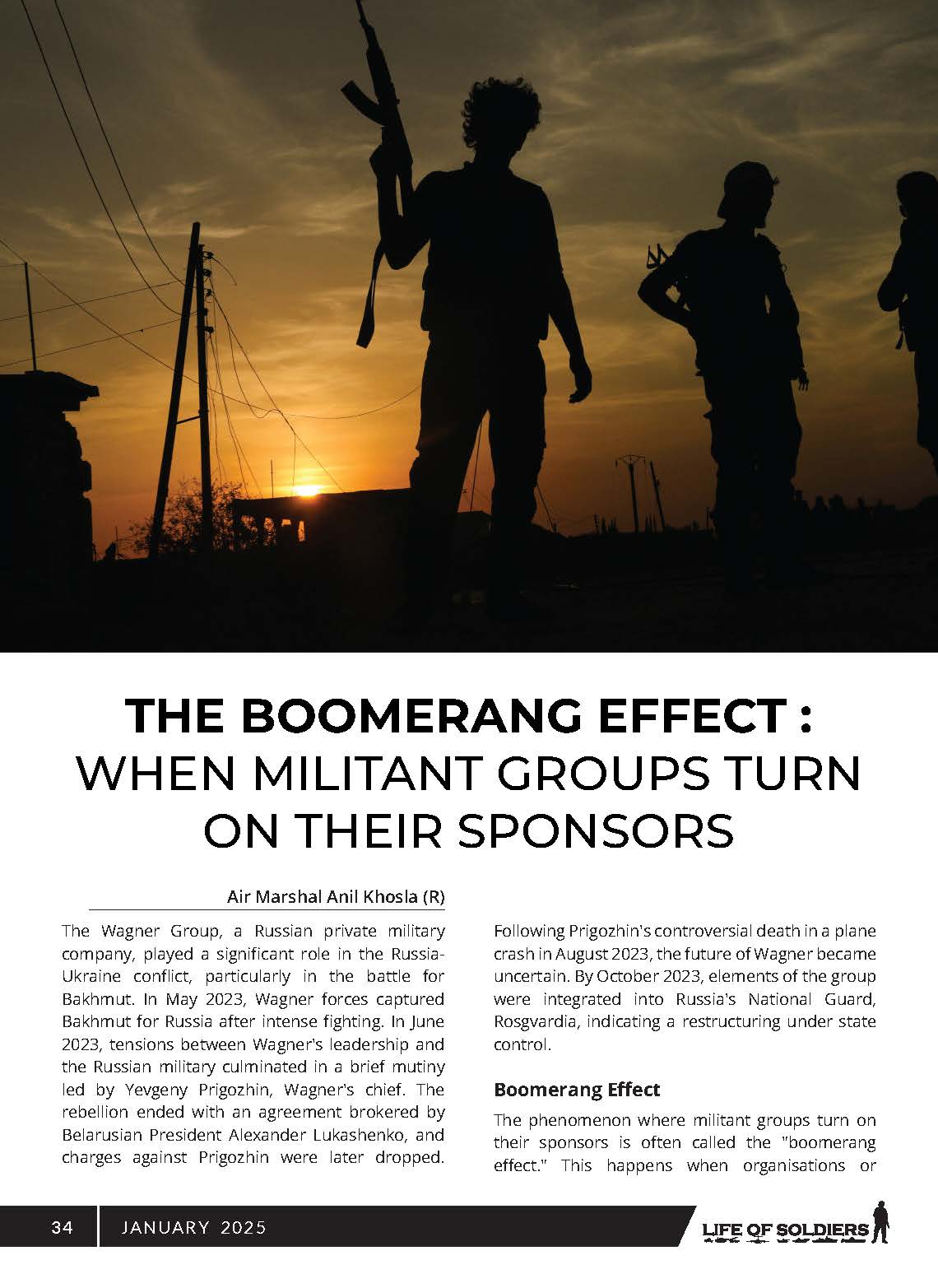
571: THE BOOMERANG EFFECT: WHEN MILITANT GROUPS TURN ON THEIR SPONSORS


Pic Courtesy Net


My Article Published in the Life of Soldiers (a premier monthly defence magazine) on 30 Dec 24.


The Wagner Group, a Russian private military company, played a significant role in the Russia-Ukraine conflict, particularly in the battle for Bakhmut. In May 2023, Wagner forces captured Bakhmut for Russia after intense fighting. In June 2023, tensions between Wagner’s leadership and the Russian military culminated in a brief mutiny led by Yevgeny Prigozhin, Wagner’s chief. The rebellion ended with an agreement brokered by Belarusian President Alexander Lukashenko, and charges against Prigozhin were later dropped. Following Prigozhin’s controversial death in a plane crash in August 2023, the future of Wagner became uncertain. By October 2023, elements of the group were integrated into Russia’s National Guard, Rosgvardia, indicating a restructuring under state control.


Boomerang Effect.


The phenomenon where militant groups turn on their sponsors is often called the “boomerang effect.” This happens when organisations or groups created, funded, or supported by a state or another actor shift their allegiances or use their skills and resources against their former backers. The reasons for this shift can be complex and multifaceted, involving ideological differences, changing power dynamics, or disillusionment with their sponsors’ objectives. Contributing factors are as follows:- 


Ideological Divergence. Initially, militant groups are often created with shared goals and objectives aligned with their sponsors. However, as they gain strength and experience, they may develop their agendas. Differences in ideology can lead to clashes, especially if the militants feel their sponsors are manipulating them for geopolitical gain.


Loss of Control. Sponsors often lose control over the militants they support. As these groups gain legitimacy and power, they may increasingly act independently, pursuing their objectives, which might not align with those of their sponsors. This can lead to a strategic shift where militants view their sponsors as obstacles rather than allies.


Disillusionment and Frustration. Sometimes, militants feel let down by their sponsors. They may believe that their resources or support are inadequate or misdirected. This frustration can lead to losing loyalty, with groups turning against their sponsors.


Changing Power Dynamics. As the geopolitical landscape changes, so too can militants’ strategic interests. They may switch sides in pursuit of more favourable conditions, especially when they see greater opportunities to achieve their goals with a different sponsor or on their own.


The Wagner Group Story


Wagner Group, a Russian private military contractor (PMC), provides a recent example of a sponsored organisation turning against its sponsor. Initially backed by the Russian government, Wagner became a powerful, semi-autonomous entity with ambitions and interests, ultimately leading to a public confrontation with the Russian state.


Background. The Wagner Group was founded around 2014 by Dmitry Utkin, a former Russian military officer, and Yevgeny Prigozhin, a businessman with close ties to the Kremlin. It served as a proxy force for Russian interests in global hotspots, allowing Russia to exert influence without direct military involvement or the political risk of deploying official troops. Wagner operated in Syria, Libya, the Central African Republic, and other countries, carrying out missions aligned with Russian geopolitical interests and reportedly receiving support and resources from the Russian state, including training facilities and equipment.


Tensions Leading to Conflict. As Wagner’s activities grew, so did its autonomy and influence. Wagner played a significant role in the 2022 invasion of Ukraine, taking on critical combat roles. However, Prigozhin became increasingly outspoken about the Russian military’s failings, explicitly criticising the Ministry of Defence’s handling of the war. Wagner’s leadership grew resentful, accusing Russian military officials of incompetence, neglecting logistical support, and underestimating Wagner’s sacrifices on the front lines.


The Wagner Rebellion of 2023. This tension culminated in a dramatic turn in June 2023, when Wagner launched an armed rebellion against the Russian military leadership. Prigozhin led his forces into the Russian city of Rostov-on-Don, seizing an army headquarters, and then began an advance toward Moscow. Prigozhin demanded changes in the Russian military leadership, mainly targeting Defence Minister Sergei Shoigu and General Valery Gerasimov. Although it was ultimately short-lived, this direct challenge to the Kremlin marked a sharp break with their previous sponsor, the Russian state. The rebellion ended after negotiations, reportedly brokered by Belarusian President Alexander Lukashenko. Prigozhin agreed to stand down in exchange for a safe passage to Belarus, and Wagner’s forces withdrew. However, the incident exposed significant rifts between Wagner and the Russian government, highlighting how sponsorship of militant or paramilitary organisations can backfire when these groups gain enough power to pursue their agendas.


Aftermath and Fallout. The fallout from the rebellion was significant. Prigozhin’s death in a plane crash in August 2023 was widely speculated to have been orchestrated by elements within the Russian state. Wagner’s operations were subsequently restructured, with many members reportedly re-assigned or integrated into other units more directly controlled by the Russian government.


Lessons and Analysis. The Wagner Group’s rebellion is a cautionary tale about the risks of using paramilitary organisations for state purposes. Once such groups gain power, resources, and a sense of autonomy, they can become difficult to control, and their interests may diverge from those of their original sponsor. In Wagner’s case, the group’s loyalty to Prigozhin and its operational independence contributed to a volatile situation where, ultimately, Wagner’s ambitions turned against the very state that enabled its rise.


Boomerang Effect: Notable Instances


Several historical examples exist of militant organisations that initially received sponsorship from governments or other entities but later turned against their sponsors. This phenomenon often results from shifting political dynamics, ideological conflicts, or changes. in militant groups’ objectives.


Al-Qaeda and the United States. During the 1980s, the United States, along with Pakistan and Saudi Arabia, provided financial and military support to Afghan mujahideen fighters to combat the Soviet Union’s invasion of Afghanistan. Many of these fighters, including Osama bin Laden, received resources and training indirectly through the CIA’s Operation Cyclone. After the Soviet withdrawal, some of these fighters, including bin Laden, formed Al-Qaeda. Al-Qaeda grew increasingly antagonistic toward the United States, particularly due to its military presence in the Middle East and its support for governments seen as oppressive or contrary to Islamic principles. This hostility culminated in the September 11, 2001 attacks, marking a complete break from their former indirect sponsor.


The Taliban and Pakistan. Pakistan’s Inter-Services Intelligence (ISI) supported the formation of the Taliban in the 1990s, seeing them as a potential ally to ensure a friendly government in Afghanistan, which would provide Pakistan with strategic depth against India. While the Taliban still maintains some ties with Pakistan, there have been periods of tension. Taliban-linked groups, such as the Tehrik-i-Taliban Pakistan (TTP), have turned against the Pakistani state, conducting attacks within Pakistan. The TTP aims to overthrow the Pakistani government and establish a stricter interpretation of Islamic law, which has led to significant violence and conflict within Pakistan itself.


Hamas and Israel. During the early years of the Palestinian resistance, Israel indirectly supported groups that would later form Hamas, aiming to create a counterbalance to the secular Palestinian Liberation Organization (PLO) led by Yasser Arafat. This was based on the notion that Islamist movements could divide the Palestinian resistance, making it easier to manage. Hamas eventually became a formidable opponent to Israel, adopting a hardline stance and engaging in numerous conflicts with the Israeli state. Today, Hamas is a prominent political and militant force in Gaza and has carried out attacks against Israeli targets, becoming one of Israel’s most persistent adversaries.


The Islamic State (ISIS) and the Gulf States. During the Syrian Civil War, several Gulf States, including Qatar and Saudi Arabia, provided funding and weapons to Sunni rebel groups to oppose the Assad regime in Syria. Some of these groups either merged with or evolved into extremist groups like ISIS. Although Gulf States may not have directly funded ISIS, their support for anti-Assad rebels indirectly bolstered ISIS’s power. Once ISIS gained control of territory and declared a caliphate, it posed a threat to all governments in the region, including those in the Gulf. ISIS targeted these governments rhetorically and sometimes directly, seeing them as illegitimate and corrupt.


M23 Rebels and Rwanda. The M23 rebel group in the Democratic Republic of the Congo (DRC) was reportedly supported by neighbouring Rwanda, which viewed them as a means to secure influence in the DRC and counter the presence of anti-Rwandan Hutu militias. Over time, M23 developed its political ambitions, creating sporadic tensions with Rwanda. Although the relationship between Rwanda and M23 is complex and fluctuates, there have been instances where M23 acted independently, with a leadership not fully aligned with Rwanda’s objectives.


Fatah al-Islam and Syria. Syria was alleged to have supported Fatah al-Islam, a militant group in Lebanon, to destabilise the Lebanese government, particularly during times of political tension between Syria and Lebanon. Fatah al-Islam later became a problem for Syria and the broader region. The group’s activities and increasing autonomy led to clashes with the Lebanese government and other regional actors, pushing them further away from Syrian influence.


Conclusion

These examples illustrate how sponsorship of militant groups is fraught with inherent risks and unintended consequences. Such alliances with unpredictable partners often backfire as these organisations evolve ideologically, gain independence, or shift their focus based on changing political landscapes.  The short-term gains can lead to long-term instability, undermining the sponsor’s original goals and threatening regional and global security. They are stark reminders of the dangers of using militancy as a proxy for power, underscoring the need for more sustainable and ethical approaches to conflict resolution and statecraft.


Your valuable comments are most welcome.


1910
Default rating

Please give a thumbs up if you  like The Post?


Link to the Article on the website:-

The Boomerang Effect: When Militant Groups Turn On Their Sponsors

For regular updates, please register your email here:-

Subscribe

References and credits

To all the online sites and channels.

References:

  1. Byman, Daniel. “Friends Like These: Counterinsurgency and the War on Terrorism.” International Security, vol. 31, no. 2, 2006, pp. 79–115.
  1. Crenshaw, Martha. “The Causes of Terrorism.” Comparative Politics, vol. 13, no. 4, 1981, pp. 379–399.
  1. Weinberg, Leonard, and William L. Eubank. “State-Sponsored Terrorism: A Reassessment.” Terrorism and Political Violence, vol. 2, no. 1, 1990, pp. 287–302.
  1. Piazza, James A. “Incubators of Terror: Do Failed and Failing States Promote Transnational Terrorism?” International Studies Quarterly, vol. 52, no. 3, 2008, pp. 469–488.
  1. Coll, Steve. Ghost Wars: The Secret History of the CIA, Afghanistan, and Bin Laden, from the Soviet Invasion to September 10, 2001. New York: Penguin Press, 2004.
  1. Mamdani, Mahmood. Good Muslim, Bad Muslim: America, the Cold War, and the Roots of Terror. New York: Pantheon Books, 2004.
  1. Gerges, Fawaz A. The Far Enemy: Why Jihad Went Global. Cambridge: Cambridge University Press, 2005.
  1. Kepel, Gilles. Jihad: The Trail of Political Islam. Cambridge, MA: Harvard University Press, 2002.
  1. Rashid, Ahmed. Taliban: Militant Islam, Oil, and Fundamentalism in Central Asia. New Haven, CT: Yale University Press, 2000.
  1. Gunaratna, Rohan. Inside Al Qaeda: Global Network of Terror. New York: Columbia University Press, 2002.
  1. Katzman, Kenneth. Afghanistan: Post-Taliban Governance, Security, and U.S. Policy. Congressional Research Service Report, 2021.
  1. Jones, Seth G. In the Graveyard of Empires: America’s War in Afghanistan. New York: W.W. Norton & Company, 2009.
  1. Norton, Augustus R. Hezbollah: A Short History. Princeton: Princeton University Press, 2007.
  1. Fair, C. Christine. In Their Own Words: Understanding Lashkar-e-Taiba. New York: Oxford University Press, 2018.
  1. Galeotti, Mark. Putin’s Wars: From Chechnya to Ukraine. London: Bloomsbury Publishing, 2022.
  1. Nixey, James. The Weaponisation of Everything: Russia’s Hybrid Warfare in the 21st Century. London: Royal Institute of International Affairs, 2021.
  1. Marten, Kimberly. Warlords and Coalition Politics in Post-Soviet States. Ithaca, NY: Cornell University Press, 2012.
  1. Marten, Kimberly. “The Puzzle of Russian Behavior in Deir Al-Zour.” War on the Rocks, 2018.
  1. Galeotti, Mark. “Russia’s Private Military Companies: The Example of Wagner.” RUSI Journal, vol. 164, no. 1, 2019, pp. 20–28.
  1. MacFarquhar, Neil, and Eric Schmitt. “Inside the Wagner Group’s Mutiny Against the Kremlin.” The New York Times, June 2023.
  1. Seddon, Max. “The Wagner Group Mutiny: What It Tells Us About Putin’s Russia.” Financial Times, July 2023.
  1. Galeotti, Mark. “The Russian Way of War: From Chechnya to Ukraine.” Foreign Affairs, 2022.

Disclaimer:

Information and data included in the blog are for educational & non-commercial purposes only and have been carefully adapted, excerpted, or edited from reliable and accurate sources. All copyrighted material belongs to respective owners and is provided only for wider dissemination.

English हिंदी