
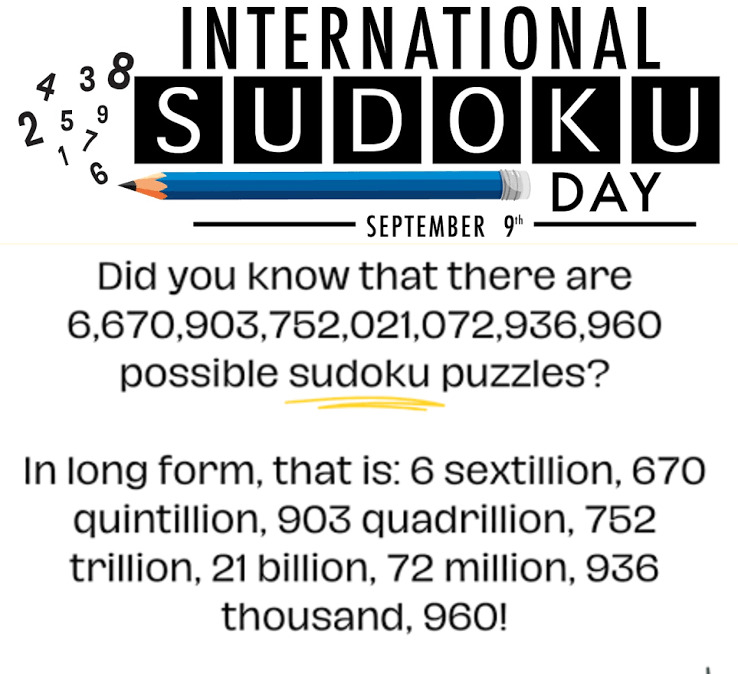
Every year, World Sudoku Day is celebrated on September 9 to recognise one of the world’s most popular number puzzles. The date, 9/9, reflects Sudoku’s familiar 9-by-9 grid, which contains nine rows, nine columns, and nine 3-by-3 boxes.
Sudoku is much more than a pastime. It is an engaging mental exercise that encourages logical thinking, concentration, patience, observation and problem-solving. People of all ages enjoy solving Sudoku for relaxation, entertainment, intellectual stimulation or simply as a way to take a break from screens and everyday distractions.
What makes Sudoku particularly interesting is its simplicity. You can understand the rules in minutes, but mastering difficult puzzles can take years of practice. It demonstrates an important lesson: a problem does not have to be solved all at once. With careful reasoning and a step-by-step approach, even a complicated challenge can become manageable.
The History of Sudoku
Although Sudoku became internationally famous in the early 21st century, its origins trace back much further. The puzzle is closely related to the mathematical concept of Latin squares, which Swiss mathematician Leonhard Euler studied extensively in the 18th century. In a Latin square, symbols are arranged so that each symbol appears only once in every row and column.
The modern form of Sudoku emerged much later. In the late 1970s, American architect and puzzle constructor Howard Garns created a puzzle similar to today’s Sudoku. It was published in Dell Pencil Puzzles and Word Games under the name “Number Place.”
The puzzle gained particular popularity in Japan after being introduced there in the 1980s. Japanese puzzle publisher Nikoli played an important role in developing and popularising the format. The name Sudoku comes from a shortened Japanese expression referring to the requirement that numbers occur only once.
From Japan, Sudoku gradually spread to other parts of the world. Its popularity increased dramatically in the 2000s when newspapers began publishing Sudoku grids alongside crosswords and other puzzles. Sudoku books, magazines, websites and competitions soon followed.
Today, Sudoku is available in newspapers, puzzle books, websites and mobile applications. It has also developed into a competitive activity, with national and international competitions attracting enthusiastic solvers.
How Sudoku Works
A standard Sudoku puzzle consists of a 9-by-9 grid divided into nine smaller 3-by-3 boxes. The objective is to fill the empty cells with the numbers 1 to 9.
There are three basic rules:
-
- Every row must contain the numbers 1 to 9 without repetition.
- Every column must contain the numbers 1 to 9 without repetition.
- Every 3-by-3 box must also contain the numbers 1 to 9 without repetition.
Sudoku does not require advanced mathematics. In fact, it usually involves no addition, subtraction, multiplication, or division. Instead, the puzzle depends mainly on logic, deduction, pattern recognition and elimination.
This makes Sudoku an excellent example of structured problem-solving: solvers gather information, consider possibilities, eliminate incorrect options, and gradually construct a solution.
Benefits of Solving Sudoku
- Improves Logical Thinking
Sudoku requires players to examine possibilities and eliminate incorrect choices. This encourages logical and analytical thinking. Instead of making random guesses, successful solvers learn to base their decisions on evidence. This reasoning habit can help beyond puzzles, including in academic work, planning, and everyday decision-making.
- Enhances Concentration
A Sudoku grid contains many small details. Solving it requires sustained attention and careful observation. Regularly engaging with these puzzles can encourage people to concentrate on one task without constant distraction. In an age of notifications and rapidly changing digital content, activities that encourage focused attention can be particularly valuable.
- Develops Problem-Solving Skills
Every Sudoku puzzle presents a problem with incomplete information. The solver must determine what can be concluded from the numbers already provided. This encourages systematic thinking. Rather than becoming overwhelmed by a difficult puzzle, the solver can break it into smaller questions: Which numbers are missing? Where can they go? Which possibilities can be eliminated? The same approach applies to many life challenges: break a large problem into smaller parts and solve them one step at a time.
- Encourages Patience and Perseverance
Not every Sudoku puzzle can be solved quickly. Challenging grids may require considerable thought and several rounds of deduction. This teaches an important quality, i.e. perseverance. When one strategy does not work, the solver can pause, reconsider the possibilities and try another logical approach. Sudoku therefore provides a simple way to practise patience without making the experience feel like work.
- Keeps the Mind Engaged
Sudoku provides mental stimulation and encourages people to use their reasoning abilities. Like many other intellectually engaging hobbies, it offers an enjoyable way to keep the mind active. However, Sudoku should be seen as recreation and mental exercise rather than a guaranteed way to prevent memory loss or neurological disease. Its greatest value lies in making thinking enjoyable and encouraging regular engagement with mentally challenging activities.
- Can Be Relaxing
Although Sudoku can be challenging, many people find it relaxing. Focusing on a grid can temporarily shift attention away from everyday worries and distractions. For some, the experience is similar to other quiet hobbies such as reading, drawing or solving crossword puzzles. The satisfaction of gradually filling the grid can create a sense of progress and completion.
- Builds Confidence
Completing a difficult puzzle can provide a genuine sense of achievement. Beginners can start with easy grids and gradually move to intermediate and advanced levels. Each completed puzzle demonstrates that persistence and logical reasoning can lead to success. This can encourage people to approach other challenges with greater confidence.
Sudoku for All Ages
One of Sudoku’s greatest attractions is its accessibility. Children can begin with simple puzzles, while experienced adults can attempt extremely challenging grids.
Teachers can also use age-appropriate Sudoku puzzles as supplementary classroom activities to encourage logical reasoning and careful thinking. For children, simplified versions can make the activity both educational and entertaining.
Older adults may also enjoy Sudoku as a convenient recreational activity. It requires little equipment (just a pencil and a puzzle) and can be completed in a few minutes or over a longer period.
Sudoku can therefore bring different generations together. A child learning the basics and an experienced solver may approach the same puzzle differently, but both can enjoy the satisfaction of finding a solution.
Sudoku in the Digital Age
The rise of smartphones and computers has changed how people play Sudoku. Traditional newspapers and puzzle books remain popular, but digital platforms have made puzzles available almost instantly.
Online Sudoku applications can offer different difficulty levels, hints, timers and error checking. Some platforms also let players compete with others or take part in timed challenges.
Despite this technological evolution, Sudoku’s fundamental appeal has remained unchanged. Whether it is printed on paper or displayed on a smartphone, the challenge is the same: use logic to complete the grid.
Pick Up a Pencil and Start
World Sudoku Day celebrates a deceptively simple puzzle that has crossed cultural, geographical and generational boundaries. From its mathematical connection with Latin squares and its early publication as Number Place to its global popularity as Sudoku, the puzzle has become an important part of modern puzzle culture.
Its enduring appeal comes from a rare combination of simplicity and challenge. The rules are easy to learn, yet every new puzzle presents a fresh problem. There is no single formula that solves every grid; instead, each puzzle invites the solver to observe, reason, eliminate possibilities and persevere.
This World Sudoku Day, picking up a pencil and solving a puzzle can be a meaningful way to challenge the mind, practise concentration, develop logical thinking and enjoy some quiet time. So, take a few minutes, open a Sudoku grid and begin. You may discover that behind those nine numbers lies a surprisingly powerful exercise in patience, logic and persistence.
Please Add Value to the write-up with your views on the subject.
For regular updates, please register your email here:-
References and credits
To all the online sites and channels.
Pics Courtesy: Internet
Disclaimer:
Information and data included in the blog are for educational & non-commercial purposes only and have been carefully adapted, excerpted, or edited from reliable and accurate sources. All copyrighted material belongs to the respective owners and is provided only for wider dissemination.
This enhancement brings increase in neurogenesis and bring active mindset throughout the day. Age really doesn’t matters.