731: AIR SUPERIORITY AND SEAD/DEAD OPERATIONS: EVOLUTION, TECHNOLOGIES, AND STRATEGIC IMPORTANCE


Presented my views on the subject (corelating it to you context) at a seminar in Leh on 26 Aug 25.


Air superiority, the ability to control the airspace over a battlefield, is essential to modern military strategy. It allows for unrestricted air operations, supports joint force manoeuvres, facilitates deep strike campaigns, and strengthens deterrence against opponents. Achieving and maintaining air superiority relies heavily on Suppression of Enemy Air Defences (SEAD) and Destruction of Enemy Air Defences (DEAD). These crucial techniques have evolved from basic tactics during the World Wars to complex, multi-domain operations in modern conflicts. This article discusses the strategic importance of air superiority, outlines the historical development of SEAD and DEAD, examines key concepts and technologies, and looks at their role in contemporary air campaign planning and joint force doctrine.


Air Superiority: A Strategic Importance 

Air superiority allows friendly forces the freedom to conduct air operations while denying that capability to the enemy. Its strategic value lies in its enabling role in multiple areas of warfare: 

Unrestricted Aerial Operations. Control of the air lets aircraft carry out reconnaissance, close air support, intelligence, surveillance, reconnaissance, and precision strikes with little risk from enemy air defences or fighters. This freedom is vital for maintaining operational pace and reaching mission objectives. 

Joint Force Operations. Air superiority protects ground and naval forces from enemy air attacks, allowing freedom of movement. It also provides real-time intelligence, improving awareness across the joint force. 

Deep Strike Campaigns. Dominating the air enables strikes against key targets deep within enemy territory, such as command and control nodes, logistics centers, or infrastructure. These operations disrupt the enemy’s ability to conduct combat operations. 

  1. Ensuring Deterrence. Having credible air superiority helps deter adversaries by showcasing the ability to neutralise their air defences and project power effectively. This can prevent conflicts by signalling a strong military presence.

Historical examples highlight the significance of air superiority. During World War II, the Allies’ air control over Normandy contributed to the success of D-Day. In the 1991 Gulf War, coalition forces quickly achieved air superiority, effectively crippling Iraq’s capacity to resist. In current conflicts, such as those in Iraq, Syria, and Ukraine, air superiority has been crucial for enabling precision strikes, protecting ground forces, and maintaining supply lines. Without air superiority, joint operations are at greater risk, and deep strikes or deterrent efforts become less effective.


The Origin and Evolution of SEAD: Concepts and Technologies 

The roots of SEAD can be traced back to the World Wars, when early air defences, mainly anti-aircraft artillery, posed serious threats to air operations. SEAD has since developed into a complex, multi-domain discipline in response to more sophisticated integrated air defence systems. 

World Wars I and II (1914–1945). In World War I, air defences were limited to anti-aircraft artillery and small arms. Efforts to suppress enemy defences involved strafing gun placements or avoiding known threats. Air superiority was mostly achieved through air-to-air combat. By World War II, the introduction of radar-guided anti-aircraft artillery necessitated focused SEAD tactics. Allied forces undertook “Flak Neutralisation Missions,” using bombers or fighters to suppress anti-aircraft guns with bombs, rockets, or machine guns. These missions depended on visual targeting and massive formations, using electronic countermeasures like chaff to disrupt radar. They carried high risks due to limited precision and awareness, depending heavily on pilot skill and overwhelming force.  The development of radar jamming technology was another significant step. The British, for instance, deployed the “Window” system, which involved dropping strips of aluminium foil to confuse enemy radar systems. These early efforts laid the foundation for the sophisticated SEAD tactics employed in later conflicts.

Cold War and Vietnam War (1950s–1970s). The Korean War introduced jet aircraft, but did not see significant advancements in SEAD due to less sophisticated air defences. However, the Vietnam War marked a turning point. North Vietnam deployed a vast network of radar-guided surface-to-air missiles, particularly the Soviet SA-2, which posed a new threat to U.S. air operations. This spurred the development of the “Wild Weasel” program, where aircraft like the F-100F, F-105G, and later F-4G featured radar warning receivers and electronic warfare systems to locate and destroy missile sites. These high-risk missions involved luring missile radars to emit signals, then attacking with bombs or early anti-radiation missiles. The F-4G and later F-16CJ integrated advanced electronic warfare systems and anti-radiation missiles, raising effectiveness. This “find-fix-finish” method greatly reduced missile threats and improved survival for strike missions. 

Post-Vietnam to Gulf War (1980s–1991). SEAD doctrine progressed during the Cold War as enemy integrated air defence systems grew more advanced. Anti-Radiation Missiles became vital to SEAD, evolving from the basic AGM-45 Shrike to the AGM-88 HARM, which offered better speed, range, and targeting. The AGM-88E Advanced Anti-Radiation Guided Missile features improved seekers and network-enabled targeting, allowing it to hit radars even if they shut down. 

SEAD / DEAD Campaign. During Operation Desert Storm, coalition forces launched a thorough SEAD-DEAD campaign, using stealth aircraft, stand-off weapons, electronic jamming platforms, and anti-radiation missiles to dismantle Iraq’s integrated air defence systems in a matter of hours, establishing a model for future operations.


Modern Conflicts (2000s–Present). Today, SEAD counters advanced integrated air defence systems, such as Russia’s S-400 or China’s HQ-9, which feature layered defences. Actions in Iraq, Syria, and Ukraine show how stealth aircraft, drones, and loitering munitions are used to disrupt enemy defences. SEAD is now a multi-domain effort, leveraging air, space, cyber, and ground capabilities to tackle mobile and electronic warfare-resistant air defence systems.

    • Stealth. Stealth aircraft like the F-117 Nighthawk, F-22 Raptor, and F-35 Lightning II minimise radar visibility, enabling them to penetrate heavily defended airspace.
    • EW. Modern SEAD (suppression of Enemy Air Defences) also fundamentally depends on electronic warfare (EW) techniques. Jamming and spoofing adversary radar systems have evolved to become more sophisticated, employing advanced electronic countermeasures to effectively disrupt and deceive enemy defences. Advanced electronic warfare systems are capable of jamming or confusing enemy radars. Dedicated electronic warfare aircraft provide jamming support, effectively blinding enemy radars and communication systems.
    • Drones and Loitering Munitions. Unmanned Aerial Vehicles have transformed SEAD. Drones like the MQ-9 Reaper provide intelligence gathering and strike capabilities, while loitering munitions offer low-cost, ongoing threats. These systems can saturate air defences, overwhelm operators, or strike urgent targets, improving safety for human pilots.
    • Cyber and Electronic Attack Cooperation. Cyber warfare is becoming central to SEAD, disrupting or damaging air defence networks, making it harder for adversaries to coordinate, and misleading sensors. When combined with electronic warfare and kinetic strikes, these methods create a layered suppression strategy that prevents opponents from effectively contesting airspace.


Integration into Air Campaign Planning and Joint Force Doctrine

SEAD has evolved from a specialised air force task to a key part of joint operations across various domains. Its incorporation into air campaign planning and joint doctrine shows its strategic value: 

Air Campaign Planning. SEAD is prioritised during the initial stages of air campaigns to neutralise integrated air defence systems, creating a safe environment for subsequent strikes. In Operation Desert Storm, SEAD operations dismantled Iraq’s radar network, yielding air dominance for coalition forces. Modern campaigns combine SEAD with offensive counter-air and defensive counter-air efforts to gain air superiority, coordinating fixed-wing fighters, electronic warfare aircraft, drones, and ground-based assets. 

Joint Force Doctrine. SEAD has to be embedded in doctrines. It requires coordination across air, land, sea, space, and cyber domains. Aspects related to Joint tactics standardise collaborative efforts, enabling centralised planning and decentralised execution for greater agility have to be highlighted.

Network-Centric SEAD. The shift to network-centric warfare has changed SEAD into a multi-platform and multi-domain effort. Real-time data sharing enables quick target detection, identification, and engagement. For instance, an F-35 can find a radar, share its location with an F-16CJ or EA-18G Growler, and guide a missile to the target. Space-based intelligence gathering and cyber operations enhance targeting precision, while new technologies like hypersonic missiles and directed-energy weapons are being tested to counter advanced air defences.

Multi-Platform Coordination. Modern SEAD combines stealth fighters, electronic warfare aircraft, drones, and ground systems. The new doctrine of Manned-Unmanned Teaming boosts SEAD effectiveness by pairing human pilots’ flexibility with drones’ endurance and expendability. Platforms like the F-35 act as “quarterbacks,” working with legacy fighters, drones, and cyber assets to suppress enemy defences.


SEAD as a Strategic Deterrence Tool 

Beyond its tactical and operational functions, SEAD is key to strategic deterrence. The ability to suppress and destroy enemy air defences imposes significant psychological and operational costs on adversaries, undermining their anti-access strategies. By showcasing the ability to breach defended airspace and threaten vital targets, SEAD strengthens deterrent postures, especially in regions with sophisticated air defence systems like the Indo-Pacific and Eastern Europe. This capability ensures freedom of movement in high-stakes conflicts, contributing to strategic stability.


Future Trends in SEAD Operations 

The ongoing evolution of SEAD will rely more on autonomy, artificial intelligence, and multi-domain operations. Autonomous platforms with advanced sensors and decision-making abilities will support manned systems, lowering risks and boosting endurance over contested areas. AI-enhanced loitering munitions will improve target identification and strikes, speeding up responses to mobile threats. 

Integration with space-based intelligence gathering and cyber warfare will further weaken enemy air defences. Hypersonic weapons, directed-energy systems, and advanced electronic warfare capabilities will tackle next-generation integrated air defence systems, ensuring low visibility and network functionality. SEAD will increasingly be a comprehensive warfare effort, coordinated in real time across global defence networks.


Conclusion 

Air superiority remains a critical requirement, enabling unrestricted operations, joint force collaboration, deep strikes, and deterrence. SEAD and DEAD have evolved from basic flak suppression in World War II to complex, network-based practices driven by innovations like the Wild Weasel program, anti-radiation missiles, stealth aircraft, drones, and cyber warfare. Their incorporation into air campaign planning and joint doctrine highlights their role as force multipliers. As enemy air defences become more complex, SEAD will continue to adapt, using multi-domain capabilities to secure air dominance in future conflicts. The success of future operations depends on advancing SEAD capabilities to ensure the freedom, flexibility, and strength that characterise modern military power projection.


Please Add Value to the write-up with your views on the subject.


1878
Default rating

Please give a thumbs up if you  like The Post?


For regular updates, please register your email here:-

Subscribe


References and credits

To all the online sites and channels.

Pics Courtesy: Internet

Disclaimer:

Information and data included in the blog are for educational & non-commercial purposes only and have been carefully adapted, excerpted, or edited from reliable and accurate sources. All copyrighted material belongs to respective owners and is provided only for wider dissemination.


References:-


  1. Air superiority: What the wars in the Middle East and Ukraine can teach Europeans about NATO readiness. (2025). European Council on Foreign Relations.


  1. Doctrine of the Indian Air Force. (2023). Indian Air Force.


  1. Finding, fixing, and finishing the guideline: The development of SEAD. (n.d.). Defense Technical Information Center.


  1. Hewitt, T. (2017). Planting the seeds of SEAD: The Wild Weasel in Vietnam. Air University.


  1. Johnson, D. E. (2014). The challenges of the “Anti-Access/Area Denial” (A2/AD) environment. RAND Corporation.


  1. Joint Publication 3-01.4: Joint tactics, techniques, and procedures for joint suppression of enemy air defences (J-SEAD). (n.d.). Defense Technical Information Center.


  1. Peck, G. (2023, March 15). The rise of loitering munitions in modern SEAD operations. Defence News.


  1. Price, A. (2017). The history of U.S. Wild Weasels: Suppression of enemy air defences (SEAD) from Vietnam to the Gulf War. Air Power Review, 20(3), 22–35.


  1. Putting the “J” in J-SEAD. (n.d.). Defense Technical Information Center.

Rethinking strategic advantages of air supremacy in modern warfare. (n.d.). SciELO.


  1. SEAD operations of the future. (n.d.). Joint Air Power Competence Centre.


  1. Sweetman, B. (2015). SEAD operations in the 21st century: An integrated approach to air defence suppression. Jane’s Defence Weekly, 52(4), 42–49.


  1. The evolution of SEAD: From World War II to modern warfare. (n.d.). SchoolTube.


  1. U.S. Air Force. (1990). The Wild Weasel mission: A history of SEAD operations. Air Force Historical Research Agency.


  1. U.S. Marine Corps. (n.d.). MCWP 3-22.2: Suppression of enemy air defences. U.S. Marine Corps.


730: BATTLEFIELD BEYOND BOUNDARIES: MILITARY CONFLICTS AND INDUSTRY


Presented my views at the Best Practices Meet 2025, organised by Data Security Council of India on 21 Aug 25.


The concept of “battlefield beyond boundaries” encapsulates the evolution of modern warfare, where conflicts transcend traditional geographic and physical limits, intertwining with industries that develop, supply, and profit from advanced technologies. This convergence blurs the lines between military and civilian spheres, raising critical questions about economics, security, ethics, and global governance. Modern battlefields extend across land, sea, air, cyberspace, and outer space, driven by technological advancements and the increasing integration of commercial industries into military operations.


  1. The Expanding Nature of Military Conflicts

Modern warfare has evolved beyond traditional battlefields, incorporating multiple domains and strategies that challenge conventional doctrines.

  • Multi-Domain Warfare: Conflicts are no longer confined to land, sea, and air. Cyberspace and outer space have become critical battlegrounds, with operations involving satellites, cyberattacks, and digital infrastructure. For instance, the Russia-Ukraine conflict highlights the use of commercial satellites like Starlink for real-time communication and coordination.
  • Hybrid Warfare: This approach combines conventional military forces with non-kinetic elements such as cyberattacks, disinformation campaigns, economic sanctions, and energy weaponisation. These tactics influence global public opinion and blur the lines between combatants and civilians.
  • Asymmetric Warfare: The rise of non-state actors and unconventional tactics, such as the use of commercial off-the-shelf (COTS) drones for reconnaissance and attacks, demonstrates the adaptability and affordability of modern tools in conflicts, as seen in Ukraine.
  • Globalisation of Conflict: Military engagements impact global supply chains, financial systems, and trade, with long-range weapons like hypersonic missiles and drones enabling strikes far from traditional frontlines, making civilian areas vulnerable.


  1. Impact of Emerging Technologies

Technological advancements are reshaping the battlefield, enhancing capabilities while introducing new challenges.

  • Artificial Intelligence (AI): AI revolutionises military operations by enabling faster decision-making, predictive analytics, and autonomous systems. It enhances surveillance, logistics, and battlefield awareness by analysing vast datasets from sensors, satellites, and civilian devices.
  • Robotics and Autonomous Systems (RAS): Unmanned vehicles (UAVs, UUVs, UGVs) and robotic systems reduce human risk in hazardous environments, improve logistics, and provide real-time intelligence. Military robotics is projected to reach a market size of $21.2 billion by 2032.
  • Cybersecurity: With increased reliance on networked systems, protecting critical defence infrastructure from cyberattacks is paramount. Technologies like blockchain and private 5G networks ensure secure, real-time coordination across sprawling battlefield networks.
  • Space-Based Technologies: Satellites provide critical intelligence, precision targeting, and communication capabilities. Companies like SpaceX play a pivotal role by supplying infrastructure like Starlink, which has proven vital in modern conflicts.
  • Hypersonic Weapons: These high-speed, manoeuvrable missiles challenge existing defence systems, potentially destabilising traditional deterrence mechanisms.
  • Additive Manufacturing (3D Printing): Enables rapid production of complex components, reducing reliance on traditional supply chains and addressing wartime shortages, such as artillery shells in the Russia-Ukraine conflict.
  • Directed Energy Weapons (DEWs): Lasers and high-power microwaves offer defence against high-speed threats but face challenges related to power requirements and atmospheric conditions.
  • Electrification and Sustainability: The defence industry is shifting toward electric and hydrogen-powered systems and eco-friendly materials to lower costs and meet regulatory demands, balancing military innovation with sustainability goals.


  1. Transformation of the Defence Industry

The global defence sector is undergoing significant changes, driven by technological advancements, economic factors, and geopolitical dynamics.

  • Military-Industrial Complex (MIC): The MIC, encompassing defence contractors like Lockheed Martin, BAE Systems, and Raytheon, drives innovation and production. This relationship influences economic policies, technological development, and societal structures.
  • Commercial Technology Integration: Companies traditionally associated with civilian sectors, such as SpaceX and Silicon Valley tech firms, are increasingly vital to military applications, providing solutions like satellites, AI, and cybersecurity.
  • Increased R&D Investment: Nations are investing heavily in research and development to maintain technological superiority, with the global defence equipment market projected to grow from $517.2 billion in 2023 to $762.1 billion by 2032.
  • Globalised Defence Markets and Supply Chains: International collaboration, foreign direct investment, and interconnected supply chains are increasing, though conflicts expose vulnerabilities, such as semiconductor shortages and reliance on critical resources like rare earth minerals.
  • Rapid Procurement and Indigenous Innovation: Active conflicts, like the 2025 India-Pakistan confrontation, accelerate defence spending and local production, as seen in policies like “Make in India,” which aim to boost self-reliance.
  • Dual-Use Technology: Military R&D, such as GPS and drones, benefits civilian sectors but also risks militarising civilian infrastructure, making it a target in conflicts.


  1. Industry as a Battlefield

Industries are not just enablers of warfare but have become battlegrounds themselves, targeted and leveraged in geopolitical conflicts.

  • Cyberwarfare: Tech companies are frontline defenders against nation-state hackers targeting critical infrastructure, such as data centres and telecom networks.
  • Supply Chain Warfare: Semiconductor shortages and sanctions highlight how industries are weaponised, with control over resources like rare earth minerals, oil, and gas becoming strategic priorities.
  • War Economies: Conflicts generate industries of private security, cyber defence, reconstruction, and resource extraction, but economies tied to war may find peace less profitable.


  1. Ethical and Policy Considerations

The integration of advanced technologies and industries into warfare raises significant ethical and legal challenges.

  • Lethal Autonomous Weapons (LAWs): The development of fully autonomous weapons raises concerns about accountability and the role of humans in targeting decisions, complicating compliance with international humanitarian law (IHL).
  • Civilian Infrastructure as Targets: The use of civilian technologies in military operations risks designating them as legitimate targets, raising humanitarian concerns and questions about the scope of cyber warfare.
  • Maintaining Strategic Stability: Emerging technologies like hypersonics and AI-driven weapons could destabilise deterrence mechanisms, increasing the risk of miscalculation and escalation.
  • Global Governance and Arms Control: The rapid pace of technological change necessitates international cooperation to address regulatory gaps in existing frameworks, like the Geneva Conventions, and promote responsible development of new military technologies.
  • Profit vs. Peace: The profitability of conflict-driven industries raises ethical questions about whether corporations should benefit from wars that cause humanitarian crises.
  • Privatisation of War: The rise of private military companies blurs accountability for violence, challenging traditional notions of state-controlled warfare.


  1. Global and Societal Impacts

The interplay of military conflicts and industry has far-reaching consequences for economies, societies, and global power dynamics.

  • Economic Ramifications: Conflicts disrupt global supply chains, food security, and economies, while industries adapt to meet wartime demands or mitigate losses. For nations like India, heightened conflict drives job creation but exposes vulnerabilities in supply chains and technology.
  • Technological Spillover: Wartime innovations, such as radar from WWII, often lead to civilian applications, driving broader industrial and societal advancements.
  • Geopolitical Shifts: The race for technological supremacy in AI, autonomous systems, and space militarisation influences global power dynamics, with nations like China and the U.S. competing for dominance.
  • Sustainability vs. Security: Defence industries face pressure to balance military innovation with climate goals, integrating eco-friendly technologies while maintaining operational effectiveness.


Conclusion

The “battlefield beyond boundaries” reflects a paradigm where military conflicts are no longer confined to physical spaces but extend into digital, economic, and societal domains, deeply intertwined with industrial advancements. The integration of commercial technologies, the rise of autonomous systems, and the globalisation of defence markets challenge traditional warfare doctrines, requiring new strategies, ethical frameworks, and international regulations. As battlefields expand to encompass industries, economies, and technologies, understanding this interdependence is essential to navigating the complex ethical, economic, and political challenges of modern warfare. The future of conflict will be defined not only by armies and strategies but by the global industries that design, supply, and sustain the mechanisms of war.


Please Add Value to the write-up with your views on the subject.


1878
Default rating

Please give a thumbs up if you  like The Post?


For regular updates, please register your email here:-

Subscribe


References and credits

To all the online sites and channels.

Pics Courtesy: Internet

Disclaimer:

Information and data included in the blog are for educational & non-commercial purposes only and have been carefully adapted, excerpted, or edited from reliable and accurate sources. All copyrighted material belongs to respective owners and is provided only for wider dissemination.


References:-


  1. Singer, P. W. (2009). *Wired for War: The Robotics Revolution and Conflict in the 21st Century*. Penguin Books.
  2. Kaldor, M. (2012). *New and Old Wars: Organised Violence in a Global Era* (3rd ed.). Stanford University Press.
  3. Grey, C. S. (2015). *The Future of Strategy*. Polity Press.
  4. Latiff, R. H. (2017). *Future War: Preparing for the New Global Battlefield*. Knopf.
  5. Bitzinger, R. A. (2021). “The Global Defence Industry in the 21st Century: Trends and Transformations.” *Journal of Strategic Studies*, 44(3), 321–345.
  6. Gilli, A., & Gilli, M. (2019). “The Diffusion of Drone Warfare? Industrial, Organisational, and Infrastructural Constraints.” *Security Studies*, 28(4), 661–696.
  7. Horowitz, M. C. (2018). “Artificial Intelligence, International Competition, and the Balance of Power.” *Texas National Security Review*, 1(3), 36–57.
  8. Lin, J., & Singer, P. W. (2022). “The Cyber Battlefield: How Nation-States and Non-State Actors Are Redefining Warfare.” *Foreign Affairs*, 101(2), 88–97.
  9. Raska, M. (2020). “The Sixth RMA Wave: Disruption in Military Affairs?” *Journal of Strategic Studies*, 43(6), 834–860.
  10. International Institute for Strategic Studies (IISS). (2023). *The Military Balance 2023*. IISS.
  11. RAND Corporation. (2021). *The Future of Warfare in 2030: Projecting Conflict in a Highly Networked World*. RAND Corporation.
  12. Stockholm International Peace Research Institute (SIPRI). (2024). *SIPRI Yearbook 2024: Armaments, Disarmament, and International Security*. Oxford University Press.
  13. NATO Science and Technology Organisation. (2022). *Emerging and Disruptive Technologies: Implications for NATO Defence Planning*. NATO.
  14. United Nations Institute for Disarmament Research (UNIDIR). (2023). *The Weaponisation of Emerging Technologies: Ethical and Legal Challenges*. UNIDIR.


729: Podcast on Drone and Information Warfare


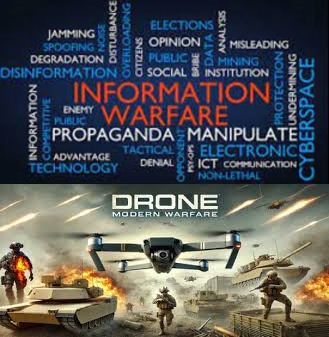
Expressed my views on Drone and  Information Warfare in a Podcast during the “Best Practices Meet 2025” organised by the Data Security Council of India on 21 Aug 25.


  1. Evolution and Transformation of Drone and Information Warfare

Drone Warfare Evolution

  • Transition from Surveillance to Multi-Role Platforms: Drones have evolved from limited reconnaissance tools in the 2000s to versatile platforms capable of precision strikes, logistics delivery, and swarm tactics. This shift has expanded their role in modern conflicts, enabling remote and technology-driven engagements.
  • Miniaturisation and Accessibility: Advances in miniaturisation and cost reduction have made drones accessible to both state and non-state actors, democratising their use in warfare. Commercial off-the-shelf drones are now modified for combat, surveillance, and psychological operations.
  • AI-Driven Autonomy: Integration of artificial intelligence (AI) has enhanced drone autonomy, enabling real-time navigation, target recognition, and reduced operator workload, resulting in faster and more precise engagements.

Information Warfare Evolution

  • Shift to Digital Campaigns: Information warfare has transitioned from traditional propaganda to sophisticated, real-time digital campaigns leveraging social media, bots, and AI-generated content for rapid narrative dissemination and control.
  • Deepfakes and Synthetic Media: The use of deepfakes, AI-generated content, and coordinated bot networks has enabled actors to manipulate public perception, sow discord, and shape narratives with unprecedented speed and scale.
  • Real-Time Global Reach: Platforms like X facilitate instant global information sharing, amplifying narratives beyond traditional media and integrating with kinetic operations to influence perceptions before, during, and after conflicts.

Transformation of Contemporary Conflicts

  • Reduced Need for Ground Forces: Drones enable precise, low-risk operations, reducing reliance on large troop deployments and allowing sustained operations with lower logistical footprints compared to traditional warfare.
  • Psychological and Technological Advantage: Information warfare shapes public opinion and morale, often overshadowing physical battles. Combined with drones, it creates hybrid warfare models where psychological and technological advantages can outweigh conventional military strength.
  • Blurring Civilian-Military Boundaries: The integration of drones and information warfare blurs civilian-military lines, as digital spaces become battlefields and low-cost drone operations enable continuous, decentralised engagements.


  1. Impact of Drones on Military Strategy, Duration, and Intensity

Military Strategy

  • Persistent Surveillance: Drones provide continuous, real-time intelligence, reducing reliance on manned reconnaissance and improving situational awareness for commanders.
  • Precision Strikes: Advanced targeting capabilities minimise collateral damage, enabling operations against high-value targets with reduced risk to personnel.
  • Cost-Effective Attrition: Drones’ affordability allows sustained operations, shifting strategies toward attritional warfare that degrades enemy assets over time.

Duration and Intensity

  • Prolonged Conflicts: Drones lower the threshold for initiating strikes, enabling continuous low-intensity engagements that can extend conflict duration without requiring decisive battles.
  • Intensified Engagements: The rapid operational tempo of drone strikes increases conflict intensity, overwhelming adversaries’ response capabilities and enabling deep strikes into enemy territory.
  • Non-State Actor Proliferation: The availability of drones to insurgents and smaller actors sustains low-level conflicts, as they conduct operations with minimal resources.


  1. Drones in Asymmetric Warfare and Non-State Actors

Asymmetric Warfare

  • Levelling the Playing Field: Drones enable smaller nations and non-state groups to conduct surveillance, harassment attacks, and precision strikes without requiring advanced air forces, challenging the dominance of larger militaries.
  • Guerrilla Tactics: Low-cost drones facilitate guerrilla-style operations, targeting critical infrastructure or personnel of stronger adversaries, as seen with groups like Hamas using modified commercial drones.

Leveraging by Smaller Actors

  • Non-State Actor Capabilities: Groups like ISIS have exploited off-the-shelf drones for reconnaissance and improvised explosive attacks, enhancing their lethality without traditional military assets.
  • State Actor Examples: Smaller nations, such as Ukraine, leverage drones for real-time battlefield intelligence, improving both defensive and offensive operations against larger adversaries.
  • Psychological Impact: Non-state actors use drones for propaganda, recording operations to amplify their psychological impact and project strength.

Impact of Drone Availability

  • Force Multiplication: Widespread access to commercial drones empowers insurgents with low-cost, high-impact capabilities, enabling rapid force multiplication.
  • Challenges to Traditional Dominance: Decentralised, agile drone operations by non-state actors complicate defence strategies for state militaries, requiring new countermeasures.


  1. Countermeasures and Risks of Drone Proliferation

Countermeasures

  • Electronic Warfare: Radio frequency jammers, GPS spoofing, and electronic countermeasures disrupt hostile drone operations by interfering with their navigation and communication systems.
  • Directed-Energy Weapons: Lasers and microwaves neutralise drones by disabling their electronics or physically destroying them.
  • Physical Interceptors: Nets, counter-drone drones, and advanced radar systems detect and intercept small, low-flying drones, enhancing air defence capabilities.

Risks of Drone Proliferation

  • Terrorist Threats: Increased accessibility heightens the risk of terrorist attacks on civilian infrastructure or public events, as drones are repurposed for malicious use.
  • Regulatory Challenges: Unregulated black-market drone trade complicates arms control, enabling adversaries to acquire advanced capabilities.
  • Escalation Risks: Misinterpretation of drone activities, such as surveillance or accidental incursions, can escalate tensions and trigger larger conflicts.

Management Strategies

  • Regulatory Frameworks: Governments enforce strict drone manufacturing, sales, and usage regulations, including mandatory registration and licensing regimes.
  • International Cooperation: Global treaties and norms aim to limit weaponised drone proliferation and establish accountability for misuse.
  • Counter-Drone Technologies: Investments in integrated air defence systems and public awareness campaigns mitigate the risks of drone misuse.


  1. AI Integration and Future Drone Technology

AI Integration

  • Autonomous Operations: AI enables drones to perform autonomous navigation, target recognition, and swarm coordination, reducing human oversight and increasing operational efficiency.
  • Resilience and Adaptation: Machine learning improves drone resilience against countermeasures like jamming and enhances predictive maintenance for mission optimisation.
  • Data-Driven Intelligence: AI-driven analysis of drone feeds provides actionable intelligence, reducing operator workload and accelerating decision-making.

Implications for Future Conflicts

  • Escalation Risks: Autonomous drones with reduced human oversight raise ethical concerns over unintended strikes and could escalate conflicts through rapid, uncoordinated actions.
  • Swarm Tactics: AI-powered drone swarms enable coordinated attacks, overwhelming defences and shifting warfare toward decentralised, networked operations.
  • Cyber Vulnerabilities: AI integration increases drones’ susceptibility to cyberattacks, as adversaries target control systems to disrupt operations.

Future Evolution

  • Hyper-Autonomous Drones: Over the next decade, drones may achieve full autonomy, executing missions independently with advanced AI decision-making.
  • Stealth and Miniaturisation: Improved stealth designs and miniaturised drones will enhance evasion capabilities, particularly for indoor and urban warfare.
  • Space-Based Integration: Integration with space-based assets for targeting and communications will extend drone operations beyond terrestrial limits, redefining strategic paradigms.


  1. Information as a Tool/Weapon in Modern Conflicts

Common Methods

  • Disinformation Campaigns: State and non-state actors spread false narratives via social media, bots, and state-sponsored media to undermine adversaries and shape public perception.
  • Cyberattacks: Targeting communication infrastructure disrupts military coordination and civilian services, as seen in cyberattacks during the Ukraine conflict.
  • Psychological Operations: Tailored propaganda demoralises enemies, rallies domestic support, or manipulates public sentiment to influence conflict outcomes.

Impact of Misinformation/Disinformation

  • Operational Delays: False intelligence, such as fabricated troop movements, confuses decision-makers and delays military responses.
  • Civilian Impact: Misinformation erodes trust in institutions, fuels polarisation, and amplifies fear, complicating conflict resolution and public support.
  • Escalation of Violence: Misinformation-induced panic or retaliatory sentiment can escalate conflicts, as seen in social media-driven unrest.


  1. Role of Social Media and Emerging Technologies

Social Media and Digital Platforms

  • Rapid Narrative Shaping: Platforms like X enable real-time narrative dissemination, with viral posts influencing global perceptions faster than traditional media.
  • Targeted Influence: Governments and groups use targeted ads, influencers, and live-streamed content to amplify narratives, as seen in Israel-Hamas propaganda battles.
  • Grassroots Mobilisation: Digital platforms facilitate international solidarity and rapid information sharing, but also enable manipulation and fake news proliferation.

Emerging Technologies

  • Deepfakes and Synthetic Media: AI-generated content creates convincing false narratives, complicating verification and increasing the impact of disinformation.
  • Blockchain for Verification: Blockchain-based platforms may authenticate information, countering manipulation and restoring trust in digital content.
  • Quantum Computing: Future advancements in quantum computing could enhance encryption and data analysis, strengthening information warfare capabilities.


  1. Challenges and Measures for Information Verification

Challenges

  • Information Overload: The high volume and velocity of digital content overwhelm traditional verification methods, delaying accurate assessments.
  • Sophisticated Falsification: Deepfakes and AI-generated misinformation require advanced detection tools, often unavailable in real-time conflict scenarios.
  • Attribution Difficulties: State-sponsored campaigns obscure sources, making it challenging to identify disinformation origins during fast-moving conflicts.

Countermeasures

  • AI-Driven Fact-Checking: Deploying tools to analyse content authenticity and detect manipulated media in real time enhances verification efforts.
  • Media Literacy Programs: Public education initiatives improve critical thinking and the ability to identify credible sources, reducing the impact of misinformation.
  • International Frameworks: Collaborative information-sharing agreements counter disinformation campaigns and establish norms for digital accountability.

Protecting Information Integrity

  • Secure Communication Channels: Governments invest in encrypted systems to protect military and civilian data from cyberattacks and manipulation.
  • Public-Private Partnerships: Collaboration with tech companies enables real-time monitoring and removal of harmful content on platforms like X.
  • Transparent Reporting: Encouraging credible media to provide transparent, verified reporting rebuilds trust and counters false narratives in conflict zones.


Please Add Value to the write-up with your views on the subject.


1878
Default rating

Please give a thumbs up if you  like The Post?


For regular updates, please register your email here:-

Subscribe


References and credits

To all the online sites and channels.

Pics Courtesy: Internet

Disclaimer:

Information and data included in the blog are for educational & non-commercial purposes only and have been carefully adapted, excerpted, or edited from reliable and accurate sources. All copyrighted material belongs to respective owners and is provided only for wider dissemination.


References:-

  1. Arquilla, J., & Ronfeldt, D. (2001). Networks and netwars: The future of terror, crime, and militancy. RAND Corporation.
  2. Betz, D. J., & Stevens, T. (2019). Cyberspace and the state: Towards a strategy for cyber-power. Routledge.
  3. Boyle, M. J. (2015). The race for drones. Orbis, 59(1), 76-94. https://doi.org/10.1016/j.orbis.2014.11.007
  4. Bunker, R. J. (2020). Non-state threats and future wars. Routledge.
  5. Chamayou, G. (2015). A theory of the drone. The New Press.
  6. Cordesman, A. H. (2020). The evolving role of drones in modern warfare. Centre for Strategic and International Studies.
  7. Cronin, A. K. (2019). Power to the people: How open technological innovation is arming tomorrow’s terrorists. Oxford University Press.
  8. Freedberg, S. J. (2021, October 15). Drone swarms and AI: The future of warfare. Breaking Defence.
  9. Hoffman, F. G. (2018). The convergence of information and kinetic warfare. Joint Force Quarterly, 89, 18-24.
  10. Kallenborn, Z. (2020). Swarming destruction: Drone swarms and the future of warfare. Modern War Institute.

Telley, C. (2022). The drone revolution: How unmanned aerial systems 11. are shaping conflicts. U.S. Army War College.

  1. Ard, A. (2023, March 10). How Ukraine’s drone war is changing the battlefield. Vox. https://www.vox.com/world/2023/3/10/23632906/ukraine-drone-war-russia-military-strategy


English हिंदी