
My Article was Published in the Aug 25 Edition of
“Life of Soldier” journal.
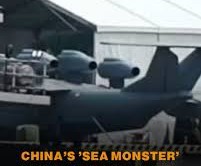
In July 2025, grainy images surfaced on social media, capturing a mysterious maritime behemoth skimming the Bohai Sea off China’s northern coast. The massive four-engine vehicle, dubbed the “Bohai Sea Monster” by intrigued observers, is a wing-in-ground-effect (WIG) craft, a hybrid of aircraft and boat that revives a Cold War-era Soviet concept. It is designed to fly just above the water’s surface, leveraging ground effect for enhanced efficiency, stealth, and speed, potentially outmanoeuvring warships and evading radar.
The Chinese craft features a flying boat hull, military camouflage, and a T-tail with twin vertical stabilisers, indicating a possible amphibious military role. Although China has not officially confirmed the existence of the craft, no official name, designation, or manufacturer has been revealed, leaving uncertainty about whether it is a technology demonstrator or intended for full-scale production. Its development appears to revive Soviet-era technology for modern military use, prompting questions about its role in China’s naval strategy. This advanced prototype showcases China’s growing commitment to leading in cutting-edge maritime technologies.
A Glimpse
The leaked images provide tantalising clues about the Bohai Sea Monster’s design. One photo shows the craft gliding just above the water’s surface, harnessing the ground-effect phenomenon that allows WIG vehicles to “float” on a cushion of compressed air trapped between their wings and the sea. The second image captures it stationary on a pier, revealing a boat-shaped fuselage, a T-tail configuration with two vertical stabilisers, and wingtip sponsons for stability during takeoff and landing. Four jet engines, mounted high above the wings, suggest powerful propulsion, with possible downward-angled nozzles to enhance lift in ground effect. The craft’s sleek, utilitarian design hints at a military focus, prioritising speed and payload over aesthetic considerations.
Estimated to be comparable in size to China’s AG600 amphibious aircraft (wingspan around 38 meters), the Bohai Sea Monster appears built for heavy-duty roles. Its jet propulsion likely enables speeds exceeding 250 knots (460 km/h), far surpassing those of traditional naval vessels. However, this speed comes at a cost as jet engines consume fuel rapidly, potentially limiting endurance compared to turboprop or hybrid-electric alternatives. The craft’s low-altitude flight, typically 3-10 meters above the water, makes it difficult to detect by radar, offering a stealthy profile that could evade conventional maritime defences, such as mines or submarines.
Strategic Implications
China’s development of the Bohai Sea Monster aligns with its broader military modernisation, emphasising asymmetric platforms to project power in contested regions such as the South China Sea and the Taiwan Strait. WIG craft offer unique advantages in littoral environments, where traditional naval ships face threats from anti-ship missiles and submarines. By skimming the surface, the Bohai Sea Monster could rapidly deploy troops, deliver supplies, or conduct maritime patrols, supporting China’s island garrisons in the Spratlys or Paracels.
The Bohai Sea Monster’s low-flying profile and high speed make it a challenging target for air defences, though it remains vulnerable in high-threat combat zones. Rough sea states, such as those in the Taiwan Strait (often exceeding Sea State 3), could also limit its operational window, a challenge faced by earlier Soviet WIG craft, like the Lun-class ekranoplan.
The Bohai Sea Monster could transform naval warfare by providing Beijing with a versatile platform for rapid troop deployment, cargo transport, and strategic surprise. Its potential roles could include:-
-
- Amphibious Operations. Rapid troop transport to seize or reinforce disputed territories, complementing China’s Type 075 amphibious assault ships.
-
- Logistics and Resupply. Delivering critical supplies like fuel, munitions, or medical equipment to remote outposts, reducing reliance on vulnerable sea lanes.
-
- Anti-Submarine Warfare. Equipped with sonar or magnetic anomaly detectors, it could hunt submarines in shallow waters.
-
- Search and Rescue. Adapting civilian applications of the AG600, the WIG craft could support disaster relief or maritime rescue missions.
Global Development of WIG Technology
The Bohai Sea Monster draws inspiration from Soviet ekranoplans, developed during the Cold War to exploit ground-effect flight for military advantage. The USSR’s Lun-class, armed with anti-ship missiles, and the massive Caspian Sea Monster demonstrated the potential of WIG technology. Still, high costs and operational limitations led to their abandonment. China, however, has leveraged its expertise in aerodynamics, hydrodynamics, and composite materials to revive this concept. The craft’s jet engines, possibly derived from military turbojets like the WS-10, indicate a focus on speed over fuel efficiency. Future iterations could explore hybrid-electric propulsion, aligning with global trends in sustainable aviation.
The Bohai Sea Monster is part of a global resurgence in WIG technology. Russia continues to explore ekranoplan designs for Arctic and Black Sea operations, while smaller nations, such as Singapore and South Korea, experiment with civilian WIG ferries. Commercial applications, such as high-speed cargo transport or tourism, could also emerge, leveraging the efficiency of ground-effect flight. However, military applications currently dominate efforts, driven by the need for rapid and stealthy platforms in contested maritime zones.
The United States, through DARPA’s Liberty Lifter program, aims to develop a heavy-lift WIG craft capable of transoceanic transport. With a first flight planned for 2028-2029, the Liberty Lifter targets a payload capacity exceeding 100 tons, dwarfing the Bohai Sea Monster’s estimated capabilities. Designed by companies such as General Atomics and Aurora Flight Sciences, it prioritises turboprop efficiency and rough-sea operability, addressing the limitations of earlier WIG designs.
China’s Project: Prospects and Challenges.
China’s secrecy surrounding the Bohai Sea Monster, lacking an official designation or acknowledgement, fuels speculation. Higher-resolution images or test footage may reveal more about its capabilities, such as payload, range, or armament. For now, it may be a technology demonstrator or an operational prototype. Still, its implications are clear: China is betting on WIG craft to gain a strategic advantage in the Indo-Pacific. The Bohai Sea Monster suggests Beijing is closer to fielding a functional WIG fleet, potentially deploying squadrons by the early 2030s.
Despite its promise, the Bohai Sea Monster faces hurdles. Environmental factors, such as high waves or crosswinds, can restrict operations, requiring advanced stabilisation systems. Maintenance of jet engines in salty maritime conditions presents logistical challenges, while crew training for low-altitude, high-speed flight requires specialised expertise. Integrating WIG craft into China’s naval strategy will also require doctrinal shifts, balancing their niche capabilities against traditional platforms, such as destroyers or aircraft carriers.
Conclusion
The Bohai Sea Monster is more than a curiosity; it’s a bold statement of China’s technological ambition. By reviving WIG technology, Beijing is carving a niche in naval warfare, blending speed, stealth, and versatility to challenge Western dominance. As the U.S. races to counter with its Liberty Lifter, the Indo-Pacific is poised to become a testing ground for these maritime giants. Whether the Bohai Sea Monster evolves into a game-changer or a costly experiment remains to be seen, but its emergence underscores a new era of innovation in military technology.
Please Add Value to the write-up with your views on the subject.
For regular updates, please register your email here:-
References and credits
To all the online sites and channels.
Pics Courtesy: Internet
Disclaimer:
Information and data included in the blog are for educational & non-commercial purposes only and have been carefully adapted, excerpted, or edited from reliable and accurate sources. All copyrighted material belongs to respective owners and is provided only for wider dissemination.
References:-
- Axe, David. “China’s ‘Bohai Sea Monster’ Wing-in-Ground-Effect Craft Spotted in Tests.” The National Interest, July 2025.
- South China Morning Post. “Mystery ‘Bohai Monster’ Wing-In-Ground Effect Craft Spotted in China’s Bohai Sea.” SCMP, July 2025.
- Sutton, H. I. “New Chinese WIG Craft Spotted – ‘Bohai Monster’ May Be a Military Ekranoplan.” Naval News, July 2025.
- Fisher, Richard D., Jr. “China’s Wing-in-Ground-Effect Craft: A New Dimension in Maritime Power Projection.” Jamestown Foundation China Brief, Vol. 25, No. 14, August 2025.
- Gady, Franz-Stefan. “The Return of the Ekranoplan? China’s WIG Craft and Regional Security.” The Diplomat, July 2025.
- Hall, David W., and E. Eugene Larrabee. Ground Effect Machines: Design and Applications. Reston, VA: American Institute of Aeronautics and Astronautics, 2000.
- Holmes, James R. “China’s Maritime Strategy and the Role of Amphibious Platforms.” Naval War College Review, Vol. 77, No. 3, Summer 2024.
- Office of Naval Intelligence. “China’s People’s Liberation Army Navy: 2025 Modernisation Outlook.” Washington, DC: U.S. Department of the Navy, 2025.
- Rozhdestvensky, Kirill V. “Wing-in-Ground Effect Vehicles: Modern Developments and Applications.” Progress in Aerospace Sciences, Vol. 42, No. 3, 2006, pp. 211–283.
- Sutton, H. I. “China’s Mystery WIG Craft: The Bohai Sea Monster Unveiled.” Covert Shores, July 2025.
- U.S. Defence Advanced Research Projects Agency (DARPA). “Liberty Lifter Program: Technical Overview and Progress Report.” DARPA.mil, March 2025.
- Xinhua News Agency. “AVIC AG600 Amphibious Aircraft Receives Civilian Certification.” April 15, 2025.