
My Article was published in the “Life of Soldier” Journal, Aug 25.
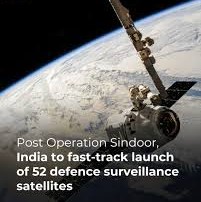
In the wake of Operation Sindoor, conducted from May 7 to 10, 2025, India has launched an ambitious mission to enhance its space-based defence capabilities. The operation, a retaliatory strike against terror camps in Pakistan following the devastating Pahalgam attack on April 22, 2025, underscored the critical need for “deep” and “persistent” surveillance over adversarial territories. This necessity has prompted India to accelerate the deployment of 52 dedicated defence satellites under the Space-Based Surveillance (SBS) Phase-3 programme, which was approved in October 2024 with a budget of Rs 26,968 crore. Coupled with the finalisation of a comprehensive military space doctrine, India is poised to transform its strategic surveillance and defence framework, reducing reliance on foreign assets.
The Catalyst: Operation Sindoor
Operation Sindoor was a pivotal moment in India’s defence strategy, highlighting both the strengths and limitations of its current surveillance capabilities. The operation targeted terror infrastructure in Pakistan-occupied territories, relying on satellite imagery from foreign providers. While these assets provided critical intelligence, the operation exposed India’s dependence on external sources for real-time, high-resolution imagery. This dependency posed risks, including delayed access to data and potential vulnerabilities in data security, especially during high-stakes military engagements.
The Pahalgam attack, which killed 29 people, including civilians and security personnel, revealed gaps in India’s ability to monitor cross-border activities with the granularity and persistence required for pre-emptive or retaliatory actions. The subsequent success of Operation Sindoor, while a tactical victory, emphasised the need for an indigenous, robust, and self-reliant space-based surveillance system. The operation’s reliance on foreign satellites underscored the urgency to develop a dedicated constellation capable of providing continuous, high-resolution coverage of strategic areas, including Pakistan, China, and the Indian Ocean Region (IOR).
The Space-Based Surveillance (SBS) Phase-3 Programme
The Indian government had approved the SBS Phase-3 programme in October 2024, allocating Rs 26,968 crore to deploy 52 defence satellites. This ambitious initiative, led by the Indian Space Research Organisation (ISRO) in collaboration with private industry, aims to establish a comprehensive space-based intelligence, surveillance, and reconnaissance (ISR) network by 2029. The programme is structured to leverage both public and private sector expertise, with ISRO tasked with launching 21 satellites and three private companies deploying the remaining 31. Key Features of the Programme are as follows:-
Satellite Constellation. The 52 satellites will operate in a mix of low Earth orbit (LEO) and geostationary orbit (GEO). LEO satellites, positioned at altitudes between 500 and 900 km, will provide high-resolution imagery (up to 0.3 meters), ideal for detailed monitoring of military installations, troop movements, and infrastructure. GEO satellites, stationed at 36,000 km, will provide continuous wide-area coverage, which is critical for tracking maritime activities in the IOR and monitoring large-scale developments along India’s borders.
Technological Capabilities. The satellites will be equipped with advanced synthetic aperture radar (SAR) and electro-optical sensors, enabling all-weather, day-and-night imaging. SAR systems are exceptionally vital for penetrating cloud cover and monitoring during adverse weather conditions, a frequent challenge in regions like the Himalayas. The constellation will also incorporate secure communication links to ensure real-time data transmission to ground stations and military command centers.
Public-Private Partnership. The involvement of private companies marks a significant shift in India’s space strategy. Companies like Tata Advanced Systems, Larsen & Toubro, and startups such as Pixxel and Skyroot Aerospace are expected to contribute to satellite manufacturing and launch services. This collaboration aims to accelerate deployment, reduce costs, and foster innovation in India’s burgeoning private space sector.
Timeline and Deployment. The first satellite launch is scheduled for April 2026, with the entire constellation expected to be operational by 2029. The phased rollout will prioritise coverage of high-threat areas, including the Line of Actual Control (LAC) with China and the Line of Control (LoC) with Pakistan, before expanding to broader regional surveillance.
Strategic Imperatives
The SBS Phase-3 programme is driven by India’s need to counter growing regional security challenges. China’s expansive space program, with over 1,000 satellites, including advanced ISR and anti-satellite (ASAT) capabilities, poses a significant threat. Beijing’s ability to disrupt or destroy satellites, demonstrated by its 2007 ASAT test, underscores the need for India to develop resilient and redundant space assets. The People’s Liberation Army (PLA) has integrated space-based ISR into its military doctrine, enabling precise targeting and real-time battlefield awareness, as seen in its activities along the LAC.
Pakistan, while less advanced in space technology, relies on Chinese support for its satellite capabilities, including the Pakistan Remote Sensing Satellite (PRSS-1). The growing China-Pakistan nexus necessitates enhanced surveillance to monitor joint military exercises, infrastructure development (e.g., the China-Pakistan Economic Corridor), and potential terror activities emanating from Pakistani territory.
The IOR, a critical maritime domain, is another focus area. With China’s increasing naval presence and the strategic importance of chokepoints like the Malacca Strait, India requires persistent surveillance to safeguard its maritime interests and counter piracy, smuggling, and hostile naval operations.
Complementary Initiatives: HAPS and Beyond
In addition to the satellite programme, the Indian Air Force (IAF) is pursuing three high-altitude platform systems (HAPS) aircraft to complement space-based ISR. These solar-powered, unmanned platforms, operating at altitudes of 18-20 km, can remain airborne for weeks, providing persistent surveillance over specific areas. HAPS aircraft are particularly suited for monitoring border regions and can serve as a cost-effective alternative to satellites for localised ISR missions.
The IAF is also exploring the integration of artificial intelligence (AI) and machine learning (ML) to process vast amounts of satellite data. AI-driven analytics can identify patterns, detect anomalies, and provide actionable intelligence in real time, enhancing India’s ability to respond to threats swiftly.
Challenges and Opportunities
While the SBS Phase-3 programme and the military space doctrine represent a significant leap forward, challenges remain. The ambitious timeline requires seamless coordination between ISRO, private companies, and the military, which could face delays due to technical complexities or funding constraints. The private sector’s relative inexperience in defence-grade satellite manufacturing may also pose risks to quality and reliability.
Moreover, the global space environment is increasingly contested, with space debris and ASAT threats complicating satellite operations. India must invest in space situational awareness (SSA) capabilities to monitor and mitigate these risks. International norms on space militarisation, which are still in their infancy, could also impact India’s plans, necessitating diplomatic efforts to safeguard its interests.
On the opportunity front, the programme positions India as a significant space power, fostering technological innovation and economic growth through the private space sector. The public-private partnership model could serve as a blueprint for future defence projects, reducing costs and enhancing efficiency. Additionally, the doctrine’s focus on international cooperation opens avenues for technology transfers and strategic alliances, strengthening India’s geopolitical standing.
Conclusion
Operation Sindoor served as a wake-up call for India, highlighting the indispensable role of space-based surveillance in modern warfare. The SBS Phase-3 programme, with its 52 dedicated defence satellites, and the forthcoming military space doctrine mark a transformative step toward self-reliance and strategic dominance in the space domain. By addressing regional threats, leveraging public-private partnerships, and integrating advanced technologies like HAPS and AI, India is poised to secure its borders, maritime interests, and national security.
Please Add Value to the write-up with your views on the subject.
For regular updates, please register your email here:-
References and credits
To all the online sites and channels.
Pics Courtesy: Internet
Disclaimer:
Information and data included in the blog are for educational & non-commercial purposes only and have been carefully adapted, excerpted, or edited from reliable and accurate sources. All copyrighted material belongs to respective owners and is provided only for wider dissemination.
References:-
- Times of India (ToI). (2025). “India to Fast-Track 52 Defence Satellites After Operation Sindoor.”
- Indian Space Research Organisation (ISRO). (2024). “Space-Based Surveillance Phase-3 Programme Overview
- Ministry of Defence, Government of India. (2024). “Approval of Rs 26,968 Crore for Defence Satellite Programme.” Press Release, October 2024.
- Defence Space Agency (DSA). (2019). “Mission Shakti and India’s Anti-Satellite Capabilities.” Government of India.
- Jane’s Defence Weekly. (2025). “India’s High-Altitude Platform System (HAPS) Acquisition for ISR Missions.”
- Stockholm International Peace Research Institute (SIPRI). (2024). “China’s Space Programme and Anti-Satellite Capabilities.” SIPRI Yearbook 2024.
- Observer Research Foundation (ORF). (2025). “India’s Military Space Doctrine: A Strategic Roadmap.”
- The Hindu. (2025). “Operation Sindoor: India’s Response to Pahalgam Attack.” May 12, 2025.
- SpaceNews. (2024). “India’s Private Space Sector: Emerging Players in Defence Satellite Manufacturing.”
- Center for Strategic and International Studies (CSIS). (2024). “Space Situational Awareness and the Contested Space Environment.”