
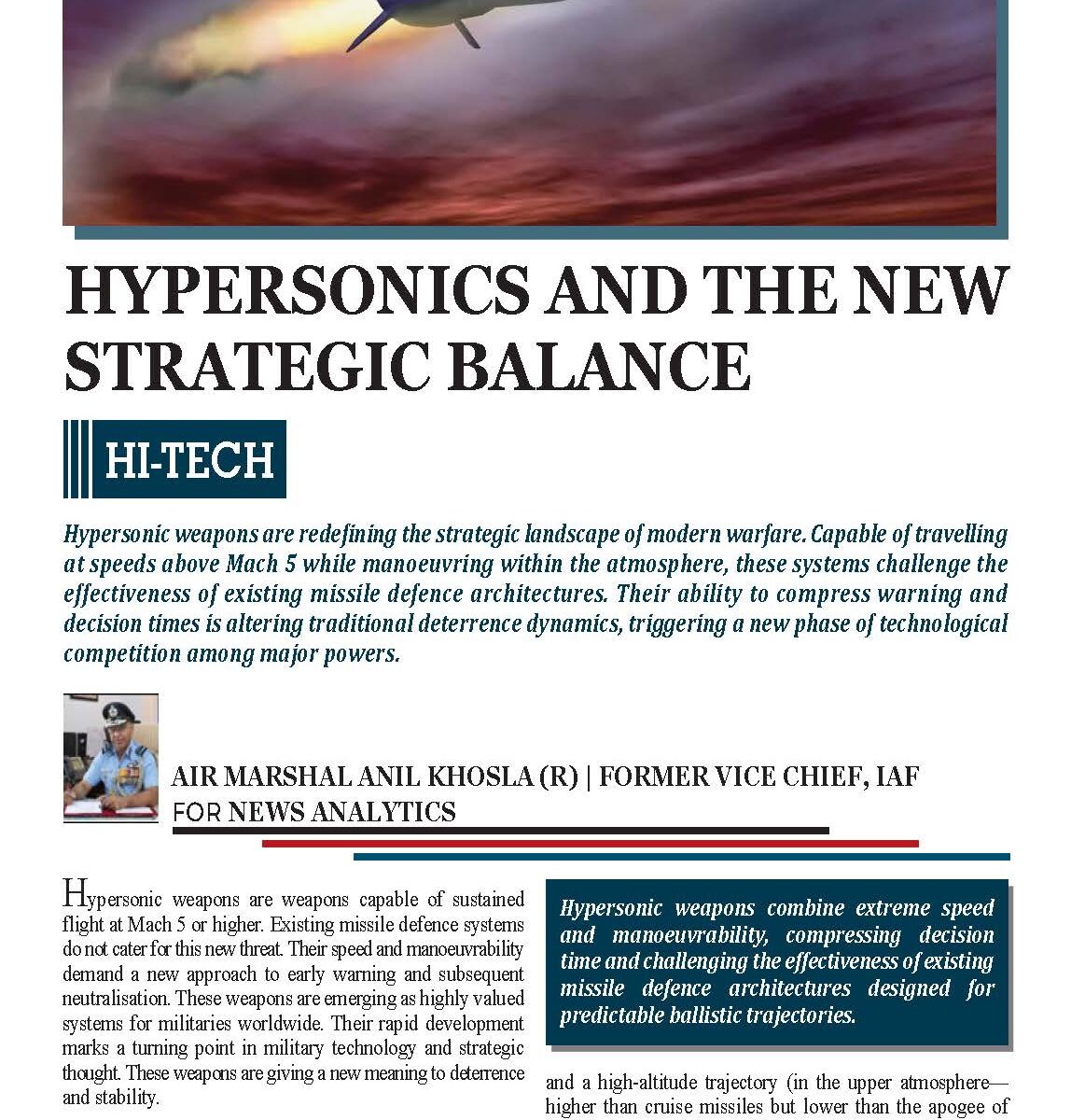
797: HYPERSONIC WEAPONS AND MISSILE DEFENCE 2.0:  NEW STRATEGIC CALCULUS


Paper published in the April 2026 edition of “The News Analytics” Journal


Hypersonic weapons are weapons capable of sustained flight at Mach 5 or higher. Existing missile defence systems do not cater for this new threat. Their speed and manoeuvrability demand a new approach to early warning and subsequent neutralisation. These weapons are emerging as highly valued systems for militaries worldwide.  Their rapid development marks a turning point in military technology and strategic thought. These weapons are giving a new meaning to deterrence and stability.

Hypersonic Weapons. Intercontinental Ballistic Missiles (ICBMs) can also reach hypersonic speeds. However, they travel through space in a predictable parabolic arc.  Their trajectory becomes predictable, and long-range radars can track them. On the other hand, the characteristics of hypersonic weapons include sustained high speed, increased manoeuvrability, and a high-altitude trajectory (in the upper atmosphere – higher than cruise missiles but lower than the apogee of ballistic missiles). These attributes of hypersonic weapons are blurring the line between ballistic and cruise missiles. Hypersonic weapons are classified into two categories: hypersonic glide vehicles (HGVs) and hypersonic cruise missiles (HCMs). HGVs are carried and launched from ballistic missiles. Post-separation, they glide through the upper atmosphere at extreme speeds following a controllable trajectory. HCMs sustain hypersonic flight within the atmosphere using advanced scramjet engines. Hypersonic weapons can alter their trajectory. This adds to the complexity of detecting, tracking, and intercepting them. High speed also compresses decision-making time. It shortens the window for assessing the threat and making a decision on counteraction.

Speed and Manoeuvrability: A Strategic Game-Changer. Hypersonic missiles are commonly depicted as a “game changer and the unprecedented capabilities of these weapons portend a revolution in missile warfare. It is considered that the speed, accuracy, and manoeuvrability of hypersonic boost-glide weapons will fundamentally change the character of warfare. Developments in hypersonic propulsion will revolutionise warfare by enabling faster strikes. With unmatched speed, these weapons will likely hit over-the-horizon targets in a fraction of the time. This claimed speed advantage is ostensibly accompanied by near-immunity to detection, rendering hypersonic weapons “nearly invisible” to existing early warning systems. Together, these capabilities will significantly compress decision and response times.


Missile Defence 2.0: Adapting to the Hypersonic Age

Missile Defence in the Pre-Hypersonic Era. Existing defences are primarily designed to counter ballistic missiles. They rely on layered architectures that include early-warning launch detection, long-range radar-based trajectory tracking, and interception. The destruction could occur during the boost, midcourse, or terminal phases.  These systems operate on the logic of predictability. However, these systems are not optimised for low-flying targets that manoeuvre frequently and have little warning time.

Hypersonic Threat Mitigation. A comprehensive missile defence strategy is required to provide an integrated and practical capability to counter ballistic, cruise, and hypersonic missile threats. The speed of hypersonic weapons leaves little time to compute a fire-control solution, communicate with command authorities, and complete an engagement to intercept them actively. Anti-Hypersonic defence would require a combination of disruptive data links and sensors, space-based tracking sensors, and innovative interception methods. Some passive defensive measures against traditional missiles are also effective against hypersonic weapons; these include deception, dispersal, hardening, concealment, etc.

Missile Defence 2.0. To counter hypersonic threats, defence developers are exploring what might be called Missile Defence 2.0. This concept emphasises integration, speed, and adaptability. One key area is sensor networks. Future defences rely on constellations of space-based infrared and tracking satellites that can track hypersonic weapons throughout their flight. Methods of interception also need to evolve. Instead of relying solely on kinetic weapons, multiple new interceptors may be required to neutralise the threat. Artificial intelligence would be essential for data fusion from multiple sensors. Another element of Missile Defence 2.0 is layered resilience rather than perfect protection, recognising that no defence will be impenetrable.

Hypersonic Race

The United States, China, and Russia are competing to develop these weapons. They would be fielding a wide array of hypersonic systems in the coming decades. The development of short-, medium-, and long-range variants of these weapons by major powers is resulting in an arms race. These technologies are changing the nature of warfare, and they have the potential to destabilise the global security environment.

USA. The U.S. has pursued both hypersonic weapons technologies since the early 2000s. It has sought to develop longer-range systems capable of reaching deep into an adversary’s territory to attack defended, hardened, and time-urgent targets. The Department of Defence (DOD) is developing hypersonic weapons under the Navy’s Conventional Prompt Strike program and through several Air Force, Army, and DARPA programs.

Russia. Russia is reportedly the first nation to deploy a hypersonic missile. It characterises these weapons as a centrepiece of its security strategy and has extensively tested at least three distinct hypersonic systems. Russia’s HGV, known as Avangard, is equipped with a nuclear warhead and deployed on SS-19 long-range land-based ballistic missiles. Avangards reportedly feature onboard countermeasures and can manoeuvre in flight to evade ballistic missile defences. Russia has successfully fielded the Zircon and Kinzhal hypersonic weapons, and it has launched the air-launched Kinzhal hypersonic missiles (with a speed of Mach 10 and a payload of 480kg) against Ukraine.

China. China has made a significant effort to match Russian and U.S. capabilities. It has invested heavily in the hypersonic research, development, test, and evaluation programs in the past decade. China is also investing heavily in hypersonic development infrastructure and weapon systems, reportedly outpacing the United States in testing these technologies. China has developed an HGV known as the DF-ZF, previously referred to as the WU-14. China is also developing the DF-41 long-range intercontinental ballistic missile, which could carry a nuclear hypersonic glide vehicle.

India. India has been investing in hypersonic weapon development. In Sep 2020, India successfully tested the Hypersonic Technology Demonstrator Vehicle (HSTDV). HSTDV is a hypersonic unmanned scramjet demonstration aircraft. In addition to the HSTDV program, India is continuing its research and development efforts across various aspects of hypersonic technology (propulsion systems, materials science, and guidance systems). In July 2025, India reportedly conducted a successful test of a hypersonic cruise missile capable of reaching Mach 8 under Project Vishnu. Reportedly, the project aims to develop the Extended Trajectory-Long Duration Hypersonic Cruise Missile (ET-LDHCM), a weapon system that will fundamentally enhance India’s strategic capabilities.

Great Power Competition and Technological Asymmetry. The development of hypersonic weapons has the potential to create a new form of asymmetry. In technologically advanced states, having these weapons gives them an edge in overcoming opponents’ defences. On the other hand, smaller or less tech-savvy states find it difficult to keep up. This creates a growing divide between the “haves” and the “have-nots.” This asymmetry is reshaping the strategic calculus. Major powers may become aggressive, while weaker states may double down on asymmetric strategies such as cyber operations or unconventional warfare.

Implications for Deterrence Stability. The most concerning aspect of hypersonics is their impact on deterrence stability. During the Cold War, stability was based on the philosophy of “Mutually Assured Destruction”.  However, now with reduced reaction time, the risk of miscalculation has increased dramatically. The shift is taking place from ‘Launch on Warning’ to ‘Launch on Uncertainty’. States may get tempted to launch their own weapons at the first sign of a perceived threat. This “crisis instability” is compounded by Strategic Ambiguity: most hypersonic vehicles can carry either a conventional or nuclear payload, leaving an adversary to guess the stakes of an incoming strike.


Conclusion

Technology is a good gadget, but a destructive weapon. Hypersonic weapons signify a significant advancement in military technology. These weapons are even more powerful than traditional ballistic ones because of their incredible speed and agility. Many countries are actively working on developing and testing them. At the same time, Missile Defence 2.0 is evolving to counter this new threat. It includes advanced sensors, smarter interceptors, and a robust architecture to provide better protection.  The proliferation of hypersonic weapons could have significant implications for the global security landscape. Their speed and manoeuvrability could reduce decision-making time in crises, increasing the risk of miscalculation. The development of hypersonic weapons is also starting a new arms race, as countries seek to maintain or gain military superiority in this field.


Please Add Value to the write-up with your views on the subject.


1878
Default rating

Please give a thumbs up if you  like The Post?


For regular updates, please register your email here:-

Subscribe


References and credits

To all the online sites and channels.

Pics Courtesy: Internet

Disclaimer:

Information and data included in the blog are for educational & non-commercial purposes only and have been carefully adapted, excerpted, or edited from reliable and accurate sources. All copyrighted material belongs to respective owners and is provided only for wider dissemination.


References:-

  1. “Hypersonic missiles: What are they and can they be stopped?”, Partyard Defence, May 10, 2019. https://partyardmilitary.com/hypersonic-missiles-what-are-they-and-can-they-be-stopped/
  1. “Hypersonic Technology”, Drishti IAS, 10 Oct 21. https://www.drishtiias.com/daily-updates/daily-news-analysis/hypersonic-technology-2
  1. “Russia, China, the U.S.: Who Will Win the Hypersonic Arms”, IEEE Spectrum, Dec 2020. https://spectrum.ieee.org/russia-china-the-us-who-will-win-the-hypersonic-arms-race
  1. Air Marshal Anil Khosla, “Hypersonic Long Range Weapons”, Air Marshals’ Perspective, 10 Nov 2021. https://55nda.com/blogs/anil-khosla/2021/11/10/hypersonic-long-range-weapons/
  1. Air Marshal Anil Khosla, “Countering Hypersonic Weapon Threat: A Difficult But Manageable Problem”, Air Marshals’ Perspective, 07 Jun 2024. https://55nda.com/blogs/anil-khosla/2024/06/07/countering-hypersonic-weapon-threat-a-difficult-but-manageable-problem/
  1. Tom Karako and Masao Dahlgren, “Complex Air Defence Countering the Hypersonic Missile Threat”, A Report of the Centre for Strategic and International Studies (CSIS) Missile Defence Project, February 2022.
  1. Rylie White, “An Emerging Threat: The Impact of Hypersonic Weapons on National Security, Crisis Instability, and Deterrence Strategy”, Potomac Institute for Policy Studies.
  1. David Roza, “Why Hypersonic Missiles’ Greatest Strength Also Makes Them Vulnerable”, Air and Space Forces Magazine, Dec 2023.
  1. Col Mandeep Singh, “Countering Hypersonics”, Indian Defence Review, Jan 2024.
  1. Economic Times. (2025, July 16). Why India’s new hypersonic missile may outrun Israel’s Iron Dome and Russia’s S-500 and shift the balance in Asia.
  1. Aroor, Shiv. “India’s Hypersonic Missile Ambitions: DRDO’s Project Vishnu and the Road Ahead.” India Today.
730: BATTLEFIELD BEYOND BOUNDARIES: MILITARY CONFLICTS AND INDUSTRY


Presented my views at the Best Practices Meet 2025, organised by Data Security Council of India on 21 Aug 25.


The concept of “battlefield beyond boundaries” encapsulates the evolution of modern warfare, where conflicts transcend traditional geographic and physical limits, intertwining with industries that develop, supply, and profit from advanced technologies. This convergence blurs the lines between military and civilian spheres, raising critical questions about economics, security, ethics, and global governance. Modern battlefields extend across land, sea, air, cyberspace, and outer space, driven by technological advancements and the increasing integration of commercial industries into military operations.


  1. The Expanding Nature of Military Conflicts

Modern warfare has evolved beyond traditional battlefields, incorporating multiple domains and strategies that challenge conventional doctrines.

  • Multi-Domain Warfare: Conflicts are no longer confined to land, sea, and air. Cyberspace and outer space have become critical battlegrounds, with operations involving satellites, cyberattacks, and digital infrastructure. For instance, the Russia-Ukraine conflict highlights the use of commercial satellites like Starlink for real-time communication and coordination.
  • Hybrid Warfare: This approach combines conventional military forces with non-kinetic elements such as cyberattacks, disinformation campaigns, economic sanctions, and energy weaponisation. These tactics influence global public opinion and blur the lines between combatants and civilians.
  • Asymmetric Warfare: The rise of non-state actors and unconventional tactics, such as the use of commercial off-the-shelf (COTS) drones for reconnaissance and attacks, demonstrates the adaptability and affordability of modern tools in conflicts, as seen in Ukraine.
  • Globalisation of Conflict: Military engagements impact global supply chains, financial systems, and trade, with long-range weapons like hypersonic missiles and drones enabling strikes far from traditional frontlines, making civilian areas vulnerable.


  1. Impact of Emerging Technologies

Technological advancements are reshaping the battlefield, enhancing capabilities while introducing new challenges.

  • Artificial Intelligence (AI): AI revolutionises military operations by enabling faster decision-making, predictive analytics, and autonomous systems. It enhances surveillance, logistics, and battlefield awareness by analysing vast datasets from sensors, satellites, and civilian devices.
  • Robotics and Autonomous Systems (RAS): Unmanned vehicles (UAVs, UUVs, UGVs) and robotic systems reduce human risk in hazardous environments, improve logistics, and provide real-time intelligence. Military robotics is projected to reach a market size of $21.2 billion by 2032.
  • Cybersecurity: With increased reliance on networked systems, protecting critical defence infrastructure from cyberattacks is paramount. Technologies like blockchain and private 5G networks ensure secure, real-time coordination across sprawling battlefield networks.
  • Space-Based Technologies: Satellites provide critical intelligence, precision targeting, and communication capabilities. Companies like SpaceX play a pivotal role by supplying infrastructure like Starlink, which has proven vital in modern conflicts.
  • Hypersonic Weapons: These high-speed, manoeuvrable missiles challenge existing defence systems, potentially destabilising traditional deterrence mechanisms.
  • Additive Manufacturing (3D Printing): Enables rapid production of complex components, reducing reliance on traditional supply chains and addressing wartime shortages, such as artillery shells in the Russia-Ukraine conflict.
  • Directed Energy Weapons (DEWs): Lasers and high-power microwaves offer defence against high-speed threats but face challenges related to power requirements and atmospheric conditions.
  • Electrification and Sustainability: The defence industry is shifting toward electric and hydrogen-powered systems and eco-friendly materials to lower costs and meet regulatory demands, balancing military innovation with sustainability goals.


  1. Transformation of the Defence Industry

The global defence sector is undergoing significant changes, driven by technological advancements, economic factors, and geopolitical dynamics.

  • Military-Industrial Complex (MIC): The MIC, encompassing defence contractors like Lockheed Martin, BAE Systems, and Raytheon, drives innovation and production. This relationship influences economic policies, technological development, and societal structures.
  • Commercial Technology Integration: Companies traditionally associated with civilian sectors, such as SpaceX and Silicon Valley tech firms, are increasingly vital to military applications, providing solutions like satellites, AI, and cybersecurity.
  • Increased R&D Investment: Nations are investing heavily in research and development to maintain technological superiority, with the global defence equipment market projected to grow from $517.2 billion in 2023 to $762.1 billion by 2032.
  • Globalised Defence Markets and Supply Chains: International collaboration, foreign direct investment, and interconnected supply chains are increasing, though conflicts expose vulnerabilities, such as semiconductor shortages and reliance on critical resources like rare earth minerals.
  • Rapid Procurement and Indigenous Innovation: Active conflicts, like the 2025 India-Pakistan confrontation, accelerate defence spending and local production, as seen in policies like “Make in India,” which aim to boost self-reliance.
  • Dual-Use Technology: Military R&D, such as GPS and drones, benefits civilian sectors but also risks militarising civilian infrastructure, making it a target in conflicts.


  1. Industry as a Battlefield

Industries are not just enablers of warfare but have become battlegrounds themselves, targeted and leveraged in geopolitical conflicts.

  • Cyberwarfare: Tech companies are frontline defenders against nation-state hackers targeting critical infrastructure, such as data centres and telecom networks.
  • Supply Chain Warfare: Semiconductor shortages and sanctions highlight how industries are weaponised, with control over resources like rare earth minerals, oil, and gas becoming strategic priorities.
  • War Economies: Conflicts generate industries of private security, cyber defence, reconstruction, and resource extraction, but economies tied to war may find peace less profitable.


  1. Ethical and Policy Considerations

The integration of advanced technologies and industries into warfare raises significant ethical and legal challenges.

  • Lethal Autonomous Weapons (LAWs): The development of fully autonomous weapons raises concerns about accountability and the role of humans in targeting decisions, complicating compliance with international humanitarian law (IHL).
  • Civilian Infrastructure as Targets: The use of civilian technologies in military operations risks designating them as legitimate targets, raising humanitarian concerns and questions about the scope of cyber warfare.
  • Maintaining Strategic Stability: Emerging technologies like hypersonics and AI-driven weapons could destabilise deterrence mechanisms, increasing the risk of miscalculation and escalation.
  • Global Governance and Arms Control: The rapid pace of technological change necessitates international cooperation to address regulatory gaps in existing frameworks, like the Geneva Conventions, and promote responsible development of new military technologies.
  • Profit vs. Peace: The profitability of conflict-driven industries raises ethical questions about whether corporations should benefit from wars that cause humanitarian crises.
  • Privatisation of War: The rise of private military companies blurs accountability for violence, challenging traditional notions of state-controlled warfare.


  1. Global and Societal Impacts

The interplay of military conflicts and industry has far-reaching consequences for economies, societies, and global power dynamics.

  • Economic Ramifications: Conflicts disrupt global supply chains, food security, and economies, while industries adapt to meet wartime demands or mitigate losses. For nations like India, heightened conflict drives job creation but exposes vulnerabilities in supply chains and technology.
  • Technological Spillover: Wartime innovations, such as radar from WWII, often lead to civilian applications, driving broader industrial and societal advancements.
  • Geopolitical Shifts: The race for technological supremacy in AI, autonomous systems, and space militarisation influences global power dynamics, with nations like China and the U.S. competing for dominance.
  • Sustainability vs. Security: Defence industries face pressure to balance military innovation with climate goals, integrating eco-friendly technologies while maintaining operational effectiveness.


Conclusion

The “battlefield beyond boundaries” reflects a paradigm where military conflicts are no longer confined to physical spaces but extend into digital, economic, and societal domains, deeply intertwined with industrial advancements. The integration of commercial technologies, the rise of autonomous systems, and the globalisation of defence markets challenge traditional warfare doctrines, requiring new strategies, ethical frameworks, and international regulations. As battlefields expand to encompass industries, economies, and technologies, understanding this interdependence is essential to navigating the complex ethical, economic, and political challenges of modern warfare. The future of conflict will be defined not only by armies and strategies but by the global industries that design, supply, and sustain the mechanisms of war.


Please Add Value to the write-up with your views on the subject.


1878
Default rating

Please give a thumbs up if you  like The Post?


For regular updates, please register your email here:-

Subscribe


References and credits

To all the online sites and channels.

Pics Courtesy: Internet

Disclaimer:

Information and data included in the blog are for educational & non-commercial purposes only and have been carefully adapted, excerpted, or edited from reliable and accurate sources. All copyrighted material belongs to respective owners and is provided only for wider dissemination.


References:-


  1. Singer, P. W. (2009). *Wired for War: The Robotics Revolution and Conflict in the 21st Century*. Penguin Books.
  2. Kaldor, M. (2012). *New and Old Wars: Organised Violence in a Global Era* (3rd ed.). Stanford University Press.
  3. Grey, C. S. (2015). *The Future of Strategy*. Polity Press.
  4. Latiff, R. H. (2017). *Future War: Preparing for the New Global Battlefield*. Knopf.
  5. Bitzinger, R. A. (2021). “The Global Defence Industry in the 21st Century: Trends and Transformations.” *Journal of Strategic Studies*, 44(3), 321–345.
  6. Gilli, A., & Gilli, M. (2019). “The Diffusion of Drone Warfare? Industrial, Organisational, and Infrastructural Constraints.” *Security Studies*, 28(4), 661–696.
  7. Horowitz, M. C. (2018). “Artificial Intelligence, International Competition, and the Balance of Power.” *Texas National Security Review*, 1(3), 36–57.
  8. Lin, J., & Singer, P. W. (2022). “The Cyber Battlefield: How Nation-States and Non-State Actors Are Redefining Warfare.” *Foreign Affairs*, 101(2), 88–97.
  9. Raska, M. (2020). “The Sixth RMA Wave: Disruption in Military Affairs?” *Journal of Strategic Studies*, 43(6), 834–860.
  10. International Institute for Strategic Studies (IISS). (2023). *The Military Balance 2023*. IISS.
  11. RAND Corporation. (2021). *The Future of Warfare in 2030: Projecting Conflict in a Highly Networked World*. RAND Corporation.
  12. Stockholm International Peace Research Institute (SIPRI). (2024). *SIPRI Yearbook 2024: Armaments, Disarmament, and International Security*. Oxford University Press.
  13. NATO Science and Technology Organisation. (2022). *Emerging and Disruptive Technologies: Implications for NATO Defence Planning*. NATO.
  14. United Nations Institute for Disarmament Research (UNIDIR). (2023). *The Weaponisation of Emerging Technologies: Ethical and Legal Challenges*. UNIDIR.


728: AERIAL WAR: THE SHIFT FROM PILOTS TO PLATFORMS TO WEAPONS


Article published on the IIRF Website on 23 Aug 25.


The history of aerial warfare is a reflection of the larger story of technology and war.


The history of aerial warfare tells a compelling story of innovation, change, and the relentless pursuit of control in the skies. Over just over a century, air combat has undergone significant changes. The focus has shifted from skilled pilots to modern technological systems, and it is now moving toward autonomy and weapon-centred warfare. This transformation is not merely machines replacing humans. It shows how technology improves on an ongoing basis, redefining the very principles of conflict and control in war. This process can be broken down into three broad periods: the Pilot Era, the Platform Era, and the soon-to-be Weapon Era. Each era signifies a profound step forward, both in terms of capability and in the way military forces conceive of power projection, air supremacy, and deterrence in an increasingly complicated and technologically oriented battlefield.


The Pilot-Centric Era: A Human-Centric Approach to Airpower

From the earliest days of aerial combat in World War I to the Cold War period, the human pilot was the central factor in air warfare. Initial aircraft were simple in design, and success was highly dependent on the skill, valour, and tactical acumen of the pilot. Aircraft were designed to complement the pilot’s eyes, experience, and manoeuvrability. The entry into the jet era further raised the reliance on human performance, valour, and high-stress decision-making.

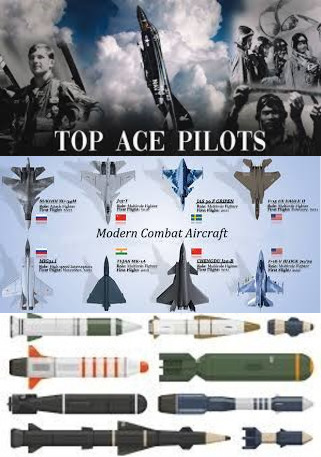
The Dogfighter’s Domain. The early 20th century celebrated the’ ace’ pilot, with prominent figures such as Manfred von Richthofen (commonly known as the Red Baron), Eddie Rickenbacker, and subsequently Chuck Yeager becoming emblematic of aerial prowess. The individual pilot was regarded not merely as a combatant but also as an embodiment of national strength and heroism. Aeroplanes like the P-51 Mustang, Spitfire, and MiG-21 were the embodiments of the era’s technology—designed to be fast, agile, and combat manoeuvrable. In the Vietnam War, American pilots carried out operations in which dogfighting was still important, and air kills were seen as personal and national accomplishments.

Tactical excellence with regard to technology. During this period, technology development focused on extending the capabilities of pilots instead of replacing them. Navigation systems, radar, and early missiles lengthened the pilots’ field of operation while maintaining control over the kill chain in their hands. Situational awareness, spatial awareness, and swift decision-making were key drivers of mission success.


The Platform Era: From Aces to Systems

The end of the Cold War signalled the beginning of the Platform Era, where aircraft system complexity and integration became more focal than pilot skill. Aircraft then transitioned to become multirole platforms that can perform a range of missions with little pilot input except to manage the systems.

Jet Age and Missiles (1950s–1980s). The introduction of jet planes like the F-86 Sabre and the MiG-15, together with guided missile technology, represents a watershed moment in combat dynamics. Air-to-air missile systems like the AIM-9 Sidewinder and the radar-guided AIM-7 Sparrow extended beyond visual recognition engagement ranges, thus reducing the requirement for close dogfighting. The Korean War typified jet warfare, while the Vietnam War emphasised the importance of sophisticated avionics and missile technology.

System-of-Systems Concept. Planes like the F-117 Nighthawk and F-22 Raptor led the development of stealth technology, making platforms harder to detect. Sophisticated avionics, radar systems, and sensor fusion (e.g., in the F-35) have allowed platforms to analyse vast amounts of data, thus expanding situational awareness. The onset of network-centric warfare is illustrated by such platforms as the E-3 AWACS and F/A-22, which exchange information via links like Link 16 in order to enable networked operations. Fifth-generation fighter aircraft, such as the F-22 Raptor and F-35 Lightning II, are the pinnacle of this platform-oriented way of thinking. These aircraft operate not just as pilots’ tools but as sensor-shooter fusion nodes in a larger, networked kill web. Manned with stealth, sensor fusion, and electronic warfare systems, they can collect intelligence, jam the enemy system, and drop precision-guided munitions—while sharing data with other platforms. The pilot’s role has shifted from warfighter to system operator, responsible for managing inputs from sensors, data links, and mission systems. Multirole and survivability.

These are defining features in modern-day military platforms. Contemporary systems place a premium on stealth, range, and payload rather than manoeuvrability. The ability to stay undetected and attack at a distance became the top priority, overtaking the long-standing value placed on dogfighting acumen. The F-35, for instance, is designed to fulfil various roles, such as strike, intelligence, surveillance, and reconnaissance (ISR) and air-to-air combat, all combined within one platform. Current survivability strategies focus primarily on avoiding engagement rather than excelling in combat. Strategic Implications. This shift changed the manner in which air forces planned their operations. Rather than sending out formations of aircraft, a limited number of high-value platforms could conduct sophisticated missions, thus minimising exposure. Nevertheless, these platforms came at a high cost—financial, logistical, and strategic. The high cost and risk of losing a $100 million-plus aircraft led air commanders to seek alternative options.


The Weapons Era: Precision, Autonomy, and Platform Agnosticism

We are now coming into the Weapons Era, which is marked by a re-emphasis on the weapon system itself. Whether launched from a manned aircraft, an unmanned drone, a ship at sea, or even in space, it is the precision-guided, often autonomous weapon that carries strategic weight.

Rise of Unmanned Systems. The mass production of drones—like the MQ-1 Predator, MQ-9 Reaper, Bayraktar TB2, and more recent stealthier and higher-speed systems like the XQ-58 Valkyrie—has revolutionised the aerial warfare landscape. These platforms can stay on station for hours, target with accuracy, and attack without endangering a human pilot. Uncrewed platforms are less expensive, more expendable, and more interchangeable. Military forces are currently developing swarms of drones capable of overwhelming defences, filling up the skies, and acting as decoys, scouts, or kinetic attackers. Artificial Intelligence and Autonomous Kill Chains.

Artificial Intelligence. The use of artificial intelligence is revolutionising the operational capacities of contemporary weapons. AI systems have the ability to select and prioritise targets, fly autonomously in GPS-deprived areas, optimise flight patterns to reduce the risk of detection, and conduct strikes independently, under particular doctrines. As examples, loitering munitions, also known as “kamikaze drones,” like the Israeli Harop or Switchblade from the U.S., can loiter above target areas, perform target search, and conduct strikes with minimal human involvement. Beyond-Visual-Range (BVR) Missiles. BVRs, including the AIM-120 AMRAAM, and hypersonic missiles, such as the AGM-183, move the focus towards weapon system range and precision. Heavy platforms like the B-21 Raider, which are designed to be stealthy and heavy-laden, place magazine capacity above manoeuvrability, as BVR combat reduces the need for close manoeuvring. Directed Energy Weapons (DEWs) are future technologies that allow for near-instant strikes, thus diminishing the dependence on close manoeuvring.

Hypersonics and Stand-off Weapons. During the Weapon Era, combat usually takes place a significant distance behind the frontline. Hypersonic glide vehicles (such as Russia’s Avangard, China’s DF-ZF) and long-range cruise missiles have the ability to destroy targets thousands of miles away in a few minutes. Missiles like the AGM-158 JASSM, LRASM, and air-launched hypersonics render the need for platforms to enter enemy airspace pointless. The role of the platform is minimised to that of a delivery vehicle only—its function diminished to that of an enabler. Platform Agnosticism. Perhaps the defining feature of this era is that the delivery platform matters less than the effectiveness of the weapon. Precision munitions can be launched from a variety of platforms, including fighters, drones, submarines, ships, and satellites. This diversification increases strategic flexibility. A naval destroyer or ground-based launcher may be just as lethal as an aircraft, especially when combined with AI-enhanced targeting data.

The Future of Human-Machine Teaming. Autonomous air systems will be the main focus in future conflicts, with human intervention or control restricted to decisive moments. The aim is to enhance lethality, survivability, and rate of operations while reducing threats to human life. With the Weapon Era ongoing, the probable future most likely involves hybrid operations that integrate manned platforms, autonomous systems, and smart weapons into coordinated battle networks.

Loyal Wingman Projects. Projects like the US Collaborative Combat Aircraft (CCA) and Australia’s Ghost Bat project envision uncrewed drones flying with manned fighters. These “loyal wingmen” carry weapons, sensors, or electronic warfare payloads, thus extending manned platform operational reach and survivability.

Swarming Strategies and Edge AI. AI and edge computing allow autonomous drones to have local decision-making capacity and move within coordinated swarms, thus ensuring autonomous operation. The tactics are likely to disrupt traditional air defence systems and can potentially revolutionise battlefield dynamics.

Integration into Multi-Domain Operations. The future air warfare will be a core element of multi-domain operations (MDO), smoothly interweaving the space, cyber, land, sea, and air domains. The AI-powered weapons will not be standalone entities, but as part of an integrated battlefield responding in real-time.

Directed Energy Weapons (DEWs). Comprising lasers and microwaves, these technologies are expected to greatly cut engagement times, hence decreasing the need for traditional dogfighting manoeuvres. These systems have the ability to disrupt enemy electronics or to destroy targets in an instant, thus reorienting strategic focus toward air and space forces. In addition, large platforms intended for Payload deployment — e.g., bomber-sized aircraft like the B-21 Raider — will prioritise stealth, longer range of operations, and payload capacity over manoeuvrability, hosting a large payload of long-range missiles or drones.


Conclusion

The shift from human pilots to platforms and then to weapons is a move away from dependence on man to dependence on machine. Pilots used to be the deciding factor in air warfare; today, planes and UAVs are the focal points. In the present day, weapons, particularly autonomous drones and guided missiles, are becoming increasingly important. The change improves efficiency in operations and minimises risks to humans, but also raises strategic and ethical issues. With the development of artificial intelligence and directed energy weapons, there is a potential to blur the distinction between platforms and weapons, and autonomous platforms can effectively revolutionise the character of warfare. The art of air power is evolving. The next chapter won’t be listed in the annals of great pilots or quantified simply by the number of aircraft. Rather, it will be measured in terabytes of information, milliseconds of reaction time, and the smooth blending of human and artificial intelligence that functions in an ever-more technology-influenced world.

Please Add Value to the write-up with your views on the subject.


1878
Default rating

Please give a thumbs up if you  like The Post?


For regular updates, please register your email here:-

Subscribe


References and credits

To all the online sites and channels.

Pics Courtesy: Internet

Disclaimer:

Information and data included in the blog are for educational & non-commercial purposes only and have been carefully adapted, excerpted, or edited from reliable and accurate sources. All copyrighted material belongs to respective owners and is provided only for wider dissemination.


References:

  1. Air Force Historical Research Agency. (n.d.). World War I aerial combat tactics.
  1. Boyne, W. J. (2003). The influence of air power upon history. Pelican Publishing.
  2. Center for a New American Security (CNAS). (2021). The Role of AI in the Future of Air Warfare.
  3. Clark, B., Gunzinger, M., & Walton, T. (2020). Winning the High-End Fight: The Role of Unmanned Aircraft. Center for Strategic and Budgetary Assessments (CSBA).
  1. Clark, R. M. (2014). Uninhabited combat aerial vehicles: Airpower by the people, for the people, but not with the people. Air University Press.
  1. Corum, J. S., & Johnson, W. R. (2003). Airpower in small wars: Fighting insurgents and terrorists. University Press of Kansas.
  2. Deptula, D. A. (2021). From Fighter Pilot to Command and Control: The Changing Face of Air Warfare. Mitchell Institute for Aerospace Studies.
  3. Freedberg, S. J. (2019, June 18). Mosaic Warfare: DARPA’s Vision of the Future Fight. Breaking Defence.
  4. Freedman, L. (2019). The future of war: A history. PublicAffairs.
  1. Gunzinger, M., & Finerty, C. (2018). Directed-Energy Weapons Are Coming: And They’re Going to Change War. War on the Rocks.
  2. Hallion, R. P. (1997). Strike from the sky: The history of battlefield air attack, 1911–1945. Smithsonian Institution Press.
  1. Kainikara, S. (2015). The Evolution of Air Power. Air Power Development Centre.
  2. Krepinevich, A. F. (2009). 7 Deadly Scenarios: A Military Futurist Explores War in the 21st Century. Bantam Books.
  1. RAND Corporation. (2021). The future of air superiority: Assessing the role of fifth-generation fighters and unmanned systems.
  1. Sayler, K. M. (2021). Emerging Military Technologies: Background and Issues for Congress. Congressional Research Service.
  2. Scharre, P. (2018). Army of None: Autonomous Weapons and the Future of War. W. W. Norton & Company.
  1. Singer, P. W. (2009). Wired for War: The Robotics Revolution and Conflict in the 21st Century. Penguin Books.
  1. U.S. Department of Defence. (2022). Unmanned Aircraft Systems Roadmap: 2022–2040.
  1. Weinberger, S. (2016). The Pentagon’s Brave New World of AI-Powered Warfare. Nature, 538, 160–163.
  1. Work, R., & Brimley, S. (2014). 20YY: Preparing for War in the Robotic Age. Center for a New American Security (CNAS).
English हिंदी