
By Air Marshal Anil Khosla
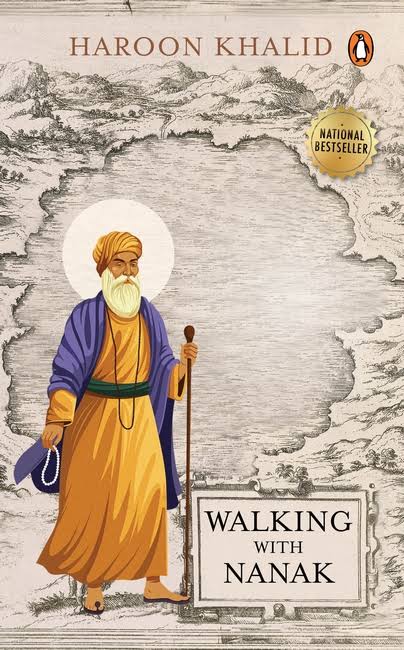
Haroon Khalid’s Walking with Nanak is an unusual blend of travelogue, history, biography, folklore, and historical fiction. First published in 2016, it follows Khalid as he retraces places associated with Guru Nanak in present-day Pakistan, accompanied by his mentor Iqbal Qaiser. Its central achievement is presenting Nanak not only as a saint, but also as a son, husband, father, poet, traveller, philosopher, and friend.
Khalid, a Lahore-based anthropologist and journalist known for his work on Pakistan’s vanishing minority heritage, was drawn back to Nanak after encountering the Baburbani verses and realising how much of the Guru’s life unfolded on Pakistani soil. The author travels across Pakistan, visiting gurdwaras, shrines and other places associated with Nanak’s life. These locations include spaces of pilgrimage, abandonment and contested memory. The journey is therefore geographical only on the surface; more deeply, it explores how history survives or disappears in landscapes transformed by Partition, nationalism and religious majoritarianism.
The book’s most distinctive feature is its blending of fact, oral history, travel writing and fiction. Khalid deliberately fictionalises parts of Guru Nanak’s journey with Bhai Mardana, his Muslim companion and rubab player. He has described this as a conscious effort to understand “Nanak the man.”
Khalid’s approach is particularly effective because he does not try to reduce Nanak to a collection of miracles. Instead, he draws upon Nanak’s poetry, the Janamsakhis, oral traditions and the physical remains of his travels. The result is a portrait of a thinker whose spiritual message emerged through engagement with society rather than withdrawal from it.
This method is both the book’s strength and its principal vulnerability. Fiction allows Khalid to imagine Nanak’s conversations, doubts, relationships and responses to the world around him. It makes the historical figure accessible and emotionally immediate. At the same time, readers must remain conscious that the reconstructed scenes are interpretive rather than verifiable biography.
A particularly strong feature is Khalid’s attention to Punjab’s syncretic religious culture. Stories of Hindus visiting Muslim shrines, Muslims preserving memories of Sikh sites, and interactions between different religious traditions allow him to present Nanak within the broader cultural world of medieval Punjab, rather than treating Sikhism as something that appeared in isolation. The book therefore becomes as much a meditation on the history of the Punjab as it is a biography of Nanak.
The book’s slight weakness is its structure. The narrative moves between Nanak’s time, Khalid’s contemporary journey, and the history of the later Sikh Gurus. Some readers may find these shifts illuminating; others may find them cumbersome.
Khalid writes with patience, curiosity and empathy. His anthropological background helps him look beyond formal doctrine toward lived religion, local memory and the political uses of heritage. He is also attentive to the meaning of Sikh sites within a Muslim-majority Pakistan. This aspect is often neglected in purely architectural or devotional accounts.
The book is especially valuable for readers interested in Sikh history, Pakistan’s neglected heritage, Partition memory and South Asian religious pluralism. It demonstrates how travel writing can recover historical meaning from abandoned sites and how poetry can sometimes reveal a historical personality more vividly than conventional biography.
Khalid’s book is thoughtful, courageous and culturally significant. Its occasional structural looseness and reliance on imaginative reconstruction prevent it from being a fully authoritative historical study, but these same qualities give it warmth and accessibility. Walking with Nanak ultimately invites readers to move beyond inherited boundaries (between faiths, nations, history, and memory) and encounter Guru Nanak as a human being whose message remains relevant in an age of sharpened identities.
Please Add Value to the write-up with your views on the subject.
For regular updates, please register your email here:-
References and credits
To all the online sites and channels.
Pics Courtesy: Internet
Disclaimer:
The information and data in this blog are for educational & non-commercial purposes only and have been carefully adapted, excerpted, or edited from reliable, accurate sources. All copyrighted material belongs to the respective owners and is provided only for wider dissemination.