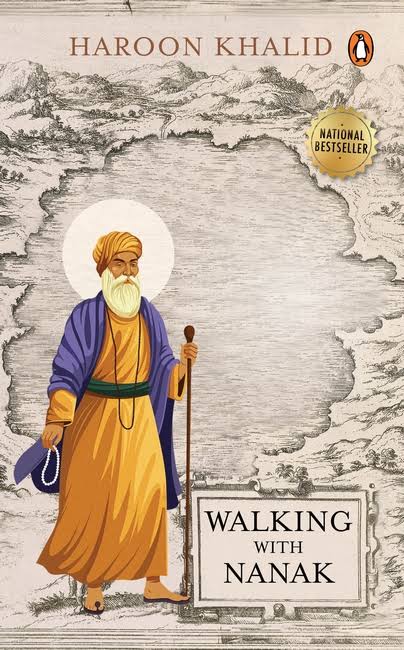
Haroon Khalid’s Walking with Nanak is an unusual blend of travelogue, history, biography, folklore, and historical fiction. First published in 2016, it follows Khalid as he retraces places associated with Guru Nanak in present-day Pakistan, accompanied by his mentor Iqbal Qaiser. Its central achievement is presenting Nanak not only as a saint, but also as a son, husband, father, poet, traveller, philosopher, and friend.
Khalid, a Lahore-based anthropologist and journalist known for his work on Pakistan’s vanishing minority heritage, was drawn back to Nanak after encountering the Baburbani verses and realising how much of the Guru’s life unfolded on Pakistani soil. The author travels across Pakistan, visiting gurdwaras, shrines and other places associated with Nanak’s life. These locations include spaces of pilgrimage, abandonment and contested memory. The journey is therefore geographical only on the surface; more deeply, it explores how history survives or disappears in landscapes transformed by Partition, nationalism and religious majoritarianism.
The book’s most distinctive feature is its blending of fact, oral history, travel writing and fiction. Khalid deliberately fictionalises parts of Guru Nanak’s journey with Bhai Mardana, his Muslim companion and rubab player. He has described this as a conscious effort to understand “Nanak the man.”
Khalid’s approach is particularly effective because he does not try to reduce Nanak to a collection of miracles. Instead, he draws upon Nanak’s poetry, the Janamsakhis, oral traditions and the physical remains of his travels. The result is a portrait of a thinker whose spiritual message emerged through engagement with society rather than withdrawal from it.
This method is both the book’s strength and its principal vulnerability. Fiction allows Khalid to imagine Nanak’s conversations, doubts, relationships and responses to the world around him. It makes the historical figure accessible and emotionally immediate. At the same time, readers must remain conscious that the reconstructed scenes are interpretive rather than verifiable biography.
A particularly strong feature is Khalid’s attention to Punjab’s syncretic religious culture. Stories of Hindus visiting Muslim shrines, Muslims preserving memories of Sikh sites, and interactions between different religious traditions allow him to present Nanak within the broader cultural world of medieval Punjab, rather than treating Sikhism as something that appeared in isolation. The book therefore becomes as much a meditation on the history of the Punjab as it is a biography of Nanak.
The book’s slight weakness is its structure. The narrative moves between Nanak’s time, Khalid’s contemporary journey, and the history of the later Sikh Gurus. Some readers may find these shifts illuminating; others may find them cumbersome.
Khalid writes with patience, curiosity and empathy. His anthropological background helps him look beyond formal doctrine toward lived religion, local memory and the political uses of heritage. He is also attentive to the meaning of Sikh sites within a Muslim-majority Pakistan. This aspect is often neglected in purely architectural or devotional accounts.
The book is especially valuable for readers interested in Sikh history, Pakistan’s neglected heritage, Partition memory and South Asian religious pluralism. It demonstrates how travel writing can recover historical meaning from abandoned sites and how poetry can sometimes reveal a historical personality more vividly than conventional biography.
Khalid’s book is thoughtful, courageous and culturally significant. Its occasional structural looseness and reliance on imaginative reconstruction prevent it from being a fully authoritative historical study, but these same qualities give it warmth and accessibility. Walking with Nanak ultimately invites readers to move beyond inherited boundaries (between faiths, nations, history, and memory) and encounter Guru Nanak as a human being whose message remains relevant in an age of sharpened identities.
Please Add Value to the write-up with your views on the subject.
For regular updates, please register your email here:-
The information and data in this blog are for educational & non-commercial purposes only and have been carefully adapted, excerpted, or edited from reliable, accurate sources. All copyrighted material belongs to the respective owners and is provided only for wider dissemination.
Career Trek: Your Professional Buddy by Coach Ram is a practical, engaging book that helps readers navigate the challenges of professional life. It is built around a mentor–mentee dynamic and addresses real-world challenges in today’s volatile, uncertain, complex, and ambiguous workplace. Rather than reading like a textbook, it functions as an engaging, reflective coaching session designed to help early- and mid-career professionals navigate forks in their career path with intent and clarity. It addresses concerns such as stagnation, toxic organisational cultures, office politics, unclear career progression, personal branding and the anxiety associated with mid-career transitions.
Coach Ram (Ramakrishna Rao) is a senior human-resources professional, leadership-development specialist and International Coaching Federation-certified coach with more than two decades of experience in coaching, talent management and organisational transformation. His work particularly focuses on mid-career professionals and CXOs seeking clarity, growth and fulfilment.
One of the book’s strongest features is its relatable, conversational style. Coach Ram makes careers easier to understand by connecting them to situations professionals commonly experience. The book explores important themes such as self-awareness, defining success, networking, personal branding, decision-making, continuous learning and dealing with career uncertainty.
One of its most useful ideas is the “Bullseye versus Compass” model. The bullseye represents a specific career target (a particular designation, organisation, salary level or role). The compass, in contrast, represents direction: whether a person is learning, growing, exploring and moving towards a meaningful professional life. The idea is particularly relevant to mid-career professionals. At the beginning of a career, the next step may appear relatively clear. With increasing seniority, however, the path becomes less certain. A functional specialist may have to choose between becoming a generalist, entering consulting, developing a portfolio career, becoming an entrepreneur or continuing in a corporate role with a different definition of impact.
Coach Ram identifies symptoms such as a slowing pace of growth, uncertainty about future roles and anxiety about professional relevance. These concerns can be intensified by organisational pyramids, shrinking opportunities at senior levels and the fear that one’s skills may become replaceable.
Career Trek also addresses the need for professionals to communicate their value. In a crowded and highly visible professional environment, competence alone may not be sufficient. Personal branding, networking and the ability to showcase one’s impact have become important elements of career management. The book presents these not as exercises in self-promotion, but as ways of making one’s contribution visible and understandable.
An equally significant theme is the changing meaning of career success. Early in professional life, individuals may prioritise salary, designation, organisational reputation and rapid advancement. Later, the emphasis may shift towards learning, fulfilment, meaningful contribution and legacy. Coach Ram’s observations suggest that career priorities evolve with age and experience rather than remaining fixed throughout one’s working life.
The book does not encourage impulsive resignation or dramatic reinvention. Instead, it emphasises reflection, skill mapping and the development of a broader professional identity. Professionals are encouraged to examine not only the jobs they have held but also the situations they have handled, the problems they have solved and the capabilities they can offer in different contexts.
The book’s mentor–mentee format makes it accessible, although readers who prefer highly structured career manuals may find the conversational approach less systematic. Some ideas are familiar from other career-development literature, but presenting them through realistic questions and mentoring conversations gives them a practical edge.
Career Trek’s greatest strength is its accessibility. Its ideas come from coaching conversations and practical workplace experience, making the book relatable to students, young professionals, managers, and executives. The dialogue-based presentation also makes the subject less formal and more approachable.
Career Trek is a thoughtful and timely guide for anyone who feels uncertain about the direction of their professional life. Its central message is that a career need not follow a predetermined straight line. Progress can also mean acquiring a new skill, exploring an adjacent role, discovering a different form of contribution or developing the confidence to make an informed transition.
The book will be especially useful for professionals facing stagnation, mid-career anxiety or uncertainty about their next chapter. It encourages readers to replace passive career management with curiosity, self-awareness and deliberate experimentation.
Ultimately, Career Trek reinforces the idea that a career is not simply a destination but a journey, one that requires self-awareness, learning, relationships, adaptability and deliberate choices.
Please Add Value to the write-up with your views on the subject.
For regular updates, please register your email here:-
Information and data included in the blog are for educational & non-commercial purposes only and have been carefully adapted, excerpted, or edited from reliable and accurate sources. All copyrighted material belongs to the respective owners and is provided only for wider dissemination.
Review by: Air Marshal Anil Khosla (Retd) PVSM, AVSM, VM
Former Vice Chief of Air Staff, Indian Air Force.
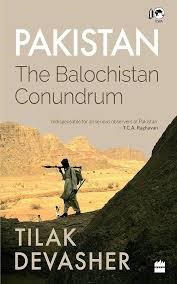
Pakistan: The Balochistan Conundrum by Tilak Devasher is a comprehensive, meticulously researched examination of one of Pakistan’s most complex and troubled regions. As a former Indian civil servant with years of experience analysing Pakistan’s internal and external affairs, Devasher offers a deep dive into Balochistan’s conflicts’ historical, political, and socioeconomic underpinnings. He presents a multidimensional narrative that explores the impact of colonial history, resource distribution, ethnic and cultural tensions, and geopolitical influences on Balochistan’s struggle for autonomy within Pakistan.
At the heart of the book lies the question: what makes Balochistan so difficult to integrate fully into Pakistan? Devasher’s analysis identifies factors that have driven Balochistan’s longstanding conflicts and challenges. The province’s vast resources, geostrategic location, and distinct ethnic identity make it both a prized possession and a perpetual problem for Pakistan’s federal government. Devasher sheds light on the complex relationship between the Pakistani state and Balochistan, often marked by mistrust, resentment, and recurring conflict. His work argues that Islamabad’s policies toward the province have remained largely focused on control rather than integration, a stance that has left Balochistan in perpetual marginalisation.
Devasher begins by tracing the origins of Balochistan’s discontent back to the time of British colonial rule. As the British expanded their influence in the region, they established an essentially exploitative relationship with Balochistan, incorporating the region into their empire while suppressing local political structures. This legacy of exploitation and suppression left the Baloch people with an enduring distrust of centralised rule, a sentiment that has only deepened under Pakistan’s federal government.
Post-independence, Pakistan adopted a similar approach to Balochistan, perceiving it as a remote, resource-rich frontier rather than an integrated part of the country. According to Devasher, the forced accession of the princely state of Kalat in 1948 laid the foundation for the ongoing resistance movements in Balochistan. The book provides a detailed account of the four main insurgencies that have taken place in Balochistan since Pakistan’s creation, underscoring how each conflict has only worsened the province’s resentment towards Islamabad. Devasher’s narration explains how Pakistan’s failure to address the region’s core issues—economic deprivation, lack of political representation, and cultural autonomy—has kept the fires of rebellion alive for decades.
Balochistan is Pakistan’s largest but least developed province, and Devasher strongly argues that the province’s socioeconomic plight is at the core of its grievances. Despite being rich in natural gas, coal, copper, and gold, most of Balochistan’s population remains impoverished and lacks access to primary education, healthcare, and infrastructure. The exploitation of these resources has been another source of discontent, as Islamabad reaps the economic benefits while Balochistan’s people continue to live in poverty. Devasher’s work highlights the deep disparities in resource distribution, pointing out that most of the profits generated from the province’s resources go to the central government rather than the local population. This economic exclusion only deepened feelings of alienation among the Baloch people. The book also addresses the question of royalties, noting that the revenues from natural gas production, for instance, rarely benefit the people of Balochistan themselves. In Devasher’s view, the Pakistani government’s policies of resource extraction without compensation or reinvestment are an example of economic colonialism that has further alienated the Baloch populace.
Devasher’s critique extends to Pakistan’s heavy reliance on military intervention to maintain control over Balochistan. Since the inception of Pakistan, the government has treated the Baloch independence movement as a national security issue rather than a political or economic one. This approach, according to Devasher, has resulted in widespread human rights abuses, including forced disappearances, extrajudicial killings, and a heavy military presence that has stifled civil life in the province. He brings forth testimonies and documented evidence from various sources to illustrate the brutality of Pakistan’s military tactics, highlighting how these methods have only fuelled further resistance among the Baloch people.
Devasher’s exploration of human rights issues is one of the book’s most powerful sections. He discusses the “missing persons” issue in depth, referring to the thousands of Baloch activists, students, and political leaders who have allegedly been abducted or killed by state security forces. This has led to what Devasher describes as a pervasive atmosphere of fear and oppression. He further explores the militarisation of Balochistan, showing how these repressive policies have created a sense of siege among ordinary Baloch citizens. By treating Balochistan as a security problem, Devasher argues that the Pakistani government has undermined its efforts to integrate the province, instead fostering an atmosphere of anger and resentment that has only served to strengthen separatist sentiments.
Another crucial element of Devasher’s analysis is Balochistan’s geopolitical significance, particularly its role in Pakistan’s relationships with Afghanistan, India, and China. Devasher notes that Balochistan’s location—bordering Iran and Afghanistan and close to the Persian Gulf—makes it a strategic asset for Pakistan. However, this same strategic significance has drawn external interest, especially from India and Afghanistan, which Pakistan accuses of supporting Baloch insurgents.
The book also covers China’s involvement in Balochistan through the China-Pakistan Economic Corridor (CPEC), a major infrastructural initiative that runs through the province. Devasher describes how the CPEC project while promising to bring development, has generated concerns among the Baloch over increased military presence, displacement, and lack of economic benefits for the local population. Devasher argues that while the CPEC may bring some development, it has also intensified fears that foreign powers exploit Balochistan’s resources without fair compensation to the local population. The geostrategic context adds further complexity to the Balochistan conundrum, as external involvement in the region creates additional pressure on Pakistan’s federal government.
In addition to political and economic issues, Devasher dedicates part of his analysis to the cultural and ethnic identity of the Baloch people. He discusses how the Pakistani state has attempted to impose a uniform national identity, one that prioritises Islam and disregards the distinct cultural heritage of the Baloch people. This attempt to assimilate Balochistan into a homogenised national identity has only heightened the Baloch people’s desire to preserve their distinct cultural and ethnic identity, adding to their resistance to centralisation.
Devasher argues that Pakistan’s policies have overlooked the Baloch people’s historical sense of autonomy and pride in their cultural identity. This aspect of Baloch identity is intertwined with their demand for greater independence and self-determination. Devasher presents an in-depth look at how cultural suppression has become a symbol of the broader political and economic neglect that the Baloch people face, arguing that this cultural dimension is a crucial yet often overlooked factor in understanding Balochistan’s resistance.
Pakistan: The Balochistan Conundrum is a profoundly insightful and compelling account of Balochistan’s struggle within Pakistan. Devasher combines historical perspective, human rights concerns, and geopolitical analysis to deliver a balanced and thorough examination of the region’s conflicts. His findings paint a sobering picture: unless Pakistan addresses the root causes of Balochistan’s grievances, its policies may continue to fuel instability and insurgency.
Devasher’s work ultimately suggests that the road to peace and integration lies not in military domination but in addressing the legitimate demands of the Baloch people, particularly in terms of economic inclusion, political representation, and respect for cultural identity. This book is a must-read for scholars, policymakers, and anyone interested in South Asian geopolitics, as it offers a clear-eyed look at a region that is both critical to Pakistan’s stability and emblematic of its internal struggles.
Your valuable comments are most welcome.
For regular updates, please register your email here:-
Information and data included in the blog are for educational & non-commercial purposes only and have been carefully adapted, excerpted, or edited from reliable and accurate sources. All copyrighted material belongs to respective owners and is provided only for wider dissemination.