
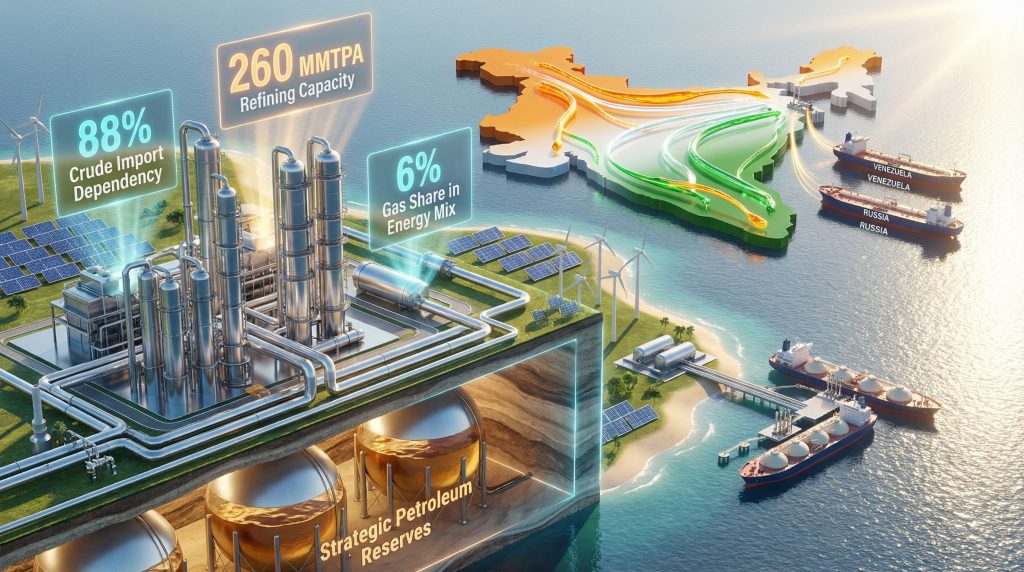
Iran declared the closure of the Strait of Hormuz on 2 March.
Brent crude surged from $70–72 to over $100 per barrel, touching $119 day trading. Over 1.6 million tonnes of crude, 320,000 tonnes of LPG, and 200,000 tonnes of LNG were stranded at sea.
This proved to be a test for India’s energy security. India invoked the Essential Commodities Act.
Statistical Picture: –
-
- Over 90% of India’s trade by volume and 85% of its crude oil imports are transported by sea.
- 80–85% of India’s crude imports pass through the Strait of Hormuz.
- The oil flow through the Strait of Hormuz averaged 20 million barrels per day in 2024.
- In 2024, India imported 27.79 million tonnes of LNG, primarily from Qatar and the UAE (both entirely dependent on the Strait of Hormuz for transit).
- Unlike crude, LNG cannot be rerouted. An LNG supply disruption simultaneously hits power generation, fertiliser manufacturing, and industrial supply chains.
- Rerouting through the Cape of Good Hope adds 5,600 km, 10–15 days, and 15–20% to fuel costs.
- A 10% rise in crude prices alone increases domestic inflation by approximately 20 basis points.
India’s energy security requires a holistic review (alternative sources, alternative supply routes, enhanced storage capacity, accelerated transition to alternative energy, and a serious push for indigenous capacity).
Energy Security Mitigation Dynamics
India’s energy strategy faces three competing pressures:-
-
- India’s domestic energy requirement is for 1.4 billion people.
- Constant pressure from the US to reduce imports of Russian crude.
- No alternative to Russian volumes at a comparable cost.
India’s official position: “Ensuring the energy security of 1.4 billion Indians is the ultimate priority. Diversifying energy sourcing is in keeping with objective market conditions and evolving international dynamics.”
This formula is precisely right. It achieves the desired policy outcome, i.e., diversification without accepting foreign dictation over Indian procurement, thereby preserving strategic autonomy.
Supplier Diversification
Over two decades, India has expanded its supplier base (from 27 to over 40 countries). However, supply from West Asia (Iraq, Saudi Arabia, Kuwait, UAE) continues to dominate, with imports from these countries accounting for over two-thirds of imports.
Russia moved from 1% in 2017 to a peak of 36% in 2024. This was driven by the availability of Urals crude at a lower price, post-sanctions. By January 2026, Russia’s share contracted to 21.2
The optimal suggested portfolio (around four clusters): –
-
- West Asia (Iraq, Saudi Arabia, UAE). The rational primary source by volume. 40–45% supply offers cost efficiency, geographic proximity, and established infrastructure.
-
- Russia. Retain Russian supply at a meaningful share of 15–20%. This will preserve price advantage and ensure availability.
-
- Western Hemisphere (US, Brazil, Guyana, Mexico). It should constitute 15–20%. It would offer insulation from sanctions.
-
- Africa (Nigeria, Angola, Mozambique, Senegal). Supply from these should be 10–15%. They are not affected by the closure of the Strait of Hormuz and the current sanctions regimes.
The discipline across all clusters: no single source should exceed 25–30% of total imports.
Shipping Capacity.
In the present crisis, Iran is selectively permitting ships to pass based on their flag. Indian-flagged vessels were advantageous, whereas foreign-flagged tankers carrying Indian cargo had no such benefit.
Shipping Corporation of India operates approximately. 70 vessels. India imports over 5 million barrels per day. The mismatch is stark.
A National Tanker Fleet Expansion Programme is needed, targeting at least 150 India-flagged crude carriers by 2035.
A pipeline is another alternative, but it is vulnerable to enemy attacks during hostilities.
Transit Security
The safety of maritime assets in transit has become a necessity.
Operation Sankalp is a security operation launched by the Indian Navy in June 2019 to ensure the safe passage of Indian-flagged merchant vessels through the Gulf region (Strait of Hormuz, Gulf of Oman, and Gulf of Aden). It has evolved from monitoring into active escort and deterrence. Indian naval destroyers, along with surveillance aircraft and helicopters, now accompany commercial vessels.
Suggested solutions to enhance security: –
-
- Bilateral maritime escort protocols with GCC states and major Asian economies (that share chokepoint vulnerabilities).
- Establish an intelligence-sharing architecture.
- Lakshadweep Islands developed into an Arabian Sea monitoring and rapid-response hub — the western equivalent of what Andaman and Nicobar provide in the east.
Storage
-
- India’s Strategic Petroleum Reserves (SPR) are 5.33 million tonnes of storage capacity (Visakhapatnam, Mangaluru, and Padur).
- Current holding is 3.37 million tonnes (64%), i.e. approximately 9.5 days of crude requirements.
- Combined with commercial stocks, it amounts to 74 days total. Still short of the IEA-recommended 90-day standard.
-
- The target must be 90 days of total coverage by 2030. That requires 15–17 million tonnes of additional storage.
-
- Phase II expansion at Chandikhol and Padur is planned.
- LNG and LPG storage are equally critical. Imports meet 60% of LPG requirements.
- Strategic gas storage has been discussed for years, but it has not been built.
The Eastern Seaboard Infrastructure
India’s energy import infrastructure is overwhelmingly concentrated along the western coast. Building robust eastern seaboard energy infrastructure is an immediate national security requirement.
Suggested priorities: –
-
- Chennai-Vladivostok Corridor. operationalised in November 2024. Saves 5,608 km and 16plus days as compared to Suez routing. Routes entirely outside Hormuz and Bab-el-Mandeb. Problem areas include inadequate port depth, regulatory bottlenecks, and poor hinterland connectivity.
-
- LNG terminals at Dhamra (Odisha) and Kakinada (Andhra Pradesh). Eastern state industrial demand centres (West Bengal, Jharkhand, Odisha, Andhra Pradesh, Tamil Nadu) are completely exposed to the Hormuz crisis. Fast-track the above projects and pair them with pipeline connections to the national gas grid.
-
- Port deepening (Chennai, Paradip, and Visakhapatnam). These ports need to be deepened to accommodate heavy tankers.
-
- Australia Energy Partnership. Australian LNG and coking coal are sanctions-insulated, high-quality, and geographically optimal for delivery to the eastern seaboard. Negotiate a long-term India-Australia Energy Security Agreement covering LNG and coal supply contracts.
The strategic logic is simple. To receive Russian crude via Chennai-Vladivostok, Australian LNG via Dhamra, and Brazilian oil via Paradip.
Alternative Energy (Non-Fossil)
India crossed a milestone in December 2025. The non-fossil fuel installed capacity reached 51.93% of the total. Renewable energy capacity tripled over a decade to 253.96 GW.
The Statistical Reality. Peak electricity demand grows at a CAGR of 5.58%, requiring total installed capacity to expand from approximately 520 GW today to 1,121 GW. Coal runs continuously at 85%+ capacity factors. It will still contribute 51% of electricity generation till 2035. Solar energy generation is restricted by daylight. Wind energy generation is intermittent. Depending upon the wind conditions. These can be considered a bonus and are not guaranteed.
A formalised action plan is necessary to enhance the use of alternative energy sources.
-
- Coal. A well-structured, sector-wise coal Phase-Down Plan with clear timelines is necessary.
-
- Nuclear. Nuclear energy is a long-term, reliable energy source. Targeting five Bharat Small Modular Reactors by 2033, and the national target of 100 GW by 2047, is the right approach.
-
- Grid-scale Battery Storage. Without grid-scale storage, solar and wind remain auxiliary, not primary, sources of generation. The 30 GWh VGF scheme is a start. Scale it to 100 GWh by 2030.
-
- Green Hydrogen. Target: 5 million tonnes annual production by 2030.
Another Vulnerability. India is dependent on Chinese-controlled critical mineral supply chains for solar panels, EV batteries, and wind turbine components. The National Critical Mineral Mission is the right response. The domestic manufacturing and allied-country sourcing (Australia) must be progressed in parallel.
Five Priorities: –
-
- Fill vacant capacity immediately and expand SPRs to 90 days.
- Build a national tanker fleet of at least 150 India-flagged crude carriers by 2035.
- Develop eastern seaboard energy infrastructure as a comprehensive, time-bound national programme.
- Accelerate nuclear baseload capacity.
- Address the challenge of maintaining a steady power supply during the renewable energy transition by investing in large-scale energy storage and smart grid technologies.
BOTTOM LINE
The lessons from the 2026 crisis are glaring. Institutional will is required to implement them. The direction is right. The pace must accelerate.
Please Add Value to the write-up with your views on the subject.
For regular updates, please register your email here:-
References and credits
To all the online sites and channels.
Pics Courtesy: Internet
Disclaimer:
Information and data included in the blog are for educational & non-commercial purposes only and have been carefully adapted, excerpted, or edited from reliable and accurate sources. All copyrighted material belongs to the respective owners and is provided only for wider dissemination.
References:
Press Information Bureau. (2026, March 11). Energy supplies remain secure. Government of India.
Reuters. (2026, March 20). India sees Qatar LNG supply cut after Iran strike.
Centre for Research on Energy and Clean Air. (2024). India’s crude oil imports from Russia: Trends and implications. CREA.
Ministry of Petroleum and Natural Gas. (2025). Indian petroleum and natural gas statistics 2024–25. Government of India.
Ministry of Statistics and Programme Implementation. (2025). Energy Statistics India 2025. Government of India.
Petroleum Planning & Analysis Cell. (2025). Ready reckoner on petroleum statistics. Ministry of Petroleum and Natural Gas.
Reuters. (2026, January 15). OPEC regains share in India as Russian oil imports slump.
Angel One. (2026, March 24). India’s strategic oil reserves reach two-thirds of their capacity amid supply concerns.
Directorate General of Shipping. (2025). Indian shipping statistics 2024. Ministry of Ports, Shipping and Waterways.
Indian Strategic Petroleum Reserves Limited. (2025). Strategic Petroleum Reserves Status Report.
International Energy Agency. (2024). Emergency oil stocks and energy security. IEA.
Indian Navy. (2024). Operation Sankalp: Maritime security operations in the Gulf region. Ministry of Defence.
Ministry of Ports, Shipping and Waterways. (2024). Chennai-Vladivostok maritime corridor: Operational update. Government of India.
Central Electricity Authority. (2026). Growth of the electricity sector in India: 1947–2025. Ministry of Power.
International Renewable Energy Agency. (2024). Renewable capacity statistics 2024. IRENA.
Ministry of New and Renewable Energy. (2026). Year-end review 2025: Achieving 50% non-fossil fuel milestone. Government of India.
Department of Atomic Energy. (2025). Nuclear energy mission: Roadmap to 100 GW by 2047. Government of India.
NITI Aayog. (2023). India’s energy security scenarios 2047. Government of India.
India has taken the All of the Above approach to maximise availability of energy, in all forms, which is also good. Limitations of each type of energy, whether based on coal, oil, LNG or Sun/ wind have been brought out. We however need to focus more on a nuclear energy generated using Thorium, which we possess in abundant quantities. Development of the required technology has to be fast tracked and production scaled up in double Quick time. This can make India aatm-nirbhar in energy.
Thanks for the value addition.
Very comprehensive and yet brief.
Thanks