
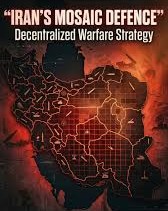
Iran’s Mosaic Defence doctrine is one of the most deliberately constructed asymmetric military strategies of the 21st century, and the ongoing US-Israel military campaign against Iran — Operation Epic Fury, launched February 28, 2026 — has provided its first real-time stress test against a peer-level adversary. The doctrine’s performance in the opening weeks of that conflict has validated decades of Iranian military planning and confounded Western expectations of rapid regime collapse.
Iran’s defence doctrine was shaped by two formative historical experiences: the 1980–88 Iran-Iraq War and Israel’s intervention in Lebanon. Both anchored ballistic missiles and proxy networks are core instruments of Iranian strategy. But the formal doctrine crystallised from a more recent lesson. Iranian military planners studied US operations in Iraq, Afghanistan, and the Balkans, concluding above all from the 2003 collapse of Saddam Hussein’s centralised regime that highly centralised militaries collapse quickly once their leadership is struck. As Foreign Minister Araghchi put it: “We’ve had two decades to study defeats of the US military to our immediate east and west. Bombings in our capital have no impact on our ability to conduct war. Decentralised Mosaic Defence enables us to decide when — and how — war will end.”
Formalisation and Architecture
The doctrine was formalised in 2005 when the IRGC, under General Mohammad Jafari, announced the Mosaic Defence model: a decentralised command-and-control system restructured into 31 separate provincial commands. Each of Iran’s 31 provinces has its own IRGC headquarters, command structure, weapons stockpile, and intelligence capability — effectively a complete military system in miniature. “Every province is a mosaic, and the commanders have the ability and power to make decisions,” analyst Farzin Nadimi has noted. “So when they are cut off from their command in Tehran, they can still function as a cohesive military force.”
Under this model, the IRGC, regular army, missile units, naval assets, and the Basij militia form a distributed defence network. If one unit is destroyed, others continue operating independently. The architecture was designed against one specific adversary capability: the decapitation strike.
The Four Operational Pillars
Asymmetric Warfare and Cost Imposition. Rather than conventional force-on-force engagement, the doctrine imposes prohibitive costs through endurance — survive the initial shock, keep retaliating through multiple channels, and raise the costs of a prolonged campaign until continuation becomes politically untenable for the attacker.
Distributed Command with Pre-Delegated Authority. Iranian sources described how the Revolutionary Guards delegated authority far down the ranks and built “successor ladders” so units continue operating if commanders are killed. Each provincial command operates with overlapping chains of command and dispersed stockpiles — not just decentralisation but redundancy at every level. Provincial IRGC units can call upon Basij forces during crises. This enables a multi-level defence that is largely unfazed by decapitation strikes.
Missile Arsenal as Strategic Anchor. Iran’s ballistic missile capability is the backbone of the mosaic architecture. Distributed missile batteries across 31 provincial commands mean that neutralising Iran’s missile threat requires destroying 31 separate, geographically dispersed launch systems rather than a single centralised arsenal — an operation orders of magnitude more complex than a leadership strike.
The Axis of Resistance as Strategic Depth. National security is not limited to the protection of national territory; it rests on preventing confrontation from spilling over national borders. Hezbollah, the Houthis, Iraqi Shia militias, and Syrian proxy forces each represent distributed nodes of retaliatory capacity operating semi-independently of Tehran — a regional application of the same mosaic logic applied domestically. Acting upon nodes across the Middle East’s interconnected system of military bases, maritime chokepoints, and energy corridors can transform a localised confrontation into a crisis with global repercussions.
The 2026 Operational Test
The initial US-Israeli campaign followed the standard Western pattern. It aimed to create a systemic collapse by destroying command centres, communications nodes, and senior figures. The US campaign did not yield the desired results. On the contrary, it highlighted the fundamental characteristic of the Iranian system, i.e. its capacity to absorb strategic shock.
Rather than triggering disintegration, the loss of the decision-making center appears to have accelerated the activation of a resilience mechanism already embedded in Iranian doctrine. What has emerged is that the Iranian strategic model can be described as “war without a centre”. The military capability is organised not around a single decision-making nucleus, but across an array of interconnected tactical centers.
The system seems to be working. The independent Iranian military units (somewhat isolated) are acting based on general instructions given to them in advance. They have responded to heavy bombardment by firing unprecedented barrages of ballistic missiles and kamikaze drones at Israel, US military and diplomatic facilities across the Middle East, and critical energy infrastructure in the Persian Gulf.
Doctrinal Vulnerabilities
Mosaic Defence, however, does carry significant structural vulnerabilities.
- Coordination Problem. Decentralisation enables resilience; however, it simultaneously creates coordination challenges. It becomes difficult to coordinate with the autonomous provincial units.
- Strategic Coherence. Without a clear political direction, the doctrine designed for endurance risks prolonging the conflict, without achieving any meaningful strategic outcomes. Military persistence must eventually convert into political outcomes.
- Dependency on Political Cohesion. The doctrine depends on public support and internal unity. Provincial commanders operating with pre-delegated authority must be politically reliable as well as militarily capable — a requirement that becomes more demanding as the human and economic costs of sustained conflict accumulate.
- Escalation Unpredictability. Units acting on general instructions given in advance, without real-time central guidance, are inherently prone to escalation. The doctrine that gives Iran resilience also makes selective de-escalation difficult. These units may not be reachable for recall or restraint.
Strategic Implications
For US and Israeli Doctrine. The most significant implication is that the standard Western decapitation playbook, which worked against Iraq in 2003 and Libya in 2011, did not work against Iran. Defeating mosaic defence requires not precision strikes on central nodes but sustained, comprehensive degradation of 31 independent provincial systems simultaneously.
For India’s Strategic Assessment of War Duration. The activation of Iran’s mosaic defence has direct implications for India. It implies that Hormuz closure is not a temporary measure, but a potentially sustained strategic instrument. India must plan for a prolonged, rather than brief, disruption scenario.
For India’s Structural Reorganisation. In terms of military doctrine, Iran’s architecture offers relevant insights for India’s distributed warfighting requirements. The concept of 31 self-contained provincial commands maps directly onto questions about India’s theatre command architecture. The lesson that decentralised command enables resilience is relevant to India’s two-front scenario planning.
For the Theory of Modern Warfare. The emergence of “war without a center” as an operational reality, rather than just a theoretical concept. It poses a fundamental challenge to the Western doctrine of rapid dominance. The assumption that power is concentrated in a single center, and that striking that center causes strategic paralysis has been disproven in real time. The broader implication is that the era of quick, decisive, decapitation-based military victories against a sophisticated adversary, who has studied and prepared specifically for such an approach, may be fundamentally over.
Analytical Perspective
Iran’s Mosaic Defence represents a genuinely innovative solution to a fundamental strategic problem—the problem of facing a technologically superior adversary by a militarily inferior state. The challenge is to survive the first strike and sustain the fight long enough to make the cost of continuation prohibitive for the attacker. The solution lies in distributing everything, pre-delegating authority, building redundancy at every level, and making the system function as a web rather than a hierarchy.
This doctrine’s greatest success is not operational but psychological. In the case of the war in Iran, it has converted Iran’s structural military inferiority into a manageable constraint. It has ensured that the adversary’s greatest advantages (i.e., precision, speed, and decapitation capability) did not translate into a rapid victory on which the entire campaign logic depended. Iran has prepared itself for a long war. Whether that long war serves Iran’s strategic interests better than a rapid defeat would have done is a question the doctrine itself cannot answer.
Please Add Value to the write-up with your views on the subject.
For regular updates, please register your email here:-
References and credits
To all the online sites and channels.
Pics Courtesy: Internet
Disclaimer:
Information and data included in the blog are for educational & non-commercial purposes only and have been carefully adapted, excerpted, or edited from reliable and accurate sources. All copyrighted material belongs to respective owners and is provided only for wider dissemination.
References:
- Connell, M. (2010). Iran’s military doctrine. CNA Analysis and Solutions.
- Eisenstadt, M. (2011). The strategic culture of the Islamic Republic of Iran: Religion, expediency, and soft power in an era of disruptive change. Middle East Journal, 65(4), 551–570.
- Golkar, S. (2015). Captive society: The Basij militia and social control in Iran. Columbia University Press.
- Jafari, M. (2005). Mosaic defence doctrine: IRGC restructuring framework [Internal IRGC policy document, as cited in open-source analyses].
- Nadimi, F. (2020). Iran’s evolving approach to asymmetric naval warfare: Strategy and capabilities in the Gulf. Washington Institute for Near East Policy.
- Ostovar, A. (2016). Vanguard of the Imam: Religion, politics, and Iran’s Revolutionary Guards. Oxford University Press.
- Takeyh, R. (2009). Guardians of the Revolution: Iran and the world in the age of the Ayatollahs. Oxford University Press.
- Ward, S. (2009). Immortal: A military history of Iran and its armed forces. Georgetown University Press.
- Pape, R. A. (1996). Bombing to win: Air power and coercion in war. Cornell University Press.
- Reuters. (2024). Iran’s Revolutionary Guards delegate authority down the chain of command amid preparations for conflict. Reuters.