
Article published on the IIRF Website on 23 Aug 25.
The history of aerial warfare is a reflection of the larger story of technology and war.
The history of aerial warfare tells a compelling story of innovation, change, and the relentless pursuit of control in the skies. Over just over a century, air combat has undergone significant changes. The focus has shifted from skilled pilots to modern technological systems, and it is now moving toward autonomy and weapon-centred warfare. This transformation is not merely machines replacing humans. It shows how technology improves on an ongoing basis, redefining the very principles of conflict and control in war. This process can be broken down into three broad periods: the Pilot Era, the Platform Era, and the soon-to-be Weapon Era. Each era signifies a profound step forward, both in terms of capability and in the way military forces conceive of power projection, air supremacy, and deterrence in an increasingly complicated and technologically oriented battlefield.
The Pilot-Centric Era: A Human-Centric Approach to Airpower
From the earliest days of aerial combat in World War I to the Cold War period, the human pilot was the central factor in air warfare. Initial aircraft were simple in design, and success was highly dependent on the skill, valour, and tactical acumen of the pilot. Aircraft were designed to complement the pilot’s eyes, experience, and manoeuvrability. The entry into the jet era further raised the reliance on human performance, valour, and high-stress decision-making.
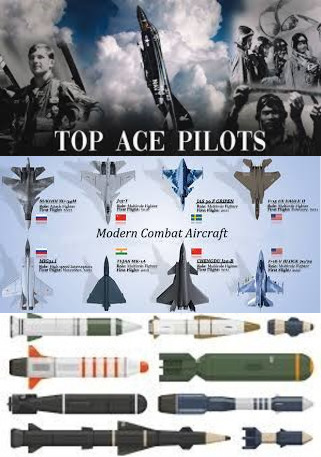
The Dogfighter’s Domain. The early 20th century celebrated the’ ace’ pilot, with prominent figures such as Manfred von Richthofen (commonly known as the Red Baron), Eddie Rickenbacker, and subsequently Chuck Yeager becoming emblematic of aerial prowess. The individual pilot was regarded not merely as a combatant but also as an embodiment of national strength and heroism. Aeroplanes like the P-51 Mustang, Spitfire, and MiG-21 were the embodiments of the era’s technology—designed to be fast, agile, and combat manoeuvrable. In the Vietnam War, American pilots carried out operations in which dogfighting was still important, and air kills were seen as personal and national accomplishments.
Tactical excellence with regard to technology. During this period, technology development focused on extending the capabilities of pilots instead of replacing them. Navigation systems, radar, and early missiles lengthened the pilots’ field of operation while maintaining control over the kill chain in their hands. Situational awareness, spatial awareness, and swift decision-making were key drivers of mission success.
The Platform Era: From Aces to Systems
The end of the Cold War signalled the beginning of the Platform Era, where aircraft system complexity and integration became more focal than pilot skill. Aircraft then transitioned to become multirole platforms that can perform a range of missions with little pilot input except to manage the systems.
Jet Age and Missiles (1950s–1980s). The introduction of jet planes like the F-86 Sabre and the MiG-15, together with guided missile technology, represents a watershed moment in combat dynamics. Air-to-air missile systems like the AIM-9 Sidewinder and the radar-guided AIM-7 Sparrow extended beyond visual recognition engagement ranges, thus reducing the requirement for close dogfighting. The Korean War typified jet warfare, while the Vietnam War emphasised the importance of sophisticated avionics and missile technology.
System-of-Systems Concept. Planes like the F-117 Nighthawk and F-22 Raptor led the development of stealth technology, making platforms harder to detect. Sophisticated avionics, radar systems, and sensor fusion (e.g., in the F-35) have allowed platforms to analyse vast amounts of data, thus expanding situational awareness. The onset of network-centric warfare is illustrated by such platforms as the E-3 AWACS and F/A-22, which exchange information via links like Link 16 in order to enable networked operations. Fifth-generation fighter aircraft, such as the F-22 Raptor and F-35 Lightning II, are the pinnacle of this platform-oriented way of thinking. These aircraft operate not just as pilots’ tools but as sensor-shooter fusion nodes in a larger, networked kill web. Manned with stealth, sensor fusion, and electronic warfare systems, they can collect intelligence, jam the enemy system, and drop precision-guided munitions—while sharing data with other platforms. The pilot’s role has shifted from warfighter to system operator, responsible for managing inputs from sensors, data links, and mission systems. Multirole and survivability.
These are defining features in modern-day military platforms. Contemporary systems place a premium on stealth, range, and payload rather than manoeuvrability. The ability to stay undetected and attack at a distance became the top priority, overtaking the long-standing value placed on dogfighting acumen. The F-35, for instance, is designed to fulfil various roles, such as strike, intelligence, surveillance, and reconnaissance (ISR) and air-to-air combat, all combined within one platform. Current survivability strategies focus primarily on avoiding engagement rather than excelling in combat. Strategic Implications. This shift changed the manner in which air forces planned their operations. Rather than sending out formations of aircraft, a limited number of high-value platforms could conduct sophisticated missions, thus minimising exposure. Nevertheless, these platforms came at a high cost—financial, logistical, and strategic. The high cost and risk of losing a $100 million-plus aircraft led air commanders to seek alternative options.
The Weapons Era: Precision, Autonomy, and Platform Agnosticism
We are now coming into the Weapons Era, which is marked by a re-emphasis on the weapon system itself. Whether launched from a manned aircraft, an unmanned drone, a ship at sea, or even in space, it is the precision-guided, often autonomous weapon that carries strategic weight.
Rise of Unmanned Systems. The mass production of drones—like the MQ-1 Predator, MQ-9 Reaper, Bayraktar TB2, and more recent stealthier and higher-speed systems like the XQ-58 Valkyrie—has revolutionised the aerial warfare landscape. These platforms can stay on station for hours, target with accuracy, and attack without endangering a human pilot. Uncrewed platforms are less expensive, more expendable, and more interchangeable. Military forces are currently developing swarms of drones capable of overwhelming defences, filling up the skies, and acting as decoys, scouts, or kinetic attackers. Artificial Intelligence and Autonomous Kill Chains.
Artificial Intelligence. The use of artificial intelligence is revolutionising the operational capacities of contemporary weapons. AI systems have the ability to select and prioritise targets, fly autonomously in GPS-deprived areas, optimise flight patterns to reduce the risk of detection, and conduct strikes independently, under particular doctrines. As examples, loitering munitions, also known as “kamikaze drones,” like the Israeli Harop or Switchblade from the U.S., can loiter above target areas, perform target search, and conduct strikes with minimal human involvement. Beyond-Visual-Range (BVR) Missiles. BVRs, including the AIM-120 AMRAAM, and hypersonic missiles, such as the AGM-183, move the focus towards weapon system range and precision. Heavy platforms like the B-21 Raider, which are designed to be stealthy and heavy-laden, place magazine capacity above manoeuvrability, as BVR combat reduces the need for close manoeuvring. Directed Energy Weapons (DEWs) are future technologies that allow for near-instant strikes, thus diminishing the dependence on close manoeuvring.
Hypersonics and Stand-off Weapons. During the Weapon Era, combat usually takes place a significant distance behind the frontline. Hypersonic glide vehicles (such as Russia’s Avangard, China’s DF-ZF) and long-range cruise missiles have the ability to destroy targets thousands of miles away in a few minutes. Missiles like the AGM-158 JASSM, LRASM, and air-launched hypersonics render the need for platforms to enter enemy airspace pointless. The role of the platform is minimised to that of a delivery vehicle only—its function diminished to that of an enabler. Platform Agnosticism. Perhaps the defining feature of this era is that the delivery platform matters less than the effectiveness of the weapon. Precision munitions can be launched from a variety of platforms, including fighters, drones, submarines, ships, and satellites. This diversification increases strategic flexibility. A naval destroyer or ground-based launcher may be just as lethal as an aircraft, especially when combined with AI-enhanced targeting data.
The Future of Human-Machine Teaming. Autonomous air systems will be the main focus in future conflicts, with human intervention or control restricted to decisive moments. The aim is to enhance lethality, survivability, and rate of operations while reducing threats to human life. With the Weapon Era ongoing, the probable future most likely involves hybrid operations that integrate manned platforms, autonomous systems, and smart weapons into coordinated battle networks.
Loyal Wingman Projects. Projects like the US Collaborative Combat Aircraft (CCA) and Australia’s Ghost Bat project envision uncrewed drones flying with manned fighters. These “loyal wingmen” carry weapons, sensors, or electronic warfare payloads, thus extending manned platform operational reach and survivability.
Swarming Strategies and Edge AI. AI and edge computing allow autonomous drones to have local decision-making capacity and move within coordinated swarms, thus ensuring autonomous operation. The tactics are likely to disrupt traditional air defence systems and can potentially revolutionise battlefield dynamics.
Integration into Multi-Domain Operations. The future air warfare will be a core element of multi-domain operations (MDO), smoothly interweaving the space, cyber, land, sea, and air domains. The AI-powered weapons will not be standalone entities, but as part of an integrated battlefield responding in real-time.
Directed Energy Weapons (DEWs). Comprising lasers and microwaves, these technologies are expected to greatly cut engagement times, hence decreasing the need for traditional dogfighting manoeuvres. These systems have the ability to disrupt enemy electronics or to destroy targets in an instant, thus reorienting strategic focus toward air and space forces. In addition, large platforms intended for Payload deployment — e.g., bomber-sized aircraft like the B-21 Raider — will prioritise stealth, longer range of operations, and payload capacity over manoeuvrability, hosting a large payload of long-range missiles or drones.
Conclusion
The shift from human pilots to platforms and then to weapons is a move away from dependence on man to dependence on machine. Pilots used to be the deciding factor in air warfare; today, planes and UAVs are the focal points. In the present day, weapons, particularly autonomous drones and guided missiles, are becoming increasingly important. The change improves efficiency in operations and minimises risks to humans, but also raises strategic and ethical issues. With the development of artificial intelligence and directed energy weapons, there is a potential to blur the distinction between platforms and weapons, and autonomous platforms can effectively revolutionise the character of warfare. The art of air power is evolving. The next chapter won’t be listed in the annals of great pilots or quantified simply by the number of aircraft. Rather, it will be measured in terabytes of information, milliseconds of reaction time, and the smooth blending of human and artificial intelligence that functions in an ever-more technology-influenced world.
Please Add Value to the write-up with your views on the subject.
For regular updates, please register your email here:-
References and credits
To all the online sites and channels.
Pics Courtesy: Internet
Disclaimer:
Information and data included in the blog are for educational & non-commercial purposes only and have been carefully adapted, excerpted, or edited from reliable and accurate sources. All copyrighted material belongs to respective owners and is provided only for wider dissemination.
References: –
- Air Force Historical Research Agency. (n.d.). World War I aerial combat tactics.
- Boyne, W. J. (2003). The influence of air power upon history. Pelican Publishing.
- Center for a New American Security (CNAS). (2021). The Role of AI in the Future of Air Warfare.
- Clark, B., Gunzinger, M., & Walton, T. (2020). Winning the High-End Fight: The Role of Unmanned Aircraft. Center for Strategic and Budgetary Assessments (CSBA).
- Clark, R. M. (2014). Uninhabited combat aerial vehicles: Airpower by the people, for the people, but not with the people. Air University Press.
- Corum, J. S., & Johnson, W. R. (2003). Airpower in small wars: Fighting insurgents and terrorists. University Press of Kansas.
- Deptula, D. A. (2021). From Fighter Pilot to Command and Control: The Changing Face of Air Warfare. Mitchell Institute for Aerospace Studies.
- Freedberg, S. J. (2019, June 18). Mosaic Warfare: DARPA’s Vision of the Future Fight. Breaking Defence.
- Freedman, L. (2019). The future of war: A history. PublicAffairs.
- Gunzinger, M., & Finerty, C. (2018). Directed-Energy Weapons Are Coming: And They’re Going to Change War. War on the Rocks.
- Hallion, R. P. (1997). Strike from the sky: The history of battlefield air attack, 1911–1945. Smithsonian Institution Press.
- Kainikara, S. (2015). The Evolution of Air Power. Air Power Development Centre.
- Krepinevich, A. F. (2009). 7 Deadly Scenarios: A Military Futurist Explores War in the 21st Century. Bantam Books.
- RAND Corporation. (2021). The future of air superiority: Assessing the role of fifth-generation fighters and unmanned systems.
- Sayler, K. M. (2021). Emerging Military Technologies: Background and Issues for Congress. Congressional Research Service.
- Scharre, P. (2018). Army of None: Autonomous Weapons and the Future of War. W. W. Norton & Company.
- Singer, P. W. (2009). Wired for War: The Robotics Revolution and Conflict in the 21st Century. Penguin Books.
- U.S. Department of Defence. (2022). Unmanned Aircraft Systems Roadmap: 2022–2040.
- Weinberger, S. (2016). The Pentagon’s Brave New World of AI-Powered Warfare. Nature, 538, 160–163.
- Work, R., & Brimley, S. (2014). 20YY: Preparing for War in the Robotic Age. Center for a New American Security (CNAS).