
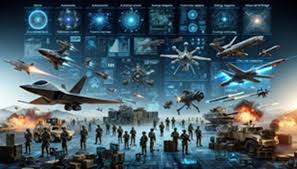
730: BATTLEFIELD BEYOND BOUNDARIES: MILITARY CONFLICTS AND INDUSTRY


Presented my views at the Best Practices Meet 2025, organised by Data Security Council of India on 21 Aug 25.


The concept of “battlefield beyond boundaries” encapsulates the evolution of modern warfare, where conflicts transcend traditional geographic and physical limits, intertwining with industries that develop, supply, and profit from advanced technologies. This convergence blurs the lines between military and civilian spheres, raising critical questions about economics, security, ethics, and global governance. Modern battlefields extend across land, sea, air, cyberspace, and outer space, driven by technological advancements and the increasing integration of commercial industries into military operations.


  1. The Expanding Nature of Military Conflicts

Modern warfare has evolved beyond traditional battlefields, incorporating multiple domains and strategies that challenge conventional doctrines.

  • Multi-Domain Warfare: Conflicts are no longer confined to land, sea, and air. Cyberspace and outer space have become critical battlegrounds, with operations involving satellites, cyberattacks, and digital infrastructure. For instance, the Russia-Ukraine conflict highlights the use of commercial satellites like Starlink for real-time communication and coordination.
  • Hybrid Warfare: This approach combines conventional military forces with non-kinetic elements such as cyberattacks, disinformation campaigns, economic sanctions, and energy weaponisation. These tactics influence global public opinion and blur the lines between combatants and civilians.
  • Asymmetric Warfare: The rise of non-state actors and unconventional tactics, such as the use of commercial off-the-shelf (COTS) drones for reconnaissance and attacks, demonstrates the adaptability and affordability of modern tools in conflicts, as seen in Ukraine.
  • Globalisation of Conflict: Military engagements impact global supply chains, financial systems, and trade, with long-range weapons like hypersonic missiles and drones enabling strikes far from traditional frontlines, making civilian areas vulnerable.


  1. Impact of Emerging Technologies

Technological advancements are reshaping the battlefield, enhancing capabilities while introducing new challenges.

  • Artificial Intelligence (AI): AI revolutionises military operations by enabling faster decision-making, predictive analytics, and autonomous systems. It enhances surveillance, logistics, and battlefield awareness by analysing vast datasets from sensors, satellites, and civilian devices.
  • Robotics and Autonomous Systems (RAS): Unmanned vehicles (UAVs, UUVs, UGVs) and robotic systems reduce human risk in hazardous environments, improve logistics, and provide real-time intelligence. Military robotics is projected to reach a market size of $21.2 billion by 2032.
  • Cybersecurity: With increased reliance on networked systems, protecting critical defence infrastructure from cyberattacks is paramount. Technologies like blockchain and private 5G networks ensure secure, real-time coordination across sprawling battlefield networks.
  • Space-Based Technologies: Satellites provide critical intelligence, precision targeting, and communication capabilities. Companies like SpaceX play a pivotal role by supplying infrastructure like Starlink, which has proven vital in modern conflicts.
  • Hypersonic Weapons: These high-speed, manoeuvrable missiles challenge existing defence systems, potentially destabilising traditional deterrence mechanisms.
  • Additive Manufacturing (3D Printing): Enables rapid production of complex components, reducing reliance on traditional supply chains and addressing wartime shortages, such as artillery shells in the Russia-Ukraine conflict.
  • Directed Energy Weapons (DEWs): Lasers and high-power microwaves offer defence against high-speed threats but face challenges related to power requirements and atmospheric conditions.
  • Electrification and Sustainability: The defence industry is shifting toward electric and hydrogen-powered systems and eco-friendly materials to lower costs and meet regulatory demands, balancing military innovation with sustainability goals.


  1. Transformation of the Defence Industry

The global defence sector is undergoing significant changes, driven by technological advancements, economic factors, and geopolitical dynamics.

  • Military-Industrial Complex (MIC): The MIC, encompassing defence contractors like Lockheed Martin, BAE Systems, and Raytheon, drives innovation and production. This relationship influences economic policies, technological development, and societal structures.
  • Commercial Technology Integration: Companies traditionally associated with civilian sectors, such as SpaceX and Silicon Valley tech firms, are increasingly vital to military applications, providing solutions like satellites, AI, and cybersecurity.
  • Increased R&D Investment: Nations are investing heavily in research and development to maintain technological superiority, with the global defence equipment market projected to grow from $517.2 billion in 2023 to $762.1 billion by 2032.
  • Globalised Defence Markets and Supply Chains: International collaboration, foreign direct investment, and interconnected supply chains are increasing, though conflicts expose vulnerabilities, such as semiconductor shortages and reliance on critical resources like rare earth minerals.
  • Rapid Procurement and Indigenous Innovation: Active conflicts, like the 2025 India-Pakistan confrontation, accelerate defence spending and local production, as seen in policies like “Make in India,” which aim to boost self-reliance.
  • Dual-Use Technology: Military R&D, such as GPS and drones, benefits civilian sectors but also risks militarising civilian infrastructure, making it a target in conflicts.


  1. Industry as a Battlefield

Industries are not just enablers of warfare but have become battlegrounds themselves, targeted and leveraged in geopolitical conflicts.

  • Cyberwarfare: Tech companies are frontline defenders against nation-state hackers targeting critical infrastructure, such as data centres and telecom networks.
  • Supply Chain Warfare: Semiconductor shortages and sanctions highlight how industries are weaponised, with control over resources like rare earth minerals, oil, and gas becoming strategic priorities.
  • War Economies: Conflicts generate industries of private security, cyber defence, reconstruction, and resource extraction, but economies tied to war may find peace less profitable.


  1. Ethical and Policy Considerations

The integration of advanced technologies and industries into warfare raises significant ethical and legal challenges.

  • Lethal Autonomous Weapons (LAWs): The development of fully autonomous weapons raises concerns about accountability and the role of humans in targeting decisions, complicating compliance with international humanitarian law (IHL).
  • Civilian Infrastructure as Targets: The use of civilian technologies in military operations risks designating them as legitimate targets, raising humanitarian concerns and questions about the scope of cyber warfare.
  • Maintaining Strategic Stability: Emerging technologies like hypersonics and AI-driven weapons could destabilise deterrence mechanisms, increasing the risk of miscalculation and escalation.
  • Global Governance and Arms Control: The rapid pace of technological change necessitates international cooperation to address regulatory gaps in existing frameworks, like the Geneva Conventions, and promote responsible development of new military technologies.
  • Profit vs. Peace: The profitability of conflict-driven industries raises ethical questions about whether corporations should benefit from wars that cause humanitarian crises.
  • Privatisation of War: The rise of private military companies blurs accountability for violence, challenging traditional notions of state-controlled warfare.


  1. Global and Societal Impacts

The interplay of military conflicts and industry has far-reaching consequences for economies, societies, and global power dynamics.

  • Economic Ramifications: Conflicts disrupt global supply chains, food security, and economies, while industries adapt to meet wartime demands or mitigate losses. For nations like India, heightened conflict drives job creation but exposes vulnerabilities in supply chains and technology.
  • Technological Spillover: Wartime innovations, such as radar from WWII, often lead to civilian applications, driving broader industrial and societal advancements.
  • Geopolitical Shifts: The race for technological supremacy in AI, autonomous systems, and space militarisation influences global power dynamics, with nations like China and the U.S. competing for dominance.
  • Sustainability vs. Security: Defence industries face pressure to balance military innovation with climate goals, integrating eco-friendly technologies while maintaining operational effectiveness.


Conclusion

The “battlefield beyond boundaries” reflects a paradigm where military conflicts are no longer confined to physical spaces but extend into digital, economic, and societal domains, deeply intertwined with industrial advancements. The integration of commercial technologies, the rise of autonomous systems, and the globalisation of defence markets challenge traditional warfare doctrines, requiring new strategies, ethical frameworks, and international regulations. As battlefields expand to encompass industries, economies, and technologies, understanding this interdependence is essential to navigating the complex ethical, economic, and political challenges of modern warfare. The future of conflict will be defined not only by armies and strategies but by the global industries that design, supply, and sustain the mechanisms of war.


Please Add Value to the write-up with your views on the subject.


1878
Default rating

Please give a thumbs up if you  like The Post?


For regular updates, please register your email here:-

Subscribe


References and credits

To all the online sites and channels.

Pics Courtesy: Internet

Disclaimer:

Information and data included in the blog are for educational & non-commercial purposes only and have been carefully adapted, excerpted, or edited from reliable and accurate sources. All copyrighted material belongs to respective owners and is provided only for wider dissemination.


References:-


  1. Singer, P. W. (2009). *Wired for War: The Robotics Revolution and Conflict in the 21st Century*. Penguin Books.
  2. Kaldor, M. (2012). *New and Old Wars: Organised Violence in a Global Era* (3rd ed.). Stanford University Press.
  3. Grey, C. S. (2015). *The Future of Strategy*. Polity Press.
  4. Latiff, R. H. (2017). *Future War: Preparing for the New Global Battlefield*. Knopf.
  5. Bitzinger, R. A. (2021). “The Global Defence Industry in the 21st Century: Trends and Transformations.” *Journal of Strategic Studies*, 44(3), 321–345.
  6. Gilli, A., & Gilli, M. (2019). “The Diffusion of Drone Warfare? Industrial, Organisational, and Infrastructural Constraints.” *Security Studies*, 28(4), 661–696.
  7. Horowitz, M. C. (2018). “Artificial Intelligence, International Competition, and the Balance of Power.” *Texas National Security Review*, 1(3), 36–57.
  8. Lin, J., & Singer, P. W. (2022). “The Cyber Battlefield: How Nation-States and Non-State Actors Are Redefining Warfare.” *Foreign Affairs*, 101(2), 88–97.
  9. Raska, M. (2020). “The Sixth RMA Wave: Disruption in Military Affairs?” *Journal of Strategic Studies*, 43(6), 834–860.
  10. International Institute for Strategic Studies (IISS). (2023). *The Military Balance 2023*. IISS.
  11. RAND Corporation. (2021). *The Future of Warfare in 2030: Projecting Conflict in a Highly Networked World*. RAND Corporation.
  12. Stockholm International Peace Research Institute (SIPRI). (2024). *SIPRI Yearbook 2024: Armaments, Disarmament, and International Security*. Oxford University Press.
  13. NATO Science and Technology Organisation. (2022). *Emerging and Disruptive Technologies: Implications for NATO Defence Planning*. NATO.
  14. United Nations Institute for Disarmament Research (UNIDIR). (2023). *The Weaponisation of Emerging Technologies: Ethical and Legal Challenges*. UNIDIR.

 

538:CHINA UNVEILS LYNX ROBOT: BROADER SHIFT TOWARDS UNMANNED WARFARE

Pic Courtesy: Net


My Article published on The EurAsian Times Website on 24 Nov 24


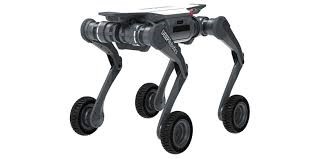
The Chinese company Deep Robotics recently unveiled the “Lynx ” advanced quadruped robot.” This robot is designed for rugged, off-road environments and showcases its versatility by navigating extreme terrain and performing stunts like backflips and sharp turns. The robot’s robust design allows it to move at high speeds across rugged landscapes, enhancing its utility in real-world applications like disaster response and exploration.​ The robot represents a significant move in China’s broader strategy of embracing unmanned warfare.


Lynx Robot


Pic Courtesy: Net


Deep Robotics, founded in 2017, has made a name for itself with its innovative quadruped robots, and the Lynx represents a leap forward in terms of versatility and performance. The Lynx has all-terrain wheels, allowing it to cover uneven ground easily. Thanks to its waterproof design, it can operate in challenging conditions, including temperatures ranging from -20°C to 55°C, and in wet environments. The Lynx can autonomously navigate challenging environments for up to 4 hours on a single charge. This robot has garnered attention for its practical applications in search and rescue, mapping, inspection, and potential military uses.


Possible Military application.


The Lynx robot by Deep Robotics, with its rugged capabilities, mobility, and autonomous navigation of extreme terrains, presents several potential military applications. These features make it suitable for a range of tactical and logistical operations in military contexts, from reconnaissance missions in complex environments to providing logistical support in combat zones.


Reconnaissance and Surveillance. The Lynx’s ability to traverse complex environments—such as rough, mountainous terrain or urban rubble—makes it ideal for reconnaissance missions. Its autonomous navigation capabilities allow it to gather intelligence in areas that are too dangerous or difficult for human soldiers to access, providing real-time data without risking lives​.


Logistical Support. The robot’s capacity to carry heavy loads and its off-road agility make it a potential asset in logistical operations, particularly in combat zones. It could transport supplies, ammunition, and equipment across uneven terrain, ensuring that military units are well-supplied in challenging environments.​


Search and Rescue Operations. Given its versatility and ability to function in extreme conditions, the Lynx could be used in military search and rescue operations. It can be deployed in environments where traditional vehicles may struggle, such as collapsed buildings or hazardous zones after combat.​


Explosive Ordnance Disposal (EOD). The robot’s agility, ability to handle rough terrain, and precision could make it a valuable tool in EOD operations. It would allow military personnel to remotely detect and disarm explosives in hostile areas without exposing humans to danger.


The Lynx’s robust design and all-terrain features lend it to military applications. As with many advanced robotic systems, its military potential could be seen as a means to reduce human casualties and enhance combat capabilities.


Future Warfare with Unmanned Systems


Unmanned systems, encompassing unmanned aerial vehicles (UAVs) and unmanned ground vehicles (UGVs), are rapidly transforming the landscape of modern warfare. With technological advancements, these systems have moved from the periphery of military operations to the forefront, providing unprecedented surveillance, reconnaissance, logistics, and combat capabilities. This article explores the tactical applications of unmanned systems in future warfare, illustrated with examples, insights from military experts, and a look at the implications for global security.


The Evolution of Unmanned Systems. The concept of unmanned systems is not new; however, their application has dramatically evolved over the past two decades. Initially utilised primarily for reconnaissance missions during the Cold War, UAVs gained prominence in the 1990s and early 2000s, particularly in the U.S. military’s operations in the Middle East. The 2001 invasion of Afghanistan and the subsequent Iraq War marked a turning point where UAVs like the MQ-1 Predator and MQ-9 Reaper became integral to combat operations, enabling real-time intelligence gathering and targeted strikes without risking pilot lives. A 2021 U.S. Defence Innovation Board report states, “Unmanned systems are reshaping how wars are fought, enabling forces to conduct operations with greater precision, efficiency, and reduced risk to personnel” (Defence Innovation Board, 2021).


Tactical Applications of Unmanned Aerial Vehicles (UAVs)


Surveillance and Reconnaissance. One of the primary applications of UAVs is for surveillance and reconnaissance missions. The ability to gather intelligence over vast areas without risking human life is invaluable. For example, during the 2012 conflict in Mali, French forces employed UAVs to monitor enemy movements and gather intelligence on insurgent groups. This enabled precise ground operations planning, significantly improving their forces’ effectiveness.


Precision Strikes. UAVs have also become crucial in delivering precision strikes against high-value targets. The use of drones for targeted killings has been a controversial yet effective tactic. Israel’s use of UAVs in conflicts, such as the 2006 Lebanon War, demonstrated the effectiveness of drones in both surveillance and combat roles. The Israeli Air Force’s use of the Heron and Hermes UAVs allowed for persistent monitoring and targeted strikes, significantly impacting Hezbollah’s capabilities.


Logistics and Resupply. Unmanned systems are also revolutionising military logistics. The U.S. Army has begun to deploy UAVs for logistical support, delivering supplies to frontline troops.  This capability was notably highlighted during the 2020 Nagorno-Karabakh conflict, where Azerbaijani forces utilised UAVs not only for combat but also for logistical operations, effectively resupplying troops in the field while minimising the risk of ground convoys being attacked.


Tactical Applications of Unmanned Ground Vehicles (UGVs)


Combat Support and Logistics Unmanned ground vehicles (UGVs) are increasingly integrated into combat operations. These systems can perform various tasks, including surveillance, logistics, and direct enemy forces engagement. The U.S. Army’s Robotic Combat Vehicle (RCV) program exemplifies this trend, as it aims to develop UGVs that can operate alongside manned units to enhance combat effectiveness. The UGVs deployed in recent military exercises have demonstrated their ability to scout ahead of troop formations, providing critical intelligence without endangering soldiers.


Counter-Improvised Explosive Device (C-IED) Operations. UGVs are particularly effective in counter-IED operations, where they can safely detect and disarm explosive devices. The U.S. military has employed systems like the PackBot and Talon, successfully reducing casualties among dismounted troops. During operations in Afghanistan, UGVs were instrumental in clearing routes for ground convoys by detecting and neutralising IED threats.


Humanitarian Assistance and Disaster Relief (HADR). UGVs are also involved in humanitarian assistance and disaster relief operations. In the aftermath of natural disasters, these vehicles can be deployed to assess damage, locate survivors, and deliver supplies. For instance, after the 2011 earthquake and tsunami in Japan, UGVs were used to navigate debris and assess the condition of affected areas, demonstrating their versatility beyond traditional military applications.


Future Warfare and the Role of Unmanned Systems.


As warfare continues to evolve, the role of unmanned systems will only expand. Integrating artificial intelligence (AI) and machine learning into unmanned systems will enhance their capabilities, enabling them to operate autonomously in complex environments. This shift toward autonomy presents both opportunities and challenges for military planners.


Enhanced Decision-Making. Integrating AI into unmanned systems will facilitate improved decision-making in combat scenarios. AI algorithms can analyse vast amounts of data from multiple sources, providing commanders with actionable intelligence and recommendations for operations. The future battlefield will be defined by speed and the ability to process information faster than the enemy.


Ethical Considerations. However, the increasing reliance on unmanned systems raises significant ethical questions. The use of drones for targeted killings has sparked debate over accountability and the rules of engagement. As military operations become more automated, the question of human oversight becomes critical. Experts argue that while unmanned systems can enhance operational efficiency, they must be governed by strict ethical guidelines to prevent misuse and collateral damage.


Global Security Implications. The proliferation of unmanned systems is reshaping global security dynamics. As countries like China and Russia invest heavily in their drone capabilities, the balance of power is shifting. The use of UAVs in conflicts such as the Syrian Civil War and the ongoing tensions in the South China Sea highlights the strategic importance of these systems in contemporary military strategies.


China’s Investment in Unmanned Systems


China has heavily invested in unmanned systems as part of its broader goal to modernise its military and lead in technological innovation. These investments are spread across several key sectors, including unmanned aerial vehicles (UAVs), unmanned underwater vehicles (UUVs), and unmanned surface vessels (USVs). These technologies have military, commercial, and strategic implications that extend beyond China’s borders.

Unmanned Aerial Vehicles (UAVs). China is a global leader in UAV technology, mainly through the success of companies like DJI. DJI dominates the global drone market, controlling up to 70% of the worldwide share. China’s military has also developed advanced UAVs, including surveillance, reconnaissance, and strike capabilities. The Wing Loong series, for example, is a family of Chinese UAVs designed for intelligence gathering and targeted strikes. These UAVs are being developed for domestic consumption and export purposes, making China a significant player in the global defence drone market.


Unmanned Surface Vessels (USVs). China is making significant strides in developing USVs, which are used for maritime surveillance, reconnaissance, and mine detection. These unmanned vessels are seen as cost-effective alternatives to manned naval operations, offering the ability to patrol contested waters like the South China Sea without risking human life. USVs also help maintain a constant presence in strategic maritime regions. These vessels align with China’s broader naval ambitions to assert its presence and power projection capabilities in the Indo-Pacific.​

Unmanned Underwater Vehicles (UUVs). China’s investment in UUVs has been critical to its maritime strategy, particularly in the South China Sea and other key waterway areas. These vehicles are essential for underwater surveillance, anti-submarine warfare, and potentially offensive operations against rival naval forces. China’s UUV technology has evolved to encompass various capabilities, from scientific exploration to military applications, such as the Haisi underwater vehicle series.​


Strategic and Military Applications. China’s investments are strategically aimed at bolstering its military capabilities, enhancing its surveillance capabilities, and reducing operational risks. By focusing on unmanned systems, China can maintain a technological edge in surveillance, reconnaissance, and potential combat operations. The country’s Military-Civil Fusion policy further accelerates the integration of civilian technological advances into the military, making these unmanned systems even more pivotal for national defence and global influence.​


Global Influence and Export Strategies. China’s dominance in the unmanned systems market has implications for its foreign policy and international influence. While Western countries like the U.S. have stricter export controls on unmanned systems, China’s more flexible approach allows it to export these technologies widely, especially to developing countries. This has led to China’s increasing presence in markets previously dominated by Western companies, positioning it as a critical player in the global defence and technology sectors.


China’s strategic investments in unmanned systems are part of a broader national ambition to lead in defence technology while reducing reliance on traditional military platforms. The country’s dominance in the drone market and advancements in USVs and UUVs make unmanned systems a cornerstone of China’s military modernisation efforts and broader geopolitical ambitions. These investments strengthen China’s defence capabilities and enhance its influence across global markets, particularly in rising geopolitical tensions in the Indo-Pacific and other strategic regions.


The increasing use of unmanned systems by state and non-state actors presents a new paradigm in warfare, challenging traditional military doctrines and necessitating a re-evaluation of defence strategies. As nations continue to develop and deploy unmanned systems, it is imperative to strike a balance between leveraging their capabilities and ensuring accountability in their use. These technologies will undoubtedly shape the future of warfare, making it essential for military leaders and policymakers to understand their implications for global security.


Your valuable inputs are most welcome.

1878
Default rating

Please give a thumbs up if you  like The Post?


For regular updates, please register your email here:-

Subscribe


References and credits

To all the online sites and channels.

References:

  1. Aviation Week Network. (2019). UAVs in Mali: The Role of Drones in Modern Warfare. aviationweek.com.
  2. Center for Strategic and International Studies (CSIS). (2020). The Future of Unmanned Systems in Global Security. csis.org
  3. Cohen, R. (2021). Logistical Innovations in Warfare: Lessons from the Nagorno-Karabakh Conflict. Military Review.
  4. Defence Innovation Board. (2021). The Future of Warfare: Unmanned Systems and Autonomous Operations. defenseinnovationboard.gov
  5. Dunford, J. (2016). Counter-IED Operations: Lessons Learned from Afghanistan. Joint Force Quarterly.
  6. McGhee, J. (2018). The Evolution of Unmanned Aerial Systems in Combat. Air Force Journal.
  7. McRaven, W. A. (2020). The Role of Robotics in Modern Warfare. Military Affairs.
  8. Shay, S. (2019). Drones in Israel’s Military Strategy: A Case Study. Journal of Military Strategy.
  9. Singer, P. W. (2019). Ethics of Drone Warfare: A Contemporary Debate. Ethics & International Affairs.
  10. Walker, W. J. (2022). Artificial Intelligence and the Future of Warfare. Army Command and General Staff College.
  11. Yasuda, T. (2012). The Role of Unmanned Systems in Disaster Response: Case Study of Japan. Disaster Management Journal.

Disclaimer:

Information and data included in the blog are for educational & non-commercial purposes only and have been carefully adapted, excerpted, or edited from reliable and accurate sources. All copyrighted material belongs to respective owners and is provided only for wider dissemination.

English हिंदी