

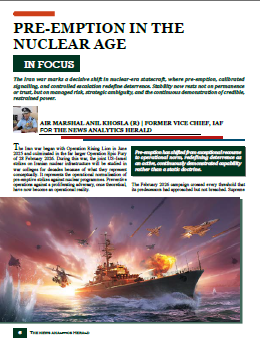
807: PRE-EMPTION AND NUCLEAR SIGNALLING IN THE CONTEMPORARY ERA: STRATEGIC IMPLICATIONS FOR INDIA


Article published in the May 26 edition of

The News Analytics Magazine


The Iran war began with Operation Rising Lion in June 2025 and culminated in the far larger Operation Epic Fury of 28 February 2026. During this war, the joint US-Israel strikes on Iranian nuclear infrastructure will be studied in war colleges for decades because of what they represent conceptually. It represents the operational normalisation of pre-emptive strikes against nuclear programmes.  Preventive operations against a proliferating adversary, once theoretical, have now become an operational reality.

The February 2026 campaign crossed every threshold that its predecessors had approached but not breached. Supreme Leader Khamenei was killed in the opening wave. IRGC leadership was decapitated. The key Iranian nuclear installations at Natanz, Fordow, and Isfahan were struck again, along with command architecture, missile production, and air defence systems. Yet catastrophic escalation has not followed, and the international system has absorbed it so far. This absorption is the strategic fact that changes everything.


Erosion of the Nuclear Taboo (From Osirak to Epic Fury)

The Cold War theory of deterrence rested on the foundational proposition that nuclear weapons created a protective envelope. They deter direct use of military force. This proposition has gradually eroded. Israel’s 1981 strike on Iraq’s Osirak reactor established what became known as the Begin Doctrine, i.e. no hostile neighbour would be permitted to acquire nuclear weapons, regardless of international law or diplomatic cost. The 2007 strike on Syria’s Al-Kibar facility extended the precedent. The Stuxnet cyber operation against Natanz in 2010 took it into the covert domain. Yet these attacks remained exceptional and limited, with denial. These attacks were not against a near-nuclear power with a ballistic missile arsenal and a functioning deterrence architecture. The 2025–2026 campaign is different in kind and degree. Iran possesses missiles capable of reaching Israel and American bases across the region. Striking it was pre-empting a perceived near-nuclear power while deliberately managing the risk of escalation to general war.


New Nuclear Signalling Paradigm

The new nuclear signalling paradigm consists of three distinct features. The first one is that deterrence is communicated through action rather than doctrine.  Second, escalation is managed by targeting discrimination rather than abstention; third, the nuclear threshold is maintained through real-time reinforcement rather than assumed stability.

Legitimisation of Pre-emption. A doctrine that cannot be justified is a doctrine that cannot be sustained. It was publicised that Iran’s programme had reached an irreversible breakout proximity. The strikes were legitimised as a necessary preventive measure. This is the first lesson of the new paradigm.  Pre-emption in the nuclear age requires strategic communication as much as operational capability.

Management of Escalation. The February 2026 strikes targeted enrichment infrastructure, command architecture, and IRGC leadership of Iran. Civilian infrastructure was not attacked, signalling limited objectives.  Iran’s retaliation consisted of missile barrages against Israeli cities and US Gulf bases, and the closure of the Strait of Hormuz. Both sides imposed costs on the other without crossing the threshold that would have made retreat impossible. This “controlled chaos” demonstrates that even in direct war between a nuclear power, a presumed nuclear power, and a threshold state, escalation can be managed if both sides retain the discipline and interest to do so.

Holding the Nuclear Threshold. Iran did not cross into nuclear use partly because weaponisation was incomplete, but also because the American strategic umbrella was made explicit in the weeks before the strikes — through repositioned assets, presidential statements, and back-channel communications that made the consequences of nuclear first use unambiguous. Extended deterrence did not merely exist; it was actively performed. The threshold was not held not because deterrence was passive but because it was continuously and visibly reinforced at the moment it was most needed.

Global Implications. The normalisation of pre-emptive strikes against nuclear infrastructure has far-reaching implications. The lesson for the near-nuclear-status states is that the period between “developing” and “possessing” can become an operational trigger point. A not-yet-complete enough-to-deter-nuclear programme is in great danger of adversary attack. For the non-proliferation regime, the damage is structural. The NPT relies on IAEA verification as the mechanism for distinguishing between civilian and military nuclear development. Military strikes that bypass this mechanism hollow out the regime’s legitimacy.


The Indian Calculus

India occupies a position of distinctive complexity in this new landscape. It is a nuclear-armed state with a declared No First Use doctrine, bordered by two nuclear-armed adversaries whose own postures diverge sharply from each other and from India’s own.

China’s nuclear doctrine, while historically minimalist, is in visible transition. It is rapidly expanding its ICBM silos, developing a more survivable sea-based deterrent, and progressively blurring the lines between conventional and nuclear delivery systems in its missile forces. These developments point toward a more assertive posture. China has not adopted preemption as declared policy. But its conventional military assertiveness means that the relevant Indian concern is not Chinese nuclear pre-emption but Chinese conventional operations that generate military pressure in the space below the nuclear threshold.

Pakistan presents a fundamentally more direct and disturbing challenge in this context. Pakistan’s nuclear posture is ambiguous, creating uncertainty about escalation thresholds. The Pakistani military’s institutional identification with its nuclear programme, the domestic political dynamics that any Pakistani government would face after absorbing a pre-emptive strike, and the genuine ambiguity about tactical thresholds all point toward escalation risk substantially higher than what obtained in the Iran case. India cannot assume that the Iran paradigm (i.e., strike, absorb limited retaliation, and manage to a ceasefire) would replicate in South Asia with the same level of containment.


Doctrinal Imperative for India

India’s No First Use doctrine has moral clarity, a stabilising function in crisis management, and diplomatic value in the international community.  It remains strategically sound and needs to be retained. But the NFU must be backed by a more explicit, operationally developed conventional deterrence capability and posture. The conventional deterrence posture should credibly signal that India can impose unacceptable costs on an adversary without resorting to nuclear first use. The Iran war demonstrates that pre-emption works when the pre-emptor has overwhelming conventional capability, credible backing, and a carefully constructed legitimising narrative. India must develop all three elements to deter the conditions that would make preemption appear necessary.

Simultaneously, India must develop protective infrastructure for its strategic assets (Critical military infrastructure, command-and-control nodes, and Weapon delivery systems). The investment in survivability, dispersal, hardening, and redundancy for India’s strategic assets is a strategic necessity and priority.


Concluding Thoughts

The operating rules of the Nuclear age are being rewritten. The new paradigm will shape the deterrence calculations globally for decades. The line between war and peace is no longer fixed; it is actively managed, contested, and increasingly blurred. For a country with India’s strategic geography, adversary configuration, and developmental ambitions, adapting to these developments is essential.

The Iran war has normalised pre-emption. Escalation control below the nuclear threshold is now a practised art form.  Deterrence is to be earned, not just declared in the doctrine. The question India must now answer is whether its doctrine, force structure, survivability investments, and strategic communication are credible enough to meet the new paradigm.

Please Add Value to the write-up with your views on the subject.


1910
Default rating

Please give a thumbs up if you  like The Post?


For regular updates, please register your email here:-

Subscribe


References and credits

To all the online sites and channels.

Pics Courtesy: Internet

Disclaimer:

Information and data included in the blog are for educational & non-commercial purposes only and have been carefully adapted, excerpted, or edited from reliable and accurate sources. All copyrighted material belongs to the respective owners and is provided only for wider dissemination.


References: –

  1. Brodie, B. (Ed.). (1946). The Absolute Weapon: Atomic Power and World Order. Harcourt, Brace.
  2. Clary, C., & Narang, V. (2019). India’s Counterforce Temptations: Strategic Dilemmas, Doctrine, and Capabilities. MIT Press.
  3. Narang, V. (2014). Nuclear Strategy in the Modern Era: Regional Powers and International Conflict. Princeton University Press.
  4. Chari, P. R. (2003). Nuclear restraint, nuclear risk reduction, and the security-insecurity paradox in South Asia. Nonproliferation Review, 10(1), 73–85.
  5. Clary, C. (2010). Thinking about Pakistan’s nuclear security in peacetime, crisis and war. IDSA Occasional Paper, 12, 1–47.
  1. Fitzpatrick, M. (2016). Iran and nuclear ambitions. Adelphi Papers, 45(374), 1–176.
  2. Sagan, S. D. (1994). The perils of proliferation: Organisation theory, deterrence theory, and the spread of nuclear weapons. International Security, 18(4), 66–107.
  1. Arms Control Association. (2025). Iran’s nuclear program: A history of key agreements and violations. Arms Control Association.
  1. Chaudhuri, R. (2023). India’s nuclear doctrine: Continuity and change. Carnegie Endowment for International Peace.
  1. International Atomic Energy Agency. (2025). Iran: Implementation of the NPT safeguards agreement and relevant provisions of Security Council resolutions (Report GOV/2025/14). IAEA Board of Governors.
  1. Panda, A. (2025). Pakistan’s nuclear posture after Nasr: Tactical weapons and strategic instability (Working Paper). Carnegie Endowment for International Peace
  2. Tellis, A. J. (2025). Striking Iran: What the US-Israeli operations mean for the Asian nuclear order. Carnegie Endowment for International Peace.
  3. Cooper, H., Schmitt, E., & Sanger, D. E. (2026, March 2). American bombers joined Israeli strikes on Iran in the February operation—The New York Times.
  4. Warrick, J. (2025, July 4). Iran’s nuclear infrastructure: What was hit and what remains. The Washington Post.
791: IRAN WAR: MANY QUESTIONS, DIVERSE PERCEPTIONS (PART 1)


The answers are collated from open sources. Information warfare and propaganda are generally active, as in any other war. Bias in the answers cannot be ruled out.


ORIGINS & CAUSES

  1. What were the root causes of the Iran-Israel conflict, and how did the US get drawn in?

The conflict’s deepest roots go back to a single transformative moment: Iran’s 1979 Islamic Revolution. The new regime did not merely dislike Israel — it wrote hostility toward it into its founding ideology, framing Israel as the “Little Satan” and an instrument of American imperialism in the region. What followed over the next four decades was a methodical Iranian effort to turn that ideological enmity into strategic reality: a nuclear programme advancing toward weapons capability, a large and growing ballistic missile arsenal, and the “Axis of Resistance” — a network of proxy forces positioned to threaten Israel from multiple directions simultaneously. For Israel, this combination eventually crossed the threshold from threat to existential danger.

The United States did not enter this conflict in a single decisive moment. Still, it drew in gradually — first as Israel’s primary partner in air defence, then as the guarantor of global non-proliferation norms that Iran was visibly eroding, and finally as a direct combatant when the Trump administration judged that Iran’s military weakening after the 2025 campaign had opened a window for military action.

  1. How did the October 7, 2023, Hamas attack reshape the broader confrontation?

October 7 set off a chain of events whose full strategic consequences Tehran almost certainly did not anticipate. The immediate result was the Gaza war — but what mattered more in the longer run was what Israel did in the wars that followed. Through 2024, Israel systematically degraded Hamas. More consequentially, between September and November 2024, it decapitated Hezbollah’s entire senior leadership in Lebanon — a blow that reverberated far beyond Lebanon itself. With Hezbollah broken, the Assad regime in Syria lost a critical pillar of support and collapsed in December 2024. By early 2025, the proxy buffer Iran had spent three decades carefully constructing — the forward deterrence that was supposed to keep any direct conflict away from Iranian territory — had been stripped away, component by component. Iran found itself exposed, facing Israel and the United States without the defensive depth its strategy had always assumed. October 7 was, in retrospect, proved to be a strategic miscalculation of historic proportions for Tehran.

  1. How did Iran’s “Axis of Resistance” strategy contribute to the escalation?

The Axis of Resistance was Iran’s answer to a fundamental strategic problem: how does a state threaten a powerful adversary without inviting direct retaliation on its own territory? The answer was proxy warfare — Hezbollah in Lebanon, Hamas in Gaza, the Houthis in Yemen, and Shia militias scattered across Iraq, each providing Iran with deniable reach and the ability to keep Israel under constant pressure from multiple fronts. After October 7, these forces launched coordinated barrages designed to overwhelm Israeli responses and demonstrate the axis’s power. Instead, they invited precisely the attrition campaign Israel had been preparing for — and one by one, the pillars of the network were destroyed. By the time direct Iran-Israel exchanges began in 2025, the axis had been reduced to survival mode: capable of rhetorical solidarity and occasional harassment strikes, but unable to mount the kind of coordinated strategic response that might have deterred Israeli action. Iran’s forward deterrence had been hollowed out. It was left to face its most powerful adversaries essentially alone.

PRIMARY GOALS & REGIME CHANGE

  1. What are the primary goals of the US and Israeli operation?

Operation Epic Fury (USA) / Roaring Lion (Israel), launched on 28 February 2026, was built around four core US military objectives: dismantling Iran’s ballistic missile arsenal and the industrial infrastructure that produces it; annihilating Iran’s navy and closing off its ability to threaten the Strait of Hormuz; permanently denying Iran a nuclear weapons capability; and degrading the IRGC command structure along with the proxy networks it funds and directs. Israel’s stated ambitions went further. Netanyahu framed the campaign not merely as the neutralisation of specific military capabilities but as the elimination of the “existential threat” posed by the Ayatollah regime — working down through Iran’s entire defence industrial chain, from the large IRGC-linked missile assembly plants to the smaller component suppliers that feed them. Trump, in his characteristic register, publicly framed the operation as delivering “freedom for the people of Iran” and ending the activities of the “number one state sponsor of terror.”

  1. Is “regime change” an official objective?

Not in so many words. Pentagon briefings have been careful to frame the campaign in terms of discrete military objectives — missiles, the navy, nuclear sites, proxy networks — rather than the fate of the Iranian government. But the gap between the stated military objectives and the unstated political ones is not hard to read. Trump and senior officials have spoken of toppling the clerical regime and called on Iranians to “seize their destiny.” The deliberate targeting and assassination of Supreme Leader Khamenei on the opening night of operations is not the kind of act a government undertakes when its goals are purely military. Analysts have consistently treated it as a calculated step toward regime collapse. Israel, by most serious assessments, holds regime change as a strategic objective — an expansion of the goals it set in the June 2025 Twelve-Day War. The real endgame, as analysts have described it, is what they call “strategic disarmament”: the permanent elimination of Iran’s ability to project power through missiles, nuclear latency, and proxy networks. Whether the regime itself survives that process in some diminished form or collapses entirely appears to be a secondary concern.

IRANIAN LEADERSHIP POST-KHAMENEI

  1. Who is leading Iran following the death of Supreme Leader Ali Khamenei?

Ali Khamenei was killed on 28 February 2026 in the opening strikes of Operation Epic Fury — the first sitting Supreme Leader to be assassinated in the history of the Islamic Republic. The immediate aftermath saw an interim three-person leadership council assume power: President Masoud Pezeshkian, Guardian Council member Ayatollah Alireza Arafi, and Judiciary head Gholam-Hossein Mohseni-Eje’i. The Assembly of Experts convened from 3 to 8 March and on 9 March unanimously elected Mojtaba Khamenei — the slain leader’s son — as his successor. He is 56 years old, deeply embedded in the IRGC, and regarded by those who know the Iranian system as a hardliner in his father’s mould, with no apparent inclination toward the kind of accommodation with the West that a less ideologically committed successor might have offered. The IRGC, meanwhile, holds de facto dominant power over security and decision-making in the vacuum the assassination created. Both Trump and Israel have already declared the appointment unacceptable. Israel has gone further — it has described Mojtaba Khamenei as a potential future target.


GLOBAL ENERGY MARKETS

  1. How will the war affect global energy markets?

The short answer is: badly, and possibly for a long time. Analysts have described the energy disruption as the worst shock to global markets since the 1970s oil crisis. The immediate trigger was Iran’s partial closure of the Strait of Hormuz — the narrow waterway through which roughly 20% of the world’s oil supplies and a significant share of LNG shipments pass every day. Within days of the closure, Brent crude surged from around $70 to over $110 per barrel, crossing $100 on 8 March 2026 for the first time in four years. European natural gas prices nearly doubled. Asian LNG costs spiked sharply. Tanker rates across the board soared as shipping companies rerouted or halted transits. Israeli strikes on Iran’s South Pars gas field and IRGC threats against Gulf oil infrastructure added a further layer of anxiety to already strained markets. The vulnerability is not evenly distributed. Around 80% of Asia’s oil imports pass through the Strait of Hormuz. Countries like Vietnam, Pakistan, and Indonesia hold emergency oil reserves estimated at less than 20 days — a dangerously thin buffer if the closure is prolonged. The International Energy Agency responded by releasing 400 million barrels from strategic reserves worldwide, a significant intervention that nonetheless covers only approximately four days of normal global demand.


RUSSIA AND CHINA

8. What are Russia’s and China’s positions?

Both countries have condemned the strikes in strong diplomatic language while doing very little that would concretely change the situation on the ground — a posture that has revealed, more clearly than any diplomatic formulation, how conditional their partnerships with Iran actually are.

Russia’s Foreign Minister Lavrov called the strikes “a deliberate, premeditated, and unprovoked act of armed aggression.” Putin expressed personal condolences over Khamenei’s death and called for an immediate ceasefire and return to diplomacy. Behind this public stance, however, Moscow has offered Tehran no direct military assistance. The reason is straightforward: Russia’s military is fully committed to Ukraine, and it has no interest in a confrontation with the United States over Iran. Russia’s bilateral strategic partnership treaty with Iran pointedly lacks a mutual-defence clause — a detail that matters enormously now. What Russia has reportedly done, behind the scenes, is share sensitive intelligence with Iran, including the precise locations of US warships and aircraft in the region — an allegation Putin publicly denied when Trump confronted him with it. Russia is also, it should be noted, a beneficiary of the conflict: elevated oil prices driven by Strait of Hormuz disruption directly ease the financial pressure of Western sanctions on Moscow.

China’s public position has been one of unambiguous condemnation. Beijing called the killing of Khamenei “a grave violation of Iran’s sovereignty” that “tramples on the purposes and principles of the UN Charter” and demanded an immediate halt to military operations. In practice, China’s support for Iran has been limited to diplomatic messaging, the supply of missile spare parts, and reported discussions on anti-ship missile systems — nothing that approaches direct military involvement. China abstained from a UN Security Council resolution condemning Iranian attacks on Gulf states, a studied ambiguity that reflects its desire to maintain working relationships with Gulf energy exporters even while criticising the US-Israeli campaign. Beijing’s longer game appears to be positioning itself as the indispensable post-conflict mediator and regional stabiliser. This power was not a party to the destruction and can therefore broker what comes after.


IMPACT ON REGIONAL ALLIES

9. What has been the impact on regional allies and the balance of power?

 Iran’s decision to widen its retaliation beyond Israel has produced a strategic result it almost certainly did not intend. By striking across nine countries — hitting US military installations and civilian infrastructure in Bahrain, Kuwait, Qatar, Saudi Arabia, Oman, and the UAE — Iran exposed Gulf states to direct attack at a scale they had not previously experienced. The effect has been paradoxical: governments that had carefully maintained public neutrality or quiet distance from the conflict have been pushed, covertly but unmistakably, toward the US-Israeli security umbrella. Intelligence-sharing with Israel is deepening. Security cooperation is expanding. Israeli defence exports to Gulf countries are growing. All of this is happening beneath the surface of public statements that continue to call for restraint and de-escalation. Iran’s proxy network, meanwhile, has been largely absent from the 2026 fighting — weakened by prior Israeli degradation, struggling to reconstitute, and capable of offering little more than solidarity gestures. The cumulative effect has been a significant and durable shift in the regional balance of power: Iran militarily diminished, its forward deterrence dismantled, and its neighbours moving — quietly but unmistakably — in the opposite direction.


(More to follow)


Please Add Value to the write-up with your views on the subject.


1910
Default rating

Please give a thumbs up if you  like The Post?


For regular updates, please register your email here:-

Subscribe


References and credits

To all the online sites and channels.

Pics Courtesy: Internet

Disclaimer:

Information and data included in the blog are for educational & non-commercial purposes only and have been carefully adapted, excerpted, or edited from reliable and accurate sources. All copyrighted material belongs to the respective owners and is provided only for wider dissemination.


English हिंदी