
774:INTEGRATION OF DIRECTED ENERGY WEAPONS ONTO MILITARY PLATFORMS


Article published in the CLAWS Yearbook 2025.


Directed Energy Weapons (DEWs), including high-energy lasers (HELs), high-power microwaves (HPMs), and particle beams, represent a transformative leap in military technology. Offering precision, speed, and cost-effectiveness compared to kinetic systems, DEWs engage targets at the speed of light with minimal collateral damage. As global militaries face evolving threats like drone swarms and hypersonic missiles, the strategic importance of integrating DEWs into naval, ground, air, and space platforms cannot be overstated. This article explores DEW integration’s technical, operational, strategic, and ethical dimensions, drawing on recent advancements and addressing challenges, global programs, and future implications.

Directed Energy Weapons: Technical FundamentalsDEWs emit focused energy, such as lasers, microwaves, or particle beams, to damage or disable enemy equipment, personnel, or facilities. Unlike conventional weapons, DEWs require no projectiles and engage targets at the speed of light. High-energy lasers focus photons to deliver thermal energy to burn through materials or disable sensors. High-power microwaves disrupt electronic circuits and communications by inducing currents in circuits. Though less developed, particle beams accelerate charged particles to damage targets at the molecular level. These systems are valuable against fast, low-cost, or swarm threats like drones, rockets, and small boats.[i]

Strategic Imperatives: DEW Integration. The rise of asymmetric threats—drone swarms, hypersonic missiles, and low-cost unmanned systems—drives DEW adoption. Traditional kinetic interceptors are often too slow or costly to counter these threats effectively. DEWs provide a layered defence, complementing kinetic systems to enhance resilience and flexibility. For example, lasers can neutralise drones while missiles engage larger threats, optimising resource allocation. Additionally, DEWs enhance deterrence by offering rapid, precise responses, reducing logistical burdens in sustained conflicts.

Technical Challenges of Integration. Integrating DEWs into platforms designed for kinetic munitions presents significant hurdles. These challenges vary by platform but share common themes, addressed through innovations like solid-state lasers, modular power kits, and AI-driven targeting.

    • Power and Thermal Management. The primary technical challenge is power generation. DEWs demand significant electrical energy, often in tens to hundreds of kilowatts for lasers and megawatts for microwaves, far beyond what existing vehicles or vessels were designed to provide. For instance, a 100 kW-class laser needs power and cooling infrastructure that challenges small air or ground platform integration.[ii] The platforms must have upgraded power generation systems, thermal management modules, hybrid power units or capacitor-based energy storage.
    • Beam Control and Targeting. Precision targeting is crucial for DEWs to be effective. Beam control is another critical factor. DEWs must maintain precision across long distances, compensating for atmospheric distortion, vibration, and platform movement. Atmospheric disturbances (for lasers) or electromagnetic interference (for HPMs) can degrade performance. Beam control systems must adapt dynamically, especially on mobile platforms or in contested electromagnetic environments.[iii] Advanced fire control radars, electro-optical/infrared sensors, and machine learning-based tracking algorithms are being developed to enhance the targeting and engagement cycles.
    • Size, Weight and Vibration Constraints. Airborne platforms present special problems due to vibration and limited space. Aircraft like fighter jets or UAVs must host compact DEW systems that can function reliably under dynamic conditions.


Platform Integration.

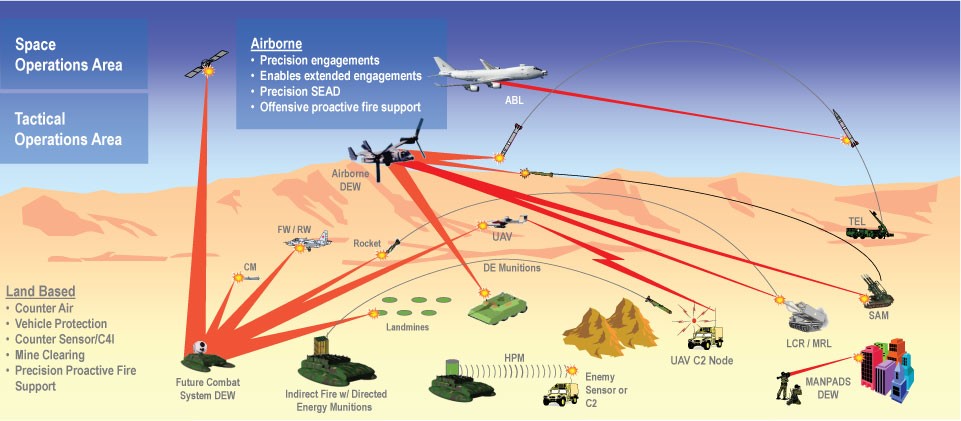
Integration into Naval Platforms. Naval vessels, such as destroyers and aircraft carriers, are prime candidates for DEW integration due to their robust power generation and deck space. Lasers enhance defence against anti-ship missiles, small boats, and drones, offering near-infinite shots compared to finite missile magazines. The U.S. Navy’s High Energy Laser with Integrated Optical-Dazzler and Surveillance (HELIOS, 60 kW) on destroyers exemplifies this, countering aerial and surface threats. India is exploring laser systems for warships to secure the Indian Ocean trade corridor. Challenges include retrofitting electrical grids, managing heat dissipation, and ensuring compact designs for smaller vessels.

Integration into Ground Platforms. On land, DEWs counter drones and loitering munitions, critical in asymmetric warfare seen in conflicts like Ukraine. The U.S. Army’s Directed Energy-Manoeuvre Short-Range Air Defence (DE-MSHORAD) mounts 50 kW lasers on Stryker vehicles, while India’s Mk-II(A) 30 kW laser, tested in April 2025, neutralised drone swarms at 5 km. Integration requires compatibility with networked systems, ruggedised optics for dust or extreme temperatures, and modular power solutions to maintain mobility.

Integration into Air Platforms. Airborne DEWs, designed for fighter jets or UAVs, counter incoming missiles at standoff distances. The U.S. Air Force’s Self-Protect High Energy Laser Demonstrator (SHiELD) equips jets with laser pods, while India envisions lasers on aircraft to counter regional missile threats. Challenges include limited onboard power (e.g., F-35’s 400 kW engine splits power across systems), heat dissipation without drag, and beam stability amid turbulence. With solar or hybrid power, UAVs may become ideal DEW platforms for long-endurance missions.

Integration into Space Platforms. Space-based DEWs, still nascent, hold potential for missile defence and satellite protection. Lasers could disable enemy satellites or intercept ballistic missiles during the boost phase. The U.S. Space Force explores megawatt-class Space-Based Lasers (SBL) powered by solar arrays. India’s satellite-mounted laser concepts aim to safeguard space assets. Challenges include power generation in compact designs, radiative cooling in vacuums, and targeting across long ranges. Legal concerns under the Outer Space Treaty, which prohibits weapons of mass destruction, limit deployment, though non-lethal applications like sensor dazzling may be permitted.[iv]


Global DEW Projects

Numerous countries are researching and developing these weapons, each with unique projects and strategic goals.[v] DEW development is a global race, with key players advancing unique projects:

United States. The US is a leader in DEW development. Besides Leonidas, the Department of Defence (DOD) and agencies like DARPA, the Air Force Research Laboratory, and the Naval Research Laboratory are researching DEWs to counter ballistic missiles and hypersonic cruise missiles.  The U.S. Navy has been a frontrunner in DEW integration. The Laser Weapon System (LaWS) was deployed on the USS Ponce in 2014.[vi] Subsequently, the U.S. Navy’s High Energy Laser with Integrated Optical Dazzler and Surveillance (HELIOS) system was tested on the USS Preble in 2022.  Its integration into the Aegis Combat System demonstrates the feasibility of combining DEWs with existing sensor suites.[vii] The U.S. Army’s Directed Energy-Manoeuvre Short-Range Air Defence (DE-MSHORAD) program aims to mount 50-kilowatt lasers on Stryker vehicles, but integration requires overcoming power and weight limitations.[viii] The US Army is exploring modular power kits, which combine batteries and compact turbines, to meet DEW demands without sacrificing mobility.  The U.S. Air Force’s Airborne High Energy Laser (AHEL) program seeks to equip platforms like the AC-130 gunship and F-35 fighter with lasers for precision strikes and missile defence. Tests in 2024 showed progress, with a 20-kilowatt laser successfully integrated onto a testbed aircraft.[ix] For special operations, lasers on AC-130s could provide silent, precise strikes, reducing reliance on munitions.[x]

China. China is making rapid strides in DEW development, focusing on high-energy lasers and microwave systems. State media and manufacturers have released images of handheld and vehicle-mounted laser systems, including the LW-30, a 30kW road-mobile high-energy laser (HEL). Their efforts extend to counter-space applications, with ground-based DEWs potentially targeting satellites. China’s military also solicits would-be suppliers for a new airborne laser weapon. Airborne laser pods are expected to be mounted on Chinese warplanes such as the Shenyang J-15 “Flying Shark” carrier-based fighter.

Russia. Russia has been developing DEWs for decades, with the Peresvet laser weapon system entering experimental combat duty in 2018 and claiming operational use during the 2022 invasion of Ukraine. A more advanced version, “Zadira,” can incinerate targets up to three miles away within five seconds. Russia is also working on EMP cannons and microwave guns for anti-drone applications.

Ukraine. [xi]Ukraine has unveiled a new laser weapon called “Tryzub” (Ukrainian for “trident”), which can shoot down aircraft over a mile away. During a defence conference, Colonel Vadym Sukharevskyi, Ukraine’s Unmanned Systems Forces commander, announced the weapon’s capabilities.

United Kingdom. The UK’s Ministry of Defence (MOD) is investing heavily in DEWs, with projects like DragonFire, a laser-directed energy weapon (LDEW) that achieved its first high-power firing against aerial targets in January 2024 at the Hebrides Range.  DragonFire is expected to be deployable by 2027. Additionally, the Radio Frequency Directed Energy Weapon (RFDEW) is nearing service by 2026, focusing on countering unmanned systems.

France and Germany. France and Germany are key players in European DEW development, often through multinational collaborations. France is involved in projects like the TALOS-TWO, involving 21 partners across eight EU nations. Germany is focusing on integrating DEWs into defence platforms. These efforts aim for operational deployment by 2030, emphasising cost-effective counter-drone and missile defence systems.

Israel. Israel is advancing the Iron Beam laser-based DEW, designed to complement its Iron Dome system. A contract signed in October 2024 for operational service within a year reflects its cost-effectiveness. The US has allocated $1.2 billion for Iron Beam procurement.

Iran and Turkey. Iran and Turkey claim DEWs in active service, adding controversy to global assessments. Iran has announced developments in laser air defence systems, while Turkey claims the ALKA DEW was used in combat in Libya in 2019. However, specifics and verification are scarce, with claims often met with scepticism due to limited transparency.

South Korea, Japan, and Australia. South Korea and Japan possess advanced technological capabilities, with South Korea developing laser-based systems for counter-drone applications, though not as prominently as major powers. Japan emphasises nuclear and space technologies, featuring limited public DEW projects. Australia is also investing in DEW technology, particularly for countering drones, which was highlighted by a £13 million deal with QinetiQ for a prototype defensive laser.


India’s DEW Programs.

India’s Defence Research and Development Organisation (DRDO) is actively pursuing DEWs, with projects like the Directionally Unrestricted Ray-Gun Array (DURGA II), a 100-kilowatt lightweight DEW set for integration with land, sea, and air platforms. Other initiatives include the KALI (Kilo Ampere Linear Injector), a particle accelerator and a 1 kW laser weapon for counter-IED operations, with plans for 25 kW and 100 kW systems.

DURGA Program. [xii]The DURGA initiative, spearheaded by the Defence Research and Development Organisation (DRDO), is dedicated to creating laser-based directed energy weapons (DEWs) to bolster India’s multi-tiered defence framework. This program focuses on developing laser systems to intercept and neutralise enemy missiles at various flight phases, enhancing India’s Ballistic Missile Defence (BMD) capabilities. Additionally, it aims to counter unmanned aerial systems (UAS) by deploying tactical laser weapons to disable drones threatening critical infrastructure and military assets. These weapons are designed for integration across land, air, and sea platforms, providing operational versatility in diverse environments. Public reports indicate that prototype laser-based DEWs under the DURGA program are currently being tested, with power levels ranging from 10 to 100 kilowatts, suitable for tactical and strategic purposes.

KALI Program. [xiii]Initially launched by the Bhabha Atomic Research Centre (BARC) with DRDO support, the KALI program began as a research effort into high-energy particle acceleration but has since evolved into a defence project focused on electronic warfare and non-lethal weaponry. The KALI system produces powerful electromagnetic pulses (EMPs) to disable enemy electronic systems, including radar, communication, and missile guidance systems. It also explores particle beam technology to neutralise targets without explosives, with potential applications such as disabling enemy satellites. The system’s scalability allows it to be used in both tactical operations and strategic deterrence, enabling non-lethal incapacitation of enemy equipment while preserving physical structures.

On April 13, 2025, [xiv] India successfully tested its first high-energy laser weapon, the Mk-II(A) Laser-Directed Energy Weapon (DEW), at the National Open Air Range in Kurnool, Andhra Pradesh. Developed by DRDO, this 30-kilowatt laser system demonstrated precise neutralisation of fixed-wing aircraft, drone swarms, and surveillance sensors at ranges up to 5 kilometers. Operating at the speed of light, the laser causes structural damage or destroys warheads, offering a cost-effective alternative to conventional munitions with minimal collateral impact. This achievement positions India alongside nations like the US, China, and Russia in advanced laser weaponry. DRDO aims to deploy the land-based system within two years, with plans for enhanced versions offering greater range and integration on ships, aircraft, and satellites. A 300-kilowatt “Surya” laser, capable of targeting high-speed missiles and drones up to 20 kilometers away, is also in development.


Strategic Operational and Doctrinal Implications

Integrating DEWs is a technical and doctrinal challenge that will reshape operational doctrines and force structures. Military planners must consider new rules of engagement, escalation risks, and interoperability with allied forces. Doctrinally, militaries are evolving from a kinetic-dominant mindset to one in which DEWs play complementary and sometimes primary roles, especially in contested and electronically dense environments.

Their low cost per shot and scalability enable sustained engagements, reducing logistical burdens. DEWs also enhance deterrence by providing rapid, precise responses to emerging threats like hypersonic missiles. However, DEWs introduce strategic risks. Adversaries may develop countermeasures, such as reflective coatings or electronic hardening, reducing their effectiveness. Proliferation of DEW technology could also destabilise conflicts, as non-state actors gain access to low-cost, high-impact weapons.[xv]

Operationally, DEWs require new training and tactics. Operators must understand beam propagation, power management, energy thresholds, atmospheric effects, engagement timelines and protocols, which differ from kinetic systems.

Moreover, AI and autonomous systems are increasingly paired with DEWs to handle target acquisition and prioritisation in real-time, particularly in drone swarm scenarios. Cybersecurity is also critical, as DEWs rely on networked sensors and software, making them vulnerable to hacking or electronic warfare.[xvi]

DEWs, especially dazzlers and HPMs, exist in a grey area of international law. The Protocol on Blinding Laser Weapons (Protocol IV) of the UN’s Convention on Certain Conventional Weapons (CCW) prohibits lasers specifically designed to cause permanent blindness.[xvii] However, systems designed for sensor blinding or equipment disablement are permitted.

Future of DEW-Enabled Battlefield

Future advancements will focus on scaling power output, improving efficiency, and reducing size. Solid-state lasers, which are more compact than chemical lasers, are driving this trend. Research into hybrid DEW-kinetic systems, where lasers complement missiles, could bridge capability gaps. Artificial intelligence will also play a role in optimising beam control and target prioritisation in complex environments. Looking ahead, several trends will define the future of DEW integration:

    • Hybrid Platforms. Future platforms will likely feature integrated DEW and kinetic options, with AI-driven decision-support systems guiding engagement choices.
    • Miniaturisation and Modularity. Advances in solid-state lasers, cooling, and power systems will allow smaller, modular DEW units suitable for a broader array of platforms.
    • Network-Centric Operations. DEWs will be part of larger sensor-to-shooter networks, leveraging battlefield data to optimise energy weapon use in multi-domain operations.
    • Export and Proliferation Risks. As DEW technologies become more widely available, concerns about proliferation and their use by non-state actors or rogue states will increase, requiring robust export control and countermeasure policies.

Conclusion

Directed Energy Weapons mark a paradigm shift in warfare, offering precision, cost-effectiveness, and scalability. Their integration on military platforms (naval, ground, air, and space) poses unique challenges. India should focus on incorporating Directed Energy Weapons (DEWs) into its military systems to strengthen its defence capabilities. This involves expediting the deployment of DURGA II (100 kW) across naval, air, and ground platforms, enhancing power and cooling systems on warships and aircraft such as the Tejas, developing AI-based targeting for accuracy in challenging environments, and integrating DEWs with existing integrated air defence systems. Partnering with allies on solid-state laser technology will ensure operational effectiveness.


Please Add Value to the write-up with your views on the subject.


1879
Default rating

Please give a thumbs up if you  like The Post?


For regular updates, please register your email here:-

Subscribe


References and credits

To all the online sites and channels.

Pics Courtesy: Internet

Disclaimer:

Information and data included in the blog are for educational & non-commercial purposes only and have been carefully adapted, excerpted, or edited from reliable and accurate sources. All copyrighted material belongs to respective owners and is provided only for wider dissemination.


References:-

[i]  J. R. Wilson, “Directed-Energy Weapons: Technologies, Applications and Implications,” Military & Aerospace Electronics, August 2021.

[ii] John Keller, “Power and Cooling Are Key Challenges in Directed-Energy Weapons,” Military & Aerospace Electronics, March 2023, 14-18.

[iii] Philip Ewing, “The Pentagon’s New Laser Weapon Blinds and Burns,” NPR, July 3, 2020.

[iv] Joan Johnson-Freese, Space Warfare in the 21st Century: Arming the Heavens (London: Routledge, 2016), 112-115.

[v] Khosla Anil, “LEONIDAS BY EPIRUS_ STAR TREK STYLE SHIELD OF DIRECTED ENERGY WEAPON”, The EurasianTimes, 29 Mar 25.

[vi] Sam LaGrone, “Navy Deploys Laser Weapon Prototype USS Ponce,” USNI News, December 10, 2014.

[vii] U.S. Navy, “HELIOS System Successfully Tested on USS Preble,” Naval News, August 2022, https://www.navalnews.com/naval-news/2022/08/helios-system-successfully-tested-on-uss-preble/.

[viii] Jen Judson, “Army’s DE-MSHORAD Prototype Zaps Drones in Latest Test,” Defense News, October 2023, https://www.defensenews.com/land/2023/10/05/armys-de-mshorad-prototype-zaps-drones-in-latest-test/.

[ix] Valerie Insinna, “Air Force Tests Airborne Laser on Testbed Aircraft,” Air Force Magazine, February 2024, https://www.airforcemag.com/air-force-tests-airborne-laser-testbed-aircraft/.

[x] Brian W. Everstine, “Lasers on AC-130s Could Redefine Special Operations,” Aviation Week, March 2023, 34-36.

[xi] Khosla Anil. “UKRAINE UNVEILS TRYZUB_ A GAME-CHANGING DIRECTED ENERGY WEAPON”, Air Marshal’s Perspective, 17 Feb 25.

[xii] Khosla Anil, “Edit Post “DURGA AND KALI_ INDIA’S DIRECTED ENERGY WEAPONS PROGRAM”, Air Marshal’s Perspective, 29 Apr 25.

[xiii] Ibid

[xiv] Khosla Anil, “INDIA ENTERS THE LASER AGE_ MK-II(A) DEW USHERS IN A NEW ERA OF DEFENCE TECHNOLOGY”,  Air Marshal’s Perspective, 16 Apr 25.

[xv] Paul Scharre, Army of None: Autonomous Weapons and the Future of War (New York: W.W. Norton, 2018), 201-205.

[xvi] Freedberg, “Lasers, Microwaves, and Particle Beams.”

[xvii] United Nations, “Protocol IV on Blinding Laser Weapons,” Convention on Certain Conventional Weapons, 1995.
740: DRDO’S OPTONIC SHIELD: FUTURE OF DEFENCE SECURITY


This article is based on news about Optonic Shield in secondary sources (Couldn’t find any official announcement by DRDO). 


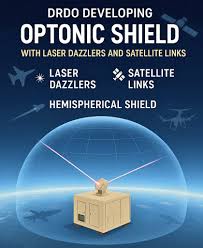
Reportedly, India’s Defence Research and Development Organisation (DRDO) is leading the way with a new defence system called Optonic Shield, which will revolutionise the nature of battles and security of essential assets. This indigenous system is likely to combine laser dazzlers, satellite communication, multifaceted electro-optical sensors and electronic warfare suites to create a hemispherical security shield. With the application of non-lethal DEWs, real-time intelligence sharing and AI-based analytical response, Optonic Shield will essentially respond to evolved threats like drones, missiles and swarm attacks.


Battlefield Transformation: Kinetic to Directed-Energy Dominance. The Optonic Shield basically would change the character of warfare by moving from traditional kinetic interceptors—guns and missiles—to a directed-energy response. It would have its core characteristics in the form of high-power laser dazzlers, which non-lethally blind or incapacitate optical sensors and guidance systems, providing a low-cost-per-shot solution with no limits to ammunition. This is especially critical in combating asymmetric threats, where low-cost UAVs and swarm UAVs, seen in recent wars, bypass conventional defences. The system’s capacity for extended engagements eliminates the numerical advantage of swarms, minimising attrition weariness on the defensive forces.


Hemispherical Coverage. Multispectral EO/IR sensors and satellite data links will provide full 360-degree panoramic situational awareness with no blind spots. Real-time coordination via secure satellite link also would enable immediate engagement, designation, and node integration. This is required for quick reaction to fast flying threats like hypersonic missiles or stealth drones, where conventional radars are often not able to track well. The Optonic Shield’s electro-optical tracking or glare detection and laser warning receivers make potential engagements possible at the speed of light, which improves accuracy while reducing overall reaction time.


Capability Enhancement. The Optonic Shield would enhance India’s deterrence by putting it alongside top countries like the US, China, Russia, and Israel in DEW capability. Its electronic warfare equipment would neutralise low-observable threats like stealth aircraft or guided munitions, enhancing defences against regional rivals with growing drone and missile capabilities. Imagery intelligence (IMINT) functions further enhance situational awareness, supporting dynamic response to threats in high-tempo, multi-domain operations.


Securing Critical Infrastructure. The Optonic Shield would provide coverage to essential assets with a paradigm shift from perimeter security to end-to-end aerial domes. High-value targets like airports, refineries, power stations, and energy installations, susceptible to drone penetration and saboteur attack, would get protection from the system. System’s 360-degree protection and laser dazzlers would disable hostile UAVs without endangering aircraft or passengers. EO/IR sensors would enable precise targeting in urban environments, where kinetic weapons could cause significant collateral damage. Satellite interface with air traffic control and national networks would facilitate quick threat remediation, as experienced in possible scenarios such as drone swarms interfering with flights. Data centers, which store critical digital content, are subject to hybrid threats from cyber and physical drone attacks. Jamming of communication and satellite signals, along with networked infrastructure, would work in tandem with cybersecurity features for complete protection. In urban and sensitive environments such as large-scale events, low collateral is necessary to maintain public safety, while operators make use of panoramic displays for effective monitoring.


Strategic Implications. The Optonic Shield represents local ingenuity, minimising foreign system dependence and support for national strategic autonomy priorities. Its modularity and scalability would enable customised deployments between borders, coasts, and metropolises. There are also deeper implications with denial-based deterrence; this could cause adversary states to reconsider their strategy of asymmetric warfare. The future versions may also leverage next-generation AI in the aspects of threat assessments and interfacing with missile defence, electronic warfare, or cyber domains.


Challenges and Limitations. Despite the promise of the Optonic Shield, challenges remain. Elements of the environment, such as rain, fog, or dust, multiply the laser beam; performance tests in India’s environment might be arduous. Beam control systems are in the process of development; however, it would be fair to say that a fair bit of innovation will be needed. High power requirements cause generation and cooling problems, especially for mobile platforms, making extended wartime operations difficult. Enemies may use countermeasures such as anti-laser paint or smoke screens that would force continuous advances in multi-spectral sensors and jamming technology. The timeline for deployment is another challenge. Complete Optonic Shield deployment, particularly satellite or aerial variants, could take years and involve a huge outlay. The reliance on satellites is indeed risky, with vulnerabilities to anti-satellite (ASAT) weapons from adversaries.  Efficacy in real-life scenarios against hypersonics or stealth has to be demonstrated.


Conclusion. As the DRDO advances the Optonic Shield, India will be at the forefront of future defence. The Optonic Shield would be an indigenous multi-layered, non-lethal system with complex real-world connections which radically change the way hybrid threats are defended against in both combat and homeland environments. By continuing to pivot to new solutions and protect India’s economic and strategic interests, India will entrench itself as a world-leader in warfare capabilities, and the Optonic Shield will usher India into the age of dynamic, responsive defence.


Please Add Value to the write-up with your views on the subject.

1879
Default rating

Please give a thumbs up if you  like The Post?


For regular updates, please register your email here:-

Subscribe


References and credits

To all the online sites and channels.

Pics Courtesy: Internet

Disclaimer:

Information and data included in the blog are for educational & non-commercial purposes only and have been carefully adapted, excerpted, or edited from reliable and accurate sources. All copyrighted material belongs to respective owners and is provided only for wider dissemination.


734: COUNTER-STEALTH TECHNOLOGIES AND THEIR EFFECTIVENESS


Stealth technology has revolutionised modern aerial warfare, allowing military aircraft to penetrate heavily defended airspace with reduced risk of detection. Advanced stealth aircraft such as the F-22 Raptor, F-35 Lightning II, and B-2 Spirit employ a combination of radar-absorbing materials (RAM), specialised shaping techniques, and electronic warfare capabilities to evade detection. However, as stealth capabilities evolve, so do counter-stealth technologies designed to detect, track, and engage these elusive targets. This article examines various counter-stealth technologies and evaluates their effectiveness against stealth aircraft.


Understanding Stealth Technology

Stealth technology is a sophisticated field of aerospace and military engineering that aims to reduce an aircraft’s detectability across various spectrums, including radar, infrared (IR), acoustic, and visual. The primary goal of stealth is not complete invisibility but rather a significant reduction in an aircraft’s signature to delay or complicate enemy detection. This enhances survivability, allowing aircraft to penetrate hostile airspace with a reduced risk of interception. Stealth technology has evolved over decades, with advancements driven by breakthroughs in materials science, aerodynamics, and electronic warfare. The development of modern stealth aircraft, such as the F-22 Raptor and the B-2 Spirit bomber, is a testament to the complexity and effectiveness of stealth principles.

Low Radar Cross-Section. A fundamental aspect of stealth design is the reduction of radar cross-section (RCS), which determines how much radar energy an aircraft reflects to a detecting system. Radar emits electromagnetic waves that bounce off objects and return to the receiver, creating an identifiable signature. By altering the shape of an aircraft, stealth engineers can redirect radar waves away from their source, making detection more difficult. This principle is evident in the angular surfaces of stealth aircraft, such as the F-117 Nighthawk, which were designed to deflect incoming radar signals rather than reflect them. Another critical method of RCS reduction is using Radar Absorbent Materials (RAM), which absorb radar waves instead of reflecting them. These materials typically comprise carbon-based composites and ferrite coatings that dissipate electromagnetic energy as heat, reducing the aircraft’s radar return. Combining shaping techniques and RAM coatings ensures that stealth aircraft remain difficult to track using conventional radar systems.

Infrared Signature. In addition to radar stealth, infrared (IR) signature reduction is crucial in modern stealth technology. Many air defence systems, particularly surface-to-air and air-to-air missiles, rely on heat-seeking sensors to lock onto an aircraft’s thermal emissions. Jet engines produce significant heat, making them prime targets for IR-guided missiles. To mitigate this vulnerability, stealth aircraft employ various IR suppression techniques. Engine nozzles are designed to minimise exhaust temperature by mixing hot gases with cooler ambient air, reducing the aircraft’s heat signature. Some designs, such as those in the B-2 Spirit, incorporate specialised exhaust vents that disperse heat over a wide area, further lowering thermal detectability. Additionally, stealth aircraft may use IR-suppressing coatings that help to absorb and dissipate heat, making them less visible to heat-seeking weapons. These measures collectively enhance the ability of stealth aircraft to evade detection from IR-based tracking systems.

Acoustic Signature. Another key component of stealth is acoustic signature reduction. Aircraft noise, generated by engines, airflow, and structural vibrations, can be a significant factor in detection, particularly at low altitudes. Advanced stealth aircraft use specially designed engine intakes and exhaust systems to minimise noise emissions. Engine placement and internal airflow management also reduce sound levels, making detection through acoustic sensors more difficult. This stealth aspect is crucial for helicopters and unmanned aerial vehicles (UAVs), which often operate in environments where ground-based sensors rely on audio detection methods.

ECM Integration. Furthermore, stealth aircraft integrate electronic countermeasures (ECM) to enhance survivability. ECM systems employ active measures such as radar jamming, decoys, and electromagnetic interference to disrupt enemy radar and missile guidance systems. These technologies can confuse enemy sensors, creating false targets or obscuring the aircraft’s position. Some stealth platforms also incorporate electronic warfare suites that detect and neutralise radar signals before they can be used to track the aircraft. Additionally, stealth aircraft may use low probability of intercept (LPI) communication systems to maintain secure transmissions while minimising the risk of detection by enemy electronic surveillance. This layered approach ensures that stealth aircraft maintain an operational advantage even when confronted with advanced air defence networks.


Challenges in Countering Stealth Aircraft

Detection vs. Targeting. One of the primary challenges in countering stealth aircraft lies in the distinction between detection and targeting. While low-frequency radars, such as over-the-horizon (OTH) and VHF-band systems, can detect the presence of stealth aircraft, they lack the precision needed to provide reliable targeting data. These radars generate larger, less defined returns, making it challenging to guide weapons effectively. In contrast, high-frequency radars used for targeting, such as fire-control radars, struggle to detect stealth aircraft due to their reduced radar cross-section (RCS). To bridge this gap, modern air defence networks attempt to integrate data from multiple sensors, including passive detection systems, infrared search and track (IRST), and multi-static radar arrays. However, coordinating these systems to produce an actionable targeting solution remains a significant technical hurdle.

Electronic Warfare (EW). Another major obstacle is stealth aircraft’s electronic warfare (EW) capabilities, which are designed to counteract detection and engagement. Modern stealth platforms employ advanced jamming techniques, radar deception methods, and decoys to disrupt enemy sensors and missile guidance systems. These aircraft can also alter their radar signatures dynamically, making them more challenging to track consistently. Furthermore, cyber warfare and electronic attacks can degrade enemy air defence networks, reducing their ability to coordinate effective countermeasures. As stealth aircraft continue to incorporate cutting-edge EW technology, adversaries must develop more resilient and adaptive detection and engagement strategies.

Operational Limitations. Operational limitations further complicate counter-stealth efforts. Terrain, atmospheric conditions, and electronic interference can all degrade the performance of radar and sensor networks. Mountainous regions, for example, create radar blind spots that stealth aircraft can exploit to avoid detection. Adverse weather conditions, such as heavy rain or storms, can impact the effectiveness of infrared sensors and degrade radar resolution. Additionally, dense electromagnetic environments, particularly in combat zones where multiple systems operate simultaneously, can generate signal interference and reduce the reliability of counter-stealth measures. Overcoming these challenges requires improved sensor fusion, AI-driven data processing, and the development of more adaptable surveillance networks.

Evolving Stealth Technologies. The rapid evolution of stealth technology presents an ongoing challenge for air defence systems. Advances in materials science, including next-generation radar-absorbent materials (RAM), allow stealth aircraft to reduce their radar visibility further. Additionally, innovations in aircraft design, such as active stealth techniques that manipulate radar reflections in real-time, push the boundaries of detectability. Hypersonic stealth platforms and unmanned stealth drones introduce new variables, requiring defences to anticipate unconventional flight profiles and sensor signatures. As counter-stealth technologies improve, stealth aircraft manufacturers continuously refine their designs to stay ahead. This ensures that the cat-and-mouse game between stealth and detection remains a dynamic and evolving contest.


Stealth Vulnerabilities

Stealth technology has long provided a tactical advantage in modern air warfare by enabling aircraft such as the F-35 Lightning II, F-22 Raptor, SU-57, J-20 and J-31 to evade conventional radar detection. These aircraft incorporate radar-absorbent materials, shaping techniques, and emission control measures to minimise their radar cross-section (RCS). However, advancements in detection technology are increasingly challenging the effectiveness of stealth designs, potentially undermining their strategic superiority.

Broadband Detection. Stealth aircraft are primarily optimised to evade detection within specific radar bands, particularly the X-band, which is commonly used in fire-control radars. However, modern air defence systems increasingly rely on broadband detection, utilising low-frequency radars that stealth coatings are less effective against. These lower-frequency bands, such as VHF and UHF, can detect and track stealth aircraft at longer ranges by exploiting their larger radar cross-section in these wavelengths. Additionally, multi-static radar networks, which use multiple transmitters and receivers, can mitigate stealth advantages by detecting subtle radar returns from different angles.

Operational Emissions. Despite strict emission control protocols, stealth aircraft inevitably produce electronic and infrared signatures that can be exploited for detection. Engine heat, electromagnetic emissions from onboard systems, and even aerodynamic disturbances contribute to a detectable presence. Passive detection networks, which do not emit signals themselves, can track these emissions using advanced electronic warfare and sensor fusion techniques. These systems analyse anomalies in the electromagnetic spectrum, triangulating stealth aircraft positions without relying on active radar. With improvements in signal processing and AI, adversaries are becoming more capable of detecting and tracking stealth platforms based on their unintended emissions.

Environmental Factors. Environmental conditions such as rain, humidity, and temperature variations can significantly impact stealth technology. For instance, moisture accumulation or ice formation on radar-absorbent materials can temporarily degrade their effectiveness, increasing radar returns. Similarly, high-speed flight through rain or dust can erode stealth coatings over time, reducing their ability to absorb radar signals. Atmospheric disturbances, such as ionised layers from solar activity, can also interfere with stealth aircraft signatures, making them more visible to specific types of radar. As stealth technology advances, new materials and coatings will be required to mitigate these environmental vulnerabilities.

Data Fusion Technologies. Advancements in artificial intelligence and sensor fusion are revolutionising counter-stealth detection. Modern air defence networks integrate data from multiple sources—including radar, infrared, acoustic, and electromagnetic sensors—to create a comprehensive situational awareness picture. AI-driven algorithms analyse patterns and anomalies, correlating weak signals across different detection methods to identify stealth aircraft. By fusing information from distributed sensors, these systems reduce reliance on any single detection method, making it increasingly difficult for stealth aircraft to operate undetected. As AI and big data analytics evolve, multi-sensor tracking will become crucial in countering stealth threats.


Counter-Stealth Technologies

Stealth is not foolproof, and counter-stealth technologies continue to evolve. Long-wavelength radar, passive detection systems, and advanced data fusion techniques are being developed to enhance the ability to track stealth aircraft. Additionally, thermal imaging and multi-static radar networks offer new avenues for countering stealth. The ongoing arms race between stealth and counter-stealth technologies ensures that offensive and defensive strategies must continually adapt. Despite these challenges, stealth remains a crucial force multiplier, allowing aircraft to operate with a more significant tactical advantage in contested environments where detection equals vulnerability.

Low-Frequency Radar (VHF/UHF Band). Low-frequency radars operating in the VHF (30–300 MHz) and UHF (300 MHz–3 GHz) bands present a significant challenge to stealth aircraft, which are optimised to evade higher-frequency radars such as X-band and C-band used in fire-control systems. These lower-frequency radars exploit the limitations of stealth shaping, as their longer wavelengths reduce the effectiveness of radar-absorbent materials and stealth geometry. Additionally, resonance effects occur when the radar wavelength is comparable to an aircraft’s physical dimensions, increasing its radar cross-section (RCS) and making it more detectable. Although VHF/UHF radars typically have lower resolution and accuracy than their higher-frequency counterparts, they provide valuable early warning and situational awareness. Systems such as Russia’s Nebo-M and China’s JY-27A are designed to detect stealth aircraft at long ranges, acting as force multipliers when integrated with high-frequency fire-control radars. The primary advantage of low-frequency radars is their ability to mitigate stealth aircraft’s key survivability features, as stealth coatings are more effective at absorbing high-frequency waves than low-frequency ones. Furthermore, the large wavelengths of VHF/UHF radars diminish the benefits of stealth aircraft’s shape-based scattering techniques, increasing the likelihood of detection. However, their lower resolution prevents them from providing precise targeting information, necessitating supplementary high-frequency radars or passive tracking methods for engagement. In modern air defence networks, low-frequency radars are essential to multi-band sensor fusion, cueing high-resolution tracking radars or infrared systems to refine target data. This layered approach improves the effectiveness of counter-stealth strategies, particularly in integrated air defence systems (IADS). As stealth aircraft continue to evolve, so do radar technologies, with advancements in digital signal processing and networked sensor integration enhancing the capability of low-frequency radars to detect and track low-observable targets more effectively.

Passive Radar Systems. Passive radar systems offer a highly effective countermeasure against stealth aircraft by leveraging ambient electromagnetic signals, thermal radiation, and acoustic emissions instead of actively transmitting radar waves. Unlike conventional radars, passive systems cannot be jammed or detected, making them particularly valuable in electronic warfare. Since stealth technology primarily reduces radar cross-section (RCS) but does not eliminate emissions, passive detection methods can exploit stealth aircraft’s inherent weaknesses. One key method is electromagnetic emission tracking, where systems detect signals from aircraft data links, sensor emissions, or satellite communications (e.g., Link-16 or SATCOM). Another method involves acoustic detection, where ground-based or airborne microphones capture engine noise or aerodynamic disturbances caused by stealth aircraft. Passive radar systems like the Czech VERA-NG, which analyses reflections of civilian communication signals, have demonstrated the capability to detect stealth aircraft at long ranges. Similarly, the U.S. Silent Sentry system utilises radio signals from existing infrastructure for passive detection. However, passive radars require a dense network of ambient signal sources, making them more effective in urban environments or areas with extensive radiofrequency activity. The lack of active emissions allows passive systems to operate covertly, reducing the risk of electronic countermeasures. Modern air defence networks increasingly integrate passive sensors alongside traditional radars to enhance situational awareness and counter stealth threats. As stealth aircraft evolve, passive detection advances—especially in signal processing and sensor fusion—will likely play a crucial role in future air defence strategies, complementing active radar systems in multi-layered detection networks.

Infrared Search and Track (IRST) Systems. Infrared Search and Track (IRST) systems are passive sensors that detect the heat signatures of aircraft engines and airframe friction, making them highly effective against stealth aircraft designed to evade radar detection. Unlike radar, IRST does not emit signals, making it immune to electronic jamming and stealth coatings that primarily reduce radar cross-section (RCS). Modern IRST systems, such as those on the Russian Su-35 and Chinese J-20, can detect stealth aircraft at ranges of up to 50 kilometres under favourable conditions, providing a critical advantage in air combat. However, their effectiveness is influenced by atmospheric conditions, as infrared tracking is degraded by factors such as heavy cloud cover, rain, or high humidity, which absorb and scatter infrared radiation. Advanced IRST systems are often integrated with radar and other sensors in a multi-sensor fusion approach to maximise accuracy and tracking capability. By combining infrared detection with radar data, pilots and air defence operators can enhance target tracking, reduce reliance on radar emissions, and improve situational awareness. Some modern IRST systems also feature advanced algorithms for filtering background noise and distinguishing aircraft heat signatures from environmental sources. As stealth aircraft continue to evolve, IRST technology is also advancing, with sensor resolution, range, and processing speed improvements, making it an increasingly vital tool in modern air combat. Future developments may focus on integrating IRST with artificial intelligence (AI) and data-link networks to further target acquisition and tracking capabilities in complex environments.

Multi-Static Radar Networks. Multi-static radar networks use multiple transmitters and receivers distributed over a wide area to detect and track stealth aircraft from various angles, making them a powerful countermeasure against low-observable (LO) technology. Unlike mono-static radars, where the transmitter and receiver are co-located, multi-static radars exploit stealth shaping optimisation for specific radar angles. By receiving scattered signals from different perspectives, these systems increase the probability of detecting stealth aircraft, reducing the effectiveness of radar cross-section (RCS) minimisation techniques. Additionally, multi-static radars can leverage passive detection methods by using ambient signals, such as civilian radio, television broadcasts, or mobile phone networks, further complicating stealth aircraft operations. One of the key advantages of multi-static radar is its ability to operate in environments where monocratic radars might struggle, particularly against aircraft employing electronic countermeasures (ECM) or low-observable design features. The spatial separation of transmitters and receivers also makes it difficult for stealth aircraft to avoid detection through a single approach angle. However, multi-static networks require adequate infrastructure and coordination, including precise synchronisation between transmitters and receivers and advanced signal processing to filter out background noise. Both NATO and Russia have invested heavily in multi-static radar technology to counter stealth threats, with examples including Russia’s “Nebo-M” multi-band radar system and Britain’s “CELLDAR,” which utilises cell phone signals for detection. As air defence networks evolve, multi-static radars are increasingly integrated into layered detection systems, combining active and passive sensors to enhance situational awareness. Future developments will likely focus on improving data fusion, automation, and artificial intelligence (AI)-assisted tracking to improve further these advanced radar networks’ detection and targeting capabilities.

AI-Powered Sensor Fusion and Big Data Analytics. AI-powered sensor fusion and big data analytics are revolutionising modern air defence by integrating data from multiple sensor types, including radar, Infrared Search and Track (IRST), and signal intelligence (SIGINT). This approach enhances target detection, tracking, and classification, significantly improving counter-stealth capabilities. Traditional sensors have limitations—radars struggle against low-observable designs, IRST is affected by weather conditions, and passive systems rely on external signal sources. AI-driven sensor fusion mitigates these weaknesses by combining data from diverse sources, enabling a more comprehensive and resilient air defence network. Artificial intelligence (AI) is crucial in analysing vast amounts of sensor data in real-time, identifying patterns indicative of stealth aircraft operations. AI-powered algorithms can correlate radar, infrared, passive RF, and acoustic sensor inputs to refine target detection. Machine learning models can also predict stealth aircraft flight paths based on historical data and environmental factors, allowing air defence operators to anticipate and counter threats more effectively. AI also improves target discrimination, reducing false alarms caused by clutter, decoys, or electronic countermeasures. Nations like China and the United States are investing heavily in AI-powered air defence solutions, recognising their potential in countering stealth technologies. Advanced air defence networks now employ hybrid sensor fusion techniques, integrating multiple detection methods to overcome stealth advantages. AI-driven decision-making enhances situational awareness, allowing operators to track and engage stealth threats with greater precision. Future advancements will likely focus on real-time data processing, automated response systems, and deep learning models that continuously adapt to evolving stealth tactics.

Over-the-Horizon (OTH) Radar. Over-the-horizon (OTH) radar systems are advanced surveillance tools that extend detection capabilities far beyond the visual and radar horizon by utilising skywave or surface-wave propagation. Unlike conventional radars, which rely on direct line-of-sight, OTH radars operate at lower frequencies, typically in the high-frequency (HF) or very-high-frequency (VHF) bands, allowing their signals to reflect off the ionosphere or travel along the surface of the ocean. This enables them to detect aircraft, ships, and even missile launches at ranges extending thousands of kilometers. A key advantage of OTH radar is its ability to counter stealth technology. Modern stealth aircraft, such as the F-35 and B-2, are optimised to evade short-range, high-frequency radars through shaping techniques that deflect signals from their source. However, OTH radars, due to their reliance on lower frequencies, are less affected by these design principles, making them valuable for early warning and strategic defence systems. Several nations have invested heavily in OTH radar technology, with Russia’s “Container” and China’s “Skywave” systems being notable examples. These radars continuously monitor vast air and maritime spaces, enhancing national security and situational awareness. Despite their advantages, OTH radars have limitations, such as reduced resolution compared to higher-frequency radars and susceptibility to ionospheric conditions that can affect signal clarity. Nevertheless, their ability to provide long-range detection makes them a crucial component of modern defence architectures, especially in an era where traditional radar evasion tactics are becoming increasingly sophisticated.

Quantum Radar (Emerging Technology). Quantum radar is an emerging technology that harnesses the principles of quantum mechanics, particularly quantum entanglement, to achieve unprecedented sensitivity in detecting stealth aircraft and other low-observable targets. Unlike conventional radar systems, which rely on radio wave reflection, quantum radar generates entangled photon pairs, transmitting one while retaining the other for comparison. Any interaction between the transmitted photons and an object, such as a stealth aircraft, disturbs their quantum state, allowing precise detection even against radar-evading materials and shaping techniques. This unique approach theoretically overcomes traditional radar limitations, making quantum radar highly resistant to electronic warfare tactics like jamming and reducing the effectiveness of stealth coatings designed to absorb or deflect signals. Additionally, quantum radar does not require high-power emissions, lowering the risk of detection by adversaries while maintaining long-range accuracy. If successfully developed, this technology could revolutionise air defence by providing a quantum leap in situational awareness, particularly in detecting advanced threats like hypersonic vehicles and next-generation stealth aircraft. However, practical deployment remains a significant challenge due to the fragile nature of quantum entanglement, environmental interference, and the need for ultra-low temperatures to maintain coherence in quantum states. While research is ongoing in countries such as China and the United States, no fully operational quantum radar systems have been fielded yet. Nonetheless, if these technical barriers are overcome, quantum radar could redefine modern warfare by rendering stealth technology ineffective and providing unparalleled early warning capabilities.


Case Studies of Counter-Stealth Systems and Operations

Counter-stealth operations have evolved as air defence networks adapt to the growing threat of stealth aircraft. While stealth technology reduces an aircraft’s radar cross-section (RCS) and infrared (IR) signature, historical and contemporary engagements demonstrate that stealth platforms are not invulnerable. Case studies of counter-stealth operations illustrate the challenges and solutions in detecting and engaging stealth aircraft.

1999 Kosovo War (F-117 Shoot Down). One of the well-documented counter-stealth successes occurred during the NATO bombing of Yugoslavia in 1999. On March 27, a Serbian air defence unit, using a Soviet-built S-125 Neva (SA-3 Goa) surface-to-air missile (SAM) system, shot down a U.S. Air Force F-117 Nighthawk stealth fighter. The engagement exposed vulnerabilities in early stealth designs and demonstrated how an adversary could exploit operational mistakes. The Serbian air defence forces adapted their tactics by using low-bandwidth radars in short bursts to detect the F-117. Additionally, intelligence gathering and visual spotting helped track stealth aircraft flight patterns. The downing of the F-117 underscored the importance of integrating multiple detection methods, including passive surveillance and human intelligence, to counter stealth threats.

US Methodology. The U.S. employs a multi-layered approach to counter stealth technology, integrating advanced radar systems, sensor fusion, and networked air defence. One key element is using low-frequency radars, such as Over-the-Horizon (OTH) and VHF/UHF-band radars, less affected by stealth-shaping techniques. Systems like the U.S. Air Force’s AN/TPS-77 and Navy’s E-2D Hawkeye help track stealth aircraft by exploiting their larger radar cross-section at lower frequencies. Additionally, the U.S. focuses on sensor fusion, combining data from multiple sources—including space-based infrared satellites (SBIRS), airborne early warning aircraft, and ground-based radars—to effectively track stealth threats. Passive detection methods, such as bistatic and multi-static radar, enhance stealth detection by analysing how signals interact with different surfaces. Emerging technologies, including artificial intelligence (AI) and quantum radar, are also being explored to improve target identification and tracking. The F-35 and F-22, while designed for stealth, also incorporate advanced sensors and data-sharing capabilities to detect and counter enemy stealth aircraft. By integrating these diverse capabilities into a networked defence strategy, the U.S. aims to neutralise the advantages of stealth technology and maintain air superiority in modern warfare.

Russian Approach. Russian forces have invested in over-the-horizon (OTH) radar systems, such as the Rezonans-NE and Container radar, designed to detect stealth aircraft at long ranges using low-frequency signals. These radars are supplemented by infrared search and track (IRST) systems, which provide an alternative method of detecting stealth aircraft by tracking heat signatures rather than radar reflections. During operations in Syria, Russian air defences, including the S-400 Triumf system, reportedly tracked U.S. stealth aircraft such as the F-22 Raptor and F-35 Lightning II. Although no confirmed engagements occurred, reports suggest that Russian multi-layered detection networks were able to identify and monitor stealth aircraft operating in contested airspace.

Chinese Focus. China has focused on counter-stealth strategies by investing in quantum radar technology, passive detection systems, and AI-enhanced sensor fusion. Chinese military analysts have acknowledged the challenge posed by U.S. and allied stealth aircraft, particularly in the Indo-Pacific region, where air superiority is critical. China has developed the JY-27A long-range early warning radar and YLC-8E anti-stealth radar to counteract these threats in the VHF and UHF bands. These radars are designed to detect stealth aircraft at significant distances, providing targeting data for integrated air defence systems. Additionally, China has expanded its electronic warfare (EW) capabilities, employing jamming and cyber warfare techniques to disrupt stealth aircraft operations. Reports indicate that China has been able to detect and track U.S. stealth aircraft patrolling near its airspace, further demonstrating the growing effectiveness of counter-stealth measures.

Indian Effort. India’s approach to countering stealth aircraft involves a combination of low-frequency radar systems, multi-layered air defence, and emerging technologies. The Indian Air Force (IAF) and Defence Research and Development Organisation (DRDO) are investing in advanced radar systems capable of detecting low-observable aircraft. The Rohini and Arudhra radars, operating in lower frequency bands, provide improved detection of stealth threats. At the same time, the Long-Range Tracking Radar (LRTR), developed for India’s Ballistic Missile Defence (BMD) program, enhances early warning capabilities. Additionally, India is acquiring Russian-origin systems like the S-400 Triumf, which integrates multi-band radar and sophisticated tracking algorithms to detect and engage stealth aircraft at long ranges. India also focuses on networked air defence, integrating multiple radar and sensor platforms through the Integrated Air Command and Control System (IACCS) to enhance situational awareness. Passive detection methods, such as electronic intelligence (ELINT) and infrared search and track (IRST) systems, are being developed to complement radar-based detection. Furthermore, India is exploring emerging technologies like quantum radar and AI-driven sensor fusion to enhance its anti-stealth capabilities in the future. By combining these efforts, India aims to mitigate the advantages of stealth aircraft and strengthen its air defence posture against evolving threats.

These case studies highlight the continuous evolution of counter-stealth operations. While stealth technology provides a significant advantage, adversaries constantly develop new detection and engagement methods. The ongoing arms race between stealth aircraft and counter-stealth defences ensures future conflicts will see further advancements in stealth capabilities and detection technologies.


Future Trends in Counter-Stealth Technologies

Integration of Space-Based Sensors. One of the most promising advancements in counter-stealth technology is the integration of space-based sensors. Satellites with advanced infrared detection and synthetic aperture radar (SAR) capabilities can significantly enhance air defence networks by providing persistent global surveillance. Unlike ground-based radars, which are limited by terrain and atmospheric conditions, space-based sensors operate from low-Earth orbit, offering a broader and less obstructed view of stealth aircraft. Modern infrared sensors can detect the heat signatures of aircraft engines, even when traditional radar fails to pick them up due to low observability techniques such as radar-absorbent materials and shaping. Additionally, SAR technology can continuously monitor stealth platforms in all weather conditions by utilising high-frequency radio waves that penetrate cloud cover and darkness. These sensors can be integrated into existing air defence systems to provide early warning and improve target acquisition, particularly in contested environments where traditional radar infrastructure may be vulnerable. With advancements in artificial intelligence and machine learning, these space-based detection systems can process vast amounts of data in real-time, identifying stealth threats faster and more accurately than ever. As more nations invest in space-based ISR (intelligence, surveillance, and reconnaissance) capabilities, stealth aircraft may find it increasingly challenging to operate undetected.

Hypersonic Defence Systems. The rapid development of hypersonic weapons has accelerated the need for advanced air defence systems capable of countering high-speed, manoeuvrable threats—including stealth aircraft. Future hypersonic defence solutions will likely include next-generation interceptors that can engage stealth platforms before penetrating defended airspace. Unlike traditional air defence missiles, which may struggle to engage low-observable aircraft at long ranges, hypersonic interceptors can leverage extreme speed and kinetic energy to neutralise threats before they can evade detection. These interceptors will be equipped with advanced seekers, incorporating multi-mode sensors that combine radar, infrared, and possibly even quantum imaging technologies to track stealth targets more effectively. Additionally, advanced command-and-control networks will support high-speed missile defences using real-time data from space-based and ground-based sensors to enhance tracking and targeting precision. Autonomous AI-powered decision-making could reduce reaction times, allowing air defence networks to engage stealth aircraft before deploying weapons or escaping detection. As hypersonic missile technology progresses, stealth aircraft are expected to face increased challenges in penetrating heavily defended regions, forcing them to adopt new tactics or countermeasures to remain survivable in future air combat scenarios.

Directed Energy Weapons (DEW). Directed Energy Weapons (DEW), particularly high-energy lasers and microwave systems, represent a game-changing approach to countering stealth aircraft. Unlike conventional air defence systems that rely on kinetic interceptors, DEWs can engage targets at the speed of light, offering near-instantaneous response times with minimal logistical constraints. High-energy lasers, for instance, could be used to blind or damage optical and infrared sensors on stealth aircraft, degrading their situational awareness and forcing them to rely on active sensors that expose their position. More powerful laser systems could heat and damage radar-absorbent coatings or structural components, making aircraft more vulnerable to traditional tracking methods. Additionally, high-power microwave weapons could disrupt or disable electronic systems onboard stealth aircraft, neutralising their advanced avionics and communications without the need for direct impact. Integrating DEWs into modern air defence networks would provide a cost-effective and scalable solution for countering stealth threats, as laser and microwave weapons do not require expensive missile stockpiles or reloading. As technological advancements continue, DEWs will likely become a critical component of future integrated air defence systems, potentially rendering some stealth technology obsolete in high-threat environments.


Conclusion

While stealth aircraft provide a significant tactical advantage, counter-stealth technologies are evolving rapidly. Countries worldwide are investing heavily in multi-domain detection systems to reduce the effectiveness of stealth platforms. No single countermeasure is foolproof; instead, the most effective approach involves a combination of radar, infrared, passive detection, AI-driven data fusion, and multi-static systems. Future developments in quantum radar and space-based detection may further challenge stealth dominance, shaping the future of aerial warfare. To maintain their strategic edge, future stealth designs must incorporate adaptive materials, enhanced electronic warfare capabilities, and multispectral countermeasures. As detection methods continue to improve, the survivability of stealth platforms will depend on continuous innovation and the integration of complementary technologies.


Please Add Value to the write-up with your views on the subject.


1879
Default rating

Please give a thumbs up if you  like The Post?


For regular updates, please register your email here:-

Subscribe


References and credits

To all the online sites and channels.

Pics Courtesy: Internet

Disclaimer:

Information and data included in the blog are for educational & non-commercial purposes only and have been carefully adapted, excerpted, or edited from reliable and accurate sources. All copyrighted material belongs to respective owners and is provided only for wider dissemination.


References:-


  1. Goure, Daniel. The Role of Stealth in Air Warfare: A RAND Perspective. RAND Corporation, 2013.


  1. Ball, Desmond. Assessing the Effectiveness of Counter-Stealth Technologies. Australian Strategic Policy Institute, 2016.


  1. John, Nicholas. Detection of Low Observable Aircraft: Advances in Radar and Sensor Fusion Technologies. Journal of Defence Research, vol. 15, no. 3, 2021, pp. 45-60.


  1. Ewers, Justin, and Barr, Rebecca. Challenges and Opportunities in Counter-Stealth Operations. U.S. Air Force Research Laboratory, 2019.


  1. Sweetman, Bill. Stealth Aircraft: Secrets of Future Airpower. Motorbooks International, 1992.


  1. U.S. Department of Defence. Radar Systems and Stealth Countermeasures: Annual Report to Congress. Pentagon, 2022.


  1. Indian Defence Research and Development Organisation (DRDO). Advancements in Low-Frequency Radar Technology for Air Defense. DRDO Publication, 2021.


  1. Russian Ministry of Defence. Over-the-Horizon Radar: A Key Element in Modern Air Defence. Moscow Defence Journal, 2020.


  1. Radarsky, Alexei. “The Role of Low-Frequency Radars in Detecting Stealth Aircraft.” IEEE Transactions on Aerospace and Electronic Systems, vol. 56, no. 2, 2020, pp. 215-230.


  1. Thompson, Mark. “Quantum Radar and the Future of Stealth Detection.” Scientific American, June 2019, pp. 58-65.


  1. Zhao, Li et al. “Multistatic Radar and Passive Detection Methods for Countering Stealth Technologies.” Chinese Journal of Radar Engineering, vol. 35, no. 4, 2022, pp. 99-113.


  1. Kopp, Carlo. “The End of Stealth? Advances in Radar and Sensor Fusion.” Journal of Electronic Warfare, vol. 28, no. 3, 2021, pp. 35-52.


  1. Axe, David. “How Russia and China Are Trying to Beat U.S. Stealth Technology.” Forbes, 2022.


  1. Mizokami, Kyle. “Why the S-400 Air Defense System Poses a Threat to Stealth Jets.” Popular Mechanics, 2023.


  1. Gady, Franz-Stefan. “China’s Over-the-Horizon Radar Capabilities and Implications for Air Superiority.” The Diplomat, 2022.


  1. Trimble, Stephen. “The Evolution of Passive Radar and Its Role in Counter-Stealth.” Aviation Week & Space Technology, 2021.


  1. U.S. Patent No. 10,776,942. “Quantum Radar System and Methods for Low Observable Target Detection.” 2020.
English हिंदी