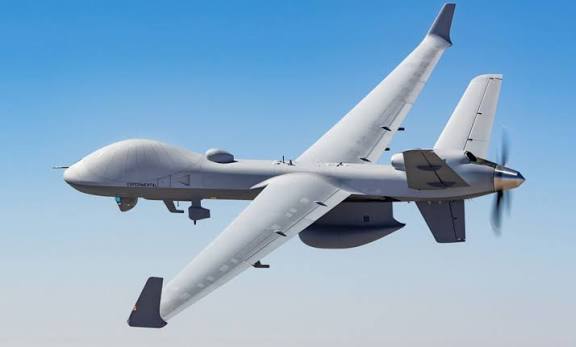
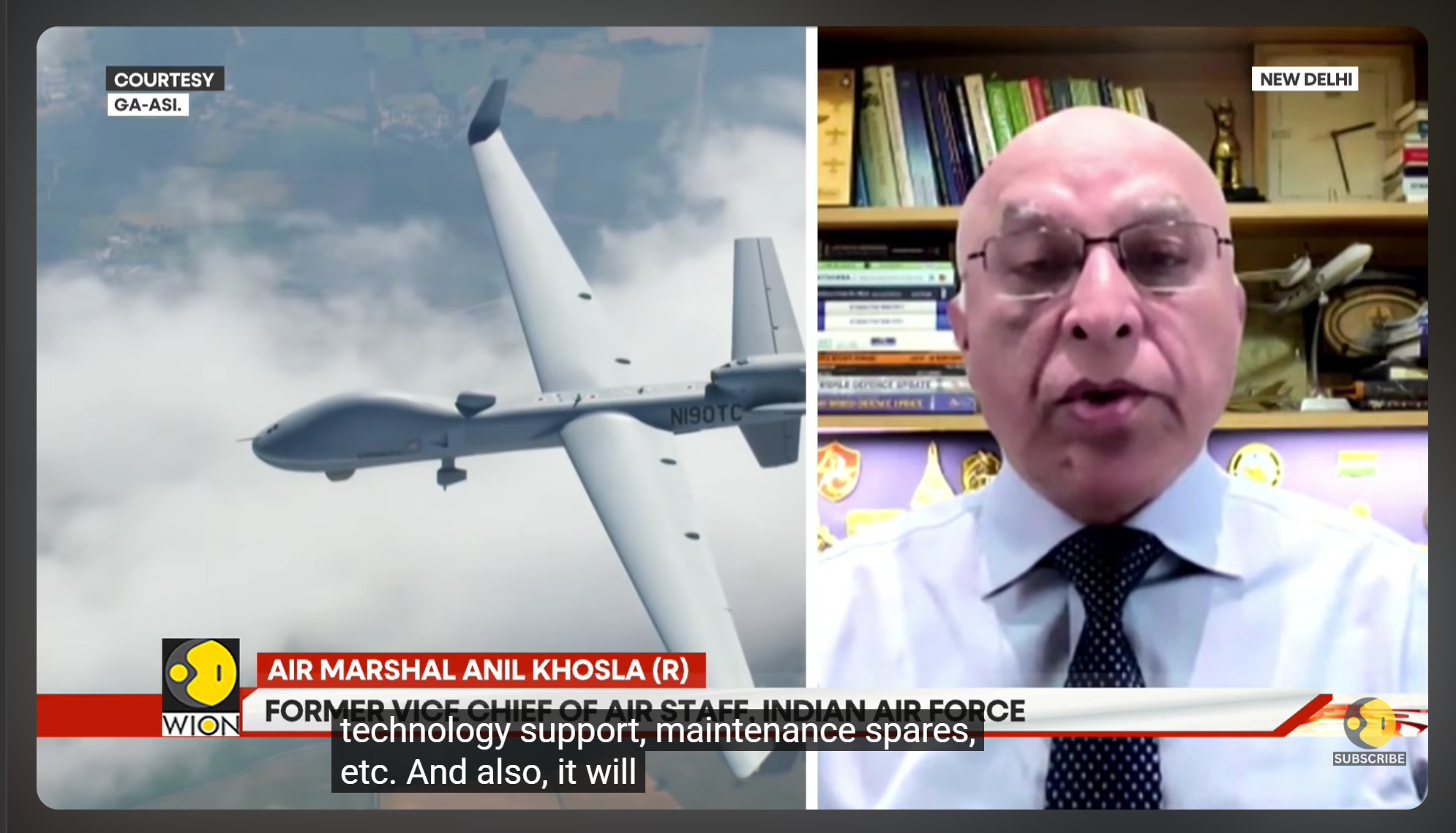
India has operated leased SeaGuardians since 2020. India leased them because the Navy needed persistent ISR capability while the much larger procurement moved through the system. The Indian Navy has found them useful and has flown them for thousands of hours.
The new lease contract has reportedly been signed on17 August 2026. It includes a 30-month lease for two MQ-9B Sea Guardian drones from General Atomics Aeronautical Systems. The contract is valued at approximately ₹1,943 crore.
On the face of it, ₹1,943 crore for two MQ-9B SeaGuardians for only 30 months looks extremely expensive. The ₹1,943 crore price tag is not a basic rental fee for two airframes. It represents a Company-Owned, Company-Operated (COCO) capability package. The value proposition includes sensors, communications, ground-control infrastructure, technical support, maintenance, operators/support personnel, availability, etc.
Complete Operational Burden. General Atomics (GA-ASI) provides the entire ecosystem (possibly including Ground Control Stations (GCS), satellite communication bandwidth, continuous payload integration, spare parts, and on-site engineering support).
Assured Flight-Hours. The cost includes availability of a guaranteed number of operational flight hours. The manufacturer would bear the cost associated with airframe degradation, maintenance cycles, component failures, and logistics overhead.
Specialised Payload Rent. The lease includes high-end, mission-specific sensor suites (360-degree maritime surface search radars, synthetic aperture radars (SAR), electro-optical/infrared (EO/IR) balls, and signals intelligence (SIGINT) packages).
The lease would buy time and capability. India entered into the agreement in October 2024 for 31 MQ-9Bs (specifically 15 SeaGuardians and 16 SkyGuardians). India’s acquisition of 31 aircraft does not mean they will become operational right away; reports indicate the first deliveries will not take place until late 2028 or early 2029. Since we need the capability right now, there will be a gap of several years. To sum up, the purchase is the long-term solution, while the lease is a short-term remedy.
There’s another way of looking at it. The lease would be a training and transition bridge. The new lease could allow personnel, maintenance teams, operators and mission planners to continue building experience while the larger fleet is inducted. It would allow operational availability, training, experience, maintenance support, sensors, contractor support, insurance/replacement risk, and immediate access. Rather than a redundant expense, the lease would serve as a high-readiness bridge. It would provide immediate maritime surveillance capacity while laying the tactical groundwork for the larger fleet’s arrival.
In short, the two newly leased Sea Guardians are not a standalone act but a deliberate interim measure that keeps the Navy’s IOR surveillance posture strong and operationally continuous while the larger, permanent 31-aircraft tri-service fleet is manufactured and delivered.
The bigger picture
The drones complement, rather than replace, the P-8I fleet. India’s surveillance architecture is increasingly layered:
MQ-9B SeaGuardian: long-endurance unmanned surveillance, able to remain on station for extended periods.
P-8I Poseidon: manned long-range maritime patrol aircraft with sophisticated radar and anti-submarine warfare capabilities.
Satellites: wide-area, space-based observation.
Coastal and island-based sensors/radars: persistent monitoring closer to shore and around strategic maritime chokepoints.
Other naval assets: ships, submarines and aircraft that can investigate or act on information generated by the surveillance network.
A layered network:
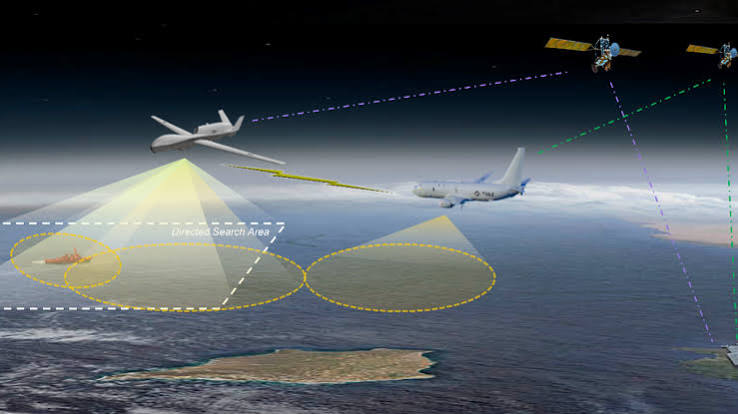
Satellites → see broadly ↓ MQ-9Bs → stay over an area for a long time. ↓ P-8Is → investigate and conduct sophisticated maritime/ASW missions. ↓ Ships/submarines → physically respond.
The MQ-9B lease fits into that picture as the tactical, tasking-responsive layer of a system whose outer layers are space-based sensing and coastal radar, and whose command layer is the fusion-centre network.
Information and data included in the blog are for educational & non-commercial purposes only and have been carefully adapted, excerpted, or edited from reliable and accurate sources. All copyrighted material belongs to the respective owners and is provided only for wider dissemination.
On 05 Aug 26, Boeing and Northrop conducted a lab demo test teaming the manned P-8A Poseidon maritime patrol aircraft and the unmanned MQ-4C Triton high-altitude long-endurance (HALE) ISR platform.
The P-8A operator sent machine-readable/machine-actionable mission tasking to a simulated Triton. The Triton then autonomously planned and executed the mission (e.g., transit to an area, collect intelligence with its sensors), processed data onboard via AI algorithms, and returned processed intelligence to the Poseidon.
The demo showed the first automated collaboration using an open systems architecture and the Universal Command and Control Interface. The announcement’s emphasis on universal standard interfaces is significant. Rather than using proprietary, platform-specific software, standard interfaces allow different systems to exchange information more easily.
Even though the P-8A and MQ-4C are both surveillance platforms, they have very different strengths.
P-8A Poseidon. Manned, multi-mission platform optimised for anti-submarine warfare (ASW), anti-surface warfare, response/agility (including lower-altitude operations), high-resolution imagery, weapons delivery, and rapid prosecution of contacts. Its crews operate in a dynamic tactical environment.
MQ-4C Triton. Unmanned HALE platform for persistent, wide-area maritime domain awareness. It has long endurance of more than 24 hours, and operates at high altitude (50,000+ feet). It has broad sensor coverage including multi-int radar, EO/IR, SIGINT.
Key Benefits for Operators
The key idea in teaming them up is about letting each do what it does best. Instead of both independently searching the same ocean, the Triton can automatically detect and cue the Poseidon. It reduces the workload on human operators.
It would reduce operator workload, speed up decision-making, enable more flexible and responsive manned-unmanned teaming, and leverage their complementary strengths for broader, more efficient maritime ISR and related missions. Key benefits would be: –
Reduced Workload and Cognitive Burden. The demonstration focuses on automating tasking, planning, execution, and the use of onboard AI. As a result, P-8 operators will no longer have to manually coordinate all the individual aspects or depend on ground stations when making routine intelligence requests or assigning tasks. Instead, they will be able to concentrate on higher-level mission management, tactical decisions, and using the fused picture, rather than closely monitoring the unmanned asset. This reduces the operator’s workload and speeds up the intelligence cycle.
Faster, More Responsive Decision-Making and Targeting. Direct machine-to-machine exchange delivers processed maritime intelligence much faster. This supports quicker cueing for follow-on actions. In contested or time-sensitive environments, this improves the overall kill chain decision speed.
Direct In-Flight Tasking and Greater Tactical Flexibility. Currently, Tritons are typically controlled from distant ground stations. The demo establishes a foundation for P-8 crews to issue tasking and receive results in flight (via realistic links such as satellite relay) without routing everything through the ground control station. This extends the Poseidon’s effective reach, allows dynamic retasking based on the manned aircraft’s real-time situational awareness, and improves the composite battlespace picture under the control of the airborne crew.
Better Use of Complementary Capabilities Without Redundancy. Triton handles the long-endurance, broad-area “look” mission persistently. Poseidon handles responsive, close-in, multi-mission work (including ASW that Triton does not perform). Automated teaming lets them operate more seamlessly as a unit rather than operating in relative isolation or with slower human-mediated coordination. Shared standards also ease training synergies (some operators cross-qualify) and common operating pictures.
Broader Interoperability and Future Scalability at Lower Cost/Risk. Use of universal/open standards rather than proprietary links allows collaboration with other platforms. This makes integration easier and more cost-effective, and also supports evolutionary upgrades on existing fleets.
Summary
By combining the two surveillance platforms, the team created a more closely integrated system. The operators gain in efficiency (because there is less manual coordination), in speed (since the intelligence and decisions can be made more quickly), in reach and flexibility (through direct control from the air) and in effectiveness (due to the continuous coverage and the ability to carry out a variety of missions in a responsive manner). This is especially valuable in the case of large areas of responsibility over seawater where both persistence and rapid response are essential. The demonstration carried out in the laboratory represents an initial stage in the way these capabilities can be put into operational use.
Please Add Value to the write-up with your views on the subject.
For regular updates, please register your email here:-
Information and data included in the blog are for educational & non-commercial purposes only and have been carefully adapted, excerpted, or edited from reliable and accurate sources. All copyrighted material belongs to the respective owners and is provided only for wider dissemination.
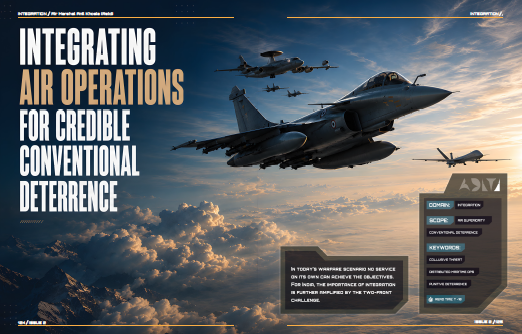
Credible conventional deterrence is not a function of numerical superiority alone. It is the demonstrated capacity to impose unacceptable costs on an adversary. The cost is imposed at short notice, with sufficient speed, precision, and integration across all domains, with a message that aggression will not be rewarded but punished. In this sense, deterrence is as much a matter of perception as of capability. The adversary must believe that the costs of military action will outweigh any conceivable gain. That belief must rest on something more substantial than a declaratory posture. It must rest on observable, tested, and credible military power.
For India, the architecture of conventional deterrence has been evolving gradually. At its heart is the transformation in how the three services fight, plan, and operate together. Jointness, once an aspirational buzzword, is now the necessary operative principle behind India’s warfighting doctrine. The nation’s security establishment has recognised that the conventional deterrent value of its armed forces is only as strong as the degree to which those forces can act in concert, with speed, precision, and lethality, across all domains simultaneously.
A Collusive Threat Environment. Understanding why joint operations matter to conventional deterrence requires first understanding the threat environment in which India operates. India faces a collusive threat and the possibility of concurrent or coordinated military pressure from both China and Pakistan. This is not merely a theoretical construct. The deepening military-to-military ties between Beijing and Islamabad, evidenced by technology transfer, co-developed weapons systems, and coordinated diplomatic positions, mean that India cannot plan its conventional responses in a sequential or siloed manner. It must be prepared to fight on multiple fronts and in multiple domains simultaneously.
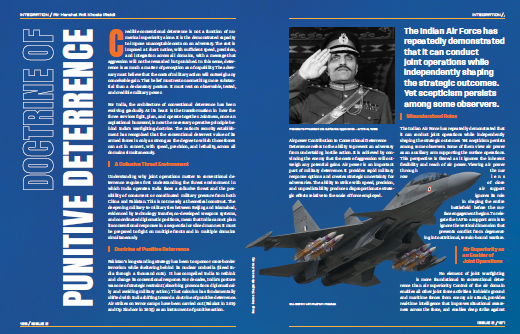
Doctrine of Punitive Deterrence. Pakistan’s long-standing strategy has been of sponsoring cross-border terrorism while sheltering behind its nuclear umbrella (bleed India through a thousand cuts). It has compelled India to rethink and change its conventional response. For decades, India’s posture was one of strategic restraint (absorbing provocations diplomatically and avoiding military action). That calculus has fundamentally changed as India has shifted toward a doctrine of punitive deterrence. Air strikes on terror camps have been carried out (Balakot in 2019 and Op Sindoor in 2025) as an instrument of punitive action.
Airpower Contribution to Conventional Deterrence. Deterrence refers to the ability to prevent an adversary from undertaking hostile action. It is achieved by convincing the enemy that the costs of aggression will outweigh any potential gains. Air power is an important part of military deterrence. It provides rapid military response options and creates strategic uncertainty for adversaries. The ability to strike with speed, precision, and unpredictability produces disproportionate strategic effects relative to the scale of force employed.
Misunderstood Roles. The Indian Air Force has repeatedly demonstrated that it can conduct joint operations while independently shaping strategic outcomes. Yet scepticism persists among some observers. Some view air power as an auxiliary arm supporting surface operations. This perspective is flawed as it ignores the inherent flexibility and reach of air power. Viewing air power through the narrow lens of close air support ignores its role in shaping the entire battlefield before the surface engagement begins. To relegate the IAF to a support arm is to ignore the vertical dimension that prevents conflict from degenerating into attritional, terrain-bound warfare.
Air Superiority as an Enabler of Joint Operations. No element of joint warfighting is more foundational to conventional deterrence than air superiority. Control of the air domain enables all other joint force activities: it shields ground and maritime forces from enemy air attack, provides real-time intelligence that improves situational awareness across the force, and enables deep strike against adversary command nodes, logistics centres, and critical infrastructure. Conversely, the absence of air superiority exposes every other component of the joint force to attrition and denial. The objective is not to achieve a permanent air superiority across an entire area of operations. A window to enable uninterrupted operations would suffice.
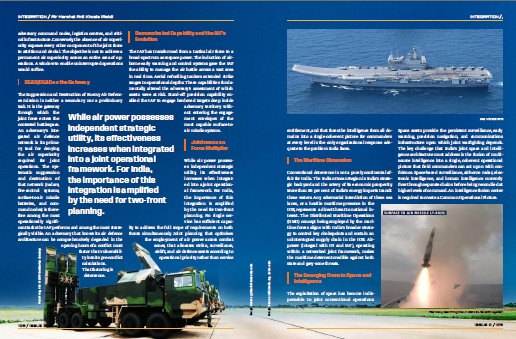
SEAD/DEAD as the Gateway. The Suppression and Destruction of Enemy Air Defences mission is neither a secondary nor a preliminary task. It is the gateway through which the joint force enters the contested battlespace. An adversary’s integrated air defence network is its primary tool for denying the air superiority required for joint operations. The systematic suppression and destruction of that network (radars, fire-control systems, surface-to-air missile batteries, and command nodes) is therefore among the most operationally significant tasks the IAF performs and among the most strategically visible. An adversary that knows its air defence architecture can be comprehensively degraded in the opening hours of a conflict must factor that vulnerability into its pre-conflict calculations. That factoring is deterrence.
Demonstrated Capability and the IAF’s Evolution. The IAF has transformed from a tactical air force to a broad-spectrum aerospace power. The induction of airborne early warning and control systems gave the IAF the ability to manage the air battle across a vast area in real time. Aerial refuelling tankers extended strike ranges to operational depths. These capabilities fundamentally altered the adversary’s assessment of which assets were at risk. Stand-off precision capability enabled the IAF to engage hardened targets deep inside adversary territory without entering the engagement envelopes of the most capable surface-to-air missile systems.
Jointness as a Force Multiplier. While air power possesses independent strategic utility, its effectiveness increases when integrated into a joint operational framework. For India, the importance of this integration is amplified by the need for two-front planning. No single service has sufficient capacity to address the full scope of requirements on both fronts simultaneously. Joint planning that optimises the employment of air power across combat zones, that allocates strike, surveillance, airlift, and air defence assets according to operational priority rather than service entitlement, and that fuses the intelligence from all domains into a single coherent picture for commanders at every level, is the only organisational response adequate to the problem India faces.
The Maritime Dimension. Conventional deterrence is not a purely continental affair for India. The Indian Ocean Region is India’s strategic backyard and the artery of its economic prosperity. More than 80 per cent of India’s energy imports transit these waters. Any adversarial interdiction of these sea lanes, or a hostile maritime presence in the IOR, represents a direct threat to national interest. The Distributed Maritime Operations (DMO) concept being employed by the maritime forces aligns with India’s broader strategy to control key chokepoints and sustain an uninterrupted supply chain in the IOR. Airpower (integral with IN and AF), operating within a networked joint framework, makes the maritime deterrent credible against both state and grey-zone threats.
The Emerging Domain Space and Intelligence. The exploitation of space has become indispensable to joint conventional operations. Space assets provide the persistent surveillance, early warning, precision navigation, and communications infrastructure upon which joint warfighting depends. The key challenge that India’s joint space and intelligence architecture must address is fusing multi-source intelligence into a single, coherent operational picture that field commanders can act upon with confidence. Space-based surveillance, airborne radar, electronic intelligence, and human intelligence currently flow through separate chains before being reconciled at higher levels of command. An intelligence fusion center, is required to create a Common Operational Picture.
Building a Credible Joint Deterrence Architecture. An adversary assessing India’s military balance would also evaluate mobilisation speed, reinforcement capacity, and sustainment resilience as carefully as it evaluates weapon and platform inventories. Several priorities emerge for India in translating these principles into a credible conventional deterrent.
Strengthening joint planning at the operational and strategic levels must be institutionalised. The Joint Operations Control Centre, bringing all three services together into a single, real-time command-and-control node, is a critical step in this direction.
Military reorganisation should prioritise meeting future challenges. A command-level joint structure for the space and cyber domains is a high priority. The existing joint Command (Andaman and Nicobar Command) on the eastern seaboard needs to be strengthened, and a similar structure needs to be established on the western seaboard.
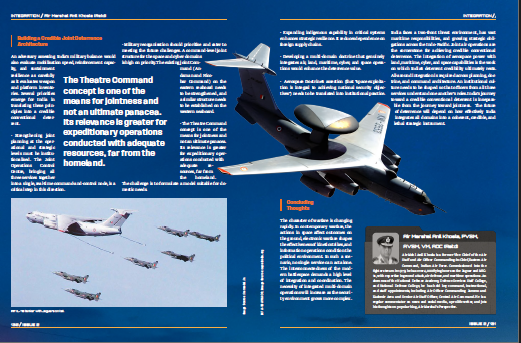
The theatre command concept is one means of achieving jointness, not an ultimate panacea. Its relevance is greater for expeditionary operations conducted with adequate resources, far from the homeland. The challenge is to formulate a model suitable for domestic needs.
Expanding indigenous capability in critical systems enhances strategic resilience. It reduces dependence on foreign supply chains.
Developing a multi-domain doctrine that genuinely integrates air, land, maritime, cyber, and space operations would enhance the deterrence value.
Aerospace Doctrine’s assertion (that “space exploitation is integral to achieving national security objectives”) needs to be translated into institutional practice.
Concluding Thoughts
The character of warfare is changing rapidly. In contemporary warfare, the actions in space affect outcomes on the ground, electronic warfare shapes the effectiveness of kinetic strikes, and information operations condition the political environment. In such a scenario, no single service can act alone. The interconnectedness of the modern battlespace demands a high level of integration and coordination. The necessity of integrated multi-domain operations will increase as the security environment grows more complex.
India faces a two-front threat environment, has vast maritime responsibilities, and growing strategic obligations across the Indo-Pacific.
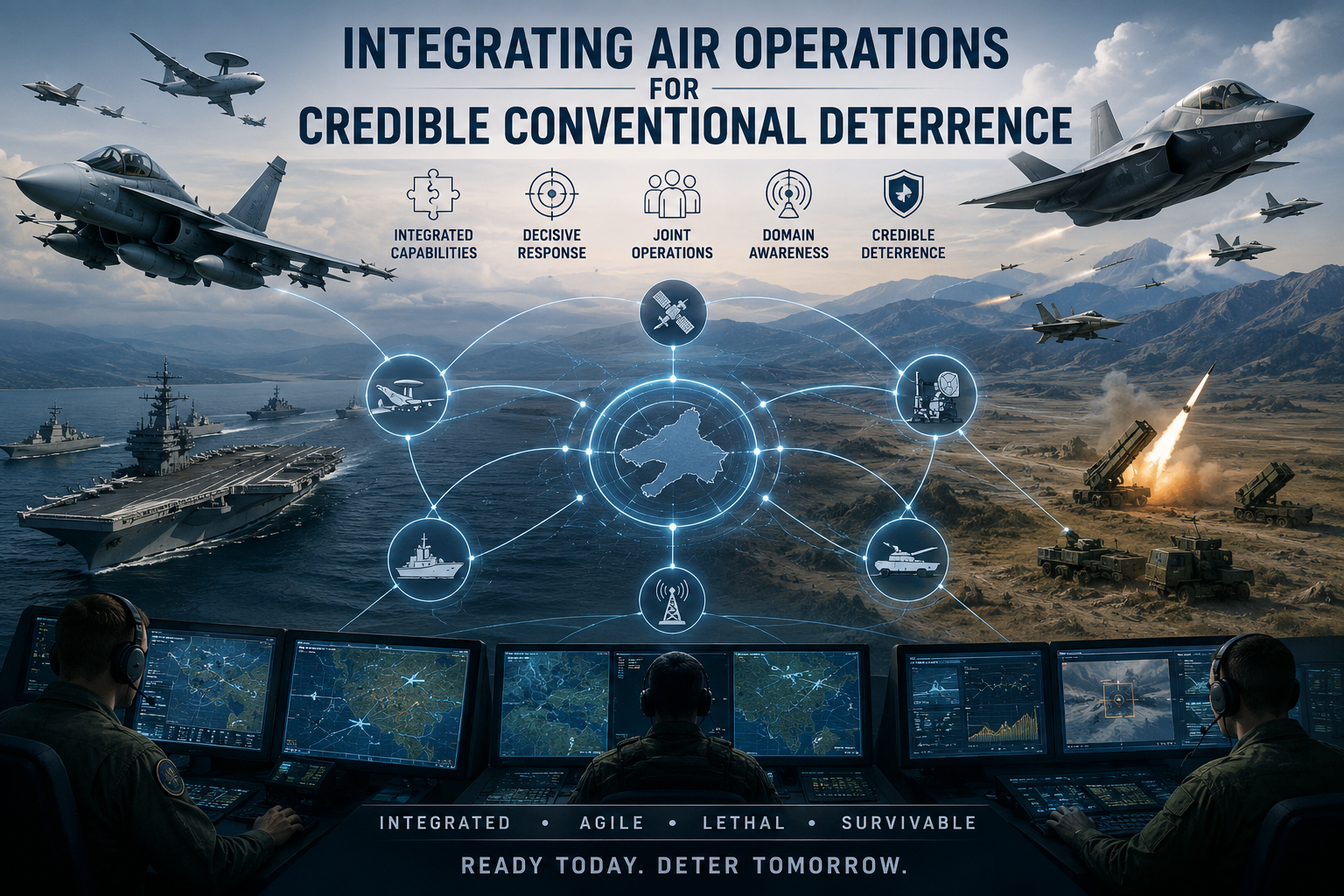
Joint air operations are the cornerstone for achieving credible conventional deterrence. The integration of aerospace power with land, maritime, cyber, and space capabilities is the work on which India’s deterrent credibility ultimately rests. All-around integration is required across planning, doctrine, and command architecture. An institutional culture needs to be shaped so that officers from all three services understand one another’s roles. India’s journey toward a credible conventional deterrent is inseparable from the journey toward jointness. The future of deterrence will depend on how effectively India integrates all domains into a coherent, credible, and lethal strategic instrument.
Please Add Value to the write-up with your views on the subject.
For regular updates, please register your email here:-
Information and data included in the blog are for educational & non-commercial purposes only and have been carefully adapted, excerpted, or edited from reliable and accurate sources. All copyrighted material belongs to the respective owners and is provided only for wider dissemination.
References: –
Cohen SP and Dasgupta S. “Arming without aiming: India’s military modernisation”, Brookings Institution Press (BIP). 2010.
Crowell L. “Multi-domain operations and the future of joint warfare”. Naval Institute Press (NIP). 2023.
Deptula, D. A. “Effects-based operations: Change like warfare”. Aerospace Education Foundation, 2001.
Government of India, Ministry of Defence. “Joint Doctrine of the Indian Armed Forces”. Headquarters, Integrated Defence Staff. 2023.
Gupta, A., “Building an arsenal: The evolution of regional power force structures”. Praeger. 2019.
Kapila, S., India’s defence modernisation: Structural constraints and strategic imperatives”. Journal of Defence Studies. 2021.
Air Mshl Anil Khosla. “Punitive deterrence: India’s evolving conventional response”. Blog “Air Marshal’s Perspective”, 2023. https://55nda.com/blogs/anil-khosla
Air Mshl Anil Khosla. “Air superiority and joint operations: The SEAD/DEAD imperative”. Blog “Air Marshal’s Perspective”, 2024. https://55nda.com/blogs/anil-khosla
Ladwig, W. C. Indian military modernisation and conventional deterrence in South Asia. “Journal of Strategic Studies”, https://doi.org/10.1080/01402390.2014.942937, 2020.
Singh, S. “India’s military transformation: Challenges and imperatives”. Strategic Analysis 2020.