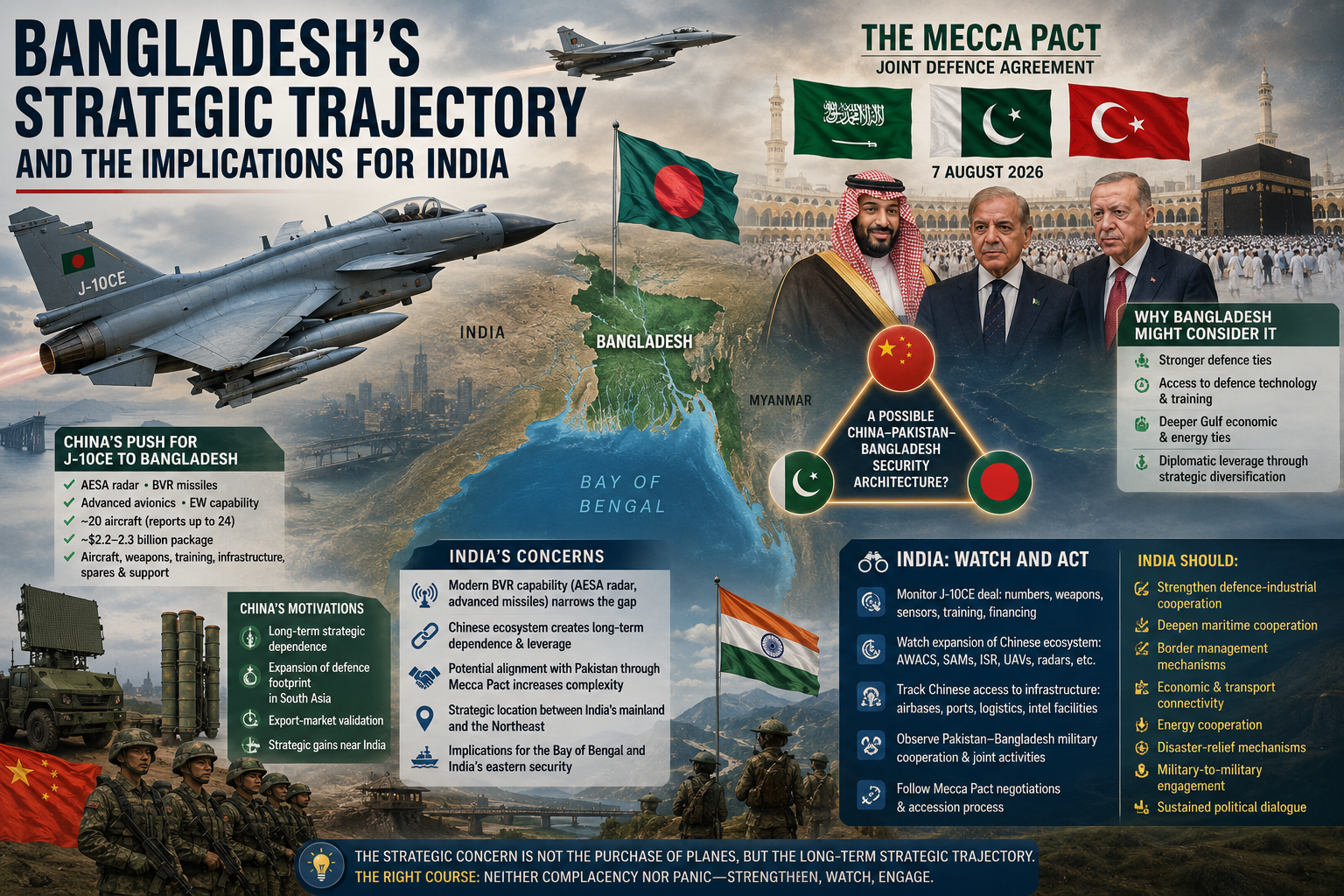
Taken together, Bangladesh’s move toward acquiring Chinese J-10CE fighters and its stated willingness to consider joining the Mecca Pact are strategically significant for India. However, neither development alone means Bangladesh has become a Chinese or Pakistani military ally. The more important issue is the direction of Bangladesh’s strategic relationships and whether these moves eventually develop into a broader China-Pakistan-Bangladesh security architecture.
China’s Push for the J-10CE to Bangladesh
China is not simply “giving” Bangladesh fighter jets. Dhaka is moving toward purchasing Chinese J-10CE multirole fighters, with reports of a draft arrangement for roughly 20 aircraft, though earlier reports mentioned up to 24. The overall package has been reported at around $2.2–2.3 billion, including aircraft, weapons, training, infrastructure, spares and support. The agreement is not yet a completed, delivered contract, so final numbers, price and delivery schedules remain subject to approval. The deal serves both Bangladeshi and Chinese interests.
Bangladesh’s Motivations.
Fleet Modernisation: Bangladesh needs to replace or augment an ageing fighter fleet, particularly its F-7s and other legacy aircraft.
Capability at a Manageable Cost: The J-10CE offers a substantial jump in capability, including AESA radar, modern beyond-visual-range (BVR) weapons, networked avionics and electronic-warfare capabilities, at a lower acquisition and operating cost than many Western alternatives.
Existing Chinese Ecosystem: China is already Bangladesh’s dominant defence supplier, with Chinese-origin aircraft, ships, tanks, missiles and other systems in service. A new Chinese fighter therefore fits relatively easily into an existing logistics, training and maintenance ecosystem.
Strategic Diversification: The acquisition also fits Dhaka’s broader “Bangladesh First” approach, in which it seeks to maximise strategic autonomy by maintaining relationships with China, India, Pakistan, Turkey, the Gulf and Western markets rather than relying exclusively on one partner.
China’s Motivations
For Beijing, the deal is about more than selling airframes.
Long-term Strategic Dependence: A fighter fleet creates a relationship that can last decades. Aircraft, missiles, spare parts, simulators, training, maintenance, upgrades and technical support can progressively tie Bangladesh’s air force to Chinese systems and standards.
Expansion of China’s Defence Footprint: Bangladesh would become another important Chinese defence customer in South Asia, strengthening Beijing’s military-industrial presence around the Bay of Bengal and along India’s eastern periphery.
Export-Market Validation: Pakistan is currently the principal established foreign operator of the J-10 family. A Bangladeshi purchase would provide China with another reference customer and strengthen its pitch to other prospective buyers.
Strategic Gains: A friendly state operating Chinese equipment near India can complicate Indian planning and give Beijing greater influence.
The key point is therefore that the strategic value of the J-10CE deal lies not only in the aircraft’s combat capability but in the long-term Chinese military ecosystem that could develop around it.
Bangladesh and the Mecca Pact
The Mecca Joint Defence Agreement, signed on 7 August 2026 by Saudi Arabia, Pakistan and Turkey, establishes a collective-defence framework under which an armed attack on one member is treated as an attack on all. It has consequently been compared with NATO-style collective defence, although publicly available information on its precise command structure, accession procedures and operational obligations remains limited.
Bangladeshi officials have said Dhaka would consider joining if formally invited. Politically and diplomatically, it appears possible, but it is not yet an imminent or settled decision. Bangladesh has expressed openness to the idea, but it has not committed to accession.
The Mecca Pact has greater potential political significance because it would move Bangladesh beyond defence procurement into a formal security relationship involving Pakistan. For Dhaka, potential benefits of joining the pact could include:
-
- Stronger defence and security relationships with Saudi Arabia, Pakistan and Turkey.
- Possible access to Turkish defence technology and training.
- Deeper Gulf economic and energy relationships.
- Additional diplomatic leverage through strategic diversification.
However, membership would also create complications. Bangladesh has traditionally pursued a non-aligned or balancing foreign policy and depends simultaneously on India for geography, connectivity and trade; China for defence and investment; Gulf countries for employment and remittances; and Western markets for exports.
Joining a mutual-defence framework that includes Pakistan would therefore represent a much more consequential foreign-policy decision than purchasing Chinese aircraft.
Most importantly, the Mecca Pact should not automatically be interpreted as a Bangladesh-Pakistan military alliance directed against India. Dhaka would retain its own interests, and actual obligations would depend on the final terms of membership and the circumstances of any future conflict.
India’s Concerns
The J-10CE would give the Bangladesh Air Force a modern BVR air-combat capability, including AESA radar and advanced air-to-air missiles. This would narrow the qualitative gap between Bangladesh and India in specific areas, particularly along India’s eastern approaches.
The J-10CE purchase alone does not fundamentally change the India-Bangladesh military balance. A fleet of roughly 20–24 aircraft would still leave Bangladesh’s overall air power considerably smaller than India’s, and combat effectiveness depends on much more than the aircraft themselves: pilot training, sortie generation, airborne early-warning and control, air defence, tankers, C4ISR and supporting infrastructure all matter.
The concern grows when the fighter purchase is considered alongside Bangladesh’s potential political alignment with a Pakistan-inclusive defence framework, and China’s growing hold on Bangladesh through the supply of defence equipment. The combination, not any single development, matters.
However, the more important issue is Bangladesh’s dependence on China. A future combination of J-10CE, Chinese missiles, Chinese radars, UAVs, air-defence systems, naval systems, training, and maintenance would increase China’s institutional and technological influence over the Bangladesh Armed Forces.
Operating the same aircraft family as Pakistan could also make future technical cooperation, training or interoperability easier. However, this should not be assumed to mean that Bangladesh and Pakistan will automatically operate as a unified military force.
Bangladesh occupies a strategically important position between much of India’s mainland and the Northeast. Joining the Mecca Pact could be more consequential for India. This could represent an evolution from the traditional China-Pakistan strategic axis toward a looser, more complicated regional network, with Bangladesh as an additional node.
The consequence to the Bay of Bengal and India’s Northeast would be particularly relevant. Such an arrangement could complicate India’s eastern security environment. Deep defence relationships, technical dependence, intelligence cooperation, infrastructure access and military interoperability can themselves create strategic leverage for China.
India: Watch and Act
Several indicators will reveal whether these developments remain limited to procurement and diplomatic diversification or become strategically more serious. India should keep a close watch on: –
-
- Final J-10CE contract, number of aircraft, delivery schedule, weapons package, sensors, data links, training arrangements and financing.
- Expansion of the Chinese ecosystem with particular attention to Chinese AWACS, SAMs, ISR systems, UAVs, radar networks and other supporting capabilities. These could matter more strategically than the fighters themselves.
- Chinese access to Bangladeshi infrastructure. Any future arrangements involving airbases, ports, logistics facilities, intelligence installations or sustained Chinese military access would represent a substantially more serious development.
- Pakistan-Bangladesh military cooperation. Joint exercises, intelligence sharing, training arrangements or institutional defence agreements would indicate whether the political relationship is translating into operational cooperation.
- Mecca Pact negotiations, accession process or a formal memorandum.
India’s response matters because excessive pressure on Dhaka could become counterproductive. A better approach would be to compete without confrontation. India should focus on: –
-
- Stronger mutually acceptable defence-industrial cooperation.
- Maritime cooperation.
- Border-management mechanisms.
- Economic and transport connectivity.
- Energy cooperation.
- Disaster-relief mechanisms.
- Continued military-to-military engagement;
- Sustained political dialogue.
At the same time, India should strengthen its own eastern capabilities rather than assume Bangladesh will remain strategically neutral indefinitely. This means continued attention to the Eastern sector.
Concluding Thoughts
The strategic concern is not whether Bangladesh acquires Chinese fighter aircraft. It is whether the agreement sets the stage for greater Chinese involvement. The situation grows more complicated if Bangladesh joins a security agreement that also includes Pakistan. If both happen, the consequences for India would be much more serious.
These developments should be seen as part of a strategic trend, not as an urgent military crisis. The right course of action is neither complacency nor panic. New Delhi should strengthen its military position in the east, watch how China and Pakistan cooperate on defence matters, and remain politically and economically engaged with Bangladesh.
Shared these thoughts with Kartikeya Sharma on News 9.

Please Add Value to the write-up with your views on the subject.
For regular updates, please register your email here:-
References and credits
To all the online sites and channels.
Pics Courtesy: Internet
Disclaimer:
Information and data included in the blog are for educational & non-commercial purposes only and have been carefully adapted, excerpted, or edited from reliable and accurate sources. All copyrighted material belongs to the respective owners and is provided only for wider dissemination.
References: –
- Ahmed, I. (2026, July 23). Recalibrating foreign policy: Implications of Tarique Rahman’s China visit. Institute of South Asian Studies, National University of Singapore.
- (2026, August 7). Saudi Arabia, Turkey and Pakistan pledge mutual defence. Reuters.
- com, Draft deal takes shape for Bangladesh’s potential purchase of Chinese J-10CE jets. bdnews24.com. (2026).
- Ministry of Foreign Affairs, Government of Pakistan. Message to the nation by the Deputy Prime Minister/Foreign Minister on the signing of the Makkah Joint Defence Agreement. (2026b, August 10).
- Rehman, I. (2021). China’s influence in South Asia: Vulnerabilities and resilience in four countries. Carnegie Endowment for International Peace.
- (2026a, August 7). Saudi Arabia, Turkey and Pakistan pledge mutual defence. Reuters.
- (2026b, August 25). Bangladesh could consider joining Mecca pact, testing foreign ties. Reuters.
- (2026c, August 25). Bangladesh in talks to buy Chinese J-10CE fighter jets. Reuters.
- Stockholm International Peace Research Institute. (n.d.). SIPRI arms transfers database.
| 10. The Business Standard. (2026). Bangladesh set to buy 20 Chinese J-10CE fighter jets for $2.3b—The Business Standard. |