Article published in the inaugural issue of
ADITI NATIONAL STRATEGY MAGAZINE
Credible conventional deterrence is not a function of numerical superiority alone. It is the demonstrated capacity to impose unacceptable costs on an adversary. The cost is imposed at short notice, with sufficient speed, precision, and integration across all domains, with a message that aggression will not be rewarded but punished. In this sense, deterrence is as much a matter of perception as of capability. The adversary must believe that the costs of military action will outweigh any conceivable gain. That belief must rest on something more substantial than a declaratory posture. It must rest on observable, tested, and credible military power.
For India, the architecture of conventional deterrence has been evolving gradually. At its heart is the transformation in how the three services fight, plan, and operate together. Jointness, once an aspirational buzzword, is now the necessary operative principle behind India’s warfighting doctrine. The nation’s security establishment has recognised that the conventional deterrent value of its armed forces is only as strong as the degree to which those forces can act in concert, with speed, precision, and lethality, across all domains simultaneously.
A Collusive Threat Environment. Understanding why joint operations matter to conventional deterrence requires first understanding the threat environment in which India operates. India faces a collusive threat and the possibility of concurrent or coordinated military pressure from both China and Pakistan. This is not merely a theoretical construct. The deepening military-to-military ties between Beijing and Islamabad, evidenced by technology transfer, co-developed weapons systems, and coordinated diplomatic positions, mean that India cannot plan its conventional responses in a sequential or siloed manner. It must be prepared to fight on multiple fronts and in multiple domains simultaneously.
Doctrine of Punitive Deterrence. Pakistan’s long-standing strategy has been of sponsoring cross-border terrorism while sheltering behind its nuclear umbrella (bleed India through a thousand cuts). It has compelled India to rethink and change its conventional response. For decades, India’s posture was one of strategic restraint (absorbing provocations diplomatically and avoiding military action). That calculus has fundamentally changed as India has shifted toward a doctrine of punitive deterrence. Air strikes on terror camps have been carried out (Balakot in 2019 and Op Sindoor in 2025) as an instrument of punitive action.
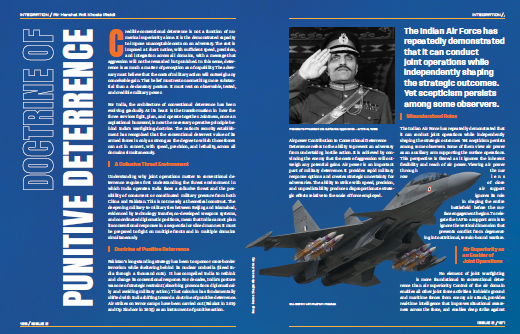
Airpower Contribution to Conventional Deterrence. Deterrence refers to the ability to prevent an adversary from undertaking hostile action. It is achieved by convincing the enemy that the costs of aggression will outweigh any potential gains. Air power is an important part of military deterrence. It provides rapid military response options and creates strategic uncertainty for adversaries. The ability to strike with speed, precision, and unpredictability produces disproportionate strategic effects relative to the scale of force employed.
Misunderstood Roles. The Indian Air Force has repeatedly demonstrated that it can conduct joint operations while independently shaping strategic outcomes. Yet scepticism persists among some observers. Some view air power as an auxiliary arm supporting surface operations. This perspective is flawed as it ignores the inherent flexibility and reach of air power. Viewing air power through the narrow lens of close air support ignores its role in shaping the entire battlefield before the surface engagement begins. To relegate the IAF to a support arm is to ignore the vertical dimension that prevents conflict from degenerating into attritional, terrain-bound warfare.
Air Superiority as an Enabler of Joint Operations. No element of joint warfighting is more foundational to conventional deterrence than air superiority. Control of the air domain enables all other joint force activities: it shields ground and maritime forces from enemy air attack, provides real-time intelligence that improves situational awareness across the force, and enables deep strike against adversary command nodes, logistics centres, and critical infrastructure. Conversely, the absence of air superiority exposes every other component of the joint force to attrition and denial. The objective is not to achieve a permanent air superiority across an entire area of operations. A window to enable uninterrupted operations would suffice.
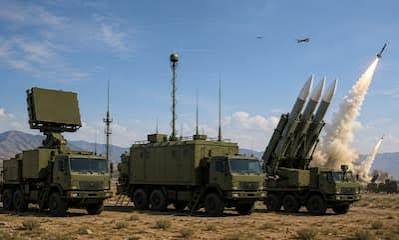
SEAD/DEAD as the Gateway. The Suppression and Destruction of Enemy Air Defences mission is neither a secondary nor a preliminary task. It is the gateway through which the joint force enters the contested battlespace. An adversary’s integrated air defence network is its primary tool for denying the air superiority required for joint operations. The systematic suppression and destruction of that network (radars, fire-control systems, surface-to-air missile batteries, and command nodes) is therefore among the most operationally significant tasks the IAF performs and among the most strategically visible. An adversary that knows its air defence architecture can be comprehensively degraded in the opening hours of a conflict must factor that vulnerability into its pre-conflict calculations. That factoring is deterrence.
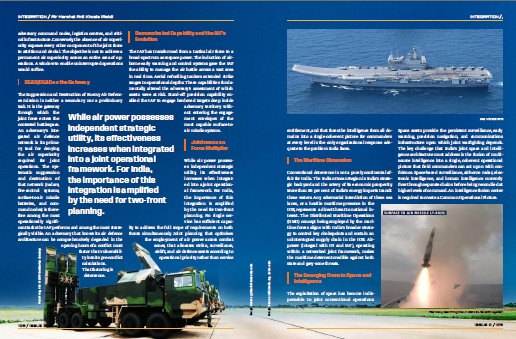
Demonstrated Capability and the IAF’s Evolution. The IAF has transformed from a tactical air force to a broad-spectrum aerospace power. The induction of airborne early warning and control systems gave the IAF the ability to manage the air battle across a vast area in real time. Aerial refuelling tankers extended strike ranges to operational depths. These capabilities fundamentally altered the adversary’s assessment of which assets were at risk. Stand-off precision capability enabled the IAF to engage hardened targets deep inside adversary territory without entering the engagement envelopes of the most capable surface-to-air missile systems.
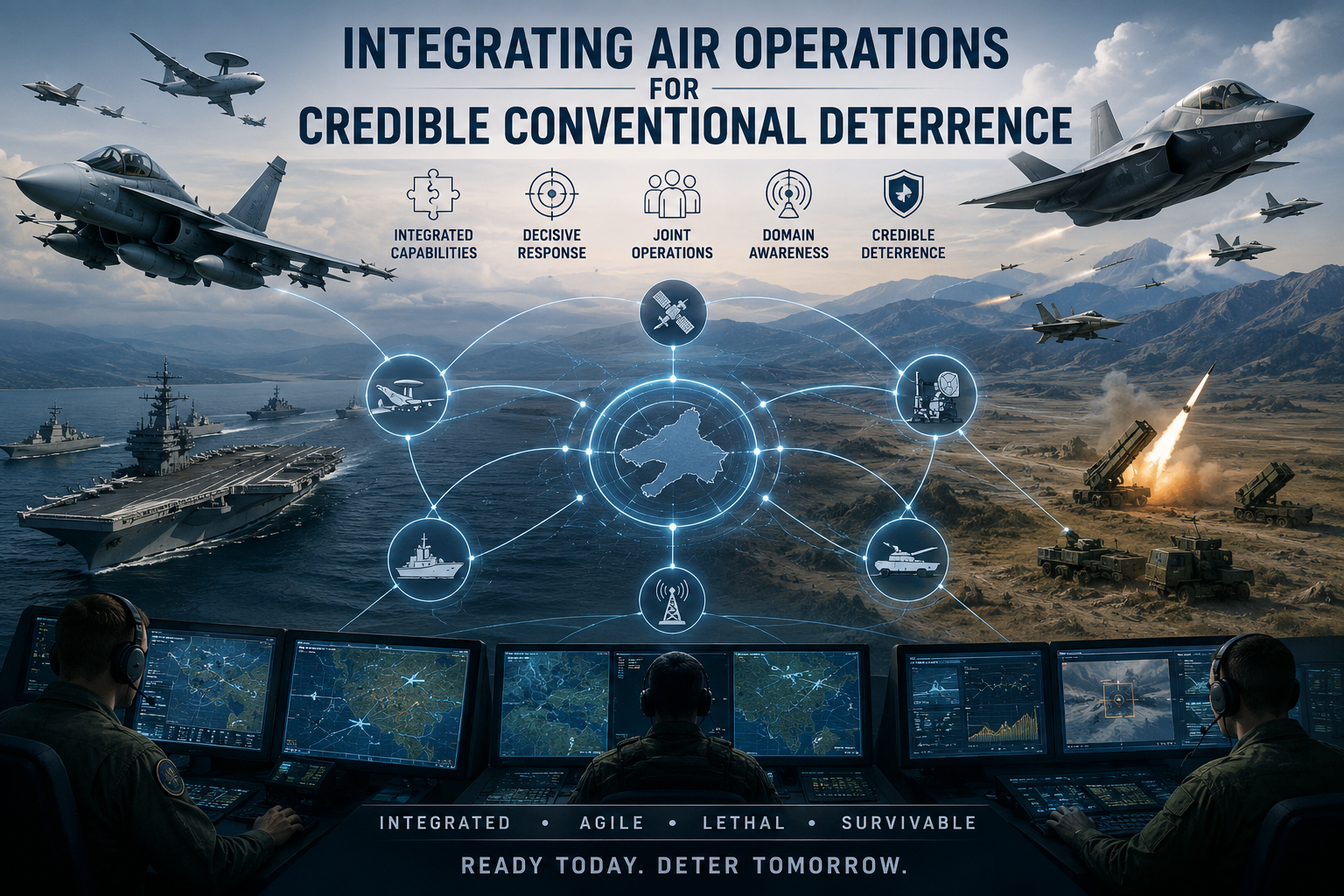
Jointness as a Force Multiplier. While air power possesses independent strategic utility, its effectiveness increases when integrated into a joint operational framework. For India, the importance of this integration is amplified by the need for two-front planning. No single service has sufficient capacity to address the full scope of requirements on both fronts simultaneously. Joint planning that optimises the employment of air power across combat zones, that allocates strike, surveillance, airlift, and air defence assets according to operational priority rather than service entitlement, and that fuses the intelligence from all domains into a single coherent picture for commanders at every level, is the only organisational response adequate to the problem India faces.
The Maritime Dimension. Conventional deterrence is not a purely continental affair for India. The Indian Ocean Region is India’s strategic backyard and the artery of its economic prosperity. More than 80 per cent of India’s energy imports transit these waters. Any adversarial interdiction of these sea lanes, or a hostile maritime presence in the IOR, represents a direct threat to national interest. The Distributed Maritime Operations (DMO) concept being employed by the maritime forces aligns with India’s broader strategy to control key chokepoints and sustain an uninterrupted supply chain in the IOR. Airpower (integral with IN and AF), operating within a networked joint framework, makes the maritime deterrent credible against both state and grey-zone threats.
The Emerging Domain Space and Intelligence. The exploitation of space has become indispensable to joint conventional operations. Space assets provide the persistent surveillance, early warning, precision navigation, and communications infrastructure upon which joint warfighting depends. The key challenge that India’s joint space and intelligence architecture must address is fusing multi-source intelligence into a single, coherent operational picture that field commanders can act upon with confidence. Space-based surveillance, airborne radar, electronic intelligence, and human intelligence currently flow through separate chains before being reconciled at higher levels of command. An intelligence fusion center, is required to create a Common Operational Picture.
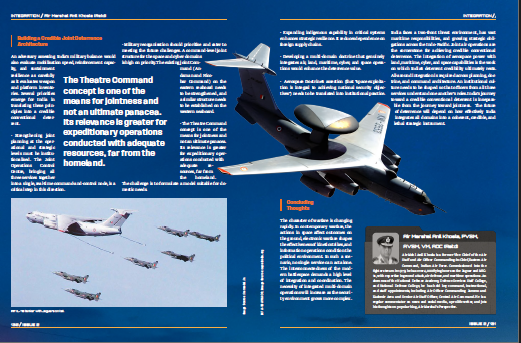
Building a Credible Joint Deterrence Architecture. An adversary assessing India’s military balance would also evaluate mobilisation speed, reinforcement capacity, and sustainment resilience as carefully as it evaluates weapon and platform inventories. Several priorities emerge for India in translating these principles into a credible conventional deterrent.
-
- Strengthening joint planning at the operational and strategic levels must be institutionalised. The Joint Operations Control Centre, bringing all three services together into a single, real-time command-and-control node, is a critical step in this direction.
-
- Military reorganisation should prioritise meeting future challenges. A command-level joint structure for the space and cyber domains is a high priority. The existing joint Command (Andaman and Nicobar Command) on the eastern seaboard needs to be strengthened, and a similar structure needs to be established on the western seaboard.
-
- The theatre command concept is one means of achieving jointness, not an ultimate panacea. Its relevance is greater for expeditionary operations conducted with adequate resources, far from the homeland. The challenge is to formulate a model suitable for domestic needs.
-
- Expanding indigenous capability in critical systems enhances strategic resilience. It reduces dependence on foreign supply chains.
-
- Developing a multi-domain doctrine that genuinely integrates air, land, maritime, cyber, and space operations would enhance the deterrence value.
-
- Aerospace Doctrine’s assertion (that “space exploitation is integral to achieving national security objectives”) needs to be translated into institutional practice.
Concluding Thoughts
The character of warfare is changing rapidly. In contemporary warfare, the actions in space affect outcomes on the ground, electronic warfare shapes the effectiveness of kinetic strikes, and information operations condition the political environment. In such a scenario, no single service can act alone. The interconnectedness of the modern battlespace demands a high level of integration and coordination. The necessity of integrated multi-domain operations will increase as the security environment grows more complex.
India faces a two-front threat environment, has vast maritime responsibilities, and growing strategic obligations across the Indo-Pacific.
Joint air operations are the cornerstone for achieving credible conventional deterrence. The integration of aerospace power with land, maritime, cyber, and space capabilities is the work on which India’s deterrent credibility ultimately rests. All-around integration is required across planning, doctrine, and command architecture. An institutional culture needs to be shaped so that officers from all three services understand one another’s roles. India’s journey toward a credible conventional deterrent is inseparable from the journey toward jointness. The future of deterrence will depend on how effectively India integrates all domains into a coherent, credible, and lethal strategic instrument.
Please Add Value to the write-up with your views on the subject.
For regular updates, please register your email here:-
References and credits
To all the online sites and channels.
Pics Courtesy: Internet
Disclaimer:
Information and data included in the blog are for educational & non-commercial purposes only and have been carefully adapted, excerpted, or edited from reliable and accurate sources. All copyrighted material belongs to the respective owners and is provided only for wider dissemination.
References: –
Cohen SP and Dasgupta S. “Arming without aiming: India’s military modernisation”, Brookings Institution Press (BIP). 2010.
Crowell L. “Multi-domain operations and the future of joint warfare”. Naval Institute Press (NIP). 2023.
Deptula, D. A. “Effects-based operations: Change like warfare”. Aerospace Education Foundation, 2001.
Government of India, Ministry of Defence. “Joint Doctrine of the Indian Armed Forces”. Headquarters, Integrated Defence Staff. 2023.
Gupta, A., “Building an arsenal: The evolution of regional power force structures”. Praeger. 2019.
Kapila, S., India’s defence modernisation: Structural constraints and strategic imperatives”. Journal of Defence Studies. 2021.
Air Mshl Anil Khosla. “Punitive deterrence: India’s evolving conventional response”. Blog “Air Marshal’s Perspective”, 2023. https://55nda.com/blogs/anil-khosla
Air Mshl Anil Khosla. “Air superiority and joint operations: The SEAD/DEAD imperative”. Blog “Air Marshal’s Perspective”, 2024. https://55nda.com/blogs/anil-khosla
Ladwig, W. C. Indian military modernisation and conventional deterrence in South Asia. “Journal of Strategic Studies”, https://doi.org/10.1080/01402390.2014.942937, 2020.
Singh, S. “India’s military transformation: Challenges and imperatives”. Strategic Analysis 2020.