
May the festival of light brighten up your life.
Happy Deepawali.
Anil & Deepshikha Khosla

CANDID AND TO THE POINT / काम की बात
May the festival of light brighten up your life.
Happy Deepawali.
Anil & Deepshikha Khosla
While researching for “future of warfare”, I came across an interesting article about classification of wars over the years into generations.
These thoughts are of Russian military theorists Major General Vladimir Slipchenko (1935–2005). General Slipchenko is considered as one of the leading thinkers on “non-contact” and “sixth-generation” warfare.
Slipchenko’s while examining warfare, classifies warfare into six generations.
Slipchenko’s Generations of Warfare
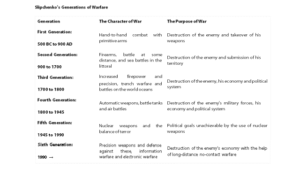
(Source: Vladimir Slipchenko, Voiny Novogo Pokolenia – Distantsionnye i Bezkontaktnye (Moscow: Olma-Press, 2004), pp. 32– 34.
No Contact Warfare. Slipchenko ties the idea of sixth-generation warfare to a concept of non-contact or contactless warfare. He conveys the idea that future war between modern states will take place without direct contact.
Future Warfare. Slipchenko outlined wars of the future as follows:
Seventh-Generation Warfare: Info Warfare
Slipchenko also worked on the concept of a future “seventh generation” of warfare, which he forecast could emerge in the 2050s among the most advanced military powers. Numerous aspects of this work, especially in relation to the exponential growth in the importance of information in modern and future warfare are already percolating into the modern day warfare.
Slipchenko ahead of his time highlighted the importance of cyber along with information in the future battle space, and also forecast this area emerging as a separate combat arm. He identifies the centrality of information in modern and future warfare, forecasting that its utility would eventually move beyond a combat support role and into the area of essentially a combat arm.
Slipchenko identified information as a future weapon in war similar to the destructive effect of kinetic systems, and suggested that this would influence war in its entirety from beginning to conflict termination. He estimated that info warfare will transform warfare beyond the strategic level to reach truly global scales.
According to Slipchenko, information superiority would be the key to gaining superiority in non-contact warfare. Domination would be required in the information domain of space systems as well as reconnaissance, warning, navigation, meteorological, command and control, and communications assets.
Information Confrontation. Slipchenko argued that the information confrontation demands continuous exploitation as compared to information warfare during a skirmish. Possibly hinting at exploitation of info warfare even in no war conditions (Present day Grey Zone).
Comments
Slipchenko’s Thoughts and predictions are coming true, that too ahead of expected timelines.
Information has become a new domain for warfare.
Information warfare is not in isolation but getting linked with other domains of cyber, space and electronics.
A new service is evolving to deal with this type of warfare (e.g. Chinese Joint Strategic Support Force).
This warfare is being exploited in a conflict scenario, without declaring open war i.e. Grey Zone warfare.
Additional Thought
Seventh or eighth generation warfare is also developing in another direction in parallel. The kinetic or contact warfare being fought by unmanned machines (or a combination of manned and unmanned machines). These machines will have a very high computing power, will be AI enabled and will work in a networked environment.
Random Observations
Sci-Fi movies become reality sooner or later.
Question
What are your views about the direction in which warfare is progressing ?
Suggestions and value additions are most welcome
For regular updates, please register here
References
https://jamestown.org/program/russian-sixth-generation-warfare-and-recent-developments/

Pic Courtesy: Blog of Lydia Abbot
Story. Gaya Lal was a Member of the Legislative Assembly from Hodal in Haryana. He won elections as an independent candidate in 1967 and joined the Indian National Congress, and thereafter he changed parties thrice in a fortnight, first by politically defecting from the Indian National Congress to the United Front, then counter defecting back to INC, and then counter-counter-defected within nine hours to United Front again. When Gaya Lal quit the United Front and join the INC, then one of the INC leaders declared that “Gaya Ram was now Aya Ram”. It became the subject of numerous jokes and cartoons.
Genesis. The term originated in 1967 in Haryana where excessive political horse trading, counter horse trading and counter-counter horse trading took place, triggered several rounds of frequent political defections by the serial-turncoat politicians within a span of short time, resulting in the dissolution of the Haryana Legislative Assembly.
Political Connotation. Aaya Ram Gaya Ram expression in politics of India means frequent floor-crossing, turn coating, switching parties and political horse trading in the legislature by the elected politicians and political parties. To end this trend, the anti-defection law was made in 1985. The trend still continues to surface every now and then, by exploiting the loopholes in existing anti-defection laws to benefit a specific party through further horse-trading, counter-defections, formation of unholy alliances and electoral fraud.
Aya Ram & Gaya Rams are found in every organisation, group and establishment.
Military World (Also in Corporate World)
Continue reading “218: Aaya Ram Gaya Ram Syndrome (Wind Socks / Yes-Men)”