
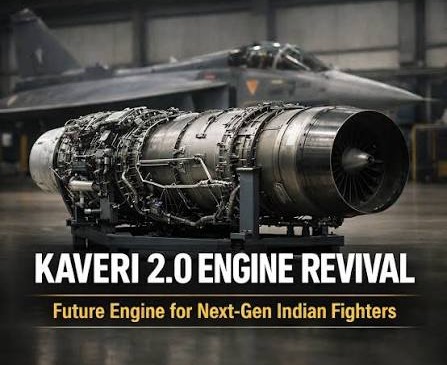
Article published in the Aug 26 edition of the “Life Of Soldier” Magazine.
The commercial discussions between GE Aerospace and India for the F414 have hit a serious roadblock. The per-unit cost has reportedly nearly tripled, from an initial estimate of approximately ₹70-80 crore to well over ₹200 crore. Moreover, the critical technologies, including the Full Authority Digital Engine Control system, are reported to remain under GE’s control. The Tejas Mk-2, the AMCA, and the Twin Engine Deck-Based Fighter have all been built around the F414’s specific dimensions, meaning any switch now entails a structural redesign, new air-intake engineering, and full recertification that takes years.
Only a small group of countries, including the United States, Russia, France, and the United Kingdom, possesses the technological capability to independently design and manufacture advanced military and civilian aircraft engines. Despite decades of effort, India remains dependent on foreign suppliers for fighter aircraft engines. This dependence represents perhaps the single most important technological vulnerability in India’s aerospace ecosystem. The Kaveri programme, which was meant to resolve the problem, did not do so. Understanding why it did not and what it would genuinely take to do so is the most important defence-industrial question India currently faces.
Engine Development Challenges. Aero engines are among the most sophisticated engineering systems ever developed. Modern jet engines operate under extreme temperatures and pressures while delivering high efficiency, reliability, and performance. Developing a high-performance military turbofan is arguably the most complex engineering challenge in modern industry. It requires the precise synchronisation of thermodynamics, fluid mechanics, advanced metallurgy, and digital controls. The engine must operate reliably under extreme conditions, with turbine entry temperatures that frequently exceed the melting points of its components. The four technologies that need to be focused on are: –
-
- Advanced Hot-Section Metallurgy to manufacture single-crystal turbine blades.
-
- Thermal Barrier Coatings (TBC) to prevent advanced alloys from failing at temperatures exceeding 1,500°C.
-
- Aerothermal Design and Core Codes to design codes to predict airflow, flame stability, and thermal stress accurately, enabling independent modifications and derivative engine designs.
-
- Full Authority Digital Engine Control (FADEC) to manage everything from fuel metering to variable stator vanes in real-time.
Kaveri Experience
The Gas Turbine Research Establishment in Bengaluru began developing the Kaveri engine in the mid-1980s. The mandate was to develop an indigenous turbofan capable of producing around 80 kilonewtons of thrust with afterburner. The original completion target was 1996, which was later extended to 2009. The engine did not achieve the required thrust-to-weight ratio. Development challenges included compressor efficiency, turbine blade durability, excessive engine weight, and inadequate afterburner performance. The programme reached a development plateau with a thrust level of approximately 73 kilonewtons. It was formally decoupled from the Tejas programme in 2008. The GE F404 was adopted as the primary powerplant.
But the Kaveri program was not a total waste. It produced important assets, including indigenous FADEC work, certified materials, accumulated engine test hours, and experience in integration and high-altitude testing. It created India’s first indigenous knowledge base in turbine engine design. It established testing facilities, trained engineers, developed computational design capability, and exposed India’s scientific community to the realities of high-performance propulsion engineering. Recent progress includes continued development of Kaveri derivatives for unmanned combat aerial vehicles (UCAVs) such as the Ghatak.
Effect of Technology Denial. Western nations imposed severe restrictions on sensitive technology transfer after India’s nuclear tests. These adversely affected India’s engine development challenges. India’s nuclear tests in 1998, in particular, triggered a period of comprehensive sanctions that froze several cooperative technology relationships at a particularly sensitive moment in the Kaveri programme’s development. Later, India was admitted to the Missile Technology Control Regime in 2016 and the Wassenaar Arrangement in the same year, and to the Australia Group and the Nuclear Suppliers Group waiver arrangement in earlier periods. These admissions improved India’s position as a purchaser of controlled technology. They did not automatically transfer the knowledge embedded in the manufacturing processes. This reflects a broader reality: countries rarely transfer technologies that determine long-term military competitiveness.
Global Approach
Nations capable of manufacturing aircraft engines show that successful aero-engine ecosystems rely on long-term national commitment. The US combined wartime demand, government-funded research, a competitive industry, and strong collaborations among government, academia, industry, and military to build a competitive engine sector. France also followed a state-led approach. It regarded engine development as a strategic sovereign task and ensured programme continuity and the preservation of knowledge. The UK focused on excellence in materials science and turbine engineering. The government, on the other hand, helped to prevent setbacks such as Rolls-Royce’s near-collapse. Russia gave priority to self-reliance. It incurred high costs to maintain specialised design bureaus and industrial infrastructure. It took China 40 years to progress from the WS-10 to the WS-15 engines. China’s perseverance highlights the importance of continued investment, iterative learning, and constant policy support. Analysis of these approaches reveals four universal lessons: –
-
- National self-sufficiency in propulsion is vital for national security.
- Institutional continuity & state support are essential to preserve knowledge and retain institutional expertise.
- Strategic Patience and project funding are required to achieve sovereignty despite slow initial results.
- Synergistic ecosystems demand long-term partnerships among government, academia, R&D establishments, and private manufacturers.
Renewed Indian Effort: National Aero Engine Mission
Forty-four years after the Gas Turbine Research Establishment first began serious work on what became the Kaveri engine, India has launched something with a different institutional character. The National Aero Engine Mission was formalised in February 2026. NAEM is not another laboratory programme with an open-ended timeline. It is an organisational structure designed to coordinate amongst the agencies involved in aircraft engine development and manufacture. The ₹61,000-crore initiative aims to achieve self-reliance (Aatmanirbharta) in the design, development, and manufacturing of high-thrust fighter jet engines. Driven by the Gas Turbine Research Establishment, the mission aims to break decades of import dependence by 2035.
Task. The task of NAEM is cut out. Develop a defined product with a hard operational deadline, not a research thrust target, or a demonstrator. An engine with a specified performance envelope, a specified platform application, and a date by which it must be ready for flight testing, with the aircraft programme formally committed to using it. The Tejas Mk-2 and the AMCA are the obvious candidates. The AMCA, in particular, intended to be India’s first fifth-generation fighter, will require an engine in the 110-kilonewton class. If that engine is not developed indigenously, India will be forced to import the powerplant for its most strategically sensitive aircraft programme, thereby recreating exactly the dependency the AMCA is meant to resolve.
Aims and Objectives of the National Aero Engine Mission. The central aim of the mission is to establish India as an independent aero engine development nation. Key objectives include: –
-
- Development of High-Thrust Engines. Co-develop a 120 kN-class engine (scalable to 130–140 kN) primarily for the AMCA Mk2 and future platforms. This engine would enable supercruise, stealth capabilities, high manoeuvrability, and an enhanced payload.
-
- Indigenous Manufacturing Ecosystem. Establish domestic capabilities for design, testing, certification, and large-scale production.
-
- Testing Infrastructure. The mission would effectuate the timely establishment of the National Aero Engine Test Complex (NAETC) to provide comprehensive ground and high-altitude testing.
-
- Human Resources and Skills. Create thousands of specialised jobs in aerospace engineering, materials science, and advanced manufacturing. It will foster a robust talent pipeline through collaborations with academic institutions.
-
- Dual-Use Technologies. Advances in high-temperature composites, coatings, and alloys will benefit civil aviation, power generation, and space sectors. India’s booming civil aviation market stands to gain significantly.
Success Imperatives.
Private sector participation with real accountability is essential to aerospace manufacturing. The Defence Research and Development Organisation’s laboratory structure has proven ill-suited to the iterative, commercially pressured development process required for engine production. A future engine program should integrate advanced manufacturing companies, startups, and research universities. What is needed is a structure in which one or more private sector aerospace companies, properly capitalised and with access to GTRE’s existing knowledge base, take on programme risk alongside the government. This is not a privatisation argument. It is an argument about what kinds of institutional incentives actually produce functional hardware.
A materials and manufacturing foundation is the need of the hour. The turbine blade problem cannot be solved by importing blades and assembling engines around them. India needs domestic capability in single-crystal casting, thermal barrier coatings, and the high-temperature alloy supply chain. Several Indian private-sector metallurgical companies have demonstrated capabilities in these areas.
Technology induction is required to speed up the development process. Structured access to technology through existing partnerships seems to be the only way out. Licence production is not the answer; knowledge of manufacturing methods needs to be shared. Companies such as Rolls-Royce, GE Aviation, Safran, and Pratt & Whitney have their own commercial and contractual reasons for not sharing the deepest layers of their process knowledge. The negotiation of that distinction matters enormously and should be a specific, explicitly stated objective of the technology transfer agreement rather than an outcome hoped for as a byproduct. It won’t be easy, and it won’t be cheap.
Concluding Thoughts
India’s aerospace ambitions cannot be fulfilled without mastering aero engine technology. An aero engine takes between fifteen and twenty-five years to move from concept to operational maturity, even under favourable conditions, and considerably longer under unfavourable ones. However, the engine problem is not unsolvable. It is genuinely hard, takes a long time, and requires sustained institutional commitment. France, Britain, the United States and Russia have solved it. China is in the process of solving it.
The success of the National Aero Engine Mission is a non-negotiable national priority. It needs to become India’s next successful strategic technology initiative through dedication, perseverance and institutional support. The Mission will not be judged by its initial test results or its early industry partnerships. It will be judged, a decade or more from now, by whether an Indian fighter is flying on an engine fully owned by India.
Please Add Value to the write-up with your views on the subject.
For regular updates, please register your email here:-
References and credits
To all the online sites and channels.
Pics Courtesy: Internet
Disclaimer:
Information and data included in the blog are for educational & non-commercial purposes only and have been carefully adapted, excerpted, or edited from reliable and accurate sources. All copyrighted material belongs to the respective owners and is provided only for wider dissemination.
References: –
- India Today. “India-US GE F414 AMCA fighter jet engine deal in limbo amid nearly 300 per cent increase in cost”. (24 Jun 2026). https://www.indiatoday.in/
- New Indian Express. “AMCA engine deal hits roadblock over GE’s threefold price demand”. (24 Jun 2026). https://www.newindianexpress.com/
- Times of India. “You have 5-7 years to develop 6th gen aero engines: Rajnath’s challenge for DRDO scientists”. (17 Feb 26). https://timesofindia.indiatimes.com/
- Defence Research and Development Organisation. (n.d.). “Gas Turbine Research Establishment (GTRE)”. Ministry of Defence, Government of India. https://www.drdo.gov.in/labs-establishment/gtre
- Ministry of Defence. “Tie-up processes under the National Aero Engine Mission launched”. Press Information Bureau. (2026, February 16). https://pib.gov.in/
- Defence Metallurgical Research Laboratory. Reports on single-crystal turbine blade technology and near-isothermal forging. DRDO Publications.(2021–2026).
- Rao, R. S. Why are engines the bottleneck in fighter jet manufacturing in India? Eurasia Review. (2026). https://www.eurasiareview.com/
- Gunston, B. “The development of jet and turbine aero engines” (4th ed.). Haynes Publishing.(2006).
- Mattingly, J. D. (2006). “Elements of propulsion: Gas turbines and rockets” (2nd ed.). American Institute of Aeronautics and Astronautics. https://doi.org/10.2514/4.861768
- Sarkar, S. (Ed.). “India’s defence industry: Challenges and opportunities”. Routledge. (2020).