799: CONVENTIONAL-NUCLEAR INTEGRATION: THE MOST DANGEROUS EVOLUTION IN MODERN WARFARE


The most consequential and least publicly debated development in contemporary strategic competition is not the size of nuclear arsenals or the speed of delivery systems — it is the progressive blurring of the boundary between conventional and nuclear warfare. What was once a relatively clear firebreak — a conceptual and operational boundary separating nuclear from non-nuclear conflict — is being systematically eroded, with consequences that existing deterrence theory is only partially equipped to address.


Conventional-Nuclear Integration.

CNI refers to the deliberate intertwining of conventional and nuclear forces, capabilities, command structures, and operational planning, making the two domains increasingly difficult to distinguish in real time.

Historical Context. During the Cold War, nuclear and conventional forces operated in largely distinct domains. Nuclear weapons were instruments of strategic deterrence. They were designed to prevent large-scale war through the theory of mutually assured destruction. On the other hand, the conventional forces handled limited conflicts and regional engagements. This separation between the two domains was reinforced by centralised political control over nuclear weapons and decentralised military command of conventional forces. Signalling mechanisms were used to avoid accidental escalation. The end of the Cold War clearly separated the two domains. However, there was a reversal in the trend in the 2010s.  Countries have developed long-range dual-capable systems and doctrines specifically designed to exploit the gap between the two domains. CNI has become an overt strategy.


Integration Dimensions. CNI manifests across four distinct but interconnected dimensions.

    • Dual-use Delivery Systems. Platforms and missiles have become capable of delivering either conventional or nuclear warheads. There is no externally observable difference between them. A launch detected by an adversary’s early warning system is indistinguishable in its initial phase. The adversary must decide whether to absorb the hit and assess, or respond according to the worst-case assumption. This decision has to be made in minutes, under maximum psychological stress, with incomplete information.
    • Co-mingled Force Postures. The nuclear and conventional forces are being physically based in proximity. They are using the same infrastructure, C2 structures, and logistics chains. The attacker cannot surgically eliminate the conventional threat without simultaneously threatening the nuclear one. Targeting these bases in a conventional campaign carries unavoidable nuclear implications.
    • Integrated Command and Control. The same communications network, battle management system, and command node are shared by both the conventional and nuclear weapon systems. Any attack on C2 infrastructure may be interpreted as a deliberate attack on nuclear capability. This may trigger a nuclear response. Equally, cyberattacks intended for conventional purposes could be misread as attempts to turn off nuclear deterrence entirely.
    • Doctrinal Integration. Maintaining an ambiguous boundary between conventional and nuclear forces has become a deliberate strategic policy norm. This also involves openly incorporating nuclear options into conventional operational planning, and vice versa.


Analytical Perspective

Integration Justifications. CNI is not an accident of technological development — it is a deliberate strategic choice driven by identifiable incentives that differ by power competition. The growing effect is a strategic environment in which every major nuclear power has rational incentives to pursue CNI.

    • For states with inferior conventional forces, integration offers a force multiplier. The threat of nuclearising any conventional action extends the nuclear deterrence to the battlefield level conventional domain. Pakistan’s Nasr tactical nuclear weapon is being explicitly projected as a weapon of choice to offset India’s conventional superiority.
    • For states with superior conventional forces, integration creates strategic ambiguity. This complicates the adversary’s planning because it cannot determine whether a given strike package carries conventional or nuclear munitions. It must plan for the worst case — constraining its own conventional operations and extending deterrence value beyond what the nuclear arsenal alone would provide.
    • For states facing precision conventional strike threats to their nuclear forces, integration is a survivability strategy. Dispersing nuclear assets among conventional forces makes them harder to target in a disarming first strike. China’s co-location of conventional and nuclear brigades within the PLA Rocket Force reflects precisely this logic.


Stability Implications. The strategic stability consequences of CNI can be seen at three levels.

    • Crisis Instability. CNI compresses decision-making timelines. The nuclear deterrence model assumed that decision-makers would have hours, if not days, to assess an adversary’s intentions and respond.  Dual-use missiles with short flight times have reduced that window to a few minutes. A decision-maker facing an incoming ballistic-missile salvo must choose quickly between waiting for an impact assessment and responding before the command structure is destroyed. CNI structurally favours the latter choice, which increases the risk of unintended escalation. Hypersonic glide vehicles, travelling at speeds exceeding Mach 5 on unpredictable trajectories, compress this timeline further still.
    • Arms Race Instability. CNI generates poorly understood action-reaction dynamics. Conventional military improvements developed for entirely non-nuclear purposes (precision strike, long-range ballistic missiles, advanced ISR, etc) are perceived by adversaries as threats to nuclear survivability. Neither side may consciously be pursuing nuclear advantage, but the conventional competition produces nuclear instability as a byproduct. This dynamic is currently not being managed.
    • Extended Deterrence Instability. CNI complicates alliance management in many ways. The credibility of the extended deterrence guarantee depends on whether the alliance would respond to a conventional strike with nuclear force when an ally faces a dual-capable missile threat. CNI makes this threshold question permanently ambiguous. The challenge of synchronising this politically across multiple capitals, where public understanding of CNI remains limited, is substantial.


Indian Context. India and Pakistan’s deterrence dynamic has evolved to the point where the conventional and nuclear domains are deeply intertwined. The Stability-Instability Paradox is at its most dangerous in this dynamic. At the same time, CNI removes the buffer zone that previously separated the two levels of conflict. The existence of nuclear weapons paradoxically encourages more intense conventional hostility. Pakistan has created a force structure in which the tactical nuclear weapons are dispersed in the field. The 2019 Balakot airstrikes and the 2025 Operation Sindoor highlighted the dependence of de-escalation on communication channels and leadership restraint. These cannot be assumed in all scenarios.


Managing CNI.

The policy responses to CNI are genuinely difficult because the drivers of integration are perceived as rational from each state’s perspective; however, the systemic effects are destabilising.

Challenges. Arms control approaches face a fundamental verification problem — dual-use systems cannot be meaningfully constrained without intrusive inspection regimes that states are unwilling to accept.  Declaratory approaches — no-first-use pledges, negative security assurances — are undermined by doctrinal ambiguity and the credibility problems inherent in any commitment that is hard to verify and costly to honour under fire.


Suggested Actions. The more promising near-term mitigations focus on risk reduction rather than elimination. These include: –

    • Establishment of direct military-to-military communication channels specifically designed for CNI-related crisis management.
    • Notifying adversaries when conventional strikes approach nuclear-sensitive facilities by agreed protocols.
    • Separation of nuclear and conventional assets, to reduce entanglement.
    • Renewed investment in strategic stability dialogues that explicitly address the conventional-nuclear interface rather than treating nuclear issues in isolation from conventional military competition.


Concluding Thought.

The fundamental intellectual challenge is that CNI requires deterrence theory to be substantially rebuilt for the prevailing environment. The goal of CNI should not be to make nuclear war easier to fight, but to make conventional war too dangerous to start. That rebuilding is urgently needed. It has barely begun.


Please Add Value to the write-up with your views on the subject.


1879
Default rating

Please give a thumbs up if you  like The Post?


For regular updates, please register your email here:-

Subscribe


References and credits

To all the online sites and channels.

Pics Courtesy: Internet

Disclaimer:

Information and data included in the blog are for educational & non-commercial purposes only and have been carefully adapted, excerpted, or edited from reliable and accurate sources. All copyrighted material belongs to the respective owners and is provided only for wider dissemination.

References:


  1. Freedman, L. (2003). The evolution of nuclear strategy (3rd ed.). Palgrave Macmillan.


  1. Acton, J. M. (2018). Escalation through entanglement: How the vulnerability of command-and-control systems raises the risks of an inadvertent nuclear war. Carnegie Endowment for International Peace.


  1. Posen, B. R. (1991). Inadvertent escalation: Conventional war and nuclear risks. Cornell University Press.


  1. Lieber, K. A., & Press, D. G. (2017). The new era of counterforce: Technological change and the future of nuclear deterrence. International Security, 41(4), 9–49.
  2. Speier, R., Nacouzi, G., Lee, C., & Moore, R. (2017). Hypersonic missile nonproliferation: Hindering the spread of a new class of weapons. RAND Corporation.
  3. Narang, V. (2014). Nuclear strategy in the modern era: Regional powers and international conflict. Princeton University Press.


  1. Dalton, T., & Krepon, M. (2016). A normal nuclear Pakistan. Stimson Center.
798: IRAN’S MOSAIC DEFENCE AND DISTRIBUTED COMMAND ARCHITECTURE


Iran’s Mosaic Defence doctrine is one of the most deliberately constructed asymmetric military strategies of the 21st century, and the ongoing US-Israel military campaign against Iran — Operation Epic Fury, launched February 28, 2026 — has provided its first real-time stress test against a peer-level adversary. The doctrine’s performance in the opening weeks of that conflict has validated decades of Iranian military planning and confounded Western expectations of rapid regime collapse.

Iran’s defence doctrine was shaped by two formative historical experiences: the 1980–88 Iran-Iraq War and Israel’s intervention in Lebanon. Both anchored ballistic missiles and proxy networks are core instruments of Iranian strategy. But the formal doctrine crystallised from a more recent lesson. Iranian military planners studied US operations in Iraq, Afghanistan, and the Balkans, concluding above all from the 2003 collapse of Saddam Hussein’s centralised regime that highly centralised militaries collapse quickly once their leadership is struck. As Foreign Minister Araghchi put it: “We’ve had two decades to study defeats of the US military to our immediate east and west. Bombings in our capital have no impact on our ability to conduct war. Decentralised Mosaic Defence enables us to decide when — and how — war will end.”


Formalisation and Architecture

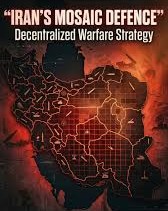
The doctrine was formalised in 2005 when the IRGC, under General Mohammad Jafari, announced the Mosaic Defence model: a decentralised command-and-control system restructured into 31 separate provincial commands. Each of Iran’s 31 provinces has its own IRGC headquarters, command structure, weapons stockpile, and intelligence capability — effectively a complete military system in miniature. “Every province is a mosaic, and the commanders have the ability and power to make decisions,” analyst Farzin Nadimi has noted. “So when they are cut off from their command in Tehran, they can still function as a cohesive military force.”


Under this model, the IRGC, regular army, missile units, naval assets, and the Basij militia form a distributed defence network. If one unit is destroyed, others continue operating independently. The architecture was designed against one specific adversary capability: the decapitation strike.


The Four Operational Pillars

Asymmetric Warfare and Cost Imposition. Rather than conventional force-on-force engagement, the doctrine imposes prohibitive costs through endurance — survive the initial shock, keep retaliating through multiple channels, and raise the costs of a prolonged campaign until continuation becomes politically untenable for the attacker.

Distributed Command with Pre-Delegated Authority. Iranian sources described how the Revolutionary Guards delegated authority far down the ranks and built “successor ladders” so units continue operating if commanders are killed. Each provincial command operates with overlapping chains of command and dispersed stockpiles — not just decentralisation but redundancy at every level. Provincial IRGC units can call upon Basij forces during crises. This enables a multi-level defence that is largely unfazed by decapitation strikes.

Missile Arsenal as Strategic Anchor. Iran’s ballistic missile capability is the backbone of the mosaic architecture. Distributed missile batteries across 31 provincial commands mean that neutralising Iran’s missile threat requires destroying 31 separate, geographically dispersed launch systems rather than a single centralised arsenal — an operation orders of magnitude more complex than a leadership strike.

The Axis of Resistance as Strategic Depth. National security is not limited to the protection of national territory; it rests on preventing confrontation from spilling over national borders. Hezbollah, the Houthis, Iraqi Shia militias, and Syrian proxy forces each represent distributed nodes of retaliatory capacity operating semi-independently of Tehran — a regional application of the same mosaic logic applied domestically. Acting upon nodes across the Middle East’s interconnected system of military bases, maritime chokepoints, and energy corridors can transform a localised confrontation into a crisis with global repercussions.


The 2026 Operational Test

The initial US-Israeli campaign followed the standard Western pattern. It aimed to create a systemic collapse by destroying command centres, communications nodes, and senior figures. The US campaign did not yield the desired results. On the contrary, it highlighted the fundamental characteristic of the Iranian system, i.e. its capacity to absorb strategic shock.

Rather than triggering disintegration, the loss of the decision-making center appears to have accelerated the activation of a resilience mechanism already embedded in Iranian doctrine. What has emerged is that the Iranian strategic model can be described as “war without a centre”.  The military capability is organised not around a single decision-making nucleus, but across an array of interconnected tactical centers.

The system seems to be working. The independent Iranian military units (somewhat isolated) are acting based on general instructions given to them in advance. They have responded to heavy bombardment by firing unprecedented barrages of ballistic missiles and kamikaze drones at Israel, US military and diplomatic facilities across the Middle East, and critical energy infrastructure in the Persian Gulf.


Doctrinal Vulnerabilities

Mosaic Defence, however, does carry significant structural vulnerabilities.

  • Coordination Problem. Decentralisation enables resilience; however, it simultaneously creates coordination challenges. It becomes difficult to coordinate with the autonomous provincial units.
  • Strategic Coherence. Without a clear political direction, the doctrine designed for endurance risks prolonging the conflict, without achieving any meaningful strategic outcomes. Military persistence must eventually convert into political outcomes.
  • Dependency on Political Cohesion. The doctrine depends on public support and internal unity. Provincial commanders operating with pre-delegated authority must be politically reliable as well as militarily capable — a requirement that becomes more demanding as the human and economic costs of sustained conflict accumulate.
  • Escalation Unpredictability. Units acting on general instructions given in advance, without real-time central guidance, are inherently prone to escalation. The doctrine that gives Iran resilience also makes selective de-escalation difficult. These units may not be reachable for recall or restraint.


Strategic Implications

For US and Israeli Doctrine. The most significant implication is that the standard Western decapitation playbook, which worked against Iraq in 2003 and Libya in 2011, did not work against Iran. Defeating mosaic defence requires not precision strikes on central nodes but sustained, comprehensive degradation of 31 independent provincial systems simultaneously.

For India’s Strategic Assessment of War Duration. The activation of Iran’s mosaic defence has direct implications for India. It implies that Hormuz closure is not a temporary measure, but a potentially sustained strategic instrument. India must plan for a prolonged, rather than brief, disruption scenario.

For India’s Structural Reorganisation. In terms of military doctrine, Iran’s architecture offers relevant insights for India’s distributed warfighting requirements. The concept of 31 self-contained provincial commands maps directly onto questions about India’s theatre command architecture. The lesson that decentralised command enables resilience is relevant to India’s two-front scenario planning.

For the Theory of Modern Warfare. The emergence of “war without a center” as an operational reality, rather than just a theoretical concept. It poses a fundamental challenge to the Western doctrine of rapid dominance. The assumption that power is concentrated in a single center, and that striking that center causes strategic paralysis has been disproven in real time. The broader implication is that the era of quick, decisive, decapitation-based military victories against a sophisticated adversary, who has studied and prepared specifically for such an approach, may be fundamentally over.


Analytical Perspective

Iran’s Mosaic Defence represents a genuinely innovative solution to a fundamental strategic problem—the problem of facing a technologically superior adversary by a militarily inferior state. The challenge is to survive the first strike and sustain the fight long enough to make the cost of continuation prohibitive for the attacker. The solution lies in distributing everything, pre-delegating authority, building redundancy at every level, and making the system function as a web rather than a hierarchy.

This doctrine’s greatest success is not operational but psychological. In the case of the war in Iran, it has converted Iran’s structural military inferiority into a manageable constraint. It has ensured that the adversary’s greatest advantages (i.e., precision, speed, and decapitation capability) did not translate into a rapid victory on which the entire campaign logic depended. Iran has prepared itself for a long war. Whether that long war serves Iran’s strategic interests better than a rapid defeat would have done is a question the doctrine itself cannot answer.


Please Add Value to the write-up with your views on the subject.


1879
Default rating

Please give a thumbs up if you  like The Post?


For regular updates, please register your email here:-

Subscribe


References and credits

To all the online sites and channels.

Pics Courtesy: Internet

Disclaimer:

Information and data included in the blog are for educational & non-commercial purposes only and have been carefully adapted, excerpted, or edited from reliable and accurate sources. All copyrighted material belongs to respective owners and is provided only for wider dissemination.


References:

  1. Connell, M. (2010). Iran’s military doctrine. CNA Analysis and Solutions.
  1. Eisenstadt, M. (2011). The strategic culture of the Islamic Republic of Iran: Religion, expediency, and soft power in an era of disruptive change. Middle East Journal, 65(4), 551–570.
  1. Golkar, S. (2015). Captive society: The Basij militia and social control in Iran. Columbia University Press.
  1. Jafari, M. (2005). Mosaic defence doctrine: IRGC restructuring framework [Internal IRGC policy document, as cited in open-source analyses].
  1. Nadimi, F. (2020). Iran’s evolving approach to asymmetric naval warfare: Strategy and capabilities in the Gulf. Washington Institute for Near East Policy.
  1. Ostovar, A. (2016). Vanguard of the Imam: Religion, politics, and Iran’s Revolutionary Guards. Oxford University Press.
  1. Takeyh, R. (2009). Guardians of the Revolution: Iran and the world in the age of the Ayatollahs. Oxford University Press.
  1. Ward, S. (2009). Immortal: A military history of Iran and its armed forces. Georgetown University Press.
  1. Pape, R. A. (1996). Bombing to win: Air power and coercion in war. Cornell University Press.
  1. Reuters. (2024). Iran’s Revolutionary Guards delegate authority down the chain of command amid preparations for conflict. Reuters.

797: HYPERSONIC WEAPONS AND MISSILE DEFENCE 2.0:  NEW STRATEGIC CALCULUS


Paper published in the April 2026 edition of “The News Analytics” Journal


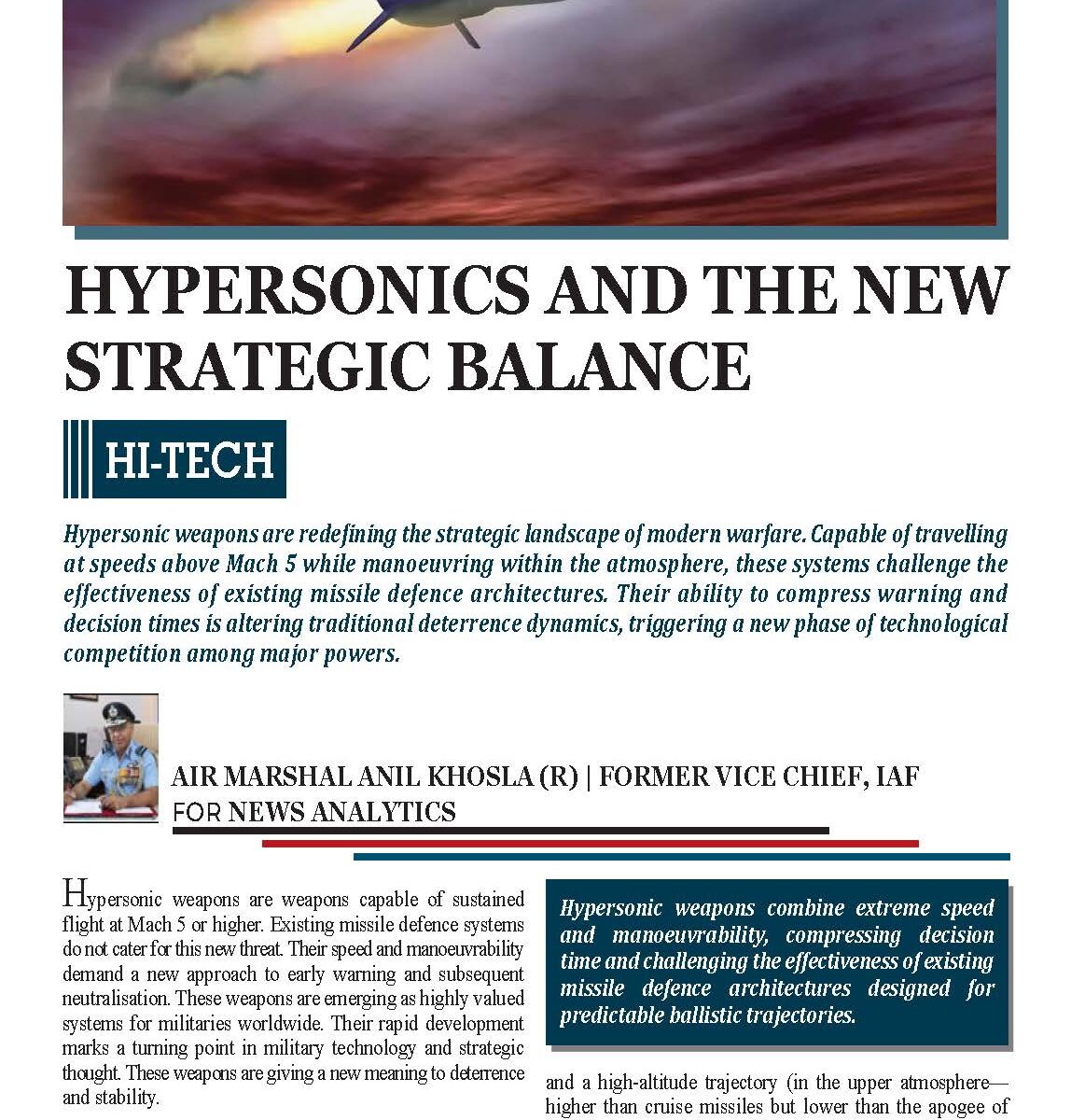
Hypersonic weapons are weapons capable of sustained flight at Mach 5 or higher. Existing missile defence systems do not cater for this new threat. Their speed and manoeuvrability demand a new approach to early warning and subsequent neutralisation. These weapons are emerging as highly valued systems for militaries worldwide.  Their rapid development marks a turning point in military technology and strategic thought. These weapons are giving a new meaning to deterrence and stability.

Hypersonic Weapons. Intercontinental Ballistic Missiles (ICBMs) can also reach hypersonic speeds. However, they travel through space in a predictable parabolic arc.  Their trajectory becomes predictable, and long-range radars can track them. On the other hand, the characteristics of hypersonic weapons include sustained high speed, increased manoeuvrability, and a high-altitude trajectory (in the upper atmosphere – higher than cruise missiles but lower than the apogee of ballistic missiles). These attributes of hypersonic weapons are blurring the line between ballistic and cruise missiles. Hypersonic weapons are classified into two categories: hypersonic glide vehicles (HGVs) and hypersonic cruise missiles (HCMs). HGVs are carried and launched from ballistic missiles. Post-separation, they glide through the upper atmosphere at extreme speeds following a controllable trajectory. HCMs sustain hypersonic flight within the atmosphere using advanced scramjet engines. Hypersonic weapons can alter their trajectory. This adds to the complexity of detecting, tracking, and intercepting them. High speed also compresses decision-making time. It shortens the window for assessing the threat and making a decision on counteraction.

Speed and Manoeuvrability: A Strategic Game-Changer. Hypersonic missiles are commonly depicted as a “game changer and the unprecedented capabilities of these weapons portend a revolution in missile warfare. It is considered that the speed, accuracy, and manoeuvrability of hypersonic boost-glide weapons will fundamentally change the character of warfare. Developments in hypersonic propulsion will revolutionise warfare by enabling faster strikes. With unmatched speed, these weapons will likely hit over-the-horizon targets in a fraction of the time. This claimed speed advantage is ostensibly accompanied by near-immunity to detection, rendering hypersonic weapons “nearly invisible” to existing early warning systems. Together, these capabilities will significantly compress decision and response times.


Missile Defence 2.0: Adapting to the Hypersonic Age

Missile Defence in the Pre-Hypersonic Era. Existing defences are primarily designed to counter ballistic missiles. They rely on layered architectures that include early-warning launch detection, long-range radar-based trajectory tracking, and interception. The destruction could occur during the boost, midcourse, or terminal phases.  These systems operate on the logic of predictability. However, these systems are not optimised for low-flying targets that manoeuvre frequently and have little warning time.

Hypersonic Threat Mitigation. A comprehensive missile defence strategy is required to provide an integrated and practical capability to counter ballistic, cruise, and hypersonic missile threats. The speed of hypersonic weapons leaves little time to compute a fire-control solution, communicate with command authorities, and complete an engagement to intercept them actively. Anti-Hypersonic defence would require a combination of disruptive data links and sensors, space-based tracking sensors, and innovative interception methods. Some passive defensive measures against traditional missiles are also effective against hypersonic weapons; these include deception, dispersal, hardening, concealment, etc.

Missile Defence 2.0. To counter hypersonic threats, defence developers are exploring what might be called Missile Defence 2.0. This concept emphasises integration, speed, and adaptability. One key area is sensor networks. Future defences rely on constellations of space-based infrared and tracking satellites that can track hypersonic weapons throughout their flight. Methods of interception also need to evolve. Instead of relying solely on kinetic weapons, multiple new interceptors may be required to neutralise the threat. Artificial intelligence would be essential for data fusion from multiple sensors. Another element of Missile Defence 2.0 is layered resilience rather than perfect protection, recognising that no defence will be impenetrable.

Hypersonic Race

The United States, China, and Russia are competing to develop these weapons. They would be fielding a wide array of hypersonic systems in the coming decades. The development of short-, medium-, and long-range variants of these weapons by major powers is resulting in an arms race. These technologies are changing the nature of warfare, and they have the potential to destabilise the global security environment.

USA. The U.S. has pursued both hypersonic weapons technologies since the early 2000s. It has sought to develop longer-range systems capable of reaching deep into an adversary’s territory to attack defended, hardened, and time-urgent targets. The Department of Defence (DOD) is developing hypersonic weapons under the Navy’s Conventional Prompt Strike program and through several Air Force, Army, and DARPA programs.

Russia. Russia is reportedly the first nation to deploy a hypersonic missile. It characterises these weapons as a centrepiece of its security strategy and has extensively tested at least three distinct hypersonic systems. Russia’s HGV, known as Avangard, is equipped with a nuclear warhead and deployed on SS-19 long-range land-based ballistic missiles. Avangards reportedly feature onboard countermeasures and can manoeuvre in flight to evade ballistic missile defences. Russia has successfully fielded the Zircon and Kinzhal hypersonic weapons, and it has launched the air-launched Kinzhal hypersonic missiles (with a speed of Mach 10 and a payload of 480kg) against Ukraine.

China. China has made a significant effort to match Russian and U.S. capabilities. It has invested heavily in the hypersonic research, development, test, and evaluation programs in the past decade. China is also investing heavily in hypersonic development infrastructure and weapon systems, reportedly outpacing the United States in testing these technologies. China has developed an HGV known as the DF-ZF, previously referred to as the WU-14. China is also developing the DF-41 long-range intercontinental ballistic missile, which could carry a nuclear hypersonic glide vehicle.

India. India has been investing in hypersonic weapon development. In Sep 2020, India successfully tested the Hypersonic Technology Demonstrator Vehicle (HSTDV). HSTDV is a hypersonic unmanned scramjet demonstration aircraft. In addition to the HSTDV program, India is continuing its research and development efforts across various aspects of hypersonic technology (propulsion systems, materials science, and guidance systems). In July 2025, India reportedly conducted a successful test of a hypersonic cruise missile capable of reaching Mach 8 under Project Vishnu. Reportedly, the project aims to develop the Extended Trajectory-Long Duration Hypersonic Cruise Missile (ET-LDHCM), a weapon system that will fundamentally enhance India’s strategic capabilities.

Great Power Competition and Technological Asymmetry. The development of hypersonic weapons has the potential to create a new form of asymmetry. In technologically advanced states, having these weapons gives them an edge in overcoming opponents’ defences. On the other hand, smaller or less tech-savvy states find it difficult to keep up. This creates a growing divide between the “haves” and the “have-nots.” This asymmetry is reshaping the strategic calculus. Major powers may become aggressive, while weaker states may double down on asymmetric strategies such as cyber operations or unconventional warfare.

Implications for Deterrence Stability. The most concerning aspect of hypersonics is their impact on deterrence stability. During the Cold War, stability was based on the philosophy of “Mutually Assured Destruction”.  However, now with reduced reaction time, the risk of miscalculation has increased dramatically. The shift is taking place from ‘Launch on Warning’ to ‘Launch on Uncertainty’. States may get tempted to launch their own weapons at the first sign of a perceived threat. This “crisis instability” is compounded by Strategic Ambiguity: most hypersonic vehicles can carry either a conventional or nuclear payload, leaving an adversary to guess the stakes of an incoming strike.


Conclusion

Technology is a good gadget, but a destructive weapon. Hypersonic weapons signify a significant advancement in military technology. These weapons are even more powerful than traditional ballistic ones because of their incredible speed and agility. Many countries are actively working on developing and testing them. At the same time, Missile Defence 2.0 is evolving to counter this new threat. It includes advanced sensors, smarter interceptors, and a robust architecture to provide better protection.  The proliferation of hypersonic weapons could have significant implications for the global security landscape. Their speed and manoeuvrability could reduce decision-making time in crises, increasing the risk of miscalculation. The development of hypersonic weapons is also starting a new arms race, as countries seek to maintain or gain military superiority in this field.


Please Add Value to the write-up with your views on the subject.


1879
Default rating

Please give a thumbs up if you  like The Post?


For regular updates, please register your email here:-

Subscribe


References and credits

To all the online sites and channels.

Pics Courtesy: Internet

Disclaimer:

Information and data included in the blog are for educational & non-commercial purposes only and have been carefully adapted, excerpted, or edited from reliable and accurate sources. All copyrighted material belongs to respective owners and is provided only for wider dissemination.


References:-

  1. “Hypersonic missiles: What are they and can they be stopped?”, Partyard Defence, May 10, 2019. https://partyardmilitary.com/hypersonic-missiles-what-are-they-and-can-they-be-stopped/
  1. “Hypersonic Technology”, Drishti IAS, 10 Oct 21. https://www.drishtiias.com/daily-updates/daily-news-analysis/hypersonic-technology-2
  1. “Russia, China, the U.S.: Who Will Win the Hypersonic Arms”, IEEE Spectrum, Dec 2020. https://spectrum.ieee.org/russia-china-the-us-who-will-win-the-hypersonic-arms-race
  1. Air Marshal Anil Khosla, “Hypersonic Long Range Weapons”, Air Marshals’ Perspective, 10 Nov 2021. https://55nda.com/blogs/anil-khosla/2021/11/10/hypersonic-long-range-weapons/
  1. Air Marshal Anil Khosla, “Countering Hypersonic Weapon Threat: A Difficult But Manageable Problem”, Air Marshals’ Perspective, 07 Jun 2024. https://55nda.com/blogs/anil-khosla/2024/06/07/countering-hypersonic-weapon-threat-a-difficult-but-manageable-problem/
  1. Tom Karako and Masao Dahlgren, “Complex Air Defence Countering the Hypersonic Missile Threat”, A Report of the Centre for Strategic and International Studies (CSIS) Missile Defence Project, February 2022.
  1. Rylie White, “An Emerging Threat: The Impact of Hypersonic Weapons on National Security, Crisis Instability, and Deterrence Strategy”, Potomac Institute for Policy Studies.
  1. David Roza, “Why Hypersonic Missiles’ Greatest Strength Also Makes Them Vulnerable”, Air and Space Forces Magazine, Dec 2023.
  1. Col Mandeep Singh, “Countering Hypersonics”, Indian Defence Review, Jan 2024.
  1. Economic Times. (2025, July 16). Why India’s new hypersonic missile may outrun Israel’s Iron Dome and Russia’s S-500 and shift the balance in Asia.
  1. Aroor, Shiv. “India’s Hypersonic Missile Ambitions: DRDO’s Project Vishnu and the Road Ahead.” India Today.
English हिंदी