699: WEST ASIAN TENSIONS IMPACTING EURASIA


Article for the “Center of Excellence for Geopolitics and International Studies” website of  Reva University on 08 Jul 25.


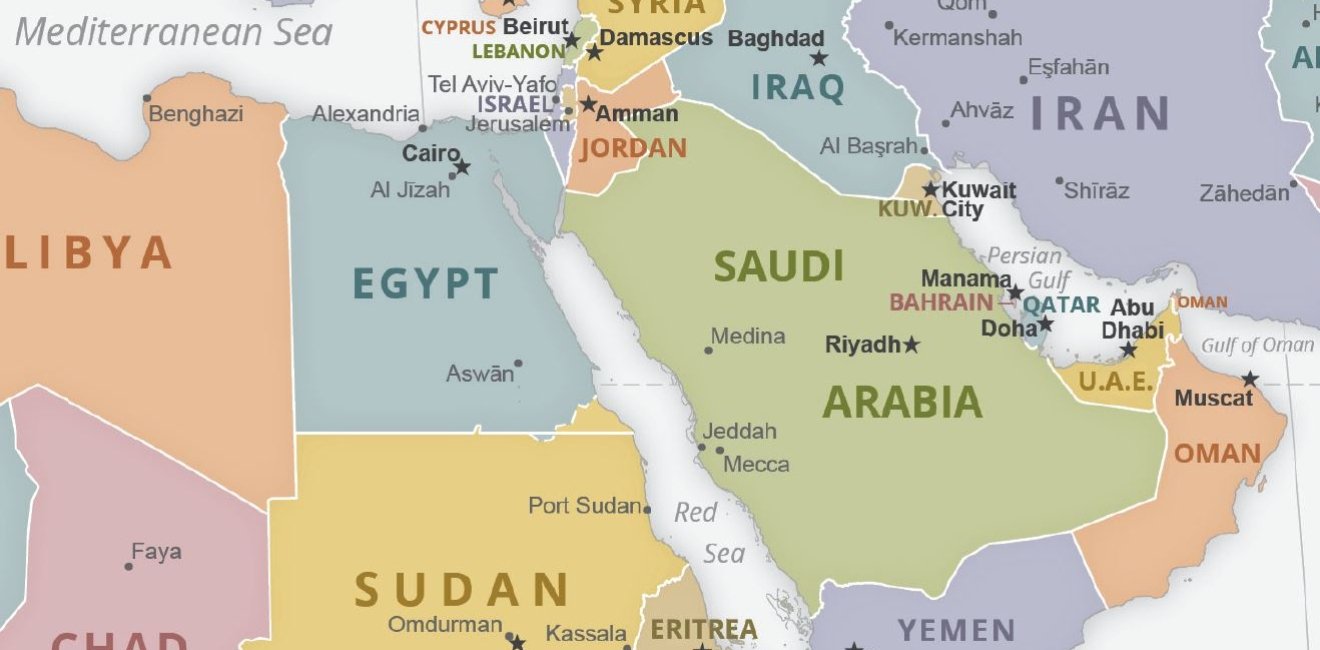
The West Asia has long been a crucible of geopolitical strife, with its conflicts reverberating far beyond its borders. In 2025, escalating tensions in the region, driven by a volatile mix of sectarian rivalries, resource competition, and great power interventions, continue to reshape the political, economic, and security landscape of Eurasia. From energy markets to migration flows, and trade routes to diplomatic alignments, the ripple effects of West Asian instability are profoundly felt across the vast Eurasian supercontinent, influencing both regional powers and global dynamics.


Energy Market Disruptions. The West Asia remains a linchpin of the global energy supply, with countries such as Saudi Arabia, Iran, and Iraq holding significant portions of the world’s oil and gas reserves. Tensions, particularly between Iran and its Gulf neighbours, have repeatedly threatened key chokepoints, such as the Strait of Hormuz, through which roughly 20% of global oil passes. Recent escalations have driven oil prices higher, with Brent crude currently hovering around $95-100 per barrel as of mid-2025. This volatility directly impacts the economies of Eurasia, particularly energy-hungry nations like China and India, which rely heavily on West Asian oil.


Trade Routes and Supply Chain Vulnerabilities. The West Asia’s strategic geography makes it a crucial node in Eurasian trade networks, particularly in the context of the Belt and Road Initiative (BRI). Conflicts in the region, such as the ongoing Israel-Palestinian/Iran crisis and Houthi attacks in the Red Sea, threaten maritime routes like the Suez Canal, through which 12% of global trade flows. Houthi drone and missile strikes on shipping in 2024-2025 have forced rerouting around the Cape of Good Hope, increasing costs and delays for goods moving between Asia and Europe. This has prompted China to bolster overland BRI routes through Central Asia.


Migration and Humanitarian Crises. West Asian conflicts have driven waves of migration, with profound implications for the Eurasian region. The Syrian civil war continues to push refugees into Turkey. In 2025, renewed violence in Iraq and Yemen has triggered fresh displacement, with refugees and asylum seekers moving not only westward but also eastward into Central Asia and South Asia. Pakistan and Iran, already hosting millions of Afghan refugees, face additional pressures, exacerbating resource scarcity and ethnic tensions. The humanitarian toll also diverts resources from development projects.


Security and Geopolitical Realignments. West Asian tensions are reshaping Eurasian security dynamics, prompting major powers to recalibrate their strategies in response. Russia, a key player in both regions, leverages its military presence in Syria to project power while deepening ties with Iran. This alignment, however, alienates Turkey and complicates Moscow’s relations with Sunni-majority states like Saudi Arabia. Meanwhile, China’s non-interventionist stance is tested as it seeks to protect its investments in the Middle East and Central Asia, leading to cautious military cooperation with regional powers. The U.S., while reducing its West Asian footprint, remains a pivotal actor through alliances with Israel and the GCC.


The Broader Eurasian Impact. The interplay of these factors creates a feedback loop that destabilises Eurasia. Regional powers, such as Turkey, Iran, and India, are often forced to adapt, often at the expense of their domestic priorities. Smaller Eurasian states, particularly in Central Asia, face heightened risks of being drawn into great power rivalries or extremist networks. Meanwhile, global initiatives like the BRI and climate transition efforts are slowed by the need to address immediate crises emanating from the West Asia.


Conclusion. In 2025, the West Asia’s tensions are not merely a regional issue but a Eurasian one, with consequences that ripple across continents. Addressing these challenges requires coordinated diplomacy, robust economic diversification, and a commitment to humanitarian principles. Without such efforts, the fault lines of the West Asia will continue to fracture the Eurasian landscape, undermining stability and prosperity for years to come.


Please Add Value to the write-up with your views on the subject.


1879
Default rating

Please give a thumbs up if you  like The Post?


For regular updates, please register your email here:-

Subscribe


Link to the article on the web site:-

https://www.geopolitics.reva.edu.in/Middle%20East%20Tensions%20Impacting%20Eurasia.html


References and credits

To all the online sites and channels.

Pics Courtesy: Internet

Disclaimer:

Information and data included in the blog are for educational & non-commercial purposes only and have been carefully adapted, excerpted, or edited from reliable and accurate sources. All copyrighted material belongs to respective owners and is provided only for wider dissemination.


References:-

  1. CSIS: Experts React: Energy Implications of Escalating Middle East Conflict, Published: October 8, 2024
  2. TRENDS Research & Advisory: Energy Geopolitics in a Fragmented World, Published: November 12, 2024
  3. Al Jazeera Centre for Studies: The Geopolitics of Global Trade: Why the Middle East Matters Now More Than Ever, Published: June 3, 2025
  4. Carnegie Endowment: The Geopolitics of Economic Development in the Middle East, Published: February 15, 2024
  5. Foreign Policy Research Institute: Turkey’s Evolving Geopolitical Strategy in the Black Sea, Published: December 4, 2024
  6. World Economic Forum: Global Risks Report 2025, Published: January 15, 2025
  7. IMF: Press Briefing Transcript: Middle East and Central Asia Department, Spring Meetings 2025, Published: April 24, 2025
  8. International Institute for Iranian Studies: The Middle East Conflict and Indications of Change in the Strategic Environment, Published: February 10, 2025
  9. Carnegie Endowment: Ending the New Wars of Attrition: Opportunities for Collective Regional Security in the Middle East, Published: March 5, 2025
  10. Brookings: Forecasting China’s Strategy in the Middle East over the Next Four Years, Published: December 19, 2024
  11. Asian Review of Political Economy: China’s Belt and Road Initiative in Southeast Asia and its Implications for ASEAN-China Strategic Partnership, Published: December 3, 2024
  12. Science Direct: The Belt and Road Initiative and Partnership for Global Infrastructure and Investment: Comparison and Current Status, Published: June 1, 2025

698: THE ISTAR TO REDEFINE STRATEGIC SURVEILLANCE FOR THE INDIAN AIR FORCE


My article was published on “The EurasianTimes” website

on 06 Jul 25.


The Indian Air Force (IAF) is set to significantly enhance its surveillance and precision strike capabilities with the procurement of three Intelligence, Surveillance, Target Acquisition, and Reconnaissance (ISTAR) aircraft under a project worth Rs 10,000 crore. The Defence Acquisition Council (DAC), chaired by Defence Minister Rajnath Singh, granted the “Acceptance of Necessity” (AoN) for this initiative on July 3, 2025, as part of a broader Rs 1.05 lakh crore defence modernisation package.

These advanced platforms integrate cutting-edge sensors, communication systems, and artificial intelligence to deliver real-time intelligence, enabling precise battlefield surveillance and strike coordination.  The IAF aims to induct three state-of-the-art ISTAR aircraft, blending global aviation platforms with indigenous sensor technology developed by the Defence Research and Development Organisation (DRDO). The induction would position India among a select group of nations with elite air-to-ground surveillance capabilities.

Understanding ISTAR: A New Class of Airborne Intelligence. ISTAR is not a single system, but an integrated suite of advanced sensors and processing systems mounted on a long-range, high-endurance aircraft. It combines multiple intelligence disciplines, electro-optical, radar, signals intelligence (SIGINT), and electronic intelligence (ELINT), to provide commanders with a comprehensive battlefield picture. Unlike conventional reconnaissance or surveillance aircraft, ISTAR systems go beyond just collecting data. They analyse and fuse it in real-time using AI and advanced analytics, enabling actionable intelligence to be delivered to frontline units and command centers with speed and precision.


The Strategic Imperative for ISTAR

In the rapidly evolving landscape of modern warfare, information superiority is a critical determinant of success. ISTAR aircraft serve as force multipliers by providing real-time intelligence, surveillance, target acquisition, and reconnaissance capabilities. Equipped with advanced sensors, these platforms offer commanders actionable data, enabling precise decision-making in complex battle environments. For the IAF, operating in a volatile geopolitical region marked by ongoing tensions, ISTAR aircraft are indispensable for monitoring enemy movements, tracking high-value targets, and coordinating precision strikes from stand-off ranges.

The urgency for such capabilities was underscored by pivotal events, including the 2019 Balakot airstrike, which highlighted the need for enhanced situational awareness, and the 2020 Chinese aggression along the Line of Actual Control, which exposed gaps in real-time battlefield intelligence. The ISTAR program aligns with India’s broader strategic objectives, including the “Make in India” initiative, which emphasises self-reliance in defence technology. By integrating indigenous sensor systems with globally sourced aircraft platforms, the IAF aims to bolster its operational effectiveness while fostering domestic innovation, positioning India as a formidable player in military aviation.


ISTAR Program

The forthcoming ISTAR project, valued at Rs 10,000 crore, involves acquiring three aircraft from global aviation manufacturers, likely Boeing or Bombardier, which will be fitted with indigenous sensor and electronic systems developed by DRDO’s Centre for Airborne Systems (CABS). These systems, already tested for efficacy, represent a significant leap in India’s defence technology capabilities. The following are relevant aspects of the ISTAR program.

Operational Parameters. The aircraft will operate at a minimum ceiling of 40,000 feet with an endurance of at least eight hours, ensuring sustained surveillance over vast areas. This high-altitude capability allows the platforms to maintain a broad operational footprint.

Sensor Suite. The aircraft will feature:-

    • Synthetic Aperture Radar (SAR) with a range of ≥200 km, enabling high-resolution imaging of ground targets, even through cloud cover or darkness.
    • Ground-Moving Target Indicator (GMTI) with a range of ≥150 km, capable of detecting and tracking moving objects on the battlefield.
    • Electro-Optical/Infrared (EO/IR) Sensors for day/night operations in complex terrains, providing visual and thermal imaging for target identification.
    • Artificial Intelligence and Machine Learning (AI/ML) algorithms for image intelligence, automatic target recognition, and change detection, enhancing the speed and accuracy of data analysis.

Communication Systems. The platforms will be equipped with high-data-rate line-of-sight (LOS) and satellite communication (SATCOM) links, facilitating seamless data sharing with other assets, including satellites, unmanned aerial vehicles (UAVs), and ground-based command centres. This connectivity is critical for integration with the IAF’s Integrated Air Command and Control System (IACCS), enabling real-time coordination across multiple domains.

Ground Segment. The program includes two fixed and four transportable ground exploitation systems for processing and disseminating data, ensuring actionable intelligence reaches commanders swiftly.

Platform. The aircraft are likely to be based on modified commercial jets, such as the Bombardier Global Express or Airbus A319, tailored for military applications. These platforms offer a balance of range, endurance, and payload capacity, making them ideal for ISTAR missions.

The IAF expects delivery within 60 months (five years) from contract signing, with DRDO’s prior testing of sensor systems expediting integration. A 1:32 scale model of the indigenous ISTAR platform, based on a pre-owned Airbus A319, was showcased at Aero India 2023, underscoring India’s commitment to blending global and domestic technologies.


Strategic Significance

The ISTAR aircraft will revolutionise the IAF’s approach to network-centric warfare, enabling real-time, multi-faceted intelligence that enhances precision and reduces collateral damage. By integrating with the IACCS, these platforms will create a cohesive operational picture, coordinating assets across air, ground, and space domains. This capability is particularly critical in India’s regional context, where operations like Operation Sindoor against Pakistan require rapid, calibrated responses without breaching hostile airspace.

Globally, the ISTAR program would position India among an elite group of nations, including the United States, the United Kingdom, and Israel, with advanced air-to-ground surveillance capabilities. The platforms will enhance India’s deterrence posture, providing the ability to monitor and neutralise threats with unparalleled accuracy. The emphasis on indigenous sensor development also aligns with India’s self-reliance goals, reducing dependence on foreign suppliers and positioning the country as a potential exporter of defence technology.


Challenges

Despite its promise, the ISTAR program faces several challenges. Addressing these challenges will be critical to ensuring the program’s success and operational readiness by 2030.

Vulnerability. ISTAR platforms are high-value targets for adversaries. For instance, Indo-Russian BrahMos missile variants are being developed to counter similar enemy platforms, highlighting the need for robust defensive measures, such as electronic countermeasures and stealth features.

Procurement Delays. Past delays due to bureaucratic hurdles and disagreements between the DRDO and the IAF underscore the importance of streamlined processes. The ongoing global tendering for aircraft platforms requires careful vendor selection to ensure compatibility with DRDO systems.

Integration Complexity. Seamlessly integrating indigenous sensors with global platforms demands rigorous testing and validation to avoid operational bottlenecks.

Cybersecurity. The reliance on real-time data sharing necessitates robust cybersecurity protocols to protect against hacking and data breaches.

Human Capital. Operating and maintaining ISTAR systems requires a cadre of highly trained analysts, technicians, and mission planners.


Conclusion

The IAF’s ISTAR aircraft program represents a bold step toward redefining India’s military capabilities in the 21st century. By combining advanced global platforms with cutting-edge indigenous technology, the program addresses urgent operational needs while advancing India’s self-reliance in defence. Expected to be operational by 2030, the three ISTAR aircraft are expected to provide the IAF with unmatched surveillance and strike coordination capabilities, positioning India among an elite group of nations with advanced ISTAR systems. Despite challenges, including procurement delays and platform vulnerabilities, the program’s strategic importance cannot be overstated. As India navigates a complex security landscape, the ISTAR aircraft will serve as a linchpin of its network-centric warfare strategy, ensuring operational superiority and reinforcing its stature as a global military power.


Please Add Value to the write-up with your views on the subject.


1879
Default rating

Please give a thumbs up if you  like The Post?


For regular updates, please register your email here:-

Subscribe


References and credits

To all the online sites and channels.

Pics Courtesy: Internet

Disclaimer:

Information and data included in the blog are for educational & non-commercial purposes only and have been carefully adapted, excerpted, or edited from reliable and accurate sources. All copyrighted material belongs to respective owners and is provided only for wider dissemination.


References: –

  1. Press Trust of India. (2025, June). “IAF’s ISTAR Aircraft Acquisition Gets Nod, Rs 10,000 Crore Project to Boost Surveillance.” The Times of India.
  1. Singh, R., & Sharma, A. (2023). “Aero India 2023: DRDO Showcases Indigenous ISTAR Model.” Defence News India.
  1. Kumar, V. (2024). “India’s Push for Network-Centric Warfare: The Role of ISTAR.” Strategic Analysis Journal, 48(3), 215–230.
  1. Ministry of Defence, Government of India. (2025). Annual Report 2024–25. New Delhi: MoD Publications
  1. Gupta, S. (2021). “Lessons from Balakot: The Need for Advanced Surveillance Platforms.” Indian Defence Review, 36(4), 45–52.
  1. DRDO Newsletter. (2024, August). “CABS Advances Indigenous Sensor Suite for ISTAR Aircraft.” DRDO Publications.
  1. Jane’s Defence Weekly. (2023). “India’s ISTAR Program: Balancing Global Procurement and Indigenous Innovation.”
  1. Bharat Rakshak. (2022). “Evolution of India’s Airborne Surveillance Capabilities.”
  1. Business Today. (2025). Rare global league: ₹10,000 crore I-STAR project to put India in elite club of airborne battlefield intel.
  1. India Defence Analysis. (2024). DRDO’s SCA/ISTAR Aircraft Plans for Indian Air Force.
  1. GlobalSecurity.org. (n.d.). ISTAR – Intelligence, Surveillance, Target Acquisition and Reconnaissance.

697: OPERATION SPIDER’S WEB – UKRAINE’S AUDACIOUS DRONE STRIKE: LESSONS FOR INDIA


My article was published in the Jul 25 issue of

the News Analytics Magazine 


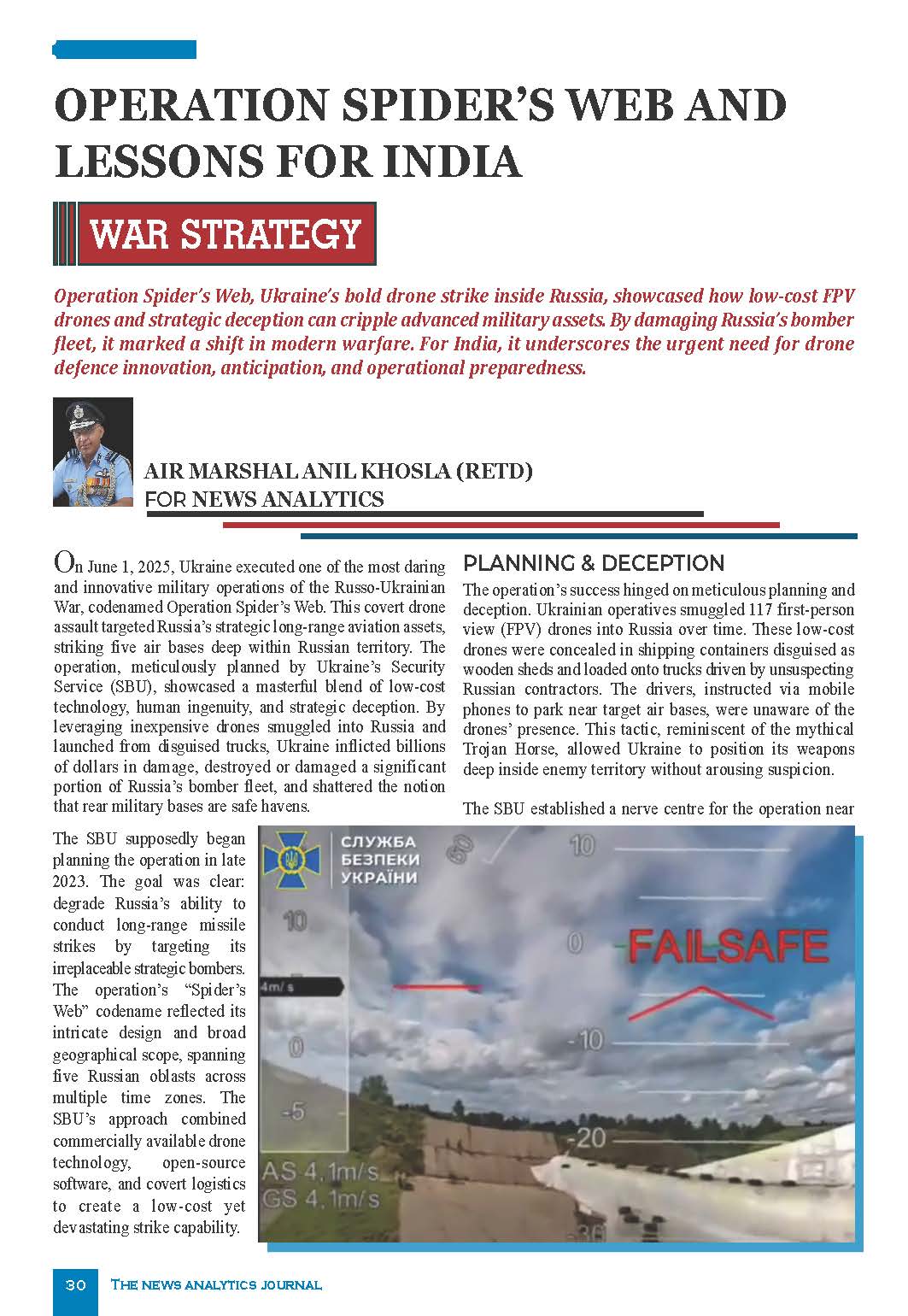
On June 1, 2025, Ukraine executed one of the most daring and innovative military operations of the Russo-Ukrainian War, codenamed Operation Spider’s Web. This covert drone assault targeted Russia’s strategic long-range aviation assets, striking five air bases deep within Russian territory. The operation, meticulously planned by Ukraine’s Security Service (SBU), showcased a masterful blend of low-cost technology, human ingenuity, and strategic deception. By leveraging inexpensive drones smuggled into Russia and launched from disguised trucks, Ukraine inflicted billions of dollars in damage, destroyed or damaged a significant portion of Russia’s bomber fleet, and shattered the notion that rear military bases are safe havens. This article explores the operation’s nuances, implications for modern warfare, and lessons for India.

The Genesis. The SBU supposedly began planning the operation in late 2023. The goal was clear: degrade Russia’s ability to conduct long-range missile strikes by targeting its irreplaceable strategic bombers. The operation’s “Spider’s Web” codename reflected its intricate design and broad geographical scope, spanning five Russian oblasts across multiple time zones. The SBU’s approach combined commercially available drone technology, open-source software, and covert logistics to create a low-cost yet devastating strike capability.


Planning and Deception: A Modern Trojan Horse.

The operation’s success hinged on meticulous planning and deception. Ukrainian operatives smuggled 117 first-person view (FPV) drones into Russia over time. These low-cost drones were concealed in shipping containers disguised as wooden sheds and loaded onto trucks driven by unsuspecting Russian contractors. The drivers, instructed via mobile phones to park near target air bases, were unaware of the drones’ presence. This tactic, reminiscent of the mythical Trojan Horse, allowed Ukraine to position its weapons deep inside enemy territory without arousing suspicion.

The SBU established a nerve center for the operation near a regional office of Russia’s FSB intelligence service in Chelyabinsk, adding a layer of audacity to the plan. Ukrainian operators used Russia’s domestic 4G/LTE networks to pilot the drones remotely, embedding control signals within civilian data traffic to evade detection. The drones were equipped with ArduPilot, an open-source autopilot software, enabling pre-programmed flight paths and precise targeting of vulnerable aircraft components, such as fuel tanks and wings. Some reports suggest AI-assisted machine vision may have enhanced strike accuracy in the drones’ terminal phase, though this remains unconfirmed.

The targets were carefully selected: five air bases—Belaya, Dyagilevo, Ivanovo Severny, Olenya, and Ukrainka—housing Russia’s Long-Range Aviation fleet. These bases, located up to 4,300 kilometers from Ukraine, were critical to Moscow’s strategic bombing campaigns. The operation’s timing, coinciding with Russia’s Military Transport Aviation Day, was likely chosen to maximise psychological impact.


Execution: A Coordinated Strike across Time Zones

On June 1, 2025, Operation Spider’s Web unfolded with surgical precision. At dawn, 117 drones were launched simultaneously from their hidden truck-based platforms, targeting aircraft at the five air bases. The drones, flying in the “air littoral”—a low-altitude zone below traditional radar coverage—evaded Russia’s air defences, which were ill-equipped to counter small, low-flying threats.

The strikes were devastating. Satellite imagery and Ukrainian footage confirmed significant damage, particularly at Belaya Air Base in Eastern Siberia, where seven bombers were destroyed on the tarmac. According to Kyiv, the operation destroyed or damaged over 40 aircraft, including Tu-95s, Tu-160s, Tu-22M3s, and an A-50 airborne early-warning jet, representing roughly one-third of Russia’s long-range strike fleet and $7 billion in hardware. NATO estimates suggest 10 to 13 aircraft were destroyed, with over 40 damaged. Russian sources downplayed the losses, but independent analysts confirmed the operation’s unprecedented scale.

The attack on Belaya, 4,300 kilometres from Ukraine, marked the farthest Ukrainian strike of the war, underscoring the operation’s geographical reach. The SBU released four minutes of drone footage showing strikes on Tu-95 wings and Tu-22M3 fuselages, highlighting the precision of the attack. Russia’s Defence Ministry admitted attacks in Murmansk and Irkutsk but claimed no casualties and minimal damage, a narrative contradicted by satellite imagery and Ukrainian reports.

Operation Spider’s Web was not just a military success, but a strategic and symbolic triumph for Ukraine. The operation also had broader implications. As The New York Times noted, it marked a “defining moment in the evolution of modern warfare.” Using inexpensive drones to destroy high-value assets challenged traditional military doctrines, which assume rear bases are secure. The “air littoral” concept gained prominence as drones exploited gaps in conventional air defences. This strategy, replicable by other nations or non-state actors, could reshape how air forces protect their assets, forcing them to harden, disperse, or treat runways as front lines.


Indian Experience

On June 26–27, 2021, India faced its first terrorist drone attack at the Jammu Air Force Station. Two low-flying drones, likely modified quadcopters (possibly DJI Matrice 600 Pro), dropped IEDs with 1–1.5 kg of RDX, launched from Pakistan near the LoC. The first explosion damaged a building roof in the high-security technical area; the second detonated harmlessly on the ground. Two IAF personnel sustained minor injuries, with no critical assets harmed and attributed to Lashkar-e-Taiba, with possible Jaish-e-Mohammad and ISI involvement. This incident highlighted the potential threat of low-cost, high-impact drone attacks and prompted India to bolster its counter-drone systems, including DRDO’s laser technology and jammers.

The attacks exposed vulnerabilities to small, low-altitude drones, previously used only for smuggling. It mirrored global trends seen in ISIS and Hamas tactics. The incident prompted India to bolster counter-drone systems, including DRDO’s laser technology and jammers. This attack marked a strategic shift, highlighting drones’ low-cost, high-impact potential.


Lessons from Operation Spider’s Web for India

Ukraine’s method of smuggling kamikaze drones into Russia to strike distant targets reveals new possibilities for attacks using smuggled weapons, even outside of wartime. Consider the potential for sabotaging critical infrastructure during peacetime or assassinating key leaders and commanders with micro kamikaze drones during public events, travel, or other vulnerabilities. This threat demands robust defence systems, tailored to its unique nature and scale. Operation Spider’s Web provides vital insights for India to modernise its military strategy, advance technological innovation, and prepare for evolving warfare, especially amid regional security threats.

Emerging Threats. India’s porous borders with Pakistan are vulnerable to low-altitude drone attacks. Adversaries could deploy similar tactics to target air bases, forward posts, or critical infrastructure like dams, refineries, or cities, using inexpensive drones operated by terrorist groups or state actors.

Defence Strategies. To counter these risks, India must implement robust defences. Install counter-drone systems at strategic installations and enhance homeland security with drone surveillance and interception in key areas. Develop rapid-response units to neutralise drone threats. Disperse aircraft and assets across multiple sites to mitigate swarm attack risks, and invest in fortified shelters, decoy systems, and rapid repair facilities.

Network Security. India’s 5G expansion offers military integration potential but risks adversary exploitation. Strengthen cybersecurity to safeguard 5G infrastructure and establish secure, encrypted military communication networks.

Adopt Cost-Effective Drones. Accelerate indigenous drone programs under Make in India, focusing on affordable, scalable systems. Expand public-private partnerships to develop FPV drones with open-source software for rapid deployment in border conflicts.

Enhance Precision and AI. Integrate AI and machine vision into drones to precisely target high-value assets like missile sites—partner with tech firms to develop AI algorithms for real-time target identification in diverse terrains.

Drive Innovation. Create innovation hubs within the Indian Armed Forces and collaborate with academia through hackathons to develop next-generation warfare tools, ensuring adaptability in modern conflicts.


Conclusion

Operation Spider’s Web is pivotal in military history, showcasing drone warfare’s transformative power in redefining modern conflicts. Through a sophisticated blend of deception, technology, and precision, Kyiv delivered a strike that echoed beyond Russia’s airfields, proving no target is truly secure in the drone era. This operation holds critical lessons for India. Deploy advanced counter-drone systems at strategic sites and simulate Ukraine-style drone attacks in war games. Train Special Forces for covert drone missions and boost indigenous drone production under Make in India, prioritising swarm technology and AI. Secure 5G networks for military operations and update doctrines to embed drone warfare, focusing on asymmetry, deception, and precision. Push for global regulations to curb drone use by non-state actors. These measures will strengthen India’s defence framework, ensuring a strategic advantage in 21st-century warfare.


Please Add Value to the write-up with your views on the subject.


1879
Default rating

Please give a thumbs up if you  like The Post?


For regular updates, please register your email here:-

Subscribe

References and credits

To all the online sites and channels.

Pics Courtesy: Internet

Disclaimer:

Information and data included in the blog are for educational & non-commercial purposes only and have been carefully adapted, excerpted, or edited from reliable and accurate sources. All copyrighted material belongs to respective owners and is provided only for wider dissemination.


References:-

  1. Axe, David. “Ukraine’s Drones Just Redrew the Map of Modern Warfare.” The Daily Beast, June 5, 2025.
  1. Barnes, Julian E., and Eric Schmitt. “Ukraine’s Audacious Drone Strike Hits Russian Air Bases, Signals New Phase in War.” The New York Times, June 2, 2025.
  1. Gibbons-Neff, Thomas, and Marc Santora. “How Ukraine Pulled Off a Surprise Drone Attack 4,300 Kilometres Into Russia.” The New York Times, June 3, 2025.
  1. Hambling, David. “Operation Spider’s Web: Ukraine’s Drone Swarm Redefines Asymmetric Warfare.” Forbes, June 4, 2025.
  1. Kofman, Michael, and Rob Lee. “Ukraine’s Drone Strike on Russian Airfields: Strategic Implications.” War on the Rocks, June 6, 2025.
  1. Lendon, Brad. “Ukraine’s Deep Drone Strike: What It Means for Russia’s Air Force.” CNN, June 3, 2025.
  1. Mitzer, Stijn, and Joost Oliemans. “Operation Spider’s Web: Counting the Cost of Ukraine’s Drone Assault.” Oryx, June 4, 2025.
  1. Rogoway, Tyler. “Ukraine’s Drone Blitz on Russian Air Bases: A New Era of Warfare.” The War Zone, June 2, 2025.
  1. Tisdall, Simon. “Ukraine’s Drone Strike Shatters Russia’s Illusion of Safety.” The Guardian, June 5, 2025.
  1. Tucker, Patrick. “Ukraine’s Operation Spider’s Web: A Case Study in Drone Warfare.” Defence One, June 7, 2025.
  1. Center for Strategic and International Studies. “Ukraine’s Drone Strikes and the Future of Strategic Warfare.” CSIS Briefs, June 8, 2025.
  1. Harding, Luke, and Andrew Roth. “Russia’s Air Force Reels After Ukraine’s Drone Strike.” The Financial Times, June 4, 2025.
  1. Reynolds, Nick. “The Air Littoral: How Ukraine Exploited Russia’s Blind Spot.” The Conversation, June 6, 2025.
English हिंदी