
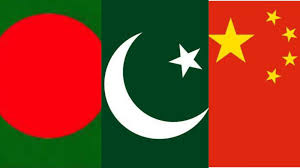
In recent years, the evolving geopolitical landscape of South Asia has been redefined by an emerging alignment among China, Pakistan, and Bangladesh. The growing convergence between these three countries, particularly under China’s Initiative, is reshaping regional dynamics and presenting new challenges to India and broader Indo-Pacific security arrangements.
China-Pakistan Relations. The China-Pakistan relationship, often described as an “all-weather friendship,” has been a cornerstone of regional geopolitics for decades. Rooted in shared strategic interests, particularly countering India, it has been institutionalised through defence cooperation, economic assistance, and infrastructural integration. It has been further deepened through initiatives like the China-Pakistan Economic Corridor (CPEC), a flagship project of China’s Belt and Road Initiative (BRI) launched in 2013, connecting China’s Xinjiang province to Pakistan’s Gwadar port on the Arabian Sea. This strategic partnership has been further solidified by China’s support for Pakistan’s nuclear program and military modernisation, with Pakistan acquiring 70–80% of its weapons from China over the past five years. China has also become Pakistan’s largest arms supplier and a crucial diplomatic ally at forums like the United Nations Security Council, where it has repeatedly shielded Pakistan from international scrutiny over terrorism-related issues.
Bangladesh’s Gradual Pivot. Bangladesh’s inclusion in this dynamic marks a shift, particularly following the ouster of Prime Minister Sheikh Hasina in July 2024. Hasina’s government maintained a balanced foreign policy, fostering close ties with India while engaging China economically. However, the interim government under Muhammad Yunus has pivoted toward closer relations with Beijing and Islamabad, driven by deteriorating India-Bangladesh ties and China’s proactive engagement. This shift was evident during Yunus’s March 2025 visit to China, where he positioned Bangladesh as a gateway for Chinese economic cooperation in the region, a move that strained relations with India. The motivations behind this convergence are multifaceted. For China, expanding influence in South Asia counters U.S.-India strategic alignment and secures access to the Bay of Bengal and Indian Ocean. Pakistan seeks to bolster its regional relevance. Bangladesh, navigating domestic political transitions, sees alignment with China and Pakistan as a means to secure economic and diplomatic support, particularly through BRI projects.
The Triangle Takes Shape. A pivotal development was the trilateral meeting in Kunming, China, on June 19, 2025, involving representatives from China, Pakistan, and Bangladesh. This “informal” consultation, hosted by China, focused on regional cooperation and connectivity, sparking speculation about a new regional bloc to replace SAARC. While Bangladesh’s interim government dismissed claims of a formal alliance, the meeting signaled a strategic intent to enhance collaboration among the three nations.
Implications for India. The proposed bloc poses a direct challenge to India. India’s concerns were heightened by comments from Bangladesh’s leadership, such as Yunus’s claim that Bangladesh is the “only guardian” of the Indian Ocean. India, finds itself encircled by Chinese-influenced states on nearly all fronts, Nepal to the north, Pakistan to the west, and Bangladesh and Myanmar to the east. From a maritime perspective, China’s presence in Gwadar (Pakistan) and Chittagong (Bangladesh) gives it a foothold in the Indian Ocean, threatening India’s naval supremacy and potentially undermining the U.S.-led Indo-Pacific strategy. The strategic alignment also threatens India’s northeastern states, especially the vulnerable Siliguri Corridor, which connects mainland India to its northeast.
Broader Geopolitical Ramifications. The China-Pakistan-Bangladesh convergence complicates the U.S.-China rivalry in the Indo-Pacific. The U.S., viewing China’s growing influence as a challenge to its regional strategy. This dynamic could intensify Sino-U.S. competition, with Bangladesh’s strategic choices shaping the regional balance of power. Smaller South Asian states, such as Nepal and Sri Lanka, may face pressure to align with either the China-Pakistan-Bangladesh bloc or India, complicating regional integration. The dormancy of SAARC, exacerbated by India’s boycott following the 2016 Uri attack, has created a vacuum that China seeks to fill, potentially reshaping South Asia’s geopolitical architecture.
Conclusion. The emerging China-Pakistan-Bangladesh alignment reflects a strategic realignment in South Asia, driven by shared economic and geopolitical interests. While not yet a formal alliance, this convergence challenges India’s regional dominance and complicates the Indo-Pacific strategic landscape. As China expands its influence through BRI and diplomatic engagements, India must navigate a complex dilemma, balancing regional influence with global partnerships. The future of South Asian stability hinges on how these dynamics evolve and whether a new regional bloc can foster cooperation without exacerbating tensions.
Please Add Value to the write-up with your views on the subject.
For regular updates, please register your email here:-
References and credits
To all the online sites and channels.
Pics Courtesy: Internet
Disclaimer:
Information and data included in the blog are for educational & non-commercial purposes only and have been carefully adapted, excerpted, or edited from reliable and accurate sources. All copyrighted material belongs to respective owners and is provided only for wider dissemination.
References:-
- Hindustan Times. “CDS Chauhan Says Convergence between China, Pakistan and Bangladesh Has Implications for Regional Stability.” July 9, 2025.2.
- India Today. “To Counter India, China, Pakistan and Bangladesh Creating a Saarc-Replacement.” June 30, 2025.
- The Hindu. “Bangladesh, Pakistan, China Hold Inaugural Trilateral Foreign Office Discussion.” June 20, 2025.
- The Hindu. “Pakistan, China Working to Establish New Regional Bloc with Potential to Replace SAARC: Report.” June 30, 2025.
- Modern Diplomacy. “Bangladesh-Pakistan Thaw and a Regional Realignment.” February 23, 2025.
- South Asian Voices. “The Bangladesh-Pakistan-China Triangle and India’s Strategic Dilemma.” April 26, 2025.
- The Express Tribune. “Ex-Bangladeshi General Urges China Alliance to Seize India’s Northeast If Pakistan Is Attacked.” May 3, 2025.
- United States Institute of Peace. “China’s Influence on Conflict Dynamics in South Asia.” December 16, 2020