
My Article was published on “The Eurasian Times” website on 02 Jul 25.
In an era where military targets are increasingly buried deep underground, the development and deployment of bunker-busting weapons have become critical to global security strategies. The United States’ GBU-57/A Massive Ordnance Penetrator (MOP) represents cutting-edge solutions to neutralise fortified, subterranean infrastructure. The GBU-57/A saw its first combat use against Iran’s nuclear facilities in 2025. Drawing inspiration from the GBU-57 and driven by India’s regional security requirements, the DRDO has reportedly intensified efforts to develop a bunker-busting weapon based on the Agni-5 missile.
The GBU-57/A: America’s Bunker-Buster
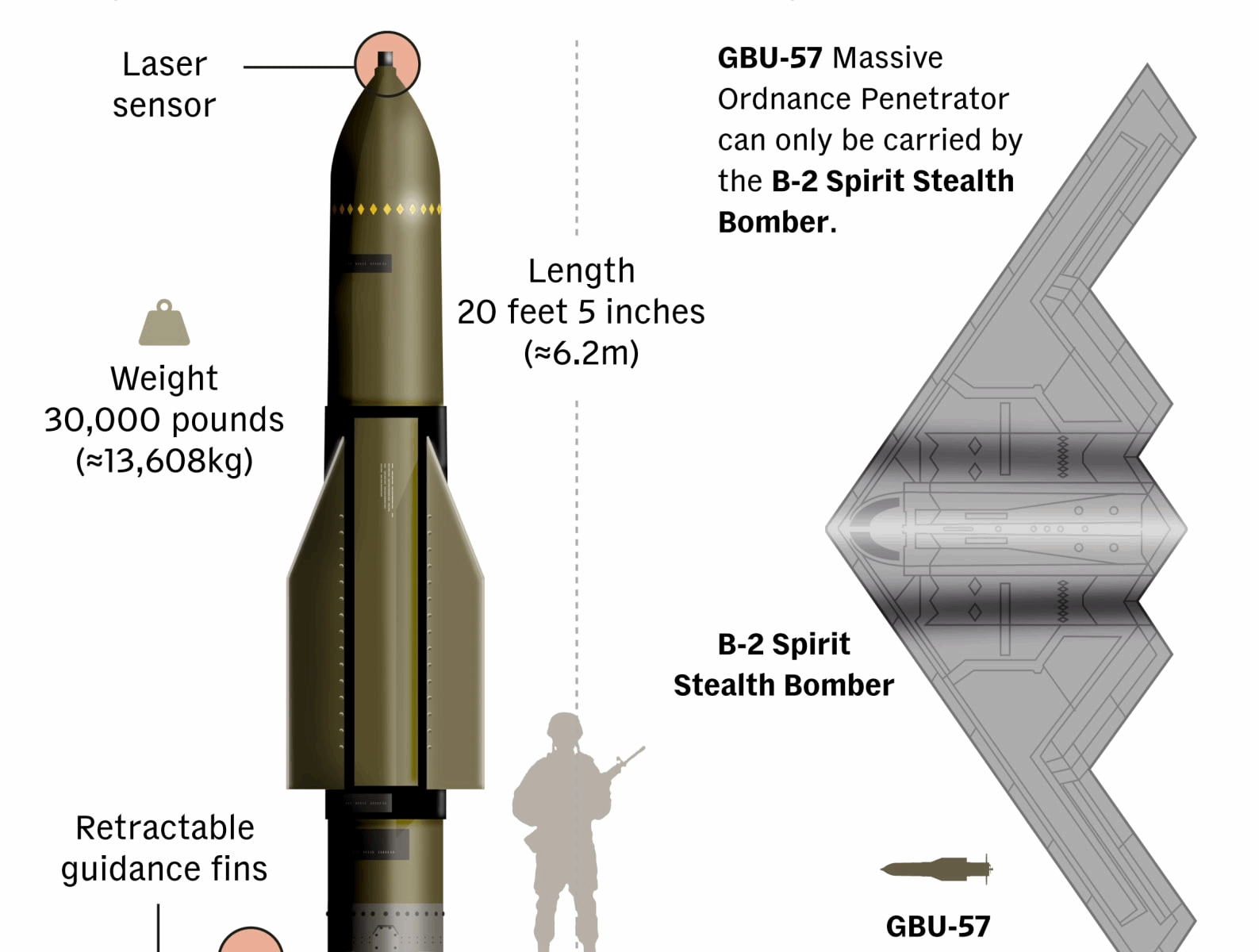
The GBU-57/A MOP, developed by Boeing for the U.S. Air Force, is the largest conventional bomb in the U.S. arsenal, weighing 30,000 pounds (13,600 kg) and carrying a 5,300-pound (2,400-kg) explosive warhead. Designed to destroy deeply buried and hardened targets, such as nuclear facilities and command bunkers, the MOP can penetrate up to 60 meters (200 feet) of moderately hard material, like 5,000-psi concrete, or 130 feet of rock before detonating. Its precision is ensured by a GPS and inertial navigation system (INS), coupled with a smart fuse that optimises detonation depth for maximum destruction. The MOP is exclusively deployed by the B-2 Spirit stealth bomber, with each bomber capable of carrying two bombs.
First Combat Use: Operation Midnight Hammer (June 22, 2025). The MOP’s combat debut occurred during Operation Midnight Hammer on June 22, 2025, targeting Iran’s nuclear facilities at Fordow and Natanz. Seven B-2 bombers dropped 14 MOPs, 12 on Fordow, a uranium enrichment facility buried 80–90 meters under a mountain, and two on an underground section of Natanz, located about 20 meters below the surface. The strikes were complemented by 30 Tomahawk cruise missiles launched from a U.S. Navy submarine, targeting surface infrastructure at Isfahan. The operation aimed to degrade Iran’s nuclear program, particularly Fordow, which was designed to withstand conventional attacks. U.S. officials, including General Dan Caine, claimed significant damage, with IAEA Director General Rafael Grossi noting “very significant” destruction to Fordow’s underground infrastructure. However, there are conflicting reports about the extent of damage.
Strategic Implications and Limitations. The MOP’s use against Iran underscored its role as a deterrent against adversaries with deeply buried facilities, such as North Korea and China. However, its limitations are notable. The MOP’s penetration depth is constrained by target composition. The reliance on B-2 bombers also exposes vulnerabilities to advanced air defences, and the risk of nuclear material release from struck facilities raises environmental and geopolitical concerns.
India’s Solution: A Missile-Based Bunker Buster
India’s DRDO is developing a bunker-busting missile based on the Agni series of surface-to-surface missiles. Unlike the nuclear-capable Agni-5, which has a range of over 5,000 km, this variant prioritises payload over distance, carrying a 7,500-kg (7.5-tonne) warhead with a reduced range of about 2,500 km. This design compensates for India’s lack of a strategic bomber, such as the B-2, by providing a cost-effective, missile-based solution.
The missile reportedly reaches hypersonic speeds (Mach 8–20), making it highly effective at evading ballistic missile defence systems. Equipped with advanced guidance systems, it achieves exceptional accuracy. Its 7,500-kg warhead, significantly larger than the GBU-57’s 2,400-kg payload, delivers potentially greater destructive power, though penetration depth varies based on warhead design and target material. The warhead can penetrate 80–100 meters of reinforced concrete or soil, targeting fortified underground structures like command centers, missile silos, and nuclear storage facilities.
Comparative Analysis: GBU-57/A vs. Agni-5 Variant
Delivery Mechanism. The GBU-57/A is deployed by B-2 stealth bombers, which use stealth technology to infiltrate defended airspace. However, the B-2 can carry only two Massive Ordnance Penetrators (MOPs) and remains vulnerable to advanced air defence systems. In contrast, the Agni-5 missile platform delivers its payload at hypersonic speeds, evading ballistic missile defences (BMD). With a 2,500-km range, it allows stand-off strikes, minimising exposure of manned aircraft to enemy defences.
Payload and Penetration. The GBU-57/A, weighing 30,000 pounds with a 5,300-pound explosive payload, can penetrate up to 60 meters of concrete or 130 feet of rock. However, deeper targets often require multiple strikes, as demonstrated in Operation Midnight Hammer. The Agni-5 Variant, carrying a 7,500-kg warhead, is designed to penetrate 80–100 meters, potentially outperforming the GBU-57 in depth capability. Its larger payload may increase its destructive power, although its performance has yet to be proven in combat.
Strategic Flexibility. The GBU-57/A is combat-proven but constrained by limited stockpiles, high costs, and its dependence on U.S. B-2 bombers, which restrict its use to U.S. operations or allied missions with U.S. support. Conversely, the Agni-5 Variant provides a cost-effective, independent solution. Its dual warhead options and missile-based delivery enhance versatility and resilience against regional BMD systems, offering greater strategic flexibility.
Analytical Perspective
Strengthened Deterrence. India’s Agni-5 missile, equipped with bunker-busting capabilities, is tailored to address regional threats. It provides a powerful conventional option to pre-emptively neutralise enemy targets. With the ability to strike deeply fortified underground sites, the Agni-5 helps India effectively counter strategic imbalances.
Controlled Escalation. These conventional deep-strike weapons offer a key advantage: they minimise escalation risks. While delivering destructive power comparable to nuclear strikes, they avoid the political, moral, and strategic consequences of nuclear weapons. This creates a new, intermediate step in the escalation ladder, providing policymakers with flexible response options during conflicts.
Strategic Impact in Modern Warfare. Deep-strike conventional weapons represent a shift in 21st-century warfare. They combine strategic-level impact with tactical precision, enabling deterrence, retaliation, and offensive strikes without the risks associated with nuclear conflict. By blurring the lines between conventional and strategic weaponry, these advancements challenge traditional arms control frameworks. Nations may now face increased pressure to enhance underground defences against non-nuclear threats, potentially sparking a new arms race focused on subterranean resilience.
Conclusion
The GBU-57/A MOP and India’s conventional Agni-5 variant represent the pinnacle of bunker-busting technology, designed to neutralise the growing threat of fortified underground facilities. The MOP’s combat use against Iran’s Fordow and Natanz facilities on June 22, 2025, demonstrated its power but also its limitations, as advanced bunker designs and limited stockpile size constrained its impact. India’s Agni-5 variant, with its hypersonic speed, 7,500-kg warhead, and dual configurations, offers a versatile, missile-based alternative, tailored to regional threats.
Please Add Value to the write-up with your views on the subject.
Link to the article on the website:-
For regular updates, please register your email here:-
References and credits
To all the online sites and channels.
Pics Courtesy: Internet
Disclaimer:
Information and data included in the blog are for educational & non-commercial purposes only and have been carefully adapted, excerpted, or edited from reliable and accurate sources. All copyrighted material belongs to respective owners and is provided only for wider dissemination.
References:-
- Berbera, A. (2025, June 23). US launches massive strikes on Iran’s nuclear facilities with B-2 bombers and MOPs. Defence News.
- Boeing. (n.d.). Massive Ordnance Penetrator (MOP). Boeing Defence, Space & Security.
- CNN. (2025, June 24). U.S. strikes on Iran’s nuclear facilities: What we know. CNN International.
- Cordesman, A. H. (2025). The Strategic Implications of U.S. Bunker Buster Strikes on Iran. Center for Strategic and International Studies.
- Defence Research and Development Organisation. (2024). Annual report 2024: Advancements in missile technology. DRDO, Ministry of Defence, Government of India.
- Hindustan Times. (2025, July 10). DRDO’s new Agni-5 variant: A conventional bunker buster for regional deterrence. Hindustan Times.
- International Atomic Energy Agency. (2025, June 25). Statement by Director General Rafael Grossi on U.S. strikes on Iranian nuclear facilities. IAEA.
- Janes. (2025). GBU-57/A Massive Ordnance Penetrator: Technical specifications and operational use. Jane’s Defence Equipment & Technology.
- Missile Defence Advocacy Alliance. (2024). China’s HQ-19 and regional ballistic missile defence systems. MDAA.
- The Times of India. (2025, March 15). Mission Divyastra: India tests Agni-5 with MIRV technology. The Times of India.