

702: INNOVATIVE USE OF SMART TECH: THE DEMOCRATISATION OF MODERN WARFARE


My Article was published in the July 2025 edition of the “Life of Soldier” Journal.
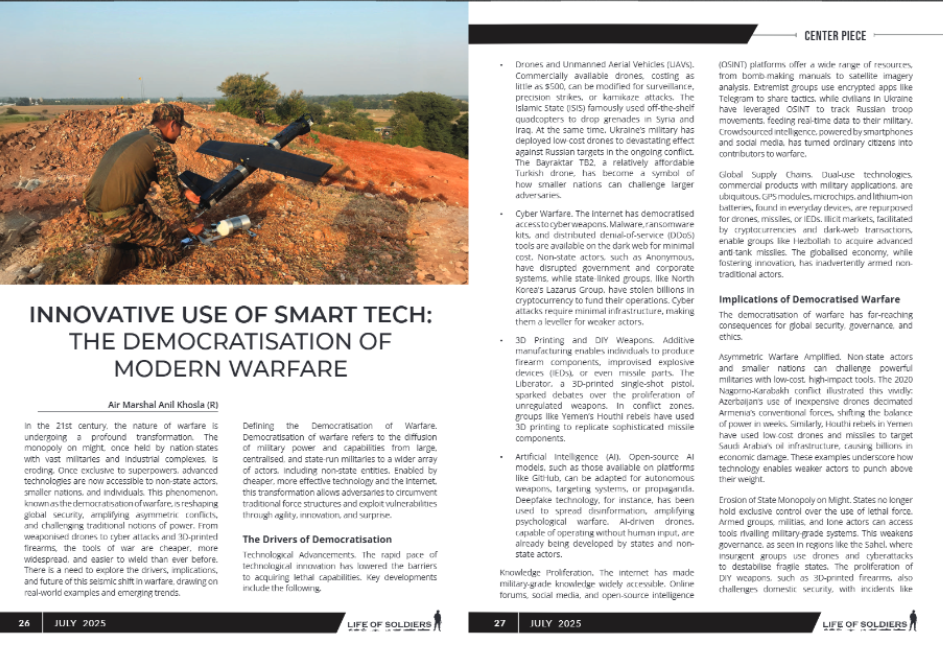


In the 21st century, the nature of warfare is undergoing a profound transformation. The monopoly on might, once held by nation-states with vast militaries and industrial complexes, is eroding. Once exclusive to superpowers, advanced technologies are now accessible to non-state actors, smaller nations, and individuals. This phenomenon, known as the democratisation of warfare, is reshaping global security, amplifying asymmetric conflicts, and challenging traditional notions of power. From weaponised drones to cyber attacks and 3D-printed firearms, the tools of war are cheaper, more widespread, and easier to wield than ever before. There is a need to explore the drivers, implications, and future of this seismic shift in warfare, drawing on real-world examples and emerging trends.

Defining the Democratisation of Warfare. Democratisation of warfare refers to the diffusion of military power and capabilities from large, centralised, and state-run militaries to a wider array of actors, including non-state entities. Enabled by cheaper, more effective technology and the internet, this transformation allows adversaries to circumvent traditional force structures and exploit vulnerabilities through agility, innovation, and surprise.


The Drivers of Democratisation

Technological Advancements. The rapid pace of technological innovation has lowered the barriers to acquiring lethal capabilities. Key developments include the following.

    • Drones and Unmanned Aerial Vehicles (UAVs). Commercially available drones, costing as little as $500, can be modified for surveillance, precision strikes, or kamikaze attacks. The Islamic State (ISIS) famously used off-the-shelf quadcopters to drop grenades in Syria and Iraq. At the same time, Ukraine’s military has deployed low-cost drones to devastating effect against Russian targets in the ongoing conflict. The Bayraktar TB2, a relatively affordable Turkish drone, has become a symbol of how smaller nations can challenge larger adversaries.
    • Cyber Warfare. The internet has democratised access to cyber weapons. Malware, ransomware kits, and distributed denial-of-service (DDoS) tools are available on the dark web for minimal cost. Non-state actors, such as Anonymous, have disrupted government and corporate systems, while state-linked groups, like North Korea’s Lazarus Group, have stolen billions in cryptocurrency to fund their operations. Cyber attacks require minimal infrastructure, making them a leveller for weaker actors.
    • 3D Printing and DIY Weapons. Additive manufacturing enables individuals to produce firearm components, improvised explosive devices (IEDs), or even missile parts. The Liberator, a 3D-printed single-shot pistol, sparked debates over the proliferation of unregulated weapons. In conflict zones, groups like Yemen’s Houthi rebels have used 3D printing to replicate sophisticated missile components.
    • Artificial Intelligence (AI). Open-source AI models, such as those available on platforms like GitHub, can be adapted for autonomous weapons, targeting systems, or propaganda. Deepfake technology, for instance, has been used to spread disinformation, amplifying psychological warfare. AI-driven drones, capable of operating without human input, are already being developed by states and non-state actors.

Knowledge Proliferation. The internet has made military-grade knowledge widely accessible. Online forums, social media, and open-source intelligence (OSINT) platforms offer a wide range of resources, from bomb-making manuals to satellite imagery analysis. Extremist groups use encrypted apps like Telegram to share tactics, while civilians in Ukraine have leveraged OSINT to track Russian troop movements, feeding real-time data to their military. Crowdsourced intelligence, powered by smartphones and social media, has turned ordinary citizens into contributors to warfare.

 Global Supply Chains. Dual-use technologies, commercial products with military applications, are ubiquitous. GPS modules, microchips, and lithium-ion batteries, found in everyday devices, are repurposed for drones, missiles, or IEDs. Illicit markets, facilitated by cryptocurrencies and dark-web transactions, enable groups like Hezbollah to acquire advanced anti-tank missiles. The globalised economy, while fostering innovation, has inadvertently armed non-traditional actors.


Implications of Democratised Warfare

The democratisation of warfare has far-reaching consequences for global security, governance, and ethics.

 Asymmetric Warfare Amplified. Non-state actors and smaller nations can challenge powerful militaries with low-cost, high-impact tools. The 2020 Nagorno-Karabakh conflict illustrated this vividly: Azerbaijan’s use of inexpensive drones decimated Armenia’s conventional forces, shifting the balance of power in weeks. Similarly, Houthi rebels in Yemen have used low-cost drones and missiles to target Saudi Arabia’s oil infrastructure, causing billions in economic damage. These examples underscore how technology enables weaker actors to punch above their weight.

 Erosion of State Monopoly on Might. States no longer hold exclusive control over the use of lethal force. Armed groups, militias, and lone actors can access tools rivalling military-grade systems. This weakens governance, as seen in regions like the Sahel, where insurgent groups use drones and cyberattacks to destabilise fragile states. The proliferation of DIY weapons, such as 3D-printed firearms, also challenges domestic security, with incidents like the 2019 Dayton shooting highlighting the risks of unregulated tech.

Increased Instability and Terrorism. The spread of advanced capabilities heightens the risk of terrorism and regional conflicts. Drones, for instance, have been used in assassination attempts, such as the 2018 attack on Venezuelan President Nicolás Maduro. Cyberattacks, such as the 2021 Colonial Pipeline ransomware incident, disrupt critical infrastructure, resulting in widespread economic and social harm. These tools’ low cost and anonymity make them attractive to terrorist organisations and rogue actors.

 Ethical and Legal Challenges. Democratised warfare raises complex questions about accountability and compliance with international law. Autonomous weapons, powered by AI, blur the lines of responsibility: Who is liable when a drone strikes civilians without human oversight? Cyberattacks, often untraceable, complicate attribution and retaliation. The Geneva Conventions, designed for state-centric warfare, struggle to address these new realities, leaving gaps in global governance.


Countermeasures and Challenges

Governments and international organisations are grappling with the implications of democratised warfare, but solutions are complex.

Regulation of Dual-Use Technologies. Efforts like the Wassenaar Arrangement aim to regulate the export of sensitive technology, but global supply chains and illicit markets undermine enforcement. Regulating 3D printing or AI development is equally challenging, as these technologies are deeply integrated into civilian economies.

Counter-Drone Systems. Militaries invest in anti-drone technologies like jammers, lasers, and radar systems. Israel’s Drone Dome and the U.S.’s Coyote system are examples, but these are expensive and not foolproof against swarming attacks.

Cyber Defence. States are bolstering cybersecurity through AI-driven threat detection and international cooperation. However, the rapid evolution of cyber tools outpaces defensive measures, and non-state actors often exploit vulnerabilities faster than they can be patched.

International Norms. Establishing rules for autonomous weapons and cyberattacks is crucial, but geopolitical rivalries hinder the formation of a consensus. The United Nations’ efforts to ban lethal autonomous weapons have stalled, leaving a regulatory vacuum.


The Future of Democratised Warfare

The democratisation of warfare is set to accelerate as technology advances.

    • Swarm Technology. AI-driven drone swarms, capable of coordinated attacks, could overwhelm defences at low cost. China and the U.S. are testing swarm systems, but the underlying tech is increasingly accessible to others.
    • Biotechnology. DIY bioengineering, enabled by tools like CRISPR, raises the spectre of biological weapons. While still nascent, the falling cost of biotech could mirror the proliferation of drones and cyber tools.
    • Space Warfare. The commercialisation of space, led by firms like SpaceX, enables smaller actors to deploy satellites for communication or surveillance. CubeSats, costing as little as $10,000, could be weaponised to disrupt orbital infrastructure.


India’s Strategic Posture and Preparedness

Counter-Drone Capabilities. India must accelerate its deployment of counter-UAS systems to protect its borders, critical infrastructure, and VIPs. These include directed energy weapons, drone jammers, and AI-based tracking systems.

Harness OSINT and Cyber vigilance. India’s military must build capabilities to monitor, analyse, and respond to social media and digital threats in real time. Collaboration with private cybersecurity firms is crucial.

Legal and Regulatory Frameworks. A robust policy is needed to regulate dual-use technologies, such as drones, 3D printing, and encryption tools, while ensuring that innovation is not stifled.

Integration of Private Sector and Startups. India’s defence innovation must leverage startups, AI labs, and academic institutions to keep pace with rapid technological changes.


Conclusion

The democratisation of warfare is a double-edged sword. It empowers smaller nations and non-state actors to challenge entrenched powers. Yet, it also risks escalating conflicts, destabilising societies, and undermining global security. As drones, AI, and cyber tools become cheaper and more accessible, the line between combatants and civilians blurs, and the battlefield extends into homes, cities, and cyberspace. Addressing this challenge requires a delicate balance: fostering innovation while regulating proliferation, strengthening defences while upholding ethical norms. The future of warfare is no longer the domain of superpowers; it belongs to anyone with the tools and the will to fight. For countries like India, the path forward lies in embracing innovation, reforming security doctrines, investing in digital resilience, and recognising that future battles may be won not just on land, sea, or air, but also in the minds of people, in cyberspace, and through tools as ubiquitous as a smartphone.


Please Add Value to the write-up with your views on the subject.


1879
Default rating

Please give a thumbs up if you  like The Post?


For regular updates, please register your email here:-

Subscribe


References and credits

To all the online sites and channels.

Pics Courtesy: Internet

Disclaimer:

Information and data included in the blog are for educational & non-commercial purposes only and have been carefully adapted, excerpted, or edited from reliable and accurate sources. All copyrighted material belongs to respective owners and is provided only for wider dissemination.


References:-

 Singer, P. W. Wired for War: The Robotics Revolution and Conflict in the 21st Century. Penguin Books, 2010.

  1. Kaldor, Mary. New and Old Wars: Organised Violence in a Global Era. 3rd ed., Stanford University Press, 2012.
  2. Arquilla, John, and David Ronfeldt. Networks and Netwars: The Future of Terror, Crime, and Militancy. RAND Corporation, 2001.
  3. Scharre, Paul. “The Democratisation of Destruction: Drones, 3D Printing, and the Future of Warfare.” Foreign Affairs, vol. 94, no. 5, September/October 2015, pp. 124–135.
  4. United Nations Institute for Disarmament Research (UNIDIR). “The Weaponisation of Increasingly Autonomous Technologies: Artificial Intelligence.” UNIDIR Resources, 2018.
  5. Center for Strategic and International Studies (CSIS). “The Role of Drones in Modern Warfare: Lessons from Nagorno-Karabakh.” CSIS Briefs,
  6. Gibbons-Neff, Thomas, and Eric Schmitt. “Cheap Drones Are Changing Modern Warfare, as Ukraine Shows.” The New York Times, March 15, 2022.
  7. Al Jazeera. “Yemen’s Houthis Claim Drone Attacks on Saudi Arabia, UAE.” Al Jazeera, January 17, 2022.
  8. Sanger, David E., and Nicole Perlroth. “Cyberattacks Show How Warfare Has Moved Beyond the Battlefield.” The New York Times, May 10, 2021.
  9. BBC News. “Venezuela’s Maduro Survives Drone Assassination Attempt.” BBC News, August 5, 2018.
  10. Wassenaar Arrangement Secretariat. “Wassenaar Arrangement on Export Controls for Conventional Arms and Dual-Use Goods and Technologies.” org, 2023.
  11. Open Source Intelligence (OSINT) Framework. “OSINT Tools and Resources.” com, accessed June 2025.
  12. Defence Advanced Research Projects Agency (DARPA). “OFFSET: Offensive Swarm-Enabled Tactics.” mil, 2021.
  13. Federation of American Scientists. “CubeSats: The Democratisation of Space.” org, 2022.
  14. Human Rights Watch. “Killer Robots: The Case for a Ban on Lethal Autonomous Weapons.” org, November 2021.
  15. FireEye (Mandiant). “Lazarus Group: North Korean Hackers and Cryptocurrency Heists.” com, 2020.
  16. Stockholm International Peace Research Institute (SIPRI). “Global Arms Trade and Technology Proliferation.” SIPRI yearbook 2025.
  17. Biddle, S. (2021). Nonstate Warfare: The Military Methods of Guerrillas, Warlords, and Militias. Princeton University Press.
  18. Conflict Armament Research. (2022). Weapon Components Manufactured by Non-State Actors Using 3D Printing.
  19. Stanford Internet Observatory. (2024). AI, Disinformation and the Weaponisation of Social Media.
  20. RAND Corporation. (2023). The Rise of Asymmetric Threats in a Networked World.
  21. Observer Research Foundation (ORF). (2024). India’s Drone Warfare and Counter-UAS Strategy.
  22. Institute for Defence Studies and Analyses (IDSA). (2024). India’s Cybersecurity Preparedness: Challenges and the Way Forward.
  23. CSIS (Center for Strategic and International Studies). (2024). The New Age of Warfare: Commercial Technology in Modern Conflicts.

701: A NEW CHALLENGE: CHINA’S NON-NUCLEAR HYDROGEN BOMB


 My Article was published on “The EurasianTimes” website on 12 Jul 25.


In April 2025, Chinese researchers made a significant breakthrough in military technology. They successfully tested a non-nuclear hydrogen-based explosive device, a creation of the 705 Research Institute of the China State Shipbuilding Corporation (CSSC). This innovative weapon, which uses magnesium hydride to produce a fireball several times longer than a comparable TNT explosion, is a departure from traditional hydrogen bombs that rely on nuclear fusion. Instead, it employs a chemical reaction to release hydrogen gas, igniting a sustained inferno without radioactive fallout. Initially designed for clean energy applications, this technology’s pivot to military use has sparked global intrigue and concern. Detailed in a paper in the Journal of Projectiles, Rockets, Missiles and Guidance and reported by the South China Morning Post, this development signals a potential shift in modern warfare, raising questions about its strategic, ethical, and geopolitical implications.


The Technology Enabling the Device

At the heart of the device is magnesium hydride (MgH₂). This compound has been extensively studied for its potential in hydrogen storage due to its ability to release hydrogen gas upon heating. The explosive exploits this property by using a controlled chemical reaction to generate and ignite hydrogen gas, creating a fireball that exceeds 1,000°C in temperature and lasts over two seconds. This is 15 times longer than the thermal output of a traditional TNT-based explosive of comparable size. What distinguishes this explosive is its non-nuclear composition. Unlike thermonuclear hydrogen bombs that use nuclear fusion to generate devastating power and radiation, this device relies purely on chemical reactions. This enables intense thermal effects without the political and environmental consequences associated with nuclear weapons.

The sustained heat, lasting over two seconds compared to TNT’s fleeting 0.12-second flash, allows for extensive thermal damage across vast areas. According to CSSC scientist Wang Xuefeng, who led the research, “Hydrogen gas explosions ignite with minimal ignition energy, have a broad explosion range, and unleash flames that race outward rapidly while spreading widely.” This combination enables precise control over blast intensity, making the device suitable for both large-area thermal strikes and targeted attacks on high-value assets, such as communication hubs or fuel depots.

A significant barrier to the practical use of magnesium hydride has been its production. The material’s high reactivity poses risks of spontaneous combustion when exposed to air, historically limiting output to mere grams per day in controlled laboratory settings. However, a breakthrough in 2025 has changed this landscape. A new facility in Shaanxi province, operated by the Dalian Institute of Chemical Physics, now produces 150 tonnes of magnesium hydride annually using a “one-pot synthesis” method. This safer, cost-effective process has overcome previous manufacturing challenges, enabling large-scale production and paving the way for both military and civilian applications. The ability to produce magnesium hydride at such volumes underscores China’s commitment to integrating this technology into its defence strategy.


Strategic Implications of the Device

The CSSC’s 705 Research Institute, renowned for its expertise in underwater weapons such as torpedoes and unmanned underwater vehicles (UUVs), has positioned this device as a versatile tool for modern warfare. Its compact size and lightweight nature make it ideal for integration into various platforms, including drones, precision-guided munitions, and naval systems. Potential applications include the following:-


    • Precision Thermal Strikes. The device’s prolonged fireball can incinerate logistics hubs, radar installations, or infantry formations, offering tactical flexibility in asymmetric conflicts. Its heat, capable of melting metals, could disable critical infrastructure without the widespread destruction of nuclear weapons.
    • Area Denial. The sustained thermal effects could create temporary “no-go zones,” denying the enemy access to key routes, disrupting supply lines and communication. It may also serve as a deterrent due to its psychological impact.
    • Naval Warfare. Integrated into torpedoes or UUVs, the device could deliver devastating heat-based damage to enemy vessels, potentially melting hulls or igniting fuel stores without nuclear fallout. This makes it a strategic asset for maritime dominance.

The device’s non-nuclear nature is a key advantage, as it avoids violating international nuclear treaties while delivering effects comparable to thermobaric weapons, which disperse fuel-air mixtures to create prolonged explosions. Compared to Russia’s TOS-1A “Buratino” rocket launcher, which relies on bulky delivery systems, the Chinese device’s compact design allows deployment via smaller platforms, enhancing its versatility.


Analytical Perspective.

Geopolitical Context. The timing of this test, amid escalating tensions with Taiwan, has amplified global concerns. China’s military modernisation and increased military spending reflect its focus on advanced technologies to assert regional dominance. The South China Morning Post suggests the device could be used in a Taiwan conflict to target underground defences or urban strongholds, drawing parallels to the U.S. Massive Ordnance Air Blast (MOAB) weapon’s psychological and tactical impact. By delivering sustained heat to fortified positions, the device could disrupt command centers or incapacitate personnel, potentially shifting the balance in urban warfare scenarios.

Dual Use Approach. The development of the device also aligns with China’s broader strategy of integrating clean energy technologies into its military framework. Magnesium hydride’s potential as a fuel source for submarines or long-endurance drones suggests a dual-use approach, blending civilian innovation with defence applications.

Legal Aspects. The emergence of this technology also presents new challenges for international arms control and humanitarian law. Because the explosive is not nuclear, it may fall outside existing treaties, such as the Treaty on the Non-Proliferation of Nuclear Weapons (NPT) or the Comprehensive Nuclear-Test-Ban Treaty (CTBT). This legal grey area could allow countries to develop and deploy such weapons without violating current international norms.

Ethical and Humanitarian Concerns. While the device avoids nuclear fallout, its similarity to thermobaric weapons raises ethical and legal questions. Thermobaric weapons, known for their devastating effects in urban environments, have faced criticism for causing indiscriminate harm, including severe internal injuries and oxygen depletion. The magnesium hydride device’s ability to produce prolonged, high-temperature fireballs could exacerbate these concerns, particularly if deployed in densely populated areas. Analysts warn that its use in conflicts could spark debates over battlefield ethics, especially given its potential to “fry electronics, melt armour, or torch an area for denial purposes.”

Global Reactions. The international community has reacted with apprehension. The U.S., already bolstering Taiwan’s defences, may view this as a challenge to its regional influence, potentially accelerating the arms race in the Indo-Pacific. Meanwhile, China’s ability to scale up magnesium hydride production suggests that this technology could soon transition from experimental to operational, potentially reshaping military strategies worldwide.


Conclusion

China’s April 2025 test of a magnesium hydride-based explosive marks a critical juncture in military technology. Offering intense, sustained thermal effects without the liabilities of nuclear fallout, this new class of weaponry could redefine how nations conduct precision strikes and deter adversaries. While developed from clean energy research, its adaptation for warfare reveals the dual-use nature of modern scientific advancement. As this technology matures and potentially spreads, it may usher in a new era of warfare, one where energy science meets battlefield strategy, and where the line between conventional and unconventional weapons becomes increasingly blurred.


Please Add Value to the write-up with your views on the subject.


1879
Default rating

Please give a thumbs up if you  like The Post?


Link to the article on the website:-

Not Nuclear Or TNT, China’s H-Bomb May Spark Global Firestorm; Here’s Why It’s Much More Destructive


For regular updates, please register your email here:-

Subscribe


References and credits

To all the online sites and channels.

Pics Courtesy: Internet

Disclaimer:

Information and data included in the blog are for educational & non-commercial purposes only and have been carefully adapted, excerpted, or edited from reliable and accurate sources. All copyrighted material belongs to respective owners and is provided only for wider dissemination.

References:-

Wang, Xuefeng, et al. “Development and Testing of a Non-Nuclear Hydrogen-Based Explosive Device Using Magnesium Hydride.” Journal of Projectiles, Rockets, Missiles and Guidance, vol. 45, no. 2, April 2025, pp. 123-130.

  1. “China Tests New Hydrogen-Based Explosive with Prolonged Thermal Effects.” South China Morning Post, 15 April 2025,
  1. China State Shipbuilding Corporation. “Annual Report on Research and Development: 705 Research Institute.” CSSC, 2025.
  1. Dalian Institute of Chemical Physics. “Breakthrough in Magnesium Hydride Production for Energy and Defence Applications.” Chinese Academy of Sciences, 10 March 2025,
  1. “China’s Defence Budget Rises to USD 249 Billion in 2025.” Global Times, 5 March 2025, www.globaltimes.cn/page/202503/1304567.shtml.
  1. Journal of Projectiles, Rockets, Missiles and Guidance. (2025). Performance analysis of a hydrogen-based thermal explosive using magnesium hydride.
  2. Li, H., & Zhao, Q. (2024). Dual-use technologies and military innovation in China. Journal of Strategic Studies, 38(2), 98–117.
  1. International Committee of the Red Cross (ICRC). (2021). Incendiary weapons and international humanitarian law.
  1. United Nations Office for Disarmament Affairs (UNODA). (2020). Treaty on the Non-Proliferation of Nuclear Weapons (NPT) and implications for non-nuclear weapon innovations.

700: INDIA EYES AIR-LAUNCHED LORA MISSILE: TO ENHANCE LONG-RANGE PRECISION CAPABILITY


My article published on “The EurasianTimes” website on 10 Jul 25


Recent news reports suggest that the Indian Air Force (IAF) is considering the acquisition of the Israeli Air-Launched Long-Range Artillery (LORA) missile. The interest in AIR LORA, reported in early July 2025, follows the IAF’s successful deployment of the Rampage missile during Operation Sindoor in May 2025, which underscored the need for advanced stand-off weapons capable of penetrating sophisticated enemy air defences.

Designed by Israel Aerospace Industries (IAI), Air LORA, which can strike targets up to 400–430 kilometers away, would enable Indian combat aircraft to launch high-impact strikes from well beyond the range of most enemy air defence systems. This capability is crucial for maintaining safety while degrading enemy targets within hostile territory.


The AIR LORA Missile: Capabilities and Specifications

Air LORA is not just a rehashed missile placed under a jet’s wing. It represents a marriage of ballistic missile technology and air-launched precision warfare. It is a quasi-ballistic missile that follows a depressed trajectory compared to traditional ballistic missiles. This makes it harder to intercept and allows for greater flexibility in targeting. One of its most attractive features is its fire-and-forget capability, which enables a pilot to disengage immediately after launch. Additionally, the missile can receive mid-course updates, allowing operators to redirect it mid-flight, a significant advantage in dynamic combat situations.

The AIR LORA, a derivative of the ground-launched Long-Range Artillery (LORA) missile, is a supersonic air-launched ballistic missile designed to deliver precision strikes against high-value targets at extended ranges. Its Key features include:-

      • Range: 400–430 kilometers.
      • Speed: Supersonic, travelling at approximately Mach 5.
      • Accuracy: Circular Error Probable (CEP) of less than 10 meters.
      • Warheads: Both blast-fragmentation and deep-penetration types, with a total weight of up to 570 kilograms.
      • Weight and Dimensions: 1,600 kg total missile weight; 5.2 meters in length.

The missile’s navigation system relies on a combination of GPS and Inertial Navigation System (INS), augmented by anti-jamming technology to ensure accuracy even in contested environments. Unlike some precision-guided munitions that require active seekers, AIR LORA’s seeker-less design reduces complexity and cost while maintaining a high degree of accuracy. It can be equipped with either blast fragmentation or deep-penetration warheads, making it versatile for targeting a range of assets, from airbases and command centers to naval vessels and hardened bunkers.


Analytical Perspective

Deep-Strike Capability. With the LORA missile integrated into its air combat platforms, India could reach deep into enemy territory without entering contested airspace. Targets that would traditionally require multi-aircraft sorties or high-risk approaches could be neutralised with a single long-range missile fired from safe standoff distances. This capability is particularly significant given India’s border challenges. Being able to strike enemy military infrastructure from Indian airspace would drastically reduce operational risks and improve the tempo of offensive operations.

Flexibility. The missile is compatible with several IAF platforms. This cross-platform flexibility means the IAF could potentially integrate the system into multiple platforms, ensuring distributed lethality and redundancy across its fleet. A single Su-30 MKI can carry up to four AIR LORA missiles, enabling a single sortie to deliver devastating strikes against multiple targets.

Complementing India’s Missile Arsenal. India already possesses an array of precision-guided long-range strike systems, such as BrahMos (Supersonic cruise missile with 300–500 km range), SCALP-EG (Used with Rafale, range of ~500 km), Pralay (Short-range ballistic missile (~500 km), and Rampage (Air-to-ground missile used successfully in recent operations). Air LORA would not replace these systems but augment them, filling a critical capability gap, specifically in air-launched ballistic precision strikes.

Industrial Impact. One of the defining features of this potential procurement is the Make in India element. IAI and Bharat Electronics Limited (BEL) signed a Memorandum of Understanding (MoU) in 2023 for joint production and technology transfer related to LORA and other defence systems. This partnership not only facilitates technology transfer but also positions India as a potential exporter of advanced missile systems in the future. If the Air LORA deal moves forward, it could be manufactured in India under license, aligning with the country’s goals of defence indigenisation and strategic autonomy. Local production of AIR LORA could reduce costs, enhance supply chain resilience, and create jobs, further boosting India’s defence manufacturing ecosystem.

Cost Effectiveness. The estimated unit cost of Air LORA ranges from $1 1million to $5 million, depending on the configuration and payload. While not inexpensive, it is competitively priced compared to similar long-range missile systems, particularly when factoring in its precision and survivability.

Challenges and Concerns. Air LORA marks a significant advancement in capability, but it faces certain operational and logistical hurdles. Integrating and testing it on Indian platforms will demand extensive flight trials. Its resistance to electronic warfare and survivability in contested environments still need thorough evaluation. Additionally, its cost-effectiveness compared to other indigenous systems, such as BrahMos or the developing Long-Range Land-Attack Cruise Missile (LRLACM), warrants careful consideration. Despite these challenges, Air LORA’s operational advantages appear to outweigh the potential risks.


Conclusion

With its range, speed, and accuracy, Air LORA is not just another missile; it is a tool for deterrence, rapid escalation dominance, and strategic messaging. India is exploring the LORA (Long-Range Artillery) missile to complement its BrahMos missile, thereby enhancing its strategic and tactical capabilities. Unlike BrahMos, a supersonic cruise missile with a low-altitude, high-speed trajectory, LORA is a quasi-ballistic missile with a lofted trajectory, offering greater flexibility in targeting and evading defences. LORA’s lower cost makes it an economical option for mass deployment. It has potential for export under India’s “Make in India” initiative, thereby fostering domestic production and enhancing global market competitiveness. Additionally, LORA’s larger payload capacity enables it to deliver heavier warheads, increasing its destructive power. Integrating LORA into Indian Air Force jets diversifies the missile arsenal, providing a versatile, high-impact option for various combat scenarios. This strategic addition would strengthen India’s defence capabilities, ensuring a balanced mix of speed, cost-efficiency, and firepower alongside BrahMos. The potential induction of the air-launched LORA missile into India’s arsenal could significantly enhance its strategic depth and offensive precision.


Please Add Value to the write-up with your views on the subject.


1879
Default rating

Please give a thumbs up if you  like The Post?


Link to the article on the website:-

Despite BrahMos, India Explores LORA Missile For Its Fighters Like Su-30 MKI; Why LORA When IAF Has BrahMos?


For regular updates, please register your email here:-

Subscribe


References and credits

To all the online sites and channels.

Pics Courtesy: Internet

Disclaimer:

Information and data included in the blog are for educational & non-commercial purposes only and have been carefully adapted, excerpted, or edited from reliable and accurate sources. All copyrighted material belongs to respective owners and is provided only for wider dissemination.


References:-

  1. “Indian Air Force Eyes Israeli Air LORA Ballistic Missile for Enhanced Strike Capabilities: Report.” Moneycontrol, 4 July 2025.
  1. “India Eyes Israeli Air LORA Missile After Rampage Strikes: Deep-Strike Capability Gets Boost.” Defence Security Asia, 4 July 2025.
  1. “IAF Plans Supersonic Firepower Upgrade: Eyes Israeli Air LORA Missile after Rampage Success.” The Times of India, 3 July 2025.
  1. “IAF Eyes Supersonic LORA Missiles from Israel to Hit High-Value Targets Deep Inside Enemy Territory.” The Economic Times, 5 July 2025.
  1. “What Are Game-Changer Air LORA Missiles? Report Claims Indian Air Force Planning to Procure These from Israel.” The Week, 3 July 2025.
  1. Indian Defence Review. (2025). Regional Security Dynamics and India’s Missile Capabilities.
  1. Israel Aerospace Industries. (2025). LORA missile system: Technical specifications.
  1. Swarajya Magazine. (2025, July). IAF wants Israel’s AIR LORA missile after the Rampage missile’s success in Operation Sindoor against Pakistan.
  1. The Print (2025, July). Indo-Israeli defence ties bolstered by talks on the AIR LORA missile deal.
English हिंदी