
340: CONTEMPORARY AIR POWER THOUGHT

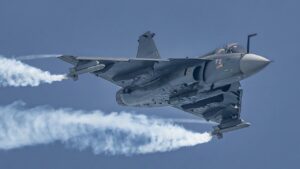
Contemporary air power refers to the use of advanced air assets and technologies to achieve military objectives in modern warfare. This can include a wide range of platforms, such as fighter jets, bombers, drones, helicopters, and fixed-wing combat support aircraft, as well as advanced weapon systems and sensor networks.


One of the key features of contemporary air power is its ability to provide a range of capabilities, including air superiority, precision strike, reconnaissance, mobility, and humanitarian support. For example, fighter jets and drones can be used to gain air superiority and conduct precision strikes against enemy targets, while combat support aircraft and helicopters can provide rapid mobility for troops and supplies. In addition, air power can be used to complement surface operations and to conduct humanitarian operations such as disaster relief and search and rescue.


Contemporary air power thought is a complex and evolving field of study that encompasses a range of topics related to the use of air power in modern warfare. Some of the key concepts and ideas that are central to contemporary air power thought include:


  1. The Role of Air Power in Modern Warfare: Modern air power is an essential element of military strategy, capable of achieving a range of objectives including reconnaissance, air superiority, precision strike, and mobility. Air power can also be used to complement surface operations and conduct humanitarian operations.


  1. The Evolution of Air Power: Air power has evolved significantly over the past century, from its earliest days as a reconnaissance tool to its current status as a highly advanced and versatile military asset. Today, air power includes a wide range of platforms including fighter jets, drones, helicopters, and bombers.


  1. The importance of Technology: Technology plays a critical role in contemporary air power, enabling the development of advanced weapons systems, sensor networks, and communication technologies. The use of artificial intelligence, machine learning, and autonomous systems is also becoming increasingly important in the field of air power.


  1. Weapons and Targeting: Airpower relies on advanced weapon systems, such as precision-guided munitions and air-to-air missiles that enable pilots to engage enemy targets with extreme accuracy and minimal collateral damage.


  1. The role of Doctrine: Military doctrine plays a critical role in shaping the use of air power in modern warfare. Doctrine provides a framework for decision-making and helps guide the development of tactics and strategies that can be applied across different campaigns of operation.


  1. Importance of Strategy and Tactics: contemporary air power also involves the development of appropriate strategy and tactics. This includes the use of strategies such as air interdiction, suppression of enemy air defenses, and joint air-ground operations, as well as the development of tactics that enable air assets to operate effectively in a range of environments and against a range of threats.


Contemporary air power is a critical element of modern warfare, enabling militaries to achieve a range of objectives quickly and efficiently using advanced technologies and tactics.


Contemporary air power thought is a dynamic and constantly evolving field that reflects the changing nature of modern warfare and the ongoing development of advanced military technologies.


Bottom Line

The application of air power is both a science and an art.

The need of the hour is – THINKING air warriors


Suggestions and value additions are most welcome


For regular updates, please register here

Subscribe

References and credits

To all the online sites and channels.

Disclaimer:

Information and data included in the blog are for educational & non-commercial purposes only and have been carefully adapted, excerpted, or edited from sources deemed reliable and accurate. All copyrighted material belongs to respective owners and is provided only for purposes of wider dissemination.

337: Air power Aspects of Ukraine Conflict and Evolving Nature of Aerial Warfare


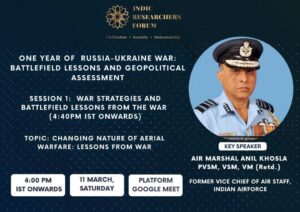
Indic Research Forum conducted an interesting seminar on 11 Mar 23.


Theme of the seminar

 One Year of Russia-Ukraine War: Battlefield Lessons and Geopolitical Assessment


Session 1

 Warfare Strategies and Battlefield Lessons from Russia-Ukraine War


Topic

Air power aspects and Evolving Nature of Aerial Warfare


Please click on the link below to listen to the 14 min talk (05:58 to 19:50):-

    • The time was short for such a vast subject.
    • Apologies for link loss for few minutes in between.


Suggestions and value additions are most welcome


For regular updates, please register here

Subscribe


References and credits

To all the online sites and channels.


Disclaimer:

Information and data included in the blog are for educational & non-commercial purposes only and have been carefully adapted, excerpted, or edited from sources deemed reliable and accurate. All copyrighted material belongs to respective owners and is provided only for purposes of wider dissemination.


333: QUANTUM FOR A DUMMY LIKE ME

Pic Courtesy: The diplomatist


Quantum Science


Quantum refers to the branch of physics that studies the behaviour of matter and energy at the smallest scales, where the laws of classical physics no longer apply.


At the quantum level, particles such as electrons and photons behave differently from what we observe in our everyday world. They exhibit strange phenomena such as wave-particle duality, superposition, and entanglement, which have important implications for fields such as computing, cryptography, and sensing.


Quantum mechanics has revolutionised our understanding of the fundamental nature of matter and energy and has important practical applications in fields such as computing, cryptography, and sensing.


Quantum Technology & Application


Quantum technology is based on the fact that at the quantum level, particles can exist in multiple states simultaneously, and can also be entangled with each other. These properties can be used to perform tasks that are difficult or impossible with classical technology.


Quantum technology refers to the practical applications of the principles of quantum mechanics. Quantum technology includes a range of fields, such as quantum computing, quantum cryptography, quantum communication, quantum sensing, and quantum metrology.


Quantum Computing. Quantum computing is a type of computing that uses the principles of quantum mechanics to process information. Quantum computers use quantum bits, or qubits, to perform calculations much faster than classical computers. Quantum computers are capable of performing certain calculations exponentially faster than classical computers, which could have significant implications for fields such as drug discovery, materials science, financial modeling, cryptography, etc.


Quantum Cryptography & Communication. Quantum cryptography and quantum communication use the principles of quantum mechanics to secure communication channels. Quantum cryptography is a form of secure communication that uses the principles of quantum mechanics to ensure the security of the communication channel. Quantum cryptography is resistant to eavesdropping, as any attempt to intercept the message will change its quantum state and alert the sender and receiver to the presence of an intruder.


Quantum sensing and quantum metrology. These applications use quantum technology to improve the precision and sensitivity of sensors. For example, quantum sensors can be used to detect very weak magnetic or gravitational fields, which have important applications in fields such as geology, medicine, and defense.


Quantum Proofing

Quantum proofing is known as quantum-resistant cryptography. It refers to the development of cryptographic algorithms and protocols that can resist attacks from quantum computers.


To “quantum proof” cryptographic systems, researchers are developing new algorithms and protocols that are resistant to quantum attacks. This includes post-quantum cryptography, which uses mathematical problems that are believed to be difficult for both classical and quantum computers to solve. Examples of post-quantum cryptographic algorithms include lattice-based cryptography, code-based cryptography, and hash-based cryptography.


Quantum proofing is important because the widespread adoption of quantum computers could potentially compromise the security of many of the cryptographic protocols that are currently in use, including those used to protect sensitive information such as financial transactions and personal data.


Quantum in India


India, like many other countries, is investing in research and development of quantum technologies, including quantum proofing.


The Indian government has set up the Quantum Technology Mission with an initial budget of Rs 8,000 crore (approximately $1.1 billion) to support research and development in quantum technologies over a period of five years. The mission aims to develop technologies for secure communication, quantum computing, quantum sensing, quantum cryptography, and quantum networking.


As part of the mission, the Indian government has also set up the Quantum Computing Applications Lab at the Centre for Development of Advanced Computing (C-DAC) in Pune. The lab aims to develop and test quantum-resistant cryptographic algorithms that can be used in various applications.


In addition, Indian researchers are also actively involved in the development of post-quantum cryptographic algorithms. For example, the Indian Institute of Technology (IIT) Bombay is conducting research on lattice-based cryptography, which is one of the leading candidates for post-quantum cryptography.


Overall, India is taking steps to develop and implement quantum-proof cryptographic protocols to ensure the security of its critical infrastructure and sensitive data in the era of quantum computing.


Quantum: Military Applications


Quantum technologies have the potential to revolutionise the field of defence and security. Some of the potential military applications of quantum technologies are:


Quantum Computing: Quantum computers can perform certain types of calculations exponentially faster than classical computers. This technology can be used to simulate complex chemical reactions, optimize logistics and resource allocation, and break classical cryptographic codes.


Quantum Communication : Quantum entanglement can be used to create highly secure communication channels that are resistant to hacking and eavesdropping.


Quantum Cryptography: Quantum key distribution (QKD) can be used to transmit highly secure cryptographic keys between two parties, which cannot be intercepted or eavesdropped upon. This technology can be used to secure military and government communication networks.


Quantum Sensing: Quantum sensors can be used to detect and track stealth aircraft, submarines, and other stealthy objects that are difficult to detect using traditional radar and sonar technologies. Quantum sensors can also be used for precision navigation, timing, and metrology.


Quantum Imaging: Quantum cameras can capture images with extremely low levels of light, making them useful for night vision and other low-light applications. Quantum imaging can also be used to see through obstacles like walls and camouflage.


Quantum Radar: Quantum radar can detect stealth aircraft, which are designed to evade traditional radar systems. This technology uses entangled photons to detect stealth aircraft, making it much more difficult to evade detection.


Quantum & Weather forecasting. Weather forecasting is essential for campaign planning (especially air campaign). It requires analysis of vast data, including various dynamic factors such as air temperature, pressure and density, all of which interact in complex ways. Quantum computing can enhance weather forecasting both at local and larger area level. 


Overall, quantum technologies have the potential to greatly enhance the capabilities of defence and security systems and are likely to play an increasingly important role in the future of defence.


Bottom Line

This technology has the potential to change the way wars are fought.


Question

Are we doing enough to harness this potential?


Suggestions and value additions are most welcome


For regular updates, please register here

Subscribe

References and credits

To all the online sites and channels.

Disclaimer:

Information and data included in the blog are for educational & non-commercial purposes only and have been carefully adapted, excerpted, or edited from sources deemed reliable and accurate. All copyrighted material belongs to respective owners and is provided only for purposes of wider dissemination.

English हिंदी