688: INNOVATION: THE NEW AGE WEAPON IN MODERN WARS


My Article was published on “The Eurasian Times” website on 22 Jun 25.


In the rapidly evolving landscape of 21st-century conflict, innovation has emerged as the cornerstone of modern warfare. Nations and non-state actors leverage cutting-edge technology and unconventional tactics to achieve strategic objectives with unprecedented precision, stealth, and impact. Three recent examples, Israel’s drone attack in Iran, Ukraine’s drone assault on Russian military targets, and Israel’s explosive pager attack on Hezbollah, illustrate how innovation is reshaping the battlefield. Executed with remarkable ingenuity, these operations highlight the shift toward asymmetric, hybrid warfare that combines advanced technology, covert intelligence, and psychological operations. The innovative aspects of these cases must be explored to understand their strategic implications and the broader challenges they present for global security.


Israel’s Drone Attack in Iran: A Master Class in Covert Precision

In June 2025, Israel executed a series of drone strikes targeting Iran’s nuclear facilities, missile launchers, and military infrastructure, showcasing a new paradigm in covert warfare. Unlike traditional airstrikes, Israel reportedly activated a network of “kamikaze” drones pre-positioned inside Iran, bypassing the country’s sophisticated air defence systems. This operation, attributed to the Mossad and Israeli Air Force, underscores several innovative aspects of modern warfare.

Strategic Innovation. The attack’s success hinged on long-term infiltration. Over the years, Israel allegedly smuggled drone components into Iran, assembling a clandestine arsenal that could be remotely activated. This approach required meticulous planning, blending human intelligence with technological expertise. By launching drones from within Iran, Israel avoided detection by radar systems designed to counter external threats, such as ballistic missiles or fighter jets. The strikes targeted high-value sites, including the Natanz nuclear enrichment facility and mobile missile launchers, disrupting Iran’s nuclear ambitions and retaliatory capabilities with surgical precision.

Technological Edge. The drones were compact, stealthy, and equipped with advanced navigation systems, enabling them to evade Iran’s multi-layered defences. Reports suggest that using AI-guided drones capable of autonomous target selection represents a leap forward in unmanned warfare. This technology allowed Israel to strike multiple targets simultaneously, maximising impact while minimising exposure.

Implications and Risks. While innovative, the operation carried significant risks. Iran retaliated with missile barrages, escalating tensions and raising fears of a broader regional conflict. The covert nature of the attack also sets a precedent for deniable operations, complicating attribution and accountability.


Ukraine’s Drone Attack in Russia: Asymmetric Warfare Redefined

Ukraine’s June 2025 drone attack on Russian military bases, dubbed “Operation Spiderweb,” destroyed over 40 warplanes, demonstrating how resource-constrained nations can challenge superpowers through innovation. By smuggling 117 drones near Russian targets and launching them from within enemy territory, Ukraine showcased the power of asymmetric warfare.

Logistical Creativity. The operation’s success relied on covert logistics. Ukraine transported disassembled drones thousands of miles into Russia, likely using local networks or operatives to assemble and deploy them. This approach bypassed Russia’s border defences and air surveillance, catching military commanders off guard. The drones, described as low-cost and modular, were designed for scalability, allowing Ukraine to mount a large-scale attack with limited resources.

Tactical Impact. The drones targeted airbases, fuel depots, and ammunition stores, inflicting significant damage. By striking deep inside Russia, Ukraine forced Moscow to divert resources to internal defence, creating a new front in the ongoing war. The psychological impact was equally profound, as Russian citizens grappled with the vulnerability of their homeland. This operation highlighted drones as a cost-effective alternative to traditional air forces, levelling the playing field for smaller nations. While a tactical triumph, Ukraine’s strategy risks escalation. Russia may intensify its punitive strikes, targeting Ukrainian cities or infrastructure.


Israel’s Pager Attack on Hezbollah: Cyber-Physical Warfare

In September 2024, Israel executed an unprecedented attack on Hezbollah, using explosive-laden pagers and walkie-talkies to target operatives across Lebanon. This operation crippled Hezbollah’s command structure and marked a new frontier in cyber-physical warfare.

Supply Chain Infiltration. The attack’s brilliance lay in its exploitation of the supply chain. Israel reportedly compromised the manufacturing and distribution of communication devices, embedding micro-explosives in pagers and radios used by Hezbollah. This required years of planning, from infiltrating tech companies to ensuring the devices reached their targets. The operation’s complexity underscores the fusion of intelligence, engineering, and deception in modern warfare.

Precision and Psychological Impact. By detonating thousands of devices simultaneously, Israel disrupted Hezbollah’s operational cohesion with minimal collateral damage compared to airstrikes. The attack killed or injured key commanders, weakening Iran’s proxy network. Beyond physical damage, it sowed distrust among Hezbollah operatives, as everyday devices became potential threats. Retired Mossad agents hailed the operation as a turning point, demonstrating how consumer technology can be weaponised with devastating effect.


The Broader Trend: “Amazon Prime Warfare”

These cases reflect a broader trend toward what can be called “Amazon Prime Warfare,” where small, modular components are delivered covertly, assembled on-site, and used for high-impact strikes. This paradigm shift is driven by AI, robotics, and supply chain manipulation advancements, enabling actors to achieve strategic goals with minimal conventional engagement. However, it also democratises warfare, allowing non-state actors and rogue regimes to adopt similar tactics.

Innovative Elements. This approach combines several innovative elements:-

  • Cost-Effectiveness. Drones and modified consumer devices are far cheaper than traditional weapons, enabling smaller actors like Ukraine to compete with larger powers.
  • Deniability and Stealth. Covert operations, like Israel’s drone and pager attacks, allow states to strike without immediate attribution, delaying retaliation and complicating diplomacy.
  • Hybrid Tactics. Integrating cyber, physical, and intelligence operations creates unpredictable threats, forcing adversaries to rethink defence strategies.

Risks and Challenges. The rise of innovative warfare poses significant challenges for global security. Each attack prompts retaliation, as seen in Iran’s missile strikes following Israel’s drone operation. This tit-for-tat dynamic risks spiralling into broader conflicts. Traditional defence systems, designed for missiles and jets, are ill-equipped to counter combined drone-supply chain attacks. To keep pace, nations must invest in new technologies, such as anti-drone systems and supply chain auditing.


Conclusion

Innovation is undeniably the key to modern warfare, as demonstrated by Israel’s and Ukraine’s ground-breaking operations. Drones, compromised devices, and covert logistics enable precision, stealth, and impact, redefining how conflicts are fought. These tactics empower smaller actors to challenge superpowers, disrupt adversaries, and achieve strategic goals with minimal resources. However, they also destabilise traditional deterrence models, inviting retaliation, proliferation, and ethical controversies.

As warfare evolves, the challenge lies in balancing innovation with restraint. Nations must develop explicit norms for emerging technologies, such as drones and cyber-physical weapons, to prevent escalation and protect civilians. International cooperation is essential to curb proliferation and ensure accountability, particularly when private companies are involved. While innovation drives progress on the battlefield, its unchecked spread risks a future where conflict is ubiquitous, unpredictable, and uncontainable. The lesson is clear for policymakers, military strategists, and global citizens: innovation in warfare is a double-edged sword.


Please Add Value to the write-up with your views on the subject.


Link to the article on the website:-

Stunning Innovative Attacks! Everything & Anything Could Be A Weapon Now; Israel & Ukraine Show The Way

2177
Default rating

Please give a thumbs up if you  like The Post?


For regular updates, please register your email here:-

Subscribe


References and credits

To all the online sites and channels.

Pics Courtesy: Internet

Disclaimer:

Information and data included in the blog are for educational & non-commercial purposes only and have been carefully adapted, excerpted, or edited from reliable and accurate sources. All copyrighted material belongs to respective owners and is provided only for wider dissemination.


References:-

  1. Bergen, Peter, and Alyssa Sims. “How Drones Are Changing Warfare.” Council on Foreign Relations, 29 September 2023.
  1. Binnie, Jeremy. “Israel’s Covert Drone Operations in Iran: A New Era of Warfare.” Jane’s Intelligence Review, 15 June 2025.
  1. Borger, Julian. “Israel’s Pager Attack on Hezbollah: A Cyber-Physical Triumph.” The Guardian, 18 September 2024.
  1. Defence News, “Ukraine’s ‘Operation Spiderweb’ destroys 40+ Russian warplanes using smuggled drones. A game-changer for asymmetric warfare”, 10 June 2025.
  1. Hambling, David. “The Rise of ‘Amazon Prime Warfare’: How Drones and Supply Chains Are Reshaping Conflict.” Forbes, 5 October 2024,
  1. Human Rights Watch. “Civilian Casualties in Israel-Iran Drone Strikes: Legal and Ethical Concerns.” HRW Reports, 20 June 2025,
  1. International Institute for Strategic Studies (IISS). “The Proliferation of Drone Warfare: Implications for Global Security.” IISS Strategic Comments, Vol. 31, No. 4, April 2025.
  1. Sanger, David E., and Ronen Bergman. “How Israel Weaponised Consumer Electronics Against Hezbollah.” The New York Times, 20 September 2024.
  1. Stratcom Analyst. “Iran’s missile retaliation after Israel’s drone strikes shows the escalation risks of covert ops”, 16 June 2025.
  1. United Nations Office for Disarmament Affairs (UNODA). “Emerging Technologies in Warfare: Drones and Cyber-Physical Weapons.” UNODA Occasional Papers, No. 42, March 2025,
640: NATO’S RELEVANCE IN TODAY’S WORLD ORDER


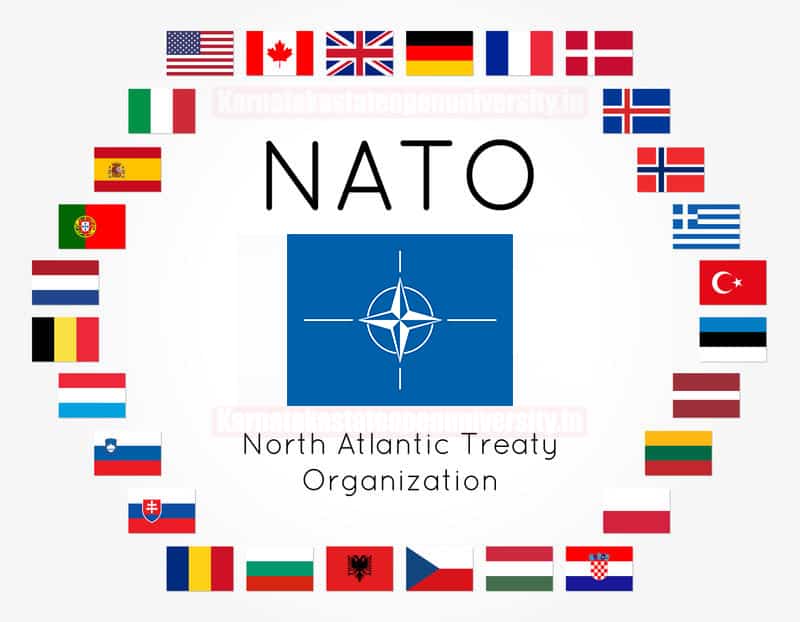
The North Atlantic Treaty Organization (NATO) was established in 1949 as a direct response to the Soviet threat during the Cold War. Built upon the principle of collective defence, enshrined in Article 5 of its founding treaty, NATO played a pivotal role in maintaining transatlantic security during the second half of the 20th century. However, in the post-Cold War era, NATO’s relevance has been increasingly questioned due to shifting global power dynamics, emerging security threats, and internal divisions among member states. While NATO remains a significant military alliance, its ability to adapt to contemporary security challenges will determine its continued importance in the evolving world order.


The Cold War’s End and the Loss of a Defined Adversary. NATO was created primarily to counter the Soviet Union and its communist bloc. With the collapse of the USSR in 1991, the alliance lost its primary adversary, creating uncertainty about its purpose. The following decades saw NATO struggling to redefine its role as the global security landscape shifted away from Cold War-style confrontations. While NATO expanded its membership and engaged in various global missions, critics argue that the absence of a direct military threat comparable to the Soviet Union has undermined its necessity.


Reduced Military Engagements and Shifting Priorities. In the post-Cold War era, NATO took on out-of-area missions, notably in the Balkans, Afghanistan, and Libya, demonstrating its role in global security. However, its military engagements have become more restrained in recent years. The withdrawal from Afghanistan in 2021 and the reluctance of many European nations to involve themselves in conflicts beyond their immediate borders signal a decreasing appetite for large-scale NATO-led interventions. This shift has raised questions about NATO’s continued role as an active military force or whether it is becoming more of a political and diplomatic entity.


Evolving Threats: Cyber Warfare, Terrorism, and Hybrid Conflicts. Modern security threats have evolved beyond conventional military conflicts. Cyber warfare, terrorism, pandemics, and economic crises increasingly define global security concerns. NATO has attempted to adapt by enhancing its cyber defence capabilities and counter-terrorism strategies. However, critics argue that these new threats often require diplomatic, economic, and technological responses rather than purely military solutions, making other organisations such as the United Nations (UN) and the European Union (EU) more relevant in addressing such challenges.


Multipolarity and the Shift toward Asia. The global power structure is transitioning from a unipolar world dominated by the United States to a multipolar system in which China, Russia, and other regional actors exert significant influence. This shift challenges NATO’s traditional dominance. The rise of China and its increasing military modernisation, alongside new security alliances like AUKUS (Australia, UK, US) and the Quad (US, India, Japan, Australia), suggest that the Indo-Pacific region is becoming a greater priority for NATO’s key member, the United States (Brookings Institution, 2024). As a result, NATO’s Euro-Atlantic focus risks diminishing in importance, particularly as Washington recalibrates its strategic priorities toward the Indo-Pacific.


Divergent Security Interests among NATO Members. NATO members increasingly have divergent security concerns. While Eastern European countries prioritise the threat from Russia, Western European nations emphasise diplomatic solutions and strategic autonomy. Meanwhile, Turkey pursues its regional agenda in the Middle East, often clashing with broader NATO objectives. These competing interests create friction within the alliance and raise doubts about its long-term cohesion.


Burden-Sharing and Defence Spending Disputes. One of NATO’s most persistent internal challenges is burden-sharing. The 2014 NATO Summit set a target for member states to spend at least 2% of their GDP on defence, yet as of 2023, only 11 out of 31 members met this goal (The Economist, 2024). The United States, which contributes disproportionately to NATO’s military budget, has repeatedly criticised its European allies for failing to uphold their financial commitments. These disparities fuel tensions and questions about NATO’s sustainability if burden-sharing remains unbalanced.


NATO’s Provocative Expansion. Since 1999, NATO has added 14 former Soviet or Warsaw Pact states to its membership, exacerbating tensions with Russia. Critics argue that NATO’s eastward expansion has contributed to geopolitical conflicts, particularly in Ukraine. Russia perceives NATO’s enlargement as a direct security threat, and the 2022 invasion of Ukraine can, in part, be seen as Moscow’s pushback against NATO’s growing footprint in Eastern Europe. While NATO insists on its open-door policy, some analysts caution that continued expansion risks further escalating tensions with Russia without necessarily increasing European security.


The Rise of Alternative Security Frameworks. As NATO grapples with internal divisions, other international alliances emerge as alternative security structures. Organisations like BRICS (Brazil, Russia, India, China, South Africa) and the Shanghai Cooperation Organization (SCO) present non-Western frameworks for economic and security cooperation. The European Union (EU) has also pursued greater military autonomy through initiatives like PESCO (Permanent Structured Cooperation), signalling a potential shift away from US-led security arrangements. If Europe continues to develop independent defence capabilities, NATO’s role as the continent’s primary security guarantor could diminish.


NATO’s Strength: Adaptation and Collective Defence. Despite these challenges, NATO remains the world’s most powerful military alliance, providing collective security and deterrence. Article 5 states that an attack on one member is an attack on all and remains a core pillar of transatlantic security. NATO has also adapted to modern threats by creating rapid response forces, strengthening its cyber defence strategies, and increasing cooperation in hybrid warfare tactics. These adaptations ensure that NATO remains relevant in key areas, even as its global dominance faces competition.


NATO’s Future in an Evolving Global Order. NATO’s relevance in the modern world order is contested. On one hand, the alliance remains a critical security framework for Western democracies, deterring aggression and maintaining transatlantic cohesion. On the other hand, shifting geopolitical priorities, internal divisions, and the rise of alternative security alliances present significant challenges to its continued dominance.


Conclusion. Ultimately, NATO’s future will depend on its ability to adapt to new security threats and navigate internal fractures while remaining a key player in global stability. Whether NATO will evolve to meet the challenges of the 21st century or gradually cede influence to emerging security frameworks remains one of the most pressing questions in contemporary international relations.


Please Enhance the content further with value addition.


2177
Default rating

Please give a thumbs up if you  like The Post?


For regular updates, please register your email here:-

Subscribe


References and credits

To all the online sites and channels.

Pics Courtesy: Internet

Disclaimer:

Information and data included in the blog are for educational & non-commercial purposes only and have been carefully adapted, excerpted, or edited from reliable and accurate sources. All copyrighted material belongs to respective owners and is provided only for wider dissemination.


References:-

  1. Andersen, L. R. (2021). The challenges of NATO burden-sharing. Global Affairs, 7(2), 185-202.
  1. BBC News. (2023). NATO expansion: What it means for global security. Retrieved from [URL]
  1. Brookings Institution. (2024). NATO and the rise of China: A strategic outlook.
  1. Chatham House. (2021). The future of NATO: Adapting to a multipolar world.
  1. European Parliament. (2022). The EU and NATO: Cooperation and challenges.
  1. NATO. (2023). Cyber security and hybrid warfare initiatives.
  1. Walt, S. M. (2022). NATO’s role in a changing global order. Foreign Affairs, 101(3), 45–58.

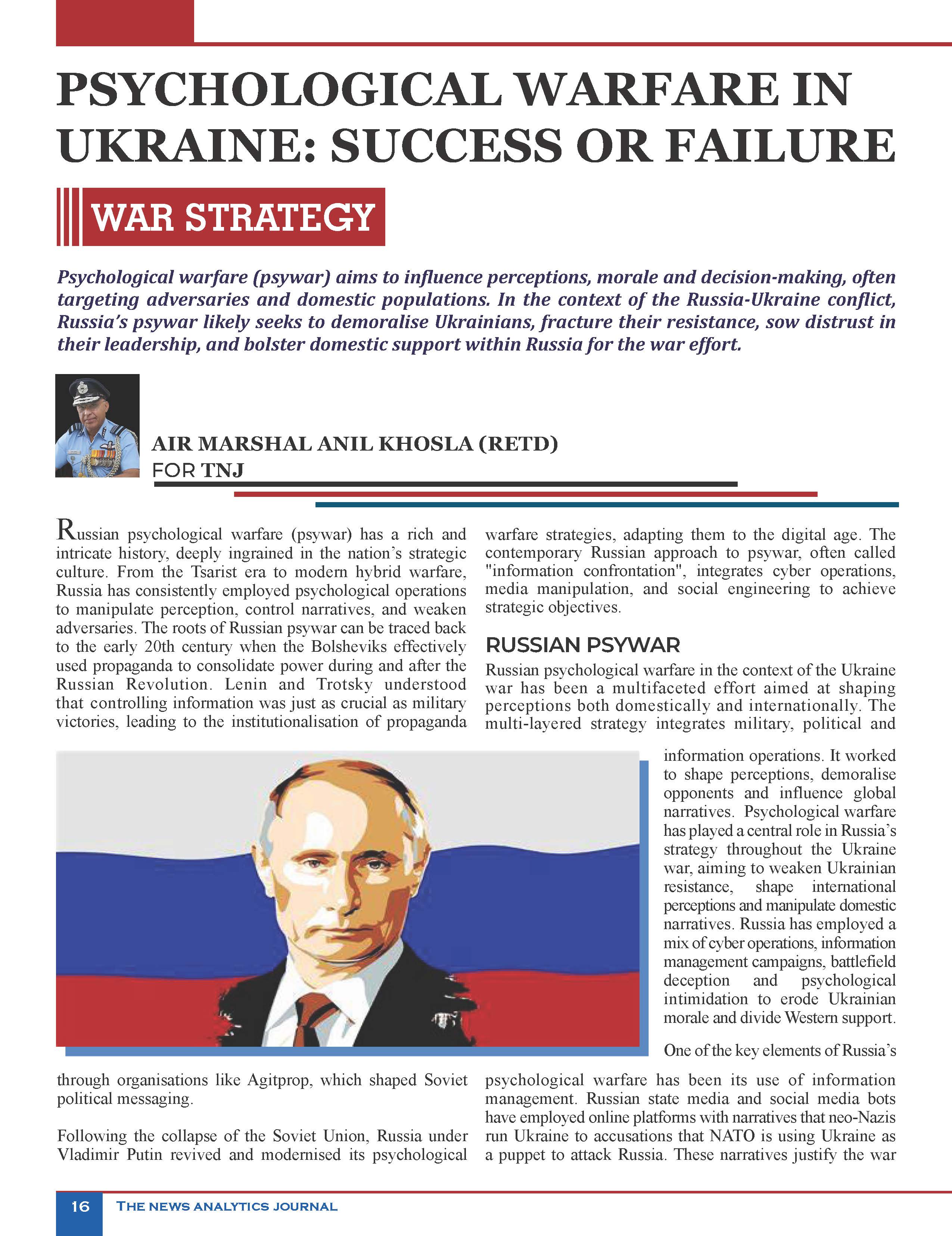
636: PSYCHOLOGICAL WARFARE IN UKRAINE: SUCCESS OR FAILURE


My Article was published in the News Analytics Journal of Mar 25.


Psychological warfare (psywar) aims to influence perceptions, morale, and decision-making, often targeting adversaries and domestic populations. In the context of the Russia- Ukraine conflict, Russia’s psywar likely seeks to demoralise Ukrainians, fracture their resistance, sow distrust in their leadership, and bolster domestic support within Russia for the war effort. An evaluation of Russia’s psychological warfare (psywar) in Ukraine would need an assessment of its objectives, tactics, and measurable impacts based on available evidence and recent developments.  This paper argues that while Russia’s psychological warfare has succeeded in shaping domestic narratives and straining Western unity, it has failed to break Ukrainian resistance or achieve a decisive strategic victory.


Historical Perspective of Russian Psychological Warfare

Russian psychological warfare (psywar) has a rich and intricate history, deeply ingrained in the nation’s strategic culture. From the Tsarist era to modern hybrid warfare, Russia has consistently employed psychological operations to manipulate perception, control narratives, and weaken adversaries. The roots of Russian psywar can be traced back to the early 20th century when the Bolsheviks effectively used propaganda to consolidate power during and after the Russian Revolution. Lenin and Trotsky understood that controlling information was just as crucial as military victories, leading to the institutionalisation of propaganda through organisations like Agitprop, which shaped Soviet political messaging.

During the early Soviet period, psywar techniques were used not only to suppress internal dissent but also to influence communist movements worldwide. The concept of “reflexive control,” developed in Soviet military thought, became a key element of Russian psywar, aiming to manipulate opponents into making decisions that ultimately benefit Russian interests. By the time of World War II, Soviet psychological operations had evolved into large-scale deception campaigns, including the use of maskirovka (military deception) to mislead Nazi Germany. Throughout the Cold War, the Soviet Union refined these methods, launching extensive “Active Measures” under the KGB to manage information and exploit societal divisions in Western nations.

Following the collapse of the Soviet Union, Russia, under Vladimir Putin, revived and modernised its psychological warfare strategies, adapting them to the digital age. The contemporary Russian approach to psywar, often called “information confrontation”, integrates cyber operations, media manipulation, and social engineering to achieve strategic objectives.


Russian Psywar during the Ukraine War

Russian psychological warfare in the context of the Ukraine war has been a multifaceted effort aimed at shaping perceptions both domestically and internationally. The multi-layered strategy integrates military, political, and information operations to shape perceptions, demoralise opponents, and influence global narratives.  Psychological warfare has played a central role in Russia’s strategy throughout the Ukraine war, aiming to weaken Ukrainian resistance, shape international perceptions, and manipulate domestic narratives. Russia has employed a mix of cyber operations, information management campaigns, battlefield deception, and psychological intimidation to erode Ukrainian morale and divide Western support.

One of the key elements of Russia’s psychological warfare has been its use of information management. Russian state media and social media bots have employed online platforms with narratives that neo-Nazis run Ukraine to accusations that NATO is using Ukraine as a puppet to attack Russia. These narratives justify the war to the Russian population, confuse Ukrainian citizens, and create divisions within Western democracies by amplifying anti-war and isolationist sentiments. Russian narratives have also sought to exploit war fatigue in Western nations, emphasising that financial and military support for Ukraine is futile, expensive, or escalatory.

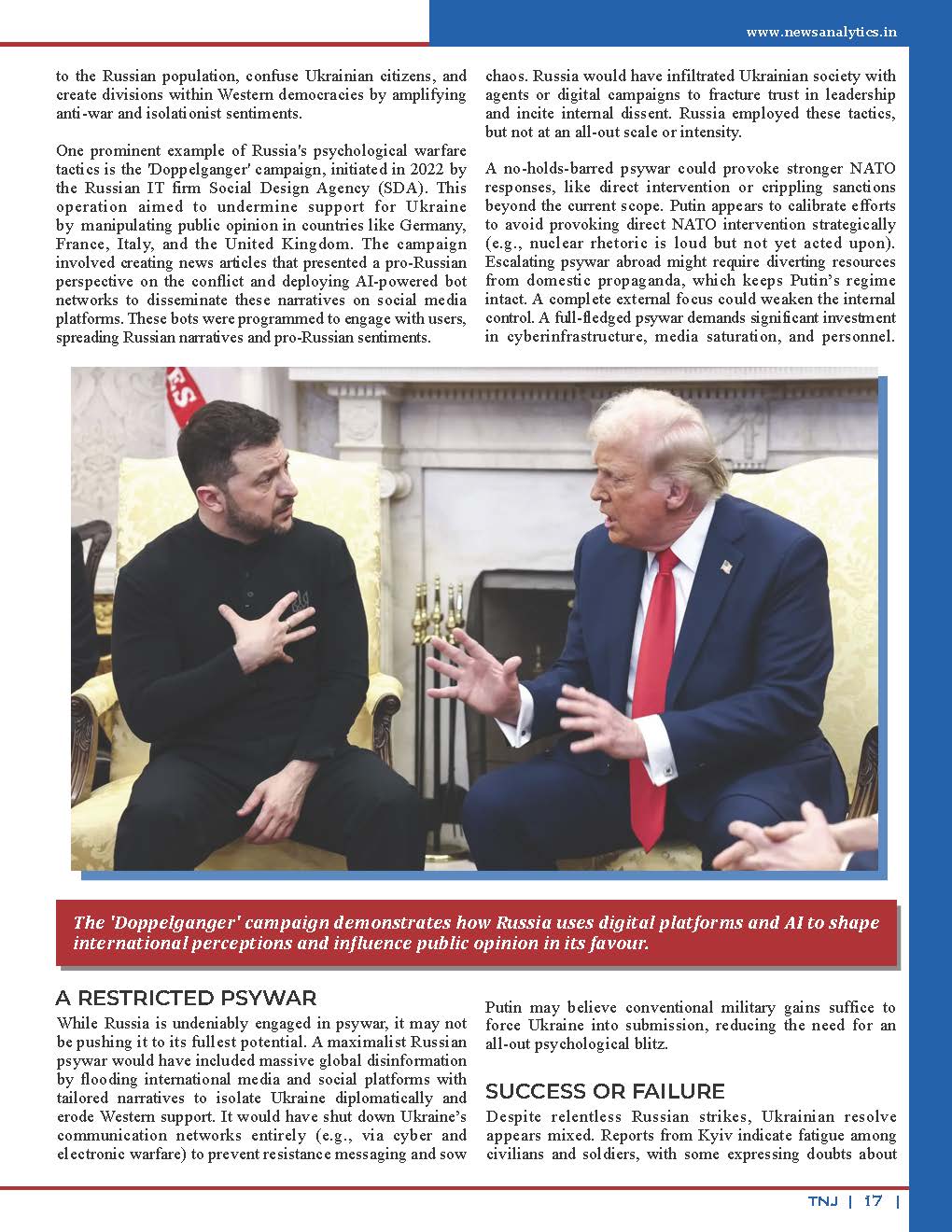
One prominent example of Russia’s psychological warfare tactics is the ‘Doppelganger’ campaign initiated in 2022 by the Russian IT firm Social Design Agency (SDA). This operation aimed to undermine support for Ukraine by manipulating public opinion in countries like Germany, France, Italy, and the United Kingdom. The campaign involved creating news articles that presented a pro-Russian perspective on the conflict and deploying AI-powered bot networks to disseminate these narratives on social media platforms. These bots were programmed to engage with users, spreading Russian narratives and pro-Russian sentiments. The ‘Doppelganger’ campaign demonstrates how Russia uses digital platforms and AI to shape international perceptions and influence public opinion in its favour.

Cyber warfare has also been a critical psychological tool. Russian cyber groups have often launched cyber attacks on Ukrainian government institutions, banks, and critical infrastructure. Beyond disabling systems, these attacks serve a psychological function, creating uncertainty, fear, and the impression that Ukraine’s leadership cannot protect its citizens.  Russian cyber efforts extend beyond Ukraine, targeting Western institutions with cyber sabotage to weaken overall support for Kyiv.


All-Out or Restricted Psywar.

While Russia is undeniably engaged in psywar, it may not be pushing it to its fullest potential. A maximalist Russian psywar would have included massive global disinformation by flooding international media and social platforms with tailored narratives to isolate Ukraine diplomatically and erode Western support. It would have shut down Ukraine’s communication networks entirely (e.g., via cyber and electronic warfare) to prevent resistance messaging and sow chaos. Russia would have infiltrated Ukrainian society with agents or digital campaigns to fracture trust in leadership and incite internal dissent. Russia employed these tactics, but not at an all-out scale or intensity.

Russia isn’t indulging in a full-fledged war not because it’s unwilling but because strategy, resources, and context constrain it. The war’s hybrid nature means that psywar is a key component, but it’s subordinated to military and economic priorities rather than unleashed as a standalone juggernaut. Russia seems content with a steady, if not maximal, psychological pressure adequate to grind Ukraine down but not bold enough to gamble on total dominance.

Strategic Restraint or Compulsion.  A no-holds-barred psywar could provoke stronger NATO responses, like direct intervention or crippling sanctions beyond the current scope. Putin appears to calibrate efforts to avoid provoking direct NATO intervention strategically (e.g., nuclear rhetoric is loud but not yet acted upon). Escalating psywar abroad might require diverting resources from domestic propaganda, which keeps Putin’s regime intact. A complete external focus could weaken the internal control. A full-fledged psywar demands significant investment in cyberinfrastructure, media saturation, and personnel. Putin may believe conventional military gains suffice to force Ukraine into submission, reducing the need for an all-out psychological blitz.


Success or Failure

Despite relentless Russian strikes, Ukrainian resolve appears mixed. Reports from Kyiv indicate fatigue among civilians and soldiers, with some expressing doubts about a negotiated peace due to distrust in Russia. However, Ukraine’s counteroffensives and continued drone strikes on Russian territory demonstrate resilience and a refusal to capitulate. This suggests Russia has not fully broken Ukrainian will, though exhaustion is a growing factor after three years of war. It has partially succeeded in weakening civilian morale and straining resources but hasn’t achieved a decisive psychological collapse.

Russian psywar has aimed to undermine trust in President Volodymyr Zelenskyy’s government. While Ukraine faces internal challenges, such as ammunition shortages and delayed Western aid, there’s no clear evidence of widespread distrust or collapse in governance.  The psychological toll on Ukrainians is undeniable. Studies from 2023-2024 highlight high rates of PTSD, anxiety, and depression exacerbated by displacement and infrastructure attacks. Yet, it hasn’t translated into mass surrender or acceptance of Russian dominance.


Impact on Putin’s Image

While the Western narrative often portrays Putin as weakened by the war in Ukraine, Russia’s psychological warfare has succeeded mainly in projecting him as an even stronger leader, both domestically and among some international audiences.

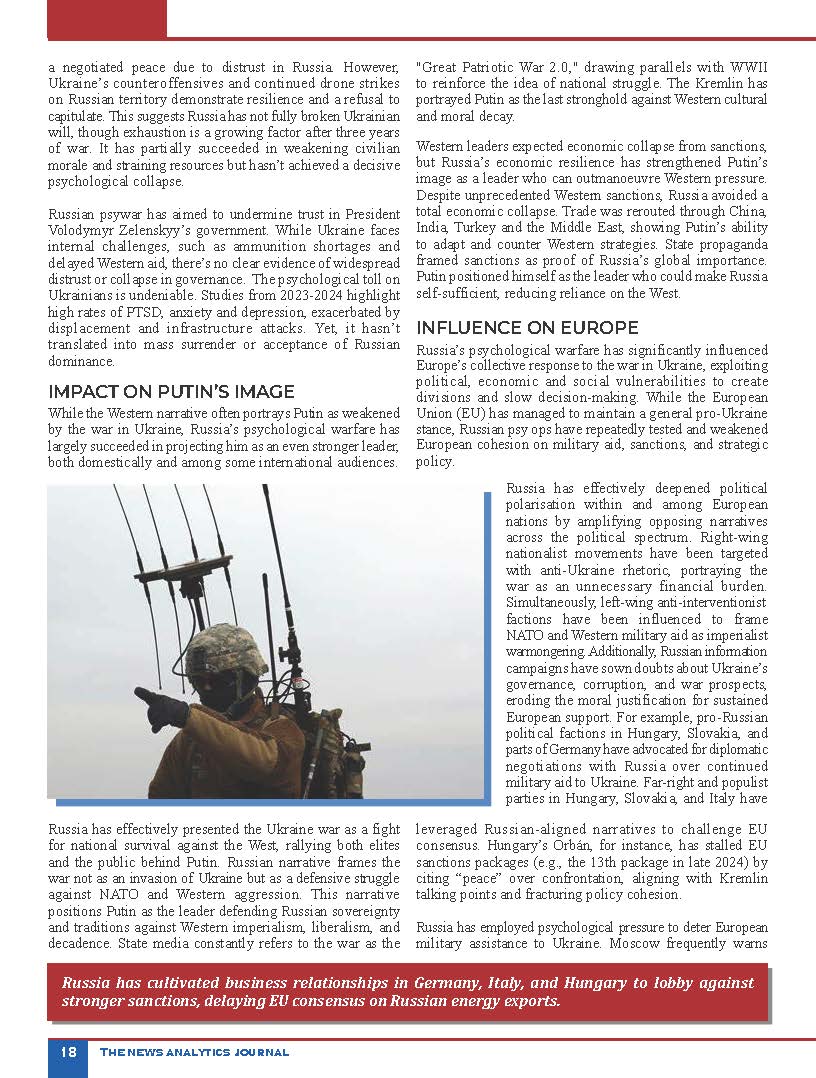
Russia has effectively presented the Ukraine war as a fight for national survival against the West, rallying both elites and the public behind Putin. The Russian narrative frames the war not as an invasion of Ukraine but as a defensive struggle against NATO and Western aggression. This narrative positions Putin as the leader defending Russian sovereignty and traditions against Western imperialism, liberalism, and decadence. State media constantly refers to the war as the “Great Patriotic War 2.0,” drawing parallels with WWII to reinforce the idea of national struggle. The Kremlin has portrayed Putin as the last stronghold against Western cultural and moral decay. Messaging around traditional values, national pride, and resistance to globalisation strengthens his appeal among conservative Russians and foreign audiences in the Global South.  The War has allowed Putin to eliminate political threats, tighten control over society, and silence opposition, reinforcing his image as an unchallenged ruler.

Western leaders expected economic collapse from sanctions, but Russia’s economic resilience has strengthened Putin’s image as a leader who can outmanoeuvre Western pressure. Despite unprecedented Western sanctions, Russia avoided a total economic collapse. Trade was rerouted through China, India, Turkey, and the Middle East, showing Putin’s ability to adapt and counter Western strategies. State propaganda framed sanctions as proof of Russia’s global importance. Putin positioned himself as the leader who could make Russia self-sufficient, reducing its reliance on the West.


Influence on Europe.

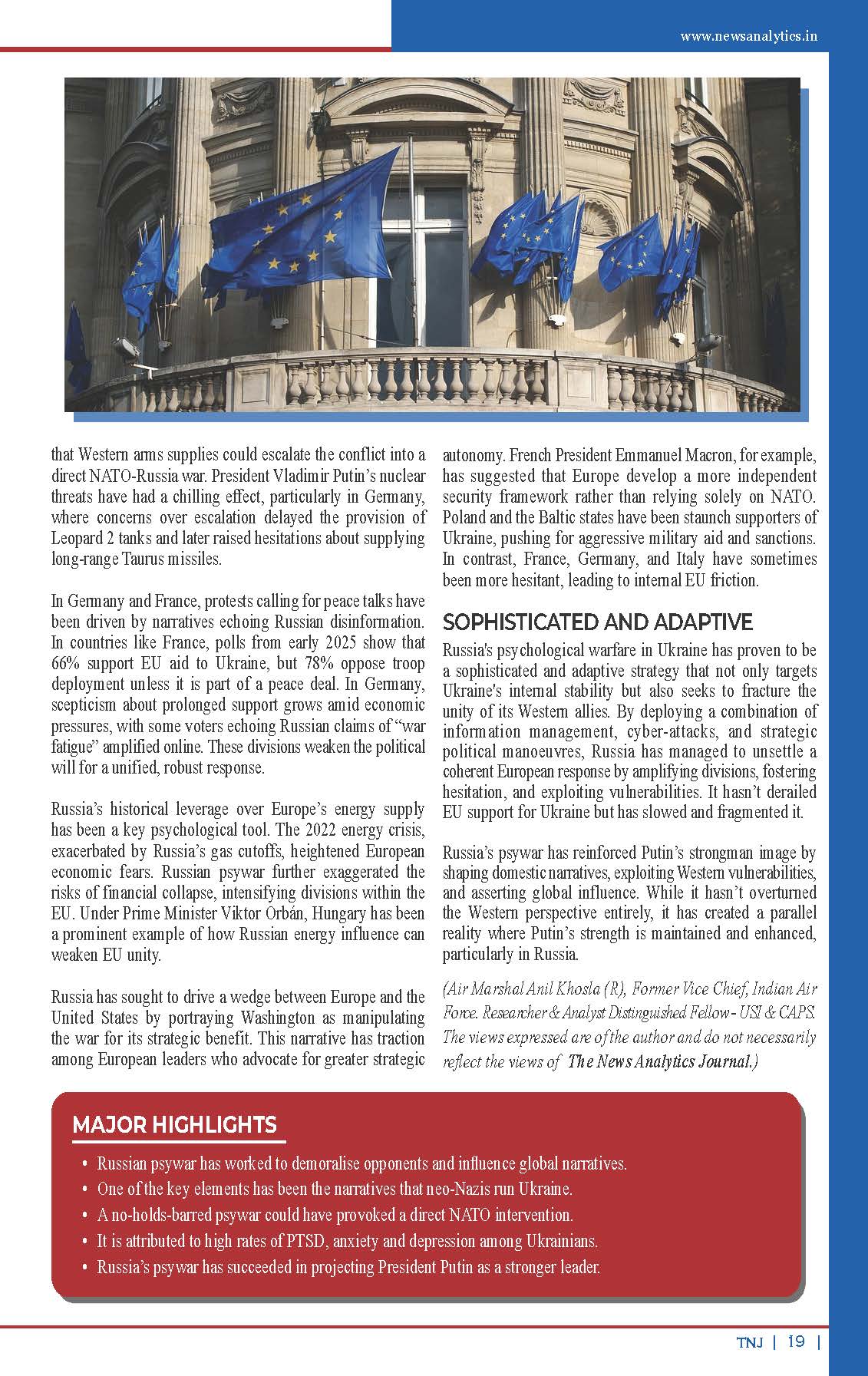
Russia’s psychological warfare has significantly influenced Europe’s collective response to the war in Ukraine, exploiting political, economic, and social vulnerabilities to create divisions and slow decision-making. While the European Union (EU) has managed to maintain a generally pro-Ukraine stance, Russian psy ops have repeatedly tested and weakened European cohesion on military aid, sanctions, and strategic policy.

 Exploiting Political Divisions in Europe. Russia has effectively deepened political polarisation within and among European nations by amplifying opposing narratives across the political spectrum. Right-wing nationalist movements have been targeted with anti-Ukraine rhetoric, portraying the war as an unnecessary financial burden. Simultaneously, left-wing anti-interventionist factions have been influenced to frame NATO and Western military aid as imperialist warmongering. Additionally, Russian information campaigns have sown doubts about Ukraine’s governance, corruption, and war prospects, eroding the moral justification for sustained European support. For example, pro-Russian political factions in Hungary, Slovakia, and parts of Germany have advocated for diplomatic negotiations with Russia over continued military aid to Ukraine. This has complicated EU-wide decision-making, as unanimous support is often required for major foreign policy measures. Far-right and populist parties in Hungary, Slovakia, and Italy have leveraged Russian-aligned narratives to challenge the EU consensus. Hungary’s Orbán, for instance, has stalled EU sanction packages (e.g., the 13th package in late 2024) by citing “peace” over confrontation, aligning with Kremlin talking points and fracturing policy cohesion.

 Weakening European Resolve on Military Aid. Russia has employed psychological pressure to deter European military assistance to Ukraine. Moscow frequently warns that Western arms supplies could escalate the conflict into a direct NATO-Russia war. President Vladimir Putin’s nuclear threats have had a chilling effect, particularly in Germany, where concerns over escalation delayed the provision of Leopard 2 tanks and later raised hesitations about supplying long-range Taurus missiles. Public opinion has also been a battleground for Russian influence. Moscow-backed media and social media campaigns have exaggerated the economic hardships caused by military aid, fuelling war fatigue. In Germany and France, protests calling for peace talks have been driven by narratives echoing Russian disinformation. In countries like France, polls from early 2025 show that 66% support EU aid to Ukraine, but 78% oppose troop deployment unless it is part of a peace deal. In Germany, scepticism about prolonged support grows amid economic pressures, with some voters echoing Russian claims of “war fatigue” amplified online. These divisions weaken the political will for a unified, robust response.

Economic Warfare and the Energy Weapon. Russia’s historical leverage over Europe’s energy supply has been a key psychological tool. The 2022 energy crisis, exacerbated by Russia’s gas cutoffs, heightened European economic fears. Russian psywar further exaggerated the risks of economic collapse, intensifying divisions within the EU. Under Prime Minister Viktor Orbán, Hungary has been a prominent example of how Russian energy influence can weaken EU unity. Orbán has repeatedly blocked or diluted Russian oil and gas sanctions, citing economic concerns. Additionally, Russia has cultivated business relationships in Germany, Italy, and Hungary to lobby against stronger sanctions, delaying EU consensus on measures such as price caps on Russian energy exports.

Encouraging Fractures in NATO and the EU. Russia has sought to drive a wedge between Europe and the United States by portraying Washington as manipulating the war for its strategic benefit. This narrative has traction among European leaders who advocate for greater strategic autonomy. French President Emmanuel Macron, for example, has suggested that Europe develop a more independent security framework rather than relying solely on NATO. Russian psyops have also exacerbated differences between Eastern and Western Europe. Poland and the Baltic states have been staunch supporters of Ukraine, pushing for aggressive military aid and sanctions. In contrast, France, Germany, and Italy have sometimes been more hesitant, leading to internal EU friction. Russia amplifies these divisions to slow collective decision-making, delaying much-needed aid to Ukraine.


Conclusion

Russia’s psychological warfare in Ukraine has proven to be a sophisticated and adaptive strategy that not only targets Ukraine’s internal stability but also seeks to fracture the unity of its Western allies. By deploying a combination of information management, cyber-attacks, and strategic political manoeuvres, Russia has managed to unsettle a coherent European response by amplifying divisions, fostering hesitation, and exploiting vulnerabilities. It hasn’t derailed EU support for Ukraine but has slowed and fragmented it.

Russia’s psywar has reinforced Putin’s strongman image by shaping domestic narratives, exploiting Western vulnerabilities, and asserting global influence. While it hasn’t overturned the Western perspective entirely, it has created a parallel reality where Putin’s strength is maintained and enhanced, particularly among Russian and non-Western audiences. Whether this perception holds as the war evolves remains uncertain, but for now, Russia’s psywar has undeniably kept Putin’s strongman myth alive and potent.


Please Do Comment.


2177
Default rating

Please give a thumbs up if you  like The Post?


For regular updates, please register your email here:-

Subscribe


References and credits

To all the online sites and channels.

Pics Courtesy: Internet

Disclaimer:

Information and data included in the blog are for educational & non-commercial purposes only and have been carefully adapted, excerpted, or edited from reliable and accurate sources. All copyrighted material belongs to respective owners and is provided only for wider dissemination.


References:-

  1. Thomas, Timothy. 2021. “Russian Military Thought: Concepts of Psychological Operations.” Journal of Slavic Military Studies 34 (1): 1-24.
  1. NATO Strategic Communications Centre of Excellence. 2022. “Russia’s Grand Strategy in the Information Space.” Riga: NATO StratCom COE.
  1. RAND Corporation. 2021. “Russian Information Warfare: The Role of Narrative and Propaganda.” Santa Monica, CA: RAND Corporation.
  1. European Council on Foreign Relations. 2022. “The Kremlin’s Playbook: Russia’s Information Operations in Europe.”
  1. Carnegie Europe. 2022. “Why Europe is Struggling to Counter Russian Information Warfare.” Brussels: Carnegie Europe.
  1. European Union External Action Service (EEAS). 2023. “Russia’s Disinformation Ecosystem and its Impact on Europe.”
  1. Chatham House. 2023. “Putin’s Strongman Image and the Role of Propaganda.” London: Chatham House.
  1. The Atlantic Council. 2023. “The Resilience of Putin’s Popularity Amid Western Sanctions.” Washington, D.C.: The Atlantic Council.
  1. The Wilson Center. 2022. “How Putin Weaponises Weakness Perception.” Washington, D.C.: The Wilson Center.
  1. Harding, Luke. 2023. Invasion: Russia’s Bloody War and Ukraine’s Fight for Survival. London: Guardian Faber.
  1. Kofman, Michael, and Rob Lee. 2024. “Assessing Ukraine’s Strategy Amidst Western Uncertainty.” War on the Rocks, February 10, 2024.
  1. The Guardian. 2024. “EU Divided Over Continued Support for Ukraine.” March 2024.
  1. NATO Strategic Communications Centre of Excellence. Reports on Russian Information Warfare. Accessed March 2024.
  1. Brookings Institution. 2023. “The West’s Cognitive Dissonance on Russia: A Strategic Weakness.” Washington, D.C.: Brookings Institution.

English हिंदी