843: RUSSIA’S INNOVATION: CONVERTING AIR DEFENCE ASSETS INTO OFFENSIVE FIREPOWER


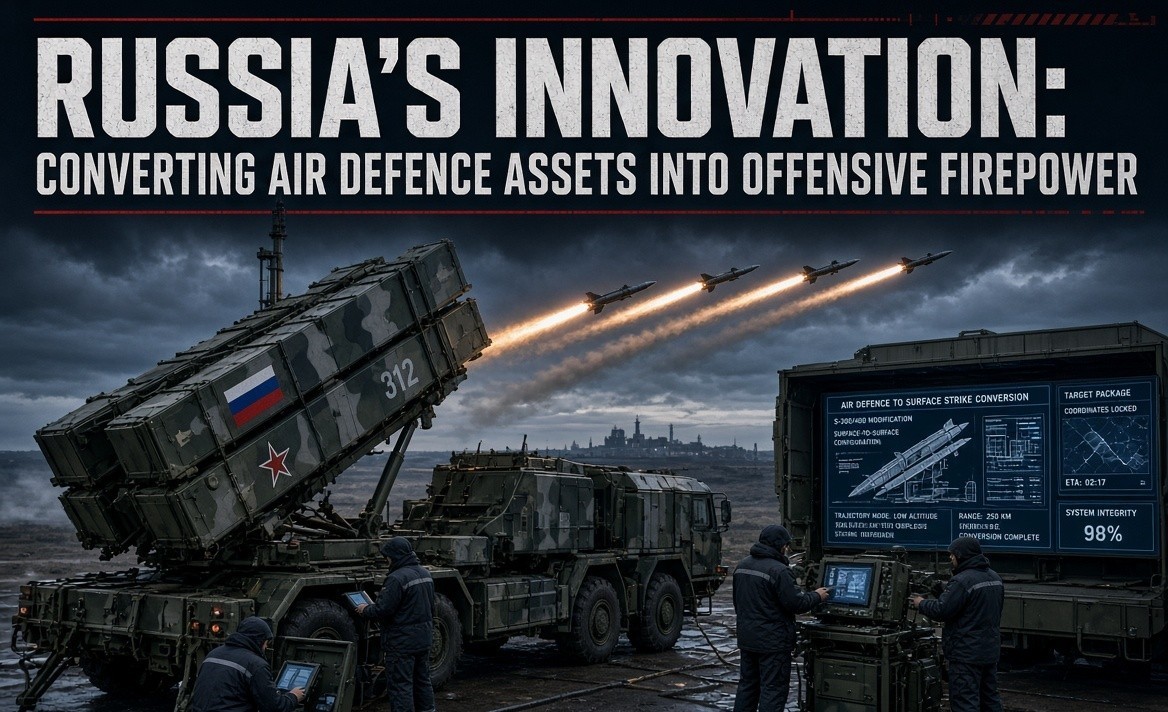
Russia is increasingly finding new ways to expand its ballistic-missile arsenal without relying entirely on purpose-built systems such as the Iskander-M. According to Ukraine’s Defence Intelligence Directorate (DIU), Russia has modified up to 17 S-400 launchers to fire RM-48U missiles against ground targets.

The modified launchers have reportedly been organised into five specialised missile groups deployed in Russia’s Bryansk and Rostov regions. Their emergence highlights a broader Russian effort to turn existing air-defence hardware and missile stocks into additional offensive capabilities.

At first glance, 17 launchers may seem relatively small. But their significance lies less in the number than in what they represent: Russia is creating another layer of ballistic strike capacity by repurposing weapons and equipment originally intended for air defence.


From Interceptor to Strike Missile

The RM-48U is essentially a ground-attack adaptation of missiles from the 48N6 family associated with the S-300 and S-400 air-defence systems. Instead of intercepting aircraft or other aerial targets, these missiles can now hit ground targets.

The conversion gives Russia a way to extract additional military value from an existing inventory. Older air-defence missiles that might otherwise remain in storage, require expensive maintenance or reach the end of their service life can potentially be refurbished and adapted for a different role.

The concept itself is not entirely new. Russia has previously used S-300 and S-400 air-defence missiles in ground-attack roles. What matters about the RM-48U development is the apparent effort to institutionalise that conversion rather than rely on improvised battlefield use. Ukrainian officials have confirmed the existence of specially modified S-400 launchers intended for these missiles.

Ukrainian intelligence assesses that the RM-48U is substantially cheaper than the purpose-built 9M723 ballistic missiles used by the Iskander-M system. Russia is also reported to hold a stockpile of roughly 400 RM-48U missiles.


A Cost-Effective Advantage

The most obvious advantage is cost, which makes the RM-48U attractive for sustained missile campaigns. Ukraine’s Defence Intelligence says Russia is using RM-48U missiles partly because they are significantly cheaper than the 9M723 ballistic missiles employed by the Iskander-M system. Ukrainian intelligence estimates Russia held around 400 RM-48Us in mid-2026, while production reportedly continued at roughly 50 missiles per month, with more than 480 planned for production during 2026.

A country conducting large-scale strikes does not need to attack every target with its most expensive or scarce missile. Purpose-built ballistic missiles such as the Iskander’s 9M723 are valuable assets, and using them against every target would place greater pressure on Russia’s stockpile and production capacity.

The RM-48U provides another option. Russia can therefore use a mixed arsenal: more capable or expensive missiles for some targets while employing converted air-defence missiles for others. The result is a larger pool of weapons that can contribute to a ballistic strike campaign.


Seventeen Launchers

The figure of 17 does not mean that the number of missiles is limited to 17. A launcher can fire, reload, and fire again. The real limitations are more likely to be missile availability, reload procedures, logistics, supply chain, and operational tempo rather than the headline figure of 17 launchers.

Russia reportedly possesses around 400 RM-48U missiles, making the size and replenishment of the missile stockpile more important for understanding the programme’s potential scale than the number of launchers.

If production and employment rates continue to rise, the missile stockpile becomes the key factor. Russia is simultaneously working to replenish that stockpile, meaning the conversion programme is not necessarily limited to older missiles already sitting in warehouses.

The modified launchers have reportedly been grouped into five specialised missile units positioned in Bryansk and Rostov oblasts, locations that provide practical reach toward Ukrainian territory.


Scalability with Existing Ecosystem

Another advantage is the existing launcher architecture. Russia already operates the S-400 system at scale. Its military-industrial sector can manufacture new launchers and modernise existing equipment. Ukrainian intelligence has identified Almaz-Antey and MKB Fakel among the principal companies associated with the S-400 system. In contrast, the Avangard Moscow Machine-Building Plant and AviaTek in Vyatka are identified as manufacturers of RM-48U missiles.

This means Moscow does not have to create an entirely new missile-launching ecosystem. The basic architecture already exists: launch vehicles, transport and handling equipment, personnel, logistics and command structures associated with the S-400 family. Modifying selected launchers to support the ground-attack mission can therefore be considerably more straightforward than developing a completely new operational missile system.

This is an important feature of Russia’s wartime adaptation. Rather than treating its enormous legacy inventory as obsolete, Moscow is looking for ways to turn existing stocks into new capabilities.


Augmentation of Missile Capability and Capacity

The RM-48U should not be viewed as a replacement for the Iskander-M. Russia still prioritises production of 9M723 missiles for Iskander-M, and Ukrainian Defence Intelligence has reported that Russia can produce more than 200 cruise and ballistic missiles of various types per month. Its estimates put monthly 9M723 production at around 60 missiles, with July production reportedly reaching 65.

The more logical interpretation is that Russia is attempting to expand the depth of its ballistic arsenal. A military does not necessarily need one weapon system to perform every task. It can be more effective to create several overlapping categories of missiles, each with different costs, capabilities and levels of availability.

The RM-48U fits neatly into that strategy. Instead of allowing older 48N6-family missiles to remain stranded in storage, Russia can convert them into offensive weapons. Instead of consuming an Iskander missile for every ballistic-strike requirement, Russian forces can draw on a second pool of missiles. And instead of developing an entirely new launcher, they can modify part of an existing S-400 infrastructure. The result is additional capacity without requiring every element of the system to be newly developed.


A Broader Look at the Russian Adaptation

The conversion of S-400 launchers illustrates a broader feature of Russia’s war effort: the attempt to squeeze additional combat value from existing inventories while expanding new production. The strategic importance of the RM-48U programme is therefore not simply that Russia has 17 modified launchers. It is that Russia appears to be building a second echelon of ballistic strike capability.

The missiles may be cheaper than Iskanders, the launchers are derived from an existing system, the missile stockpile is substantial, and production is continuing. The same basic concept could potentially be applied to large inventories of older air-defence weapons.

For Ukraine, this complicates defence against Russian missile attacks. The more diverse Russia’s strike arsenal becomes, the harder it is to predict which missile types will be used in a particular attack and how rapidly Russia can replenish weapons after a major strike.


Concluding Thought

The RM-48U programme should be seen not as Russia giving up on the Iskander, but as an attempt to expand its ballistic-missile stock. Instead of keeping the air-defence systems, Moscow is turning them into an offensive reserve. Although the 17 altered launchers are the obvious aspect of this initiative, the more significant point is the fundamental principle that when missiles already in existence can be refurbished and then combined with the modified launchers and used against ground targets, weapons which were originally intended to defend Russia’s airspace can be made into a further source of offensive capability.

Please Add Value to the write-up with your views on the subject.

2055
Default rating

Please give a thumbs up if you  like The Post?


For regular updates, please register your email here:-

Subscribe


References and credits

To all the online sites and channels.

Pics Courtesy: Internet

Disclaimer:

Information and data included in the blog are for educational & non-commercial purposes only and have been carefully adapted, excerpted, or edited from reliable and accurate sources. All copyrighted material belongs to the respective owners and is provided only for wider dissemination.


References: –

1. Defence Express, “Russia has up to 17 S-400 launchers adapted to fire RM-48U missiles at Ukraine”, 27 Aug 26.

2.Center for Strategic and International Studies, “S-400 Triumf. Missile Threat” 06 Jul 26.

3.Dotsenko, A, “Kyiv under S-400 fire: How Russia has turned air defence missiles into a weapon of terror and why they keep coming”, Ukrainska Pravda, 09 Aug 26.

4.Ukrainska Pravda, “Ukraine’s Defence Intelligence provides Ukrainska Pravda with data on Russia’s missile stockpiles and production rates”, 20 Aug 26.

5.Critical Threats Project, “Russian offensive campaign assessment”, American Enterprise Institute, 20 Aug 26.

6.Bronk, J, “Analysis of Russia’s use of converted surface-to-air missiles as an additional ballistic-strike capability”, Royal United Services Institute (RUSI), 2026.

697: OPERATION SPIDER’S WEB – UKRAINE’S AUDACIOUS DRONE STRIKE: LESSONS FOR INDIA


My article was published in the Jul 25 issue of

the News Analytics Magazine 


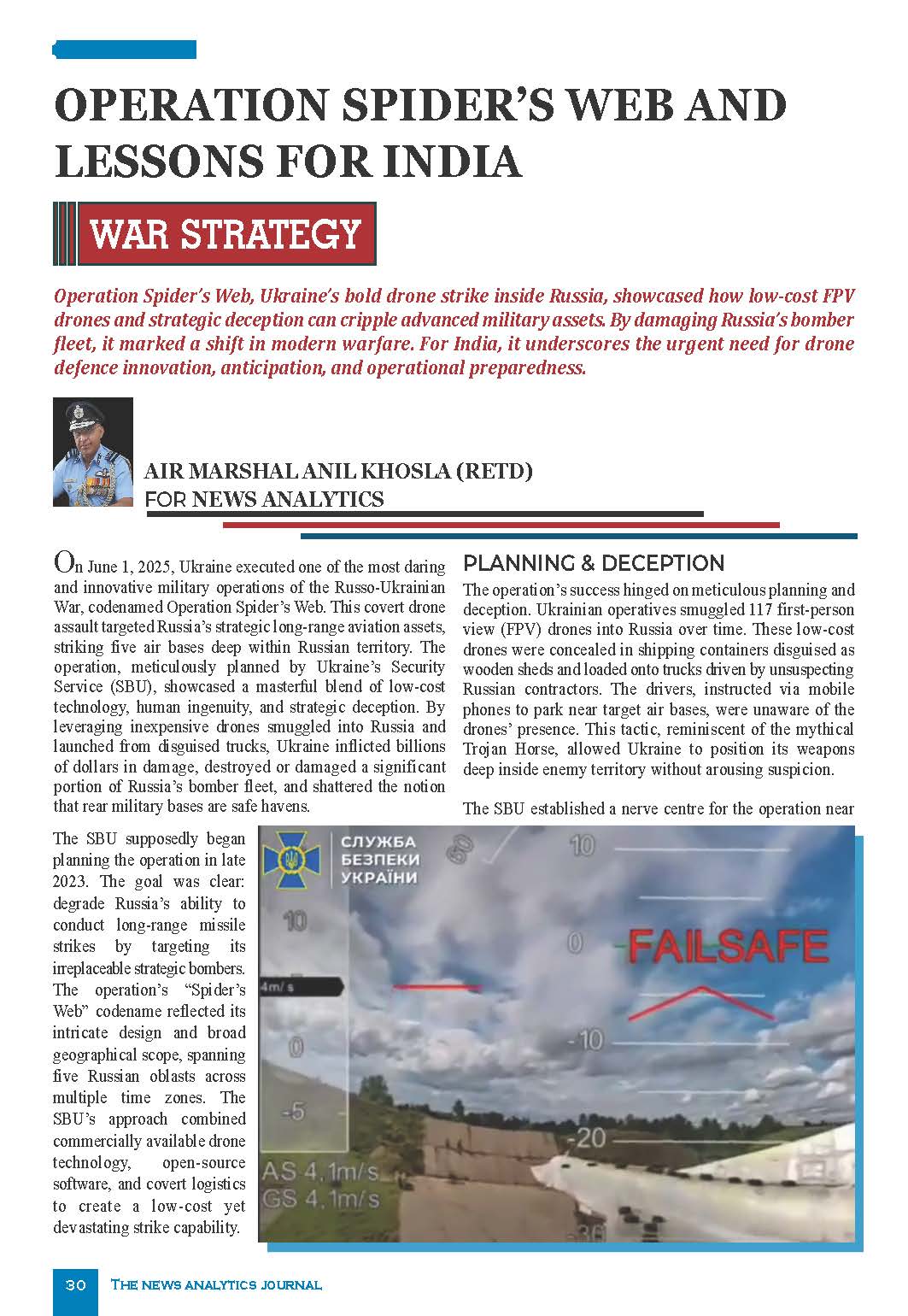
On June 1, 2025, Ukraine executed one of the most daring and innovative military operations of the Russo-Ukrainian War, codenamed Operation Spider’s Web. This covert drone assault targeted Russia’s strategic long-range aviation assets, striking five air bases deep within Russian territory. The operation, meticulously planned by Ukraine’s Security Service (SBU), showcased a masterful blend of low-cost technology, human ingenuity, and strategic deception. By leveraging inexpensive drones smuggled into Russia and launched from disguised trucks, Ukraine inflicted billions of dollars in damage, destroyed or damaged a significant portion of Russia’s bomber fleet, and shattered the notion that rear military bases are safe havens. This article explores the operation’s nuances, implications for modern warfare, and lessons for India.

The Genesis. The SBU supposedly began planning the operation in late 2023. The goal was clear: degrade Russia’s ability to conduct long-range missile strikes by targeting its irreplaceable strategic bombers. The operation’s “Spider’s Web” codename reflected its intricate design and broad geographical scope, spanning five Russian oblasts across multiple time zones. The SBU’s approach combined commercially available drone technology, open-source software, and covert logistics to create a low-cost yet devastating strike capability.


Planning and Deception: A Modern Trojan Horse.

The operation’s success hinged on meticulous planning and deception. Ukrainian operatives smuggled 117 first-person view (FPV) drones into Russia over time. These low-cost drones were concealed in shipping containers disguised as wooden sheds and loaded onto trucks driven by unsuspecting Russian contractors. The drivers, instructed via mobile phones to park near target air bases, were unaware of the drones’ presence. This tactic, reminiscent of the mythical Trojan Horse, allowed Ukraine to position its weapons deep inside enemy territory without arousing suspicion.

The SBU established a nerve center for the operation near a regional office of Russia’s FSB intelligence service in Chelyabinsk, adding a layer of audacity to the plan. Ukrainian operators used Russia’s domestic 4G/LTE networks to pilot the drones remotely, embedding control signals within civilian data traffic to evade detection. The drones were equipped with ArduPilot, an open-source autopilot software, enabling pre-programmed flight paths and precise targeting of vulnerable aircraft components, such as fuel tanks and wings. Some reports suggest AI-assisted machine vision may have enhanced strike accuracy in the drones’ terminal phase, though this remains unconfirmed.

The targets were carefully selected: five air bases—Belaya, Dyagilevo, Ivanovo Severny, Olenya, and Ukrainka—housing Russia’s Long-Range Aviation fleet. These bases, located up to 4,300 kilometers from Ukraine, were critical to Moscow’s strategic bombing campaigns. The operation’s timing, coinciding with Russia’s Military Transport Aviation Day, was likely chosen to maximise psychological impact.


Execution: A Coordinated Strike across Time Zones

On June 1, 2025, Operation Spider’s Web unfolded with surgical precision. At dawn, 117 drones were launched simultaneously from their hidden truck-based platforms, targeting aircraft at the five air bases. The drones, flying in the “air littoral”—a low-altitude zone below traditional radar coverage—evaded Russia’s air defences, which were ill-equipped to counter small, low-flying threats.

The strikes were devastating. Satellite imagery and Ukrainian footage confirmed significant damage, particularly at Belaya Air Base in Eastern Siberia, where seven bombers were destroyed on the tarmac. According to Kyiv, the operation destroyed or damaged over 40 aircraft, including Tu-95s, Tu-160s, Tu-22M3s, and an A-50 airborne early-warning jet, representing roughly one-third of Russia’s long-range strike fleet and $7 billion in hardware. NATO estimates suggest 10 to 13 aircraft were destroyed, with over 40 damaged. Russian sources downplayed the losses, but independent analysts confirmed the operation’s unprecedented scale.

The attack on Belaya, 4,300 kilometres from Ukraine, marked the farthest Ukrainian strike of the war, underscoring the operation’s geographical reach. The SBU released four minutes of drone footage showing strikes on Tu-95 wings and Tu-22M3 fuselages, highlighting the precision of the attack. Russia’s Defence Ministry admitted attacks in Murmansk and Irkutsk but claimed no casualties and minimal damage, a narrative contradicted by satellite imagery and Ukrainian reports.

Operation Spider’s Web was not just a military success, but a strategic and symbolic triumph for Ukraine. The operation also had broader implications. As The New York Times noted, it marked a “defining moment in the evolution of modern warfare.” Using inexpensive drones to destroy high-value assets challenged traditional military doctrines, which assume rear bases are secure. The “air littoral” concept gained prominence as drones exploited gaps in conventional air defences. This strategy, replicable by other nations or non-state actors, could reshape how air forces protect their assets, forcing them to harden, disperse, or treat runways as front lines.


Indian Experience

On June 26–27, 2021, India faced its first terrorist drone attack at the Jammu Air Force Station. Two low-flying drones, likely modified quadcopters (possibly DJI Matrice 600 Pro), dropped IEDs with 1–1.5 kg of RDX, launched from Pakistan near the LoC. The first explosion damaged a building roof in the high-security technical area; the second detonated harmlessly on the ground. Two IAF personnel sustained minor injuries, with no critical assets harmed and attributed to Lashkar-e-Taiba, with possible Jaish-e-Mohammad and ISI involvement. This incident highlighted the potential threat of low-cost, high-impact drone attacks and prompted India to bolster its counter-drone systems, including DRDO’s laser technology and jammers.

The attacks exposed vulnerabilities to small, low-altitude drones, previously used only for smuggling. It mirrored global trends seen in ISIS and Hamas tactics. The incident prompted India to bolster counter-drone systems, including DRDO’s laser technology and jammers. This attack marked a strategic shift, highlighting drones’ low-cost, high-impact potential.


Lessons from Operation Spider’s Web for India

Ukraine’s method of smuggling kamikaze drones into Russia to strike distant targets reveals new possibilities for attacks using smuggled weapons, even outside of wartime. Consider the potential for sabotaging critical infrastructure during peacetime or assassinating key leaders and commanders with micro kamikaze drones during public events, travel, or other vulnerabilities. This threat demands robust defence systems, tailored to its unique nature and scale. Operation Spider’s Web provides vital insights for India to modernise its military strategy, advance technological innovation, and prepare for evolving warfare, especially amid regional security threats.

Emerging Threats. India’s porous borders with Pakistan are vulnerable to low-altitude drone attacks. Adversaries could deploy similar tactics to target air bases, forward posts, or critical infrastructure like dams, refineries, or cities, using inexpensive drones operated by terrorist groups or state actors.

Defence Strategies. To counter these risks, India must implement robust defences. Install counter-drone systems at strategic installations and enhance homeland security with drone surveillance and interception in key areas. Develop rapid-response units to neutralise drone threats. Disperse aircraft and assets across multiple sites to mitigate swarm attack risks, and invest in fortified shelters, decoy systems, and rapid repair facilities.

Network Security. India’s 5G expansion offers military integration potential but risks adversary exploitation. Strengthen cybersecurity to safeguard 5G infrastructure and establish secure, encrypted military communication networks.

Adopt Cost-Effective Drones. Accelerate indigenous drone programs under Make in India, focusing on affordable, scalable systems. Expand public-private partnerships to develop FPV drones with open-source software for rapid deployment in border conflicts.

Enhance Precision and AI. Integrate AI and machine vision into drones to precisely target high-value assets like missile sites—partner with tech firms to develop AI algorithms for real-time target identification in diverse terrains.

Drive Innovation. Create innovation hubs within the Indian Armed Forces and collaborate with academia through hackathons to develop next-generation warfare tools, ensuring adaptability in modern conflicts.


Conclusion

Operation Spider’s Web is pivotal in military history, showcasing drone warfare’s transformative power in redefining modern conflicts. Through a sophisticated blend of deception, technology, and precision, Kyiv delivered a strike that echoed beyond Russia’s airfields, proving no target is truly secure in the drone era. This operation holds critical lessons for India. Deploy advanced counter-drone systems at strategic sites and simulate Ukraine-style drone attacks in war games. Train Special Forces for covert drone missions and boost indigenous drone production under Make in India, prioritising swarm technology and AI. Secure 5G networks for military operations and update doctrines to embed drone warfare, focusing on asymmetry, deception, and precision. Push for global regulations to curb drone use by non-state actors. These measures will strengthen India’s defence framework, ensuring a strategic advantage in 21st-century warfare.


Please Add Value to the write-up with your views on the subject.


2055
Default rating

Please give a thumbs up if you  like The Post?


For regular updates, please register your email here:-

Subscribe

References and credits

To all the online sites and channels.

Pics Courtesy: Internet

Disclaimer:

Information and data included in the blog are for educational & non-commercial purposes only and have been carefully adapted, excerpted, or edited from reliable and accurate sources. All copyrighted material belongs to respective owners and is provided only for wider dissemination.


References:-

  1. Axe, David. “Ukraine’s Drones Just Redrew the Map of Modern Warfare.” The Daily Beast, June 5, 2025.
  1. Barnes, Julian E., and Eric Schmitt. “Ukraine’s Audacious Drone Strike Hits Russian Air Bases, Signals New Phase in War.” The New York Times, June 2, 2025.
  1. Gibbons-Neff, Thomas, and Marc Santora. “How Ukraine Pulled Off a Surprise Drone Attack 4,300 Kilometres Into Russia.” The New York Times, June 3, 2025.
  1. Hambling, David. “Operation Spider’s Web: Ukraine’s Drone Swarm Redefines Asymmetric Warfare.” Forbes, June 4, 2025.
  1. Kofman, Michael, and Rob Lee. “Ukraine’s Drone Strike on Russian Airfields: Strategic Implications.” War on the Rocks, June 6, 2025.
  1. Lendon, Brad. “Ukraine’s Deep Drone Strike: What It Means for Russia’s Air Force.” CNN, June 3, 2025.
  1. Mitzer, Stijn, and Joost Oliemans. “Operation Spider’s Web: Counting the Cost of Ukraine’s Drone Assault.” Oryx, June 4, 2025.
  1. Rogoway, Tyler. “Ukraine’s Drone Blitz on Russian Air Bases: A New Era of Warfare.” The War Zone, June 2, 2025.
  1. Tisdall, Simon. “Ukraine’s Drone Strike Shatters Russia’s Illusion of Safety.” The Guardian, June 5, 2025.
  1. Tucker, Patrick. “Ukraine’s Operation Spider’s Web: A Case Study in Drone Warfare.” Defence One, June 7, 2025.
  1. Center for Strategic and International Studies. “Ukraine’s Drone Strikes and the Future of Strategic Warfare.” CSIS Briefs, June 8, 2025.
  1. Harding, Luke, and Andrew Roth. “Russia’s Air Force Reels After Ukraine’s Drone Strike.” The Financial Times, June 4, 2025.
  1. Reynolds, Nick. “The Air Littoral: How Ukraine Exploited Russia’s Blind Spot.” The Conversation, June 6, 2025.

692: UNFINISHED RUSSIAN OBJECTIVE: REGIME CHANGE IN UKRAINE


My article was published on the Indus International Research Foundation website on June 30, 2025.


Since Russia launched its special military operation on February 24, 2022, its primary strategic objective was widely understood to be the overthrow of Ukraine’s government and the installation of a pro-Russian regime. This goal has proven elusive, rooted in Moscow’s desire to reassert influence over its neighbour and prevent Ukraine’s integration with the West. Over three years into the conflict, Russia has not been able to achieve regime change. There are possibly multifaceted reasons behind it, encompassing military, political, economic, societal, and informational dimensions.


Analytical Perspective

Strategic Miscalculations: Flawed Assumptions. At the heart of Russia’s failure lies a cascade of flawed assumptions.  Before launching the invasion on 24 February 2022, Moscow wrongly believed that the Ukrainian society was deeply fractured along ethnic and linguistic lines. Secondly, the Zelensky government lacked legitimacy and would collapse under pressure. Lastly, NATO and the West would not intervene decisively. These assumptions led Russia to pursue an audacious plan aimed at rapidly occupying Kyiv, decapitating Ukraine’s leadership, and presenting the world with a fait accompli. However, Russian intelligence had gravely underestimated both the unity and the resilience of Ukrainian society. When the war began, the anticipated internal collapse did not materialise; instead, Ukraine mobilised as a unified nation.

Ukrainian Resilience and National Unity. One of the most critical factors thwarting Russia’s ambitions has been the extraordinary resilience of the Ukrainian people and their government. From the outset, Ukraine’s people displayed unwavering resolve. Ukrainian society mobilised rapidly, with civilians joining territorial defence units, volunteering in humanitarian efforts, and supporting the military. The war has forged a stronger national identity, with polls consistently showing overwhelming support for Zelenskyy’s government and rejection of Russian influence. This societal cohesion has made installing a pro-Russia regime more difficult, as any pro-Russian government would face relentless resistance and lack legitimacy.

Russian Military Miscalculation: Collapse of the Hostomel-Kyiv Blitz. Russia’s regime-change ambitions were staked on the success of a swift airborne operation. Russian forces did seize Hostomel Airport, located just outside Kyiv, to establish an air bridge for further troops. However, Ukrainians were able to repel the assault, destroying incoming aircraft and delaying Russian reinforcements. With the Hostomel plan thwarted, Russian ground forces were left advancing slowly on narrow roads with overstretched supply lines and inadequate logistics. Russians had to change their strategy and the plan at an early stage.

Western Support. The unprecedented scale of Western support for Ukraine has been a pivotal factor. NATO countries, led by the United States, the United Kingdom, and the European Union, have provided Ukraine with billions of dollars in military, financial, and humanitarian aid. Advanced weaponry, including HIMARS rocket systems, ATACMS missiles, Patriot air defences, and Leopard tanks, has enabled Ukraine to counter Russian offensives and launch successful counterattacks. Beyond material support, Western intelligence-sharing and training programs have enhanced Ukraine’s operational effectiveness. On the other hand, sanctions on Russia, targeting its energy exports, financial systems, and military-industrial complex, have dented Moscow’s ability to sustain the tempo of the war.

Geopolitical and Terrain Challenges. Ukraine’s geography has posed significant challenges for Russia’s regime change ambitions. Over 600,000 square kilometers of Ukraine is Europe’s second-largest country, with diverse terrain ranging from open steppes to dense urban centers. Controlling such a vast area requires substantial manpower and resources. Urban warfare, particularly in cities, favours Ukrainian defenders, who benefit from local knowledge and fortified positions. Russia’s territorial gains have been concentrated in eastern and southern regions, such as parts of Donbas, and Crimea, but these areas represent only a fraction of Ukraine. Stretching its forces across multiple fronts has diluted Russia’s ability to consolidate control or advance toward Kyiv, the political heart of Ukraine.

Russian Internal Constraints. Russia’s domestic challenges have further undermined its war effort. The invasion has strained Russia’s economy, with sanctions disrupting trade, freezing foreign reserves, and limiting access to critical technologies. While high energy prices initially cushioned the blow, long-term economic decline and inflation have eroded public support for the war to an large extent. Political dissent, though suppressed, persists among some of Russia’s factions. These internal pressures have constrained Russia’s ability to escalate the war or sustain a long-term occupation of Ukraine.

Alienating the Ukrainian Population. Russia’s offensive and punitive tactics have obliterated any chance of winning Ukrainian support for a pro-Russian regime. Deliberate attacks on infrastructure have fuelled hatred toward Russia and unified Ukrainians against Moscow’s agenda. The Kremlin’s narrative about “denazifaction” of Ukraine has not resonated well with Ukrainians.  The absence of a viable pro-Russian political base in Ukraine has left Russia with no credible allies to prop up a pro-Russian government.

Dominance in the Information War. Ukraine has done well in the information domain, maintaining global sympathy and domestic morale. Russia, by contrast, has maintained a low-key approach to control the narrative. Its state-controlled media dominates domestically but has little sway abroad. This information asymmetry has reinforced Ukraine’s legitimacy while undermining Russia’s ability to justify regime change.

The Evolution of the Conflict. As the war has evolved into a protracted struggle, Russia’s initial goal of regime change has become increasingly unattainable, and Moscow has pivoted to territorial objectives. The limited military operation has evolved into a long-drawn-out slug match, with Ukraine periodically launching counter-offensives and Russia resorting to punitive action with long-range weapons. The prospect of a frozen conflict or negotiated settlement looms, but both sides are sticking to their terms.


Conclusion

Russia’s inability to achieve regime change in Ukraine results from a confluence of factors: Ukrainian unity and resolve, Russian strategic miscalculations, continued Western support, geographical challenges, and Moscow’s internal constraints. These elements have transformed the conflict into a grinding stalemate, with Ukraine’s government not only surviving but emerging as a symbol of resistance. As the war continues, Russia’s prospects for overturning Ukraine’s leadership remain dim.


Please Add Value to the write-up with your views on the subject.


2055
Default rating

Please give a thumbs up if you  like The Post?


For regular updates, please register your email here:-

Subscribe


References and credits

To all the online sites and channels.

Pics Courtesy: Internet

Disclaimer:

Information and data included in the blog are for educational & non-commercial purposes only and have been carefully adapted, excerpted, or edited from reliable and accurate sources. All copyrighted material belongs to respective owners and is provided only for wider dissemination.


Link to the article on the website:-

Unfinished Russian Objective: Regime Change In Ukraine

References:-

  1. Charap, S., & Colton, T. (2022). Everyone loses: The Ukraine crisis and the ruinous contest for post-Soviet Eurasia. Routledge.
  2. D’Anieri, P. (2023). Ukraine and Russia: From civilised divorce to uncivil war (2nd ed.). Cambridge University Press.
  3. Galeotti, M. (2023). Russia’s war in Ukraine: The end of the beginning? Foreign Affairs, 102(4), 48–59.
  4. Kofman, M., & Lee, R. (2022). Not built for purpose: The Russian military’s ill-fated force design. War on the Rocks.
  5. Kuzio, T. (2024). Russia’s war against Ukraine: The whole story. Routledge.
  6. Plokhy, S. (2023). The Russo-Ukrainian war: The return of history. W. W. Norton & Company.
  7. Sasse, G., & Lackner, A. (2023). War and identity: The case of Ukraine. Journal of Slavic Military Studies, 36(1), 1–19.
  8. The Economist. (2024, December 12). How sanctions are reshaping Russia’s economy.
  9. SIPRI Yearbook 2025. Armaments, Disarmament and International Security. Stockholm International Peace Research Institute, June 2025.
  10. Institute for the Study of War (ISW). Russian Offensive Campaign Assessments, 2022–2025.
  11. RAND Corporation. “The Russian Way of War: Doctrine, Logistics, and Constraints.” RAND Reports, 2023–2024.
  12. BBC News. “Ukraine War: The Battle for Hostomel Airport.” BBC Special Report, March 2022.
  13. European Union External Action Service (EEAS). EU Support to Ukraine: Ukraine Facility and Sanctions Against Russia, 2024–2025.
  14. The Economist. “Why Russia’s Regime Change Strategy in Ukraine Has Failed,” April 2025.
  15. Royal United Services Institute (RUSI). Lessons from the Ukraine War: Air Superiority and ISR, 2023.
  16. New York Times. “Inside Ukraine’s Counteroffensives,” October 2022–June 2025 Special Reports.
  17. Jane’s Defence Weekly. Russia-Ukraine Conflict Technical Assessments, 2022–2025.
English हिंदी