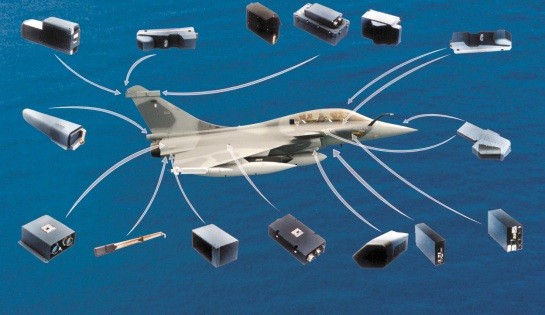
Survivability in a modern aerial combat environment depends on mastery of the electromagnetic spectrum. This mastery in the Dassault Rafale is provided by a single sophisticated system called SPECTRA (Système de Protection et d’Évitement des Conduites de Tir du Rafale). It is a state-of-the-art, fully integrated electronic warfare suite developed jointly by Thales Group and MBDA.
Unlike external EW pods that compromise aerodynamics and radar cross-section, SPECTRA is embedded directly within the Rafale’s airframe. Sensors are distributed across the fuselage, wing roots, wingtips, and tail sections. This creates an all-aspect awareness bubble with no blind spots. This “smart skin” philosophy means the system is not an add-on but is a core nervous system. It is networked directly with the aircraft’s RBE2 AESA radar, OSF infrared search-and-track system, and mission computer to produce a single, fused tactical picture for the pilot.
360-Degree, Multi-Spectral Coverage. SPECTRA’s defining capability is its ability to detect, classify, and respond to threats across the full electromagnetic spectrum simultaneously. It monitors radar emissions from enemy SAM batteries and airborne fire-control radars, detects the heat signatures of infrared-homing missiles, and identifies laser rangefinders and target designators — all in real time, from any direction. This matters immensely in modern contested airspace where multiple weapons create an overlapping defensive envelope. A system that addresses only one spectral dimension leaves the aircraft exposed to the others. SPECTRA addresses all three simultaneously, with sensors capable of detecting threats at ranges that provide the pilot with a meaningful reaction time.
The Architecture: Key Components. The system’s effectiveness flows from four tightly integrated subsystems working in concert:
The DDM NG (Détecteur de Départ Missile Nouvelle Génération) is MBDA’s next-generation missile approach warning system. It uses advanced infrared and ultraviolet sensors with wide-angle coverage to detect missile launches at long range — including from low-observable platforms — with sub-degree angular resolution. Critically, it can detect non-radiating passive threats that older UV-based systems miss.
The Radar Warning Receiver (RWR) passively scans for hostile radar emissions. It identifies and geolocates emitters using techniques such as interferometry and time-difference-of-arrival. It compares signals against an extensive, field-reprogrammable threat library capable of distinguishing an S-400 battery from an airborne AESA fire-control radar, and assigning threat priority accordingly.
The Laser Warning System (LWS) detects when laser rangefinders or weapon designators are illuminating the Rafale, providing precise bearing data to cue the appropriate countermeasure.
The Phased Array Jammer (JAM NG) is the most potent and secretive element. Using active electronically scanned array technology, it directs precisely shaped jamming energy toward specific emitters — applying noise jamming, false target generation, or range deception — without broadcasting the aircraft’s position. This targeted approach is far more effective and far harder to counter than legacy brute-force jammers.
Data Fusion. SPECTRA is not just an assembly of sensors. Its strength lies in its data fusion capability. A central management unit continuously merges raw signals received from multiple sensors (RWR, DDM NG, and LWS). The CMU assesses threat lethality, trajectory and urgency. It then presents the crew with a prioritised, actionable threat picture. In practice, this means that if the RWR detects a fire-control radar and the DDM NG simultaneously observes a launch from the same bearing, the system doesn’t merely alert the pilot — it identifies the optimal countermeasure (chaff for radar-guided threats, flares for infrared seekers, or active jamming), and can execute it automatically within milliseconds. Pilots retain full manual override, but the cognitive burden during high-G combat manoeuvring is dramatically reduced. Equally significant is SPECTRA’s offensive contribution: by passively geolocating enemy radars without emitting, it allows the Rafale to prosecute SEAD missions or precision strikes without activating its own radar — preserving the aircraft’s electromagnetic silence and complicating the adversary’s situational picture.
Constant Evolution. SPECTRA has demonstrated the Rafale’s ability to penetrate contested airspace without dedicated SEAD escorts. SPECTRA is designed for longevity. Its modular architecture permits continuous software and hardware updates. Its threat libraries can be refreshed easily to address new radar types, advanced IR seekers, and low-probability-of-intercept systems. The new standards introduced in the system have improved its jamming performance and AI-assisted threat recognition. The future enhancements include capabilities to counter stealth-detecting low-frequency radars and future hypersonic threats.
For air forces like India’s, operating in environments bracketed by advanced Chinese and Pakistani integrated air defence systems, it is not merely a defensive feature. It is a strategic enabler.
Please Add Value to the write-up with your views on the subject.
For regular updates, please register your email here:-
Information and data included in the blog are for educational & non-commercial purposes only and have been carefully adapted, excerpted, or edited from reliable and accurate sources. All copyrighted material belongs to respective owners and is provided only for wider dissemination.
My Article Published in the Life of Soldier e-Magazine Feb 25.
The geopolitical landscape in South Asia and the Indo-Pacific region is undergoing a significant transformation in the emerging world order. In this context, India’s need for a technologically advanced and combat-ready air force is more crucial than ever. The impending Multi-Role Fighter Aircraft (MRFA) acquisition program, a strategic necessity, marks a critical juncture in India’s quest to modernise its air power. This program, which aims to procure 114 state-of-the-art fighter jets under the ‘Buy Global, Make in India’ initiative, is a pivotal step in addressing the IAF’s operational challenges, including an ageing fleet, numerical shortfalls, and the growing assertiveness of adversarial air forces. By integrating next-generation platforms equipped with cutting-edge avionics, superior weapons systems, and enhanced survivability features, the IAF is poised to significantly bolster its strategic deterrence capabilities and maintain air superiority in the region.
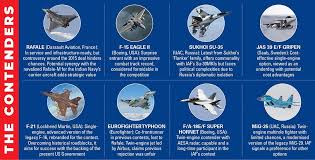
The MRFA acquisition is not a mere procurement exercise; it is a comprehensive effort to revamp India’s aerospace ecosystem. This initiative, which fosters technological self-reliance and bolsters the defence industrial base, is a testament to India’s commitment to its defence capabilities. With contenders such as the Dassault Rafale, Boeing F-15EX, Lockheed Martin F-21, Eurofighter Typhoon, and the Russian Sukhoi Su-35, the competition promises to be intense, offering India a wide array of options that blend operational effectiveness with long-term economic and strategic benefits. The program’s emphasis on indigenous production through partnerships with Indian defence firms is expected to stimulate job creation, enhance research and development capabilities, and position India as a global hub for aerospace manufacturing.
However, the MRFA acquisition is not without its challenges. Budgetary constraints, bureaucratic delays, and the intricate process of technology transfer and industrial collaboration pose significant hurdles. Moreover, the rapidly evolving nature of aerial warfare, characterised by the increasing role of unmanned systems, artificial intelligence, and cyber warfare, necessitates a forward-looking approach to ensure that the selected platform remains relevant over the next several decades. The decision-making process must also consider the IAF’s evolving doctrinal requirements, interoperability with existing assets such as the indigenous Tejas fighter and the recently acquired Rafale jets, and the long-term sustainability of the fleet.
As India navigates the complexities of the MRFA program, it is a testament to the nation’s commitment to safeguarding its airspace. The successful execution of this program will not only enhance India’s operational preparedness but also strengthen its position as a credible regional power capable of countering emerging threats and contributing to collective security frameworks. With strategic foresight and meticulous planning, the MRFA acquisition has the potential to not just bolster but redefine India’s aerial combat capabilities, ensuring that the IAF remains a formidable force in the 21st century.
Historical Perspective. The history of India’s MRFA acquisition effort is marked by ambitious plans and evolving defence strategies to modernise the IAF’s fighter fleet. The origins of the MRFA initiative can be traced back to the Medium Multi-Role Combat Aircraft (MMRCA) tender issued in 2007, which sought to acquire 126 fighter jets to replace the ageing MiG-21 fleet. The competition saw participation from major global defence manufacturers, including Dassault, Boeing, Lockheed Martin, Saab, and Eurofighter. After extensive evaluations and trials, the Dassault Rafale emerged as the preferred choice in 2012; however, contractual disagreements and cost escalations led to the eventual scrapping of the deal in 2015. In its place, the Indian government opted for a government-to-government deal to procure 36 Rafale jets in 2016 to meet urgent operational needs. The failure of the MMRCA tender to materialise in its original form highlighted the complexities involved in large-scale defence procurements, including cost considerations, technology transfer requirements, and offset agreements. In response to these challenges, the IAF redefined its requirements and reinitiated the procurement process under the MRFA program in 2019. The renewed effort sought to leverage lessons learned from the previous tender while emphasising indigenisation and the development of India’s defence manufacturing capabilities under the ‘Make in India’ initiative. Unlike its predecessor, the MRFA acquisition focuses more on domestic production, requiring foreign vendors to collaborate with Indian defence firms to establish local assembly lines and facilitate technology transfers.
Overview of the MRFA Acquisition Program. The MRFA acquisition program is a critical initiative by the Indian Air Force to acquire 114 advanced multi-role fighter jets to enhance its operational capabilities and replace its ageing fleet of legacy aircraft. The program seeks to address the dwindling squadron strength of the IAF, which has declined from the sanctioned 42 squadrons to around 31, posing a strategic challenge in the face of potential two-front threats from China and Pakistan. Under MRFA, the IAF aims to procure state-of-the-art fighters that can undertake various combat roles, including air superiority, ground attack, reconnaissance, and electronic warfare, ensuring dominance in modern warfare scenarios. The MRFA acquisition process is structured under the ‘Make in India’ initiative, emphasising indigenous production and technology transfer to boost the domestic defence industry. The IAF issued a global Request for Information (RFI) in 2019, inviting proposals from major aircraft manufacturers worldwide. The procurement is expected to be executed under the Strategic Partnership (SP) model, which involves collaboration between foreign Original Equipment Manufacturers (OEMs) and Indian defence firms. This collaboration will not only establish production lines within the country but also transfer critical technologies, thereby reducing dependency on imports and promoting self-reliance in the defence sector. One of the critical requirements outlined by the IAF in the MRFA tender is the transfer of technology (ToT), which will allow Indian defence companies to gain technical expertise in aircraft manufacturing, maintenance, and future upgrades. The aircraft must be capable of conducting missions in diverse operational environments, from high-altitude regions like the Himalayas to maritime operations over the Indian Ocean. The MRFA jets must possess advanced radar systems (AESA), electronic warfare capabilities, precision-guided munitions, and compatibility with Indian and Western weapons. Additionally, the IAF would be keen on ensuring interoperability with existing platforms such as the indigenous Tejas Light Combat Aircraft (LCA) and the recently inducted Rafale fighters.
Advantages and Necessity. The integration of Multi-Role Fighter Aircraft (MRFA) into the Indian Air Force (IAF) is expected to bridge several operational gaps while complementing the existing fighter fleet, which includes the Su-30MKI, Rafale, and Tejas.
The IAF’s sanctioned strength is 42 fighter squadrons, but the current strength hovers around 31 squadrons. The MRFA will fill this shortfall, ensuring better preparedness against a two-front threat scenario involving China and Pakistan.
MRFA will bring advanced multirole capabilities, allowing the fleet to handle air superiority, ground attack, and maritime roles seamlessly. This versatility fills gaps in specific mission profiles, especially when assets are stretched thin.
The Multi-Role Fighter Aircraft (MRFA) will be a critical asset for the Indian Air Force (IAF) in multi-domain operations (MDO), enhancing network-centric warfare capabilities. Its advanced systems, flexible mission profiles, and integration capabilities will enable the IAF to operate effectively across air, land, sea, space, and cyber domains.
The MRFA will provide the IAF with cutting-edge technologies and weaponry to dominate contested environments. By combining advanced sensors, stealth, weapon systems, and network-centric capabilities, the MRFA ensures a decisive edge over adversaries.
The MRFA program is more than a defence procurement initiative. It is a catalyst for India’s self-reliance in aerospace and defence. By emphasising technology transfer, local production, and industrial collaboration, the program will strengthen the IAF and lay the foundation for a robust and competitive domestic aerospace sector, aligning seamlessly with India’s vision of Atmanirbhar Bharat (Self-Reliant India).
Timelines. The acquisition process encompasses several critical phases. In April 2019, the IAF issued an RFI to global aerospace manufacturers, marking the formal commencement of the MRFA program. This step invited potential vendors to submit details about their aircraft offerings suitable for India’s defence requirements. The next step in the process is the Acceptance of Necessity (AoN) and Request for Proposal (RFP). Following AoN, the IAF hopes to issue the RFP by mid-2025, detailing specific requirements and inviting formal bids from shortlisted manufacturers. Upon receiving responses to the RFP, the IAF will conduct comprehensive evaluations, including technical assessments and field trials, to ascertain the suitability of each aircraft. This meticulous process is expected to span approximately two years. Post-evaluation, the IAF will negotiate with the selected vendor to finalise terms encompassing pricing, technology transfer, and local production under the ‘Make in India’ initiative. Given the complexity of such defence procurements, this phase is anticipated to take around two years. Following contract finalisation, the establishment of production facilities and commencement of manufacturing are projected. The induction could start as early as 2030, based on fast-tracking. This timeline underscores the intricate and prolonged nature of large-scale defence acquisitions.
Interested Contenders. The MRFA program has attracted interest from multiple global aerospace manufacturers, with contenders including Boeing F/A-18E/F Super Hornet, Boeing F-15EX Eagle II, Dassault Rafale, Eurofighter Typhoon, Lockheed Martin F-21 (a variant of the F-16V tailored for Indian requirements), Mikoyan MiG-35, Sukhoi Su-35 (Russia), and Saab JAS-39 Gripen E/F. Each aircraft offers advanced features such as cutting-edge avionics, stealth capabilities, and superior weapon systems, which are crucial for India’s evolving defence needs.
Challenges. The Multi-Role Fighter Aircraft (MRFA) acquisition program of the Indian Air Force (IAF) faces several significant challenges that could impact its timely execution and successful implementation. One of the foremost challenges is the complexity of the procurement process, which involves multiple stages such as issuing the Request for Proposal (RFP), conducting extensive evaluations and trials, negotiating contracts, and ensuring technology transfer under the ‘Make in India’ initiative. These steps are time-consuming and often subject to bureaucratic delays, which could push the timeline further. Another critical challenge is budgetary constraints, as the estimated cost of the MRFA program exceeds $20 billion. Allocating such a substantial budget amidst competing defence priorities, such as developing Indigenous fighter programs like the Tejas Mk2 and the Advanced Medium Combat Aircraft (AMCA), poses financial challenges. Additionally, fluctuations in the global economy and currency exchange rates could further complicate financial planning. Technology transfer and local production requirements also present challenges, as ensuring meaningful knowledge sharing and developing a robust domestic defence ecosystem will require significant investments in infrastructure and skilled workforce development. Partnering foreign Original Equipment Manufacturers (OEMs) may be reluctant to share critical proprietary technologies, potentially limiting India’s self-reliance goals. Furthermore, geopolitical factors play a crucial role in the procurement. India’s defence acquisitions must often align with its strategic partnerships and foreign policy objectives. Selecting an aircraft from Western or Russian manufacturers could have diplomatic ramifications, affecting relations with other key defence partners. Lastly, operational challenges such as integrating new fighter platforms with existing IAF assets, logistics support, and pilot training add further complexity. Ensuring compatibility with existing weapon systems and communication networks is crucial for maintaining operational efficiency. Overcoming these challenges will be vital to the success of the MRFA program.
Urgency and Review. Despite the government’s support, the MRFA program has encountered delays, partly due to the complexities of the procurement process and the imperative to align with indigenous production goals. In the meantime, the adversaries have inducted fifth-generation aircraft in large numbers and have already flown sixth-generation prototypes. Given emerging threats, investing in 4.5-generation technology may not suffice, advocating for a shift towards fifth-generation fighter capabilities. The indigenous Advanced Medium Combat Aircraft (AMCA) project is underway but faces delays, with production not expected until the mid-2030s. In the interim, options such as accelerating the AMCA’s development or exploring international collaborations for next-generation fighter technology must be pursued with vigour.
Conclusion. The MRFA is a critical investment for the IAF to overcome existing operational gaps and maximise the potential of its current fighter platforms. Enabling seamless integration and interoperability would ensure a balanced, versatile, and future-ready air force capable of effectively addressing current and future threats. The MRFA program’s success lies in balancing operational needs with financial prudence. The MRFA fleet can remain sustainable and aligned with the IAF’s operational tempo by emphasising lifecycle cost management, indigenous production, and efficient logistics. This would ensure a modern, capable, and resilient air force capable of effectively addressing present and future challenges.
Please do Comment.
For regular updates, please register your email here:-
Centre for Air Power Studies (CAPS). Next-Gen Combat Aircraft for the IAF: MRFA and Beyond. CAPS, 2021.
Disclaimer:
Information and data included in the blog are for educational & non-commercial purposes only and have been carefully adapted, excerpted, or edited from reliable and accurate sources. All copyrighted material belongs to respective owners and is provided only for wider dissemination.