
PART 1: POLICY DOCUMENT & ITS ADVANTAGES
NSS Policy Document
- NSS document outlines country’s major security concerns and guideline plans to deal with them.
- It is Vision of the path nation should take in pursuit of attaining national objectives.
- It outlines countries power to overcome internal and external challenges and projection of comprehensive national power.
- It is a plan to employ tools of national power in accordance with national policy to achieve national security objectives I support of national interests.
- It guides Military and Foreign Policy.
- From NSS flows the national military strategy.
- Joint, air, land and maritime strategies are derived from the military strategy.
Advantages of Clearly Defined NSS Policy Document.
- It provides clear direction preventing ad hocism and knee jerk reactions.
- It helps in a synchronised approach by various agencies and ministries. Whole of government approach becomes easier.
- It encourages proactive approach.
- It provides consistency and immunity from regime change.
- It helps in formulation of appropriate response policy by better coordination and analysis of complex inter-relationship between domestic and external dimensions.
- It helps in dealing with internal security challenges arising out of economic, political and social issues. Helps in timely political intervention and implementation of social welfare programmes, rather than using hard power alone.
PART 2: INDIAN CONTEXT
India Does not have a Comprehensive National Security Strategy Document.
NSC was formed in 1999. Still after 22 years the NSS document has not been promulgated.
Previous Attempts
Last two decades the issue has surfaced many times in the media.
- In 1999 it found a mention in the Kargil Review Committee report.
- It was reported that in 2007, HQ IDS submitted a draft NSS document to NSA and PMO.
- It found a mention again in 2012, in the Naresh Chandra Task Force report on security.
- It was reported in 2015 that NSAB document “Building Comprehensive National Power towards Integrated NSS” has been prepared.
- In 2018 it was reported again that NSAB has drafted a NSS document and it has been reviewed by the Defence Planning Committee and forwarded to defence and foreign secretory.
- In 2019 Congress party asked Retired Gen DS Hooda to prepare a draft NSS document.
Possible Reasons for Non promulgation of NSS.
- No Political consensus on national security issues and ways to deal with them.
- No common understanding and agreement about its contents
- Fear of failure and criticism.
- Political games and election gimmicks.
Indian National Security Objectives
For formulation of NSS document the starting point would be listing out the National Security Objectives. These have been suggested by many think tanks, analysts and writers. The national security objectives could include the following:
- Strengthening of capabilities to maintain credible deterrence.
- Protect and safe guard India’s
- National Sovereignty.
- National Constitution and Core Values.
- National Territorial Integrity.
- Air, space, cyber and maritime domains.
- Maintain peaceful Internal Security environment by guarding against threats to national unity and development.
- Human security by protecting citizens and providing them a safe, just, equitable and prosperous climate.
- Achieving Safe neighbourhood and constructive engagement with other nations.
- Maintaining rightful place in the international global affairs.
PART 3: RECOMMENDATIONS
There is an urgent need to formulate and promulgate NSS document. Suggestions are as follows:
- It should be a comprehensive document covering all the security concerns.
- It should contain broad guidelines about ways to deal with them.
- It could be very specific about certain issues while being open ended about others.
- It could have two components – classified and unclassified.
- It should have a short, medium and long term road map.
- It should cover external and internal challenges.
- It should touch regional and global issues of concern.
- It should provide guidelines for multi-agency response.
- It should serve as a national guiding document and not become a political tool.
Suggested Contents
Some of the suggested contents are as follows:
- National security objectives.
- Geopolitical and security environment (regional and global).
- Security concerns related to all the tools of statecraft (DIME).
- Could include following:
- External security.
- Internal security (NE, J&K, Naxalism and Terrorism)
- Economic security
- Energy security
- Food security
- Health security
- CBRN concerns
- Cyber security
- Space security
- Information security and media concerns
- Water concerns
- Environmental concerns
- Disaster management.
- Military capabilities
- Deterrence value
- Multi domain capabilities to deal with future wars.
- Expeditionary capabilities.
- Technology harnessing for civil and military purposes.
- Structural reforms of national security apparatus.
- Border management and demographic issues.
- Issues related to natural resources and minerals.
- Defence industry and Atmanirbharta.
The list is not comprehensive. Many more issues could be added or some of these could be left out for time being. A beginning could be made with a draft document and let it evolve over a period of time.
Titbits
USA in a period of 30 years (1987 – 2017) published 17 NSS documents. The document has been reviewed by every president and multiple times by some of them. The US document size varies from 40 to 70 Pages.
Coming Up
Pakistan’s Proposed National security policy Document.
Bottom Line
There is an urgent need for Formulation and publication of National Security Strategy / Policy document.
Question
In India can we overcome political fears and publish the document?
Suggestions and value additions are most welcome
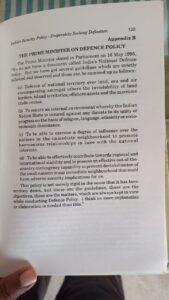
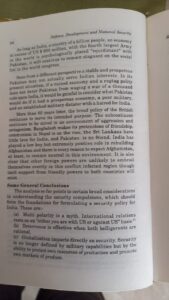
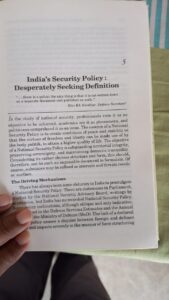
Commodore Sujeet Samaddar (Retd) wrote about this topic in his book in 2003.


For regular updates, please register here
References:
- https://thewire.in/security/india-must-chart-out-a-national-security-strategy-for-a-changing-geopolitical-world
- https://www.cprindia.org/news/need-comprehensive-national-security-strategy
- https://www.thehindu.com/opinion/op-ed/a-blueprint-for-a-national-security-strategy/article27211062.ece
- https://idsa.in/idsacomments/ANationalSecurityStrategyDocumentforIndia_arvindgupta_201011
- http://164.100.47.193/fileupload/current/120816.pdf
- https://www.news18.com/news/opinion/india-needs-national-security-strategy-to-set-redlines-like-ladakh-intrusion-force-govt-to-build-capability-2783219.html