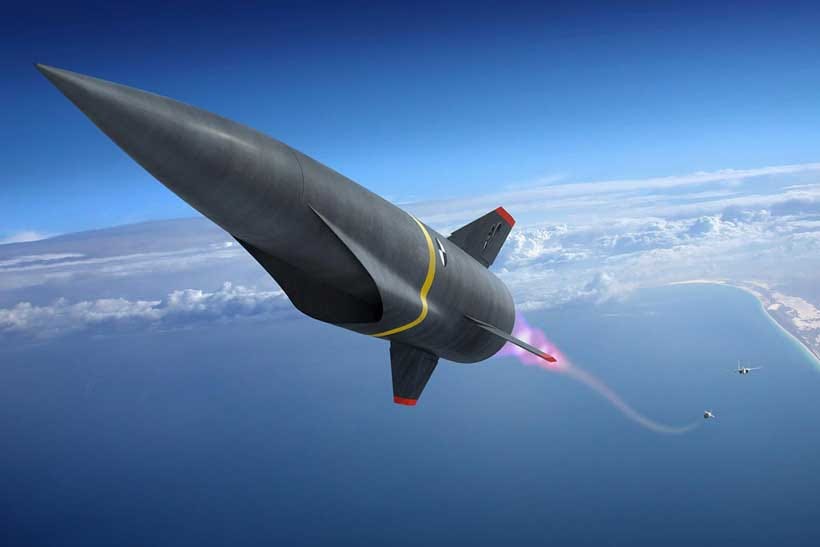
447: SPEED RACE: HYPERSONIC WEAPONS


Pic Courtesy: Internet


Hypersonic projectiles and platforms are emerging as a highly valued weapon system for militaries worldwide, due to their unique combination of attributes. The characteristics of hypersonic missiles include sustained high speed (five times the speed of sound), increased manoeuvrability, and a High altitude trajectory (in the upper atmosphere – higher than cruise missiles but lower than the apogee of ballistic missiles). These attributes make them difficult for the existing missile defence systems to intercept.

Hypersonic Weapons

The emerging class of missile technologies include manoeuvrable vehicles that carry warheads through the atmosphere at more than five times the speed of sound. Hypersonic glide vehicles (HGVs), like all weapons delivered by medium and longer-range rocket boosters, can travel at speeds of at least Mach 5, or about 1 mile per second. The key difference between missiles armed with HGVs and missiles armed with ballistic re-entry vehicles (i.e., those that travel on a ballistic trajectory throughout their flight) is not their speed, but their ability to manoeuvre and change course after they are released from their rocket boosters. Hypersonic weapons can be classified into two distinct categories:

  • Hypersonic cruise missiles operate like typical subsonic and supersonic cruise missiles (using air-breathing engines to power themselves through the atmosphere) but fly at higher speeds. They cannot match the speeds or ranges achievable by boost-glide vehicles.
  • Hypersonic boost-glide Vehicles. They are accelerated to extremely high velocities on rocket boosters like those used to launch ballistic missiles. They then proceed to glide, unpowered, through the upper atmosphere until reaching their target.

The flight of a hypersonic boost-glide vehicle is divided into six stages: boost, ballistic, re-entry, pull-up, glide, and terminal phases. In the boost phase, a rocket booster accelerates the missile carrying the hypersonic vehicle until the booster exhausts its fuel. At this point, it detaches from the glide vehicle and falls back to Earth. In the ballistic phase, the vehicle travels above the atmosphere on a ballistic trajectory under only the influence of gravity. Both of these phases are comparable to a ballistic missile launch. Hypersonic trajectories diverge from those of ballistic missiles in the re-entry and pull-up phases. Here, the vehicle pierces the upper atmosphere and then slows its descent to enter a stable glide trajectory. In the glide phase, the vehicle generates aerodynamic lift to sustain near-level flight. Finally, in the terminal phase, the glider dives toward its target.

These weapons outperform existing missiles in terms of delivery time and evasion of early warning systems. Their flight characteristics are distinct from those of typical ballistic missiles, which spend most of their flight above the atmosphere and are capable of only limited manoeuvrability, and those of subsonic or supersonic cruise missiles, which travel through the atmosphere but fly more slowly.

Effect on Warfare

Hypersonic missiles are commonly depicted as a “game changer and the unprecedented capabilities of these weapons portend a revolution in missile warfare. It is considered that the speed, accuracy, and manoeuvrability of hypersonic boost-glide weapons will fundamentally change the character of warfare. Developments in hypersonic propulsion will revolutionise warfare by providing the ability to strike targets more quickly. With unmatched speed, these weapons will likely hit over-the-horizon targets in a fraction of the time. This claimed speed advantage is ostensibly accompanied by near-immunity to detection, rendering hypersonic weapons “nearly invisible” to existing early warning systems. Together, these capabilities will significantly compress decision and response times.

 War Fighting Utilisation Philosophy. Hypersonic missiles launched from planes or ships can reach targets further away than equivalent ground-based systems launched from mainland bases. More importantly, they can approach a target from a wider range of locations than if launched from a land-based system, compounding their ability to evade existing BMD systems. These weapons are most likely to be employed in the opening phases. Because of their speed and unique trajectory capabilities, hypersonic missiles can, as first-strike weapons, facilitate follow-on attacks by non-hypersonic strike systems by disabling an adversary’s air and missile defence systems. In future, they could be employed as a network of hypersonic UCAV swarms.

Hypersonic Threat Mitigation. A comprehensive missile defence strategy must deliver an integrated and practical capability to counter ballistic, cruise, and hypersonic missile threats. Some passive defensive measures against traditional missiles are also effective against hypersonic weapons; these include deception, dispersal, hardening, concealment, etc. The speed of hypersonic weapons leaves little time for computing a fire control solution, communicating with command authorities, and completing an engagement for active interception of these weapons. In the future, more active responses could encompass disrupting hypersonic data links and sensors, space-based sensors that can track missiles in the upper atmosphere, and novel technologies for interception during various phases of the weapon’s flight.

Hypersonic Race

The United States, China, and Russia are racing to develop these weapons, and each plans to field a wide array of hypersonic systems in the coming decades. The ongoing U.S., Russian, and Chinese development of HGVs and boost-glide weapons is an arms race as each nation seems to develop them and expand them to include short, medium, and long-range systems. Individually, each country claims to be developing them to meet its security needs and national objectives. These technologies are changing the nature of warfare, and they have the potential to destabilise the global security environment.

USA. The U.S. has pursued both hypersonic weapons technologies since the early 2000s. It has sought to develop longer-range systems that could reach deep into an adversary’s territory to attack defended, hardened, and time-urgent targets. The Department of Defence (DOD) is developing hypersonic weapons under the Navy’s Conventional Prompt Strike program and through several Air Force, Army, and DARPA programs. The Pentagon’s FY2022 budget request for hypersonic-related research is $3.8 billion, approximately 3 % of the total defence research and development budget.

Russia. Russia is reportedly the first nation to deploy a hypersonic missile. It characterises these weapons as a centrepiece of its security strategy and has extensively tested at least three distinct hypersonic systems. Russia’s HGV, known as Avangard, is equipped with a nuclear warhead and deployed on SS-19 long-range land-based ballistic missiles. Avangards reportedly feature onboard countermeasures and can manoeuvre in flight to evade ballistic missile defences. Russia conducted successful Avangard tests in 2016 and 2018. On December 27, 2019, the Russian military announced that it had activated two SS-19 missiles equipped with Avangard. Beginning of March this year, Russia launched its most significant aerial attack in its ongoing war with Ukraine. The attack comprised a variety of weapons, including the air-launched Kinzhal (literally ‘dagger’) hypersonic missiles with a speed of Mach 10 and a payload of 480kg. The Kinzhal is a modified version of the Russian Army’s Iskander short-range ballistic Missile (SRBM) truck-mounted weapons system. The Kinzhal version is launched at high altitude from modified MiG-31 aircraft to get maximum range.  

China. As in the space race and other high-technology fields, China has made a significant effort to match Russian and U.S. capabilities. In the past, PRC research into the military potential of hypersonic technologies used to lag far behind that of Russia and the United States. However, China has invested heavily in new hypersonic research, development, test, and evaluation programs and facilities during the past decade. Now, her research may have surpassed that of the U.S. in some regards. China is also investing heavily in hypersonic development infrastructure and weapon systems, reportedly outpacing the United States in testing these technologies. China has developed an HGV known as the DF-ZF (previously referred to as the WU-14) and has tested it at least nine times since 2014. It is estimated that the HGV may be capable of performing extreme manoeuvres during flight, allowing it to evade ballistic missile defences. Unclassified reports indicate this glider would likely be equipped with conventional warheads, and when mated with the DF-17 booster, could travel to ranges of 1,800-2,500 kilometres. China is also developing the DF-41 long-range intercontinental ballistic missile, which could carry a nuclear hypersonic glide vehicle.

India. Realising the combat value of hypersonic weapons, India has been endeavouring to develop them independently. R&D on hypersonic weapons in India goes back to 2007. India’s primary hypersonic pursuit is premised on the remarkably successful medium-range, supersonic BrahMos missile. India’s Defence Research and Development Organisation (DRDO) successfully tested the Hypersonic Technology Demonstrator Vehicle (HSTDV) in September 2020. The HSTDV is an unmanned scramjet demonstration aircraft designed to cruise at hypersonic speeds. The successful test marked a significant advancement in India’s development of hypersonic capabilities. In addition to the HSTDV program, India is continuing its research and development efforts in various aspects of hypersonic technology, including propulsion systems, materials science, and guidance systems

Controls and Measures. These developments may pose new risks and exacerbate existing risks to regional stability and international peace and security. The advancements of and growing interest in hypersonic missile technology, primarily by China, Russia and the United States, but also increasingly by other states, threaten to spur new arms race dynamics. The proliferation of more established missile technology, particularly in Asia and the Middle East, continues quickly. These trends demand a serious re-evaluation of the existing international missile non-proliferation instruments. Without new missile arms control instruments on the horizon, it is important to explore to what extent existing ones are equipped to address these risks and challenges. The Missile Technology Control Regime (MTCR) and the Hague Code of Conduct against Ballistic Missile Proliferation (HCOC) have established necessary export control standards, transparency, and confidence-building measures. While both instruments face serious challenges and limitations, they have also taken strides towards more engagement with non-members and other relevant regimes, expansion of their coverage, transparency and sharing of good practices. Suitably reviewed and modified control regimes, instruments, and agreements must be implemented.

Technology is a good gadget, but a destructive weapon. Hypersonic weapons represent a significant advancement in military technology, offering unparalleled speed and manoeuvrability compared to traditional ballistic weapons. Several countries are actively developing and testing hypersonic weapons, including the United States, Russia, China, and others. The proliferation of hypersonic weapons could have significant strategic implications for international security and stability. Their speed and manoeuvrability could reduce decision-making time in crises and increase the risk of miscalculation. The development of hypersonic weapons has also raised concerns about a new arms race, as countries seek to maintain or gain military superiority in this area. The rapid pace of technological development and competition could exacerbate tensions between major powers. Appropriate checks and balances need to be put in place.

    • Suggestions and value additions are most welcome


For regular updates, please register here:-

Subscribe


References and credits

To all the online sites and channels.

 References:

1.https://jamestown.org/program/chinas-development-of-hypersonic-missiles-and-thought-on-hypersonic-defense/

2.https://partyardmilitary.com/hypersonic-missiles-what-are-they-and-can-they-be-stopped/

3.https://www.drishtiias.com/daily-updates/daily-news-analysis/hypersonic-technology-2

4.https://spectrum.ieee.org/russia-china-the-us-who-will-win-the-hypersonic-arms-race

5.https://55nda.com/blogs/anil-khosla/2021/11/10/hypersonic-long-range-weapons/

6.https://media.defense.gov/2020/Sep/01/2002488689/-1/-1/1/2020-DOD-CHINA-MILITARY-POWER-REPORT-FINAL.PDF

7 https://gjia.georgetown.edu/2021/01/27/chinas-hypersonic-weapons/

  1. https://link.springer.com/article/10.1007/s11432-019-2765-7

09.https://www.uscc.gov/sites/default/files/Research/China%20and%20INF_0.pdf

10.https://www.atlanticcouncil.org/wp-content/uploads/2020/08/Hypersonics-Weapons-Primer-Report.pdf

11.https://www.defense.gov/Portals/1/Interactive/2018/11-2019-Missile-Defense-Review/The%202019%20MDR_Executive%20Summary.pdf

12.https://www.indiandefencereview.com/news/hypersonic-weapon-systems-for-india/#:~:text=India’s%20primary%20hypersonic%20pursuit%20is,land%20or%20ships%20and%20submarines.

Disclaimer:

Information and data included in the blog are for educational & non-commercial purposes only and have been carefully adapted, excerpted, or edited from sources deemed reliable and accurate. All copyrighted material belongs to respective owners and is provided only for purposes of wider dissemination.

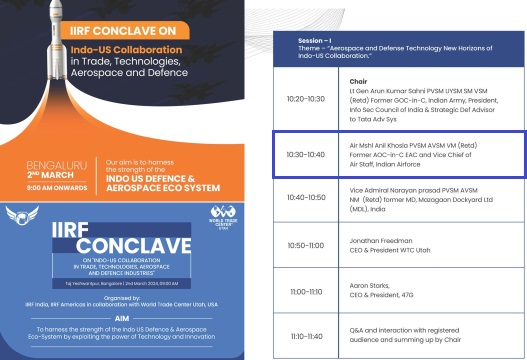
 

444: Ritu’s Column:  China’s Newest FC-31 Gyrfalcon Stealth Jet

Pic Courtesy: Internet


Ritu Sharma is a journalist, with a Master’s Degree in Conflict Studies and Management of Peace from the University of Erfurt, Germany. Her areas of interest include Asia-Pacific, the South China Sea, and Aviation history. She has been writing on subjects related to defence, foreign affairs, and nuclear technology for the last 15 years. She has written for PTI, IANS and The New Indian Express. Presently she is writing for the EurAsian Times.  


Her informative article on the subject was published on 13 Jan 2024 on “The EurAsian Times”


(Views of the author are her own)


‘Stolen Tech’ From F-35 & F-22 Raptor, How Powerful IsChina’s Newest FC-31 Gyrfalcon Stealth Jet?


The news about Pakistan showing interest in the Chinese FC-31 Gyrfalcon (formerly known as the J-31) has generated quite a buzz in South Asia, with military watchers talking about it altering the balance of power in the Indian subcontinent. But experts feel that, at best, it is a tempest in a teacup.


The grapevine about Pakistan’s interest in purchasing FC-31 has been going on for some time. However, the Islamic Republic’s lack of economic resources and choices to replace its ageing fleet of F-16s and Mirages make the Chinese fighter jet its only option. Its JF-17 fleet is also facing technical issues. The FC-31 is yet to enter the PLA-Air Force but the Pakistan Air Force has made its interest official.


Air Marshal Anil Khosla (retired), former Vice Chief of the Indian Air Force, calls it “a marriage of convenience”. The sale to Pakistan will help China to claim the exportability of its aircraft. The aircraft with PAF will provide the Chinese manufacturer with a free trial ground. At the same time, it will help Beijing in exerting more control over Islamabad by making them more dependent,” Khosla told the EurAsian Times.


The EurAsian Times decided to compare Indian Rafale – a 4.5 generation combat-proven fighter jet from the French aerospace maker Dassault Aviation; and FC-31 – the underdevelopment 5th generation fighter jet developed by the Shenyang Aircraft Corporation. On the face of it, both aircraft are twin-engine, single-cockpit, multi-role fighter jets.


Design & Capabilities: Rafale Vs J-31


The design philosophy behind Dassault’s Rafale (meaning ‘Gust of Wind’) has been to pack more punch in the fighter jet. The Rafale is one of the most advanced fighter jets of the present times and is designed to carry out omni-role missions. It can perform seven types of missions – Air-defence/air superiority/air policing, Reconnaissance, nuclear deterrence, Air-to-ground precision strike, Battlefield air strikes, anti-ship attacks, and buddy-buddy refuelling.


The French fighter jet features a delta wing with close-coupled canards that provide stability throughout the whole flight envelope. It improves Rafale’s combat performance, even at a high angle of attack.


The airframe of Rafale extensively uses composite materials; they account for 70 per cent of the wetted area. This increases the max take-off weight to empty weight ratio compared with traditional airframes built of aluminum and titanium by 40 percent.


On the other hand, the limited information about the FC-31 indicates that it was designed to provide close support and air-to-ground bombing. Its design also suggests that it might have been designed for carrier use.


Many observers have noted the stark resemblance that the FC-31 has with the American F-35. The flat tail and twin engines of FC-31 seem to be derived from the F-22, and the front end resembles the F-35. This doesn’t come as a surprise as the 2014 “U.S.-China Economic and Security Review Commission” Congressional report cited a Defence Science Board finding that Chinese cyber-attacks have siphoned off crucial specs and technical details of a range of US weapons systems—including the F-35.


The Chinese composite material industry had a late start. Russia helped for some time, but sanctions have slowed the import of Radar Absorbent Material (RAM).


The J-31 uses 3D laser-printed components in large amounts to save weight. The J-31 features advanced stealth technology, including a carefully designed shape and radar-absorbent materials, to reduce its radar cross-section and enhance survivability on the battlefield.


Rafale Vs J-31: Engines


When it comes to engines, Rafale is powered by two Snecma M882 (Thrust to Weight Ratio: 5.68:1 dry and8.52:1 with afterburner) new generation turbofan engines generating 2×75 kN of thrust and can achieve a maximum speed of Mach 1.8.


Besides ensuring a high serviceability rate, Dassault Aviation made some India-specific modifications to the 4.5-generation fighter jets. The modifications included an engine that can start up to 12000 feet. The specification caters to the threat India faces on its eastern border.


Within a few months of its induction, the IAF had Rafale fighter jets armed with MICA air-to-air missiles on their wingtips flying in Ladakh, its northernmost sector. Post heightened tension along the Indo-China border, India has been augmenting its capabilities to operate in the region.


In contrast, the FC-31 prototype was powered by two Russian engines, RD-93, with an afterburning thrust of2×81 kN (Thrust to weight ratio: 4.82 dry, 7.9 afterburning). The engine’s thrust-to-weight ratio indicates that the FC-31s engine is heavier and provides lesser thrust as compared to Rafale’s lighter engines.


The engines could be the chink in FC-31’s armour. After some time, Shenyang Aircraft Corporation replaced the RD-93 turbofans with new stealthy engines WS-13 from Guizhou Aircraft Industry Corporation. Beijing has offered the same engine for the technically troubled JF-17 exported to the Pakistan Air Force (PAF), but Pakistan has refused.


“The Chinese are trying hard to market their WS-13 engine. I am not sure if the engine is any good. But, PAF had refused to accept it for their JF-17s. Now, with J-31 as a sweetener, the WS-13 is going to find its way into PAF. Eventually, it might also find its way into PAF JF-17s,” a source told the EurAsian Times.


There have been reports about the aircraft finally being fitted by the more modern WS-19 engines currently under development.


Rafale Vs J-31: Armament


With its 10-tonne empty weight, the Rafale is fitted with 14 hard points (13 on the Rafale M). Five of them are capable of carrying heavy ordnance or drop tanks. The total external load capacity is more than nine tonnes (20,000 lbs.).


The Rafale has been cleared to operate a wide range of weapons, including air-to-air missiles, air-to-ground missiles, bombs, and guns. The Indian Rafales can deploy the Meteor very long-range air-to-air missile, the MICA air-to-air “Beyond Visual Range” (BVR) interception, the HAMMER rocket boosted air-to-ground precision-guided weapon, the SCALP long-range stand-off missile, laser-guided bombs, and classic non-guided bombs. The fighter jet has a 30 mm internal cannon that can fire 2500 rounds/min. Meteor gives Indian Rafales the capability to shoot down enemy aircraft over 100 kilometres without having to cross the border. Rafales are going to be part of India’s nuclear triad when Brahmos integrates with the platform.


In comparison, the Shenyang FC-31 stealth fighter can be fitted with one internal cannon, two internal weapons bays in the fuselage, and three payload hard points on each of the two wings. Each internal weapons bay can accommodate up to two missiles. The FC-31 could carry larger missiles like the YJ-12 anti-ship missile under its wings, but like with the F-35, at the cost of its stealth.


FC-31Avionics Onboard


The Rafale is the first European combat aircraft to use an active electronic scanning radar, giving it greater situational awareness in detecting and tracking multiple targets.


Rafale’s “multi-sensor data fusion” has earned accolades for reducing pilot workload and increasing situational awareness within and outside the boundaries of the combat sphere. Rafale allows the pilot to act as a true“tactical decision maker” rather than being only a sensor operator.


The Indian Rafales are equipped with the Thales Areos recon pod, which can be used from a high-altitude stand-off distance and even at extremely low levels. But it is also integrated with Israeli Litening Pod to maintain commonality with other fighter jets in IAF, such as Mirage-2000, Su-30 MKI, MiG-29 UPG, and SPECAT Jaguar.


The single-seated cockpit of the Shenyang FC-31 is confined by a two-piece transparent canopy to enhance the pilot’s visibility during flight. It is also designed to use the KLJ-7A Active Electronically Scanned Array (AESA)radar by Nanjing Research Institute of Electronics Technology (NRIET) and Distributed Aperture System (DAS)optical early warning system.


Stealth


The FC-31 is essentially designed with increased stealth features. The Indian Rafale F3R boasts Spectra and a low-band jammer that can jam the frequency of any radar and become invisible. “It is a dichotomy. The Rafale can jam the radars to become invisible, but if the moment a stealth aircraft uses its jammer, he will be caught on the adversary’s sensors,” another military aviation specialist opined.


The French aircraft maker also catered to the Indian demand for a different Jammer and enhanced radar capabilities like Non-Cooperative Target Recognition (NCTR) mode, Doppler Beam Sharpening, and synthetic aperture Radar modes in Radar. It also has Ground Moving Target Track modes in the Radar.


The Indian Rafale also has the Infrared Search and Track (IRST) sensor that differentiates it from its French counterpart. The IRST gives an edge to Rafale to detect and track airborne targets and the sensor can be used in conjunction with the radar or independently. This is a passive system and doesn’t emit any radiation of its own. It gives Rafale the capability to detect other targets while remaining undetected.


Combat Development


The first Rafale F1 was delivered to the French Navy exactly a decade later, on May 18, 2001. Since then, France has deployed this combat jet in Afghanistan, Libya, Iraq, Syria, and Mali, where it flew its longest mission in 2013, spanning nine hours and 35 minutes. From Afghanistan, Libya, Mali, Iraq, and Syria, Rafale jets “outclassed” its enemies everywhere and have never-ever been shot down.


In 2011, French Air and Space Force and French Navy Rafale fighters were successfully engaged in coalition operations over Libya. They were the first fighters to operate over Benghazi and Tripoli. During the Libyan conflict, hundreds of targets – tanks, armoured vehicles, artillery emplacements, storage dumps, command centres, and air defence systems (fixed and mobile SAM launchers) – were hit with controlled accuracy by Rafale aircrews.


This column is still blank for FC-31 and probably the sale to PAF will help the Chinese aerospace makers to script a few achievements under this head.


Conclusion

In the words of Air Marshal Khosla, “Should India take cognizance of the development in the neighbourhood –Yes. Should India be worried – No. Instead, India should address the issue.” The retired Vice-Chief of the IAF doesn’t advise diversifying the already diverse inventory of the force to meet the challenge; he suggests accelerating indigenous projects like Tejas Mk2 and Advanced Multi-role Combat Aircraft (AMCA). Also, the IAF could go in for two more squadrons of already tested, selected, and inducted Rafale aircraft.


Suggestions and value additions are most welcome


For regular updates, please register here:-

Subscribe


References and credits

To all the online sites and channels.


Disclaimer:

Information and data included in the blog are for educational & non-commercial purposes only and have been carefully adapted, excerpted, or edited from sources deemed reliable and accurate. All copyrighted material belongs to respective owners and is provided only for purposes of wider dissemination.
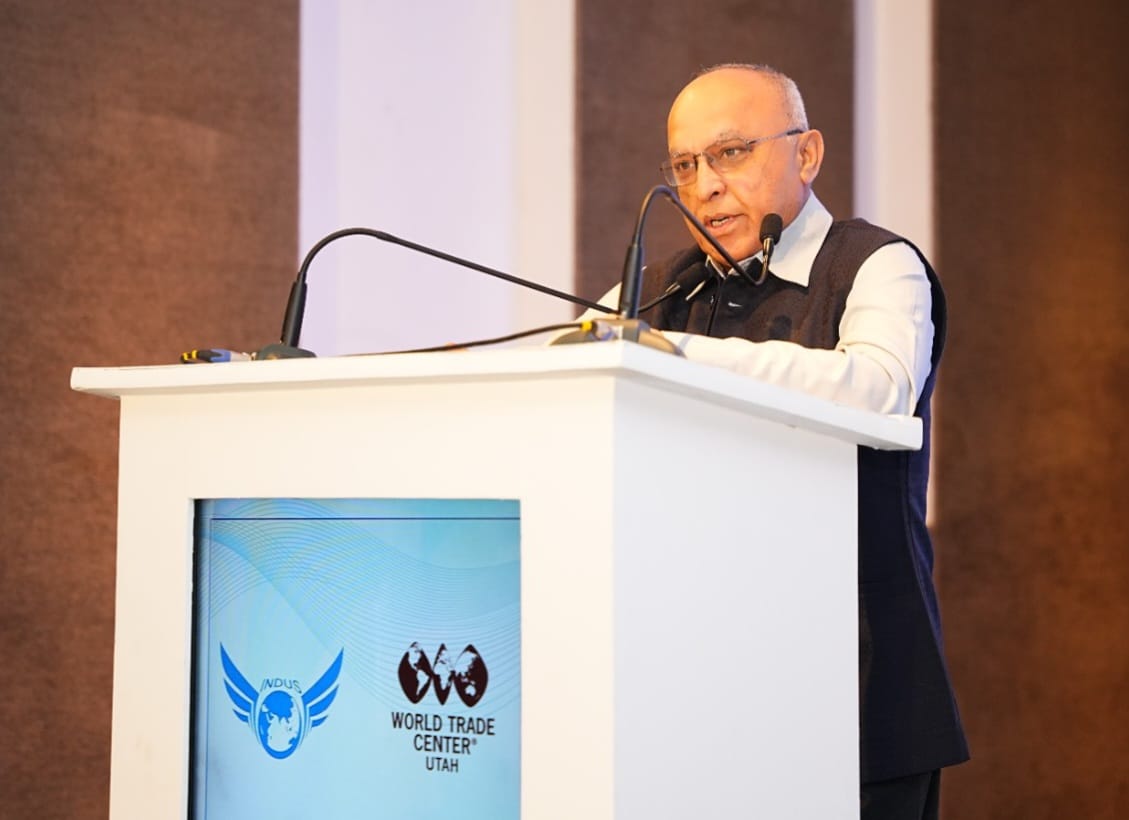


443: INDO-RUSSIA RELATIONS: FRESH IMPETUS

Pic Courtesy: Internet


Geography and Geopolitics brought India and Russia (USSR) together and it developed into a time-tested close partnership.


Five phases of the relationship:-

    • Engagement phase – pre-independence.
    • Warm-up phase – Post Independence.
    • Close phase – Cold War period.
    • Preoccupation phase – Post USSR breakup.
    • Rejuvenation phase – Current (Fresh Impetus required).


Pillars of the relationship:-

    • Historical Trust.
    • Defence cooperation.
    • Economy and trade engagement.
    • Cultural exchanges (Soft power).
    • Mutual Geopolitical interests.


Historical Timelines.

    • Post-Independence – Cordial relations.
    • 1960 – Friendship declared, Military cooperation commenced.
    • 1962 – Neutral stance in India-China war (China Brother – India Close Friend).
    • 1966 – Facilitated Tashkent Treaty.
    • 1971 – Treaty of Friendship and Cooperation. (USA sided Pakistan along with China.
    • 1990 Testing times for both.
    • 2000 – Strategic partnership finalised.
    • 2010 – Upgraded to special and privileged partnership (Political, security, trade, economy, defence, science and technology and cultural cooperation).


Defence Cooperation

One of the main pillars of Indo-Russia cooperation.

1960’s – India needed defence equipment desperately.

The USA and West were closer to Pakistan and reliable supply was not assured.

USSR found it attractive strategically and geopolitically.

It was a mutually beneficial development. India needed military modernisation and the USSR saw a promising and strategic partner to counterbalance the USA, Pakistan and China.

India became the principal defence market of the USSR.

The military equipment was made available at a cheaper cost, with deferred payments, low-interest rates and easy payment options like payment in kind of finished goods and products.

Technology was also shared with the transfer of technology and allowing licensed production (Mig-21 licensed production).

At one time almost 80 % of the defence equipment in India was soviet origin. (some quoted figures indicate 60 % of Army equipment, 70 % of Navy equipment and 80% of IAF equipment).

Over the years, some of the Russian equipment includes T-90 tanks, Aircraft Carrier, Mig -21, SU-7, Mig-23, Mig 25, Mig 27, Mig 29, and SU-30 aircraft, MI-8, Mi17, Kamov and attack helicopters, a variety of AD weapons including recent S-400 system, An-32, IL-76 and IL-78, and maritime recce aircraft and several air to ground and air to air weapons.

The joint development of the BrahMos missile is a success story.

Almost for four decades (1960 to 2000) India was reliant on Russian for military needs.

Post-breakup of the USSR, Issues of Cost, Quality, Delays and Post-sale support cropped up.

For Russia, even the China market declined due to Chinese indigenisation.

However, India continued to be a reliable market. At one time almost 800 odd Russian defence production facilities were kept alive due to Indian contracts.

Defence cooperation was high with regular engagements, exchanges, exercises, sharing of knowledge and information and training.


Recent Times and Indian Compulsions.

In recent times, the threat to India has increased due to the rapid modernisation of the Chinese military, its belligerent attitude, aggressive behaviour and collusivity with Pakistan.

Having learnt the hard way, India is in desperate need to modernise and strengthen its security system and defence forces.  It needs the latest technology induction.


The Indian approach to deal with the situation includes:-

    • Promote self-reliance (Atmanirbharta) with indigenous R&D and manufacturing.
    • Maintaining a minimum level of deterrence by procurement from outside.
    • Diversification of sources (USA, France, Israel and Europe).
    • Competitive bidding to get the best equipment and deal (maximum bang for the buck).
    • Offer India as an alternative destination for “Make for the World”.


Indian Ideology and Engagements.

India continues to be a peace-loving country with no territorial ambitions or expansionist desire. It believes in Mutual growth and prosperity (One world – One family – One future)

Its concern is to safeguard its territory and political sovereignty.

Its international engagements are adapting to the changes taking place in the world. The policy of Non-alignment is transforming into a Policy of equidistance.

The engagements are Interest-based without joining any camp or military alliance (India to date has not joined any military alliance).


Indo-Russian Relations: Challenges and Opportunities.

Both Russia and India are in a similar situation with threats to their respective interests. From NATO and USA for Russia and China and Pakistan for India.

The prevailing circumstances and the geo-political world situation present both challenges and opportunities for cooperation.

The challenge is not to get drawn into the China-USA rivalry, resulting in divergent views and interests.

Opportunities include scope for closer cooperation, mutual growth and progress, collective security and sharing of resources, technology, knowledge, and information.


Mutually Common Concerns

    • Non-traditional security threats
    • Environmental degradation
    • Organised crime network.
    • Drug Trafficking.
    • Human Trafficking and illegal migration.
    • Religious/fundamental insurgencies.
    • Cyber security.
    • Nuclear terrorism and threats.
    • Biological threats and pandemics.


Indo-Russian Cooperation: New Approach.

New impetus is required to revitalise the time-tested Indo-Russian friendship.

Avoid the trap of a “with us or against us” mindset.

Understand each other’s compulsions and reasons.

Not let the business dealings (Russia with China, and Pakistan and India with the USA) come in the way of mutual friendship.

Engage each other with the aim of mutual and joint development, modernisation, transformation and growth.

Strengthen the old pillars and explore and build on new pillars. Unanimity and agreement already exist concerning the following:-

    • Nuclear Proliferation.
    • Review of existing multilateral organisations.
    • Trans-national crimes.
    • Environmental degradation issues.
    • Non-traditional security threats.


Indo-Russia Cooperation Way Ahead

Some of the suggested areas of cooperation are:-


Defence.

    • Develop into a symbiotic partnership.
    • Not see India as a defence market but as a development partner with joint R7D, development, design and production.
    • Share defence technology and know-how.
    • Support Indian endeavour of “Make in India” and “Make for the world”.
    • Increase Interoperability with regular multi-service exercises.
    • Assist each other in the mitigation of disaster situations arising out of enemy grey zone activities.
    • Assist each other in information warfare (Info dominance and narrative formulation).
    • Chart out an escalation ladder matrix of defence cooperation for political signalling.
    • Joint ventures for unmanned platforms. Drones. Swarms and anti-drone systems.
    • Address the concerns related to cost, Quality, Delay, and post-sale support.


Energy (Oil, Gas and Nuclear).

  • Besides the import and export of oil and gas, maybe explore the possibility of joint exploration.
  • Go beyond nuclear reactor building projects.
  • Maybe form a consortium for making for the rest of the world.


Diplomatic/Political Support

    • Continue mutual support in the common multilateral forum (UN, BRICS, RIC, G-20, SCO etc).
    • Respect each other’s sensitivities.
    • India has never joined and will not join any military alliance.
    • Quad is not a military alliance, nor is it an Asian NATO (it is not anti-Russia).


Science and Technology.

    • Joint R&D and manufacturing.
    • Sharing of knowledge.
    • Cyber security cooperation.
    • Joint space programs and projects.
    • Ares of Chips/semiconductors, high-pressure tools, medical equipment, telecom industry, maritime equipment and electronics.


Trade and economy.

    • Further, increase bilateral trade (already touched 45bn US $ to reach 50 bn US $ soon).
    • Make trade and business transactions attractive with “ease of doing business” policies.
    • Regain and maintain trade balance.
    • Besides Govt to Govt transactions, encourage Private sector (G2G and P2P) engagements.
    • Improve connectivity for cargo and personnel (Multi-mode travel corridors)
    • Review the Rupee-Rouble exchange system for trade to make it mutually beneficial. It could become a model for the rest of the world to emulate.
    • India-Russia inter-government commission with two wings (to look after the trade, science & tech, and economy issues and a second one for military and military technology issues) is the right approach. Energise the commission.
    • Two plus two dialogue is also a step in the right direction. Follow the top-down approach.
    • A joint entrepreneur’s council is a good idea.
    • Enhancing each other’s MRO (Maintenance, Repair and Overhaul) capabilities (for both civil and military aviation).


Cultural exchanges.

    • Increase the number of exchanges and encourage tourism.
    • Review the VISA rules to make them travel-friendly.
    • Increase the travel facilities (Flights and sea travel).
    • Encourage language studies.
    • India’s skilled manpower can be effectively used to offset Russia’s demographic issues.


Infrastructure development. Besides making for each other, can explore the possibility of jointly making for the world (Africa could be one possible market).


Environmental concerns. Jointly develop and promote a globally acceptable carbon emission policy and monitoring system.


Other areas of possible cooperation are:-

    • Diamond industry.
    • Food security – Agro, meat and dairy products.
    • IT and chip development and manufacture.
    • Pharmaceutical industry.
    • Biotech and pandemic mitigation.
    • Natural resources.


Coming up:- A detailed write-up on the subject.


Question

Should India join the Western bloc or continue with its existing policy?


Opinion Poll

Russia identifies itself with:-

a) Europe

b) Asia

c) Both

d) Eurasia.


Suggestions and value additions are most welcome

For regular updates, please register here

Subscribe

References and credits

To all the online sites and channels.

Disclaimer:

Information and data included in the blog are for educational & non-commercial purposes only and have been carefully adapted, excerpted, or edited from sources deemed reliable and accurate. All copyrighted material belongs to respective owners and is provided only for purposes of wider dissemination.
English हिंदी