
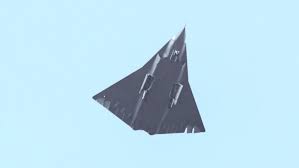
Pic Courtesy Net
My Article published in the SP Aviation Defence Magazine
In November 2024, at the Zhuhai Air show, China unveiled a full-scale model of its sixth-generation fighter, named the “White Emperor” or “Baidi.” This aircraft is part of Project Nantianmen’s research initiative exploring future aviation technologies. However, on 26 Dec 24, pictures and videos of the flight of two advanced prototypes were shared on social media. These are considered to be its sixth-generation fighter jets but seem to have little similarity with the “White Emperor” model shown at Zhuhai Airshow 2024. This milestone underscores China’s advancing aerospace capabilities and ambition to compete with global superpowers in the future of air combat.
China has made significant strides in developing cutting-edge military technologies in the ongoing arms race among world powers. China’s Sixth-Generation Aircraft program has generated considerable buzz in defence and aviation circles. While official reports and state-controlled media often paint a picture of cutting-edge technology and a new era of Chinese air dominance, the hype surrounding these aircraft usually exceeds the tangible realities. At the heart of China’s push for a sixth-generation fighter is surpassing existing U.S. and Russian technologies by integrating artificial intelligence, enhanced stealth, hypersonic speeds, and advanced weaponry. However, the actual capabilities of these aircraft, still shrouded in secrecy, remain uncertain. Understanding the gap between expectation and reality is crucial for evaluating the true impact of China’s ambitions on global aviation and defence strategies. The successful development and deployment of these sixth-generation fighters could potentially shift the balance of power in the global defence landscape, influencing the strategy and capabilities of other major powers.
The Prototypes
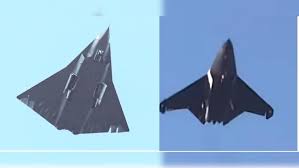
Two advanced jet prototypes were observed flying over China’s airspace, marking a significant milestone in China’s military aviation development.
The first (the Cheng-6 on Chinese social media), developed by Chengdu Aircraft Corporation, features a tailless, diamond-shaped modified delta wing design, enhancing its stealth capabilities and aerodynamic efficiency. The airframe is optimised for internal payload storage and has an underside reminiscent of the YF-23. Notably, this aircraft is believed to utilise a unique three-engine configuration, with air intakes positioned atop the fuselage. Underpowered Chinese engines may have driven the apparent three-engine design, or the third engine could be for high-speed space operations. The aircraft will likely have a high fuel/weapons load and a significant range. Its design suggests a focus on long-range missions and advanced stealth features. The design configuration indicates its potential use in roles requiring long-range missions, high-speed flight, and significant payloads, such as heavy tactical fighter or regional bomber missions.
The second prototype (Shen-6), attributed to Shenyang Aircraft Corporation, also exhibits a tailless design with a twin-engine configuration but a more conventional layout than its Chengdu counterpart. It has a few features similar to those of the U.S. F-22 and F-35 aircraft. This aircraft emphasises stealth characteristics, aiming to minimise radar detection. It could be a low-observable F-35-style multi-role fighter featuring higher manoeuvrability without sacrificing range. It may be a mass-manufacturable second-tier fighter to complement the J-20. The Shen-6’s design characteristics indicate it could be suited for multi-role operations, including carrier-based missions.
The simultaneous development of these two prototypes indicates China’s commitment to advancing its aerial combat capabilities and achieving a diversified fleet of next-generation fighter jets. Although this could be a case of two separate companies bidding on the same project, the apparent Maximum Take-off Weight (MTOW) difference may imply different mission roles. The two prototypes seem complementary rather than competitive, with the Chengdu prototype’s design more consistent with characteristics attributed to the JH-XX tactical fighter-bomber concept. In contrast, the Shenyang prototype features seem to enhance operational flexibility. Both aircraft align with principles associated with sixth-generation fighter designs, including advanced stealth, and in all probability, are capable of integration with unmanned systems and networked combat capabilities. It remains unclear whether these are crewed, optionally crewed, or intended to be uncrewed but temporarily feature pilots for the test phase only.
Hype vs. Reality
The Chinese Ministry of Defence and state media have not officially confirmed the aircraft’s specifications or capabilities. This lack of official confirmation is consistent with China’s typical approach to military advancements, where details are often withheld until the government deems it appropriate to release information. The controlled dissemination of information seems intentional, aiming to generate discussion and speculation about China’s advancements in military aviation. Without official confirmation, the aircraft’s true capabilities and purpose remain speculative. The Chinese Ministry of Defence’s silence leaves room for various interpretations and analyses, making it challenging to ascertain the exact nature of the aircraft and its implications for global military dynamics.
Assessing the reality of China’s sixth-generation fighter aircraft program amidst the hype requires a meticulous analysis of the available evidence, China’s broader military capabilities, and historical trends. This scrutiny is essential to separate the facts from the exaggerations and understand China’s ambitions’ actual impact on global aviation and defence strategies.
Observable Reality. Two distinct sixth-generation prototypes—one from Chengdu Aircraft Corporation and another from Shenyang Aircraft Corporation—have reportedly conducted flights. Videos and imagery on social media and analysts substantiate these claims. China has made significant strides in aerospace technologies, such as radar-absorbing materials, hypersonic weapons, and advanced sensors. These technologies align with sixth-generation fighter requirements. The prototypes and China’s technological advances are actual. China is progressing quickly in aerospace capabilities, and its sixth-generation fighter program is a credible effort to develop cutting-edge aircraft. These aircraft designs appear consistent with sixth-generation fighter concepts, i.e. Tailless shapes, advanced stealth features, and potential for artificial intelligence integration. The Chengdu prototype’s three-engine configuration suggests focusing on greater thrust and energy generation, possibly for directed-energy weapons or advanced sensor systems.
Likely Exaggerations (Hype). China’s military often uses high-profile unveilings to signal technological prowess, which may not reflect immediate readiness. Publicising advanced aircraft boosts national pride and deter adversaries by creating the perception of parity or superiority in air combat. Historically, Chinese designs often take cues from existing foreign designs. The speed of development may indicate reliance on reverse-engineered components or speculative technologies. Some claims about capabilities—such as seamless artificial intelligence integration, swarm control of drones, or fully functional directed-energy weapons—are unverified and might be aspirational rather than operational. China’s ability to mass-produce sixth-generation fighters remains uncertain, particularly under international sanctions and technological bottlenecks (e.g., domestic jet engine reliability).
Comparative Analysis
The global race to develop sixth-generation fighter aircraft is focused on pushing the boundaries of air combat capabilities. Comparing China’s emerging sixth-generation fighters with programs in the U.S., Europe, and Russia highlights differences in strategy, technology, and priorities. Subsequent paragraphs compare their core specifications and capabilities.
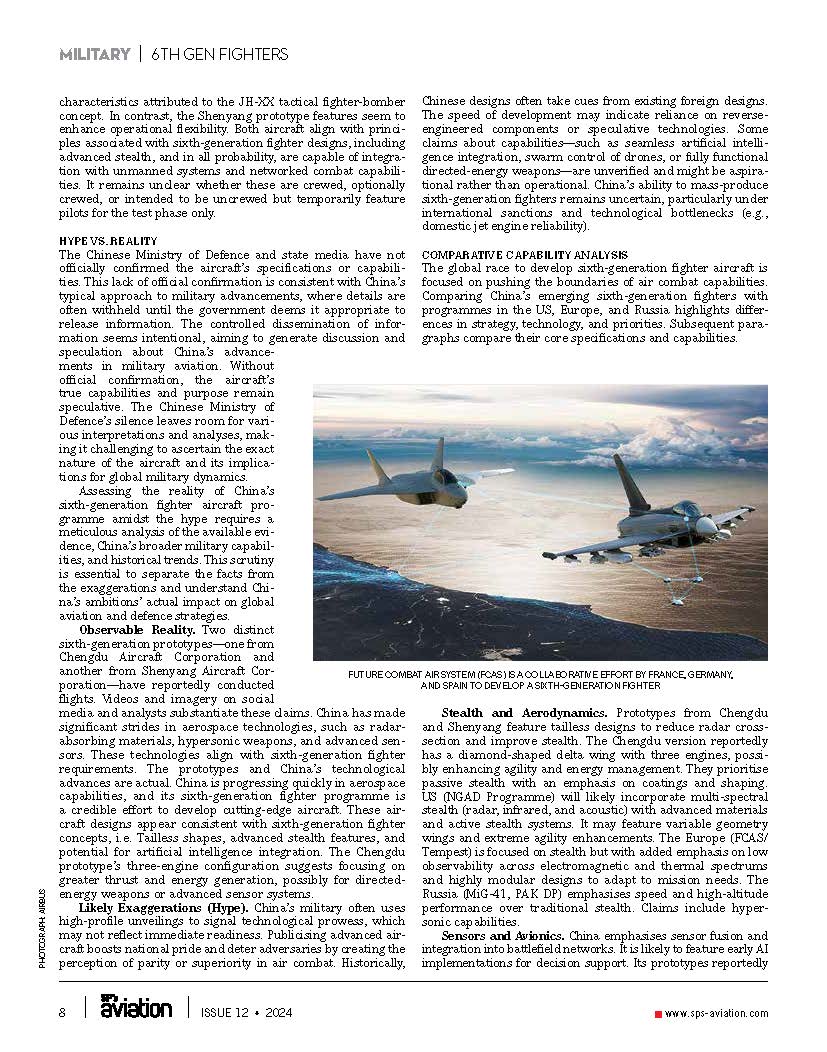
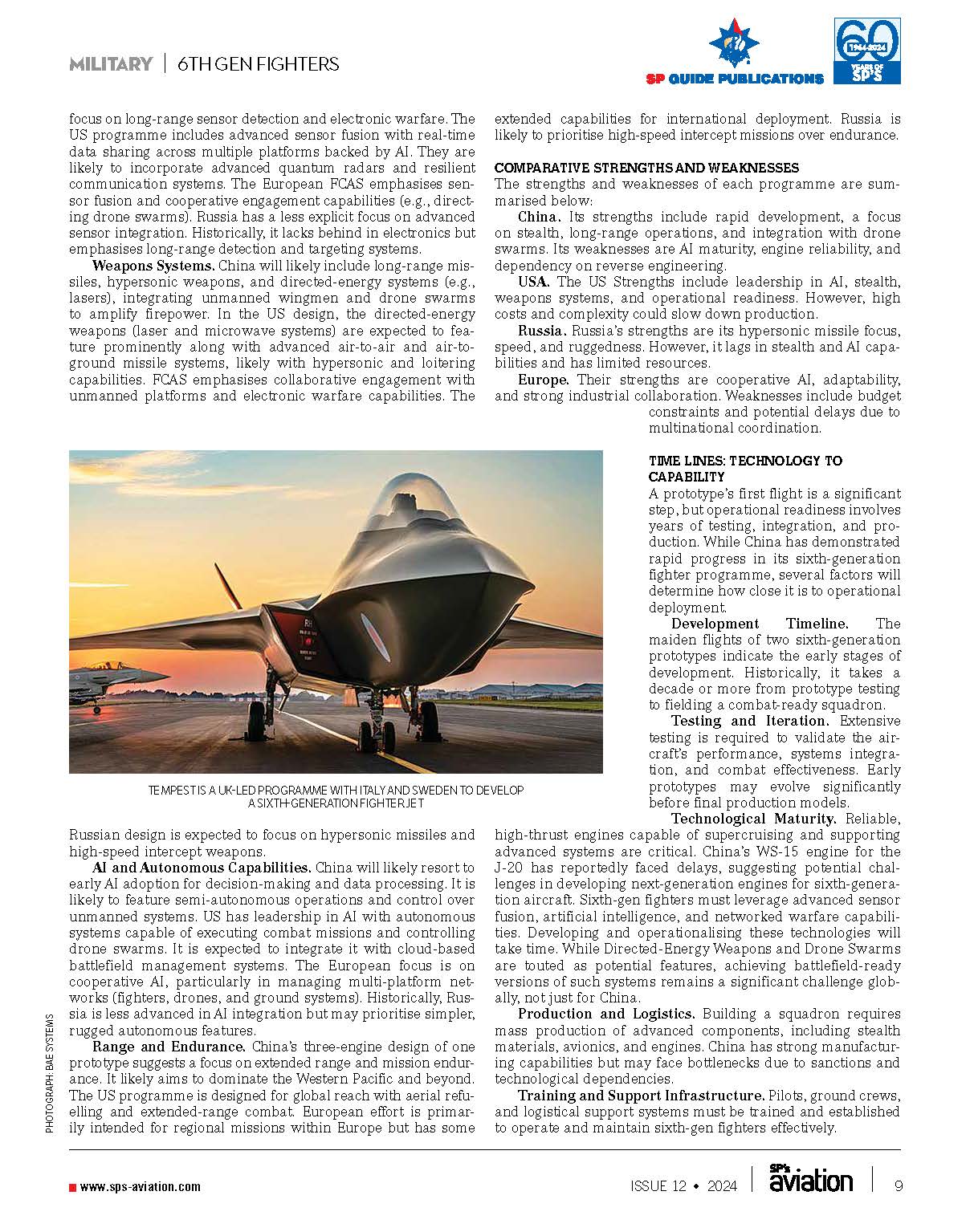
Stealth and Aerodynamics. Prototypes from Chengdu and Shenyang feature tailless designs to reduce radar cross-section and improve stealth. The Chengdu version reportedly has a diamond-shaped delta wing with three engines, possibly enhancing agility and energy management. They prioritise passive stealth with an emphasis on coatings and shaping. U.S. (NGAD Program) will likely incorporate multi-spectral stealth (radar, infrared, and acoustic) with advanced materials and active stealth systems. It may feature variable geometry wings and extreme agility enhancements. The Europe (FCAS/Tempest) is focused on stealth but with added emphasis on low observability across electromagnetic and thermal spectrums and highly modular designs to adapt to mission needs. The Russia (MiG-41, PAK DP) emphasises speed and high-altitude performance over traditional stealth. Claims include hypersonic capabilities.
Sensors and Avionics. China emphasises sensor fusion and integration into battlefield networks. It is likely to feature early AI implementations for decision support. Its prototypes reportedly focus on long-range sensor detection and electronic warfare. The U.S. program includes advanced sensor fusion with real-time data sharing across multiple platforms backed by AI. They are likely to incorporate advanced quantum radars and resilient communication systems. The European FCAS emphasises sensor fusion and cooperative engagement capabilities (e.g., directing drone swarms). Russia has a less explicit focus on advanced sensor integration. Historically, it lacks behind in electronics but emphasises long-range detection and targeting systems.
Weapons Systems. China will likely include long-range missiles, hypersonic weapons, and directed-energy systems (e.g., lasers), integrating unmanned wingmen and drone swarms to amplify firepower. In the U.S. design, the directed-energy weapons (laser and microwave systems) are expected to feature prominently along with advanced air-to-air and air-to-ground missile systems, likely with hypersonic and loitering capabilities. FCAS emphasises collaborative engagement with unmanned platforms and electronic warfare capabilities. The Russian design is expected to focus on hypersonic missiles and high-speed intercept weapons.
AI and Autonomous Capabilities. China will likely resort to early AI adoption for decision-making and data processing. It is likely to feature semi-autonomous operations and control over unmanned systems. U.S. has leadership in AI with autonomous systems capable of executing combat missions and controlling drone swarms. It is expected to integrate it with cloud-based battlefield management systems. The European focus is on cooperative AI, particularly in managing multi-platform networks (fighters, drones, and ground systems). Historically, Russia is less advanced in AI integration but may prioritise simpler, rugged autonomous features.
Range and Endurance. China’s three-engine design of one prototype suggests a focus on extended range and mission endurance. It likely aims to dominate the Western Pacific and beyond. The U.S. program is designed for global reach with aerial refuelling and extended-range combat. European effort is primarily intended for regional missions within Europe but has some extended capabilities for international deployment. Russia is likely to prioritise high-speed intercept missions over endurance.
Strengths and Weaknesses. The strengths and weaknesses of each program are summarised below:-
-
- China. Its strengths include rapid development, a focus on stealth, long-range operations, and integration with drone swarms. Its weaknesses are AI maturity, engine reliability, and dependency on reverse engineering.
-
- The USA. The U.S. Strengths include leadership in AI, stealth, weapons systems, and operational readiness. However, high costs and complexity could slow down production.
-
- Russia. Russia’s strengths are its hypersonic missile focus, speed, and ruggedness. However, it lags in stealth and AI capabilities and has limited resources.
-
- Europe. Their strengths are cooperative AI, adaptability, and strong industrial collaboration. Weaknesses include budget constraints and potential delays due to multinational coordination.
Time Lines: Technology to Capability
A prototype’s first flight is a significant step, but operational readiness involves years of testing, integration, and production. While China has demonstrated rapid progress in its sixth-generation fighter program, several factors will determine how close it is to operational deployment.
-
- Development Timeline. The maiden flights of two sixth-generation prototypes indicate the early stages of development. Historically, it takes a decade or more from prototype testing to fielding a combat-ready squadron.
-
- Testing and Iteration. Extensive testing is required to validate the aircraft’s performance, systems integration, and combat effectiveness. Early prototypes may evolve significantly before final production models.
-
- Technological Maturity. Reliable, high-thrust engines capable of supercruising and supporting advanced systems are critical. China’s WS-15 engine for the J-20 has reportedly faced delays, suggesting potential challenges in developing next-generation engines for sixth-generation aircraft. Sixth-gen fighters must leverage advanced sensor fusion, artificial intelligence, and networked warfare capabilities. Developing and operationalising these technologies will take time. While Directed-Energy Weapons and Drone Swarms are touted as potential features, achieving battlefield-ready versions of such systems remains a significant challenge globally, not just for China.
-
- Production and Logistics. Building a squadron requires mass production of advanced components, including stealth materials, avionics, and engines. China has strong manufacturing capabilities but may face bottlenecks due to sanctions and technological dependencies.
-
- Training and Support Infrastructure. Pilots, ground crews, and logistical support systems must be trained and established to operate and maintain sixth-gen fighters effectively.
-
- Strategic Drivers. China’s ability to accelerate development depends on how aggressively it prioritises this program over others, including improvements to existing platforms like the J-20 or J-31. Rising tensions with the U.S. and its allies could push China to field these fighters sooner, even in limited numbers, for deterrence purposes.
Current Estimate. A cautious view suggests that while China is advancing rapidly, its sixth-generation fighters may still be years away from full operational deployment, with significant technological and logistical challenges to overcome. The U.S. F-35, for instance, first flew in 2006 but reached initial operational capability (IOC) only in 2015. Based on available information and historical parallels, if China follows a similar timeline, its sixth-generation fighters could achieve IOC by the early to mid-2030s. China could field a symbolic squadron earlier, but these would likely have been pre-operational units used for further testing and refinement rather than full combat readiness. A fully Operational Squadron could be formed earliest by 2035, assuming no significant development, production, or integration setbacks are faced.
Implications
The development of sixth-generation fighter aircraft positions China at the forefront of the global race for sixth-generation fighter technology, potentially challenging the air superiority of other nations and reshaping the dynamics of modern aerial warfare. These developments significantly affect regional security dynamics, particularly in the Far East and South Asia.
Broader Geopolitical Implications. A successful sixth-gen program would boost China’s confidence in its ability to deter external intervention, particularly by the U.S., in disputes over Taiwan or the South China Sea. It may embolden China to pursue a more assertive posture in regional disputes. The U.S. will likely increase military support to its allies (Japan, South Korea, Taiwan, and potentially India) to counterbalance China’s growing air power. Regional powers are likely to boost defence budgets to acquire or develop next-gen capabilities, exacerbating the arms race in Asia. Smaller Southeast Asian nations may seek advanced air defence systems to avoid vulnerability.
Overall Regional Impact. China’s advancement in sixth-generation aircraft challenges the air superiority traditionally held by the United States and its allies in the Indo-Pacific. Once operationalised, these fighters could extend China’s ability to project power far beyond its borders, including contested areas like the Taiwan Strait, the South China Sea, and the East China Sea. A credible sixth-generation capability is a deterrent, raising the risks for nations contemplating countering China’s military actions in disputed regions. It also strengthens China’s bargaining power in regional and global negotiations. This development could trigger a technological and military response from neighbouring countries, prompting increased defence spending and collaboration with the U.S. or European powers.
Implications for Specific Nations
Japan. Japan faces heightened security risks in the East China Sea, particularly around the disputed Senkaku Islands, as advanced Chinese aircraft could dominate contested airspace. China’s long-range strike capabilities threaten Japan’s strategic assets and population centers. Japan has already committed to the F-X program, a sixth-generation fighter co-developed with the UK (Tempest) and Italy. This program may accelerate to counter China’s advancements. It may strengthen the U.S.-Japan alliance, hosting more advanced U.S. assets like the F-35 and NGAD platforms.
South Korea. The Korean Peninsula’s proximity to China makes South Korea vulnerable to Chinese air power in any regional conflict. Chinese sixth-generation fighters could neutralise South Korea’s current air force, including its F-35 fleet. South Korea may fast-track its KF-21 Boramae fighter program and consider deeper integration with U.S. defence systems. It may enhance missile defence and joint military drills with the U.S. and Japan to prepare for aerial threats.
Taiwan. Taiwan is the most directly threatened. Sixth-generation fighters could overwhelm Taiwan’s defences, outmatch its current fleet, and enforce air superiority over the Taiwan Strait. Combined with unmanned systems and precision weapons, China could use these fighters in a potential blockade or invasion scenario. Taiwan must invest heavily in asymmetric defence strategies, such as anti-air systems, drones, and missile capabilities, to offset China’s technological advantage. It will strengthen U.S.-Taiwan collaboration, particularly for advanced defensive systems like the Patriot and Aegis missile systems.
India. While geographically distant from East Asia, India faces security challenges along its disputed borders with China. Chinese sixth-generation fighters could provide superior air power in a conflict scenario, outmatching India’s existing fourth-generation aircraft, such as the Su-30MKI or its limited fleet of Rafales. India’s AMCA (Advanced Medium Combat Aircraft) project gains urgency to develop a fifth-generation platform and potentially leapfrog into sixth-gen technologies. It may need to strengthen partnerships and collaborations with Western nations, emphasising indigenous development and joint ventures.
China’s sixth-generation fighter program signifies a leap forward in its military modernisation. It presents a direct challenge to the regional balance of power, making it a pivotal development in shaping the strategic dynamics of the Indo-Pacific. The operationalisation of China’s sixth-generation fighters could reorder regional air power dynamics, with the U.S. and its allies responding with their advanced capabilities.
Conclusion
China’s sixth-generation fighter aircraft program is impressive, and as it inches closer to operational readiness, it signals a pivotal shift in global airpower dynamics. By leveraging advanced technologies like artificial intelligence, stealth, and hypersonic capabilities, China aims to achieve dominance in air combat and strategic deterrence. Compared to the United States and its contemporaries, Beijing’s accelerated progress highlights its determination to close the technology gap. While equally ambitious, the U.S. Next Generation Air Dominance (NGAD) program emphasises joint combat capabilities and seamless integration within a broader technological ecosystem. Meanwhile, Europe’s Tempest and FCAS programs underscore the necessity for international collaboration but face delays and funding challenges.
The sixth-generation race is not merely about the aircraft but about the strategic ecosystems they represent. China’s approach, marked by centralised control and rapid prototyping, offers speed but raises questions about operational reliability and sustainability. Notwithstanding, the implications of this development are profound. It mandates investments in asymmetric warfare and counter-stealth technologies for regional countries to mitigate a growing disparity. Globally, China’s advancements could prompt a new arms race, influencing defence spending and alliances.
Request Please do Comment
For regular updates, please register your email here:-
Disclaimer:
Information and data included in the blog are for educational & non-commercial purposes only and have been carefully adapted, excerpted, or edited from reliable and accurate sources. All copyrighted material belongs to respective owners and is provided only for wider dissemination.
References and credits
To all the online sites and channels.
References:-
- Global Times. “China Showcases Sixth-Gen Fighter Model at Zhuhai Air show.” Published November 15, 2024.
- South China Morning Post. “China’s Sixth-Gen Fighter: Prototypes Take to the Skies.” Published December 27, 2024.
- BBC News. “China’s Advanced Fighters: How They Compare with the US and Europe.” Published December 2024.
- The Guardian. “What China’s Sixth-Generation Fighter Program Means for Global Security.” Published December 2024.
- CNN International. “China’s Aerospace Leap: Sixth-Gen Fighters Take Center Stage.” Published December 2024.
- Defence News. “A Tale of Two Prototypes: China’s Sixth-Gen Fighter Race Heats Up.” Published December 2024.
- Breaking Defence. “China’s Sixth-Gen Jets: Decoding the Strategic Message.” Published November 2024.
- The Straits Times. “Asia Responds to China’s Next-Gen Fighter Developments.” Published December 2024.
- The Economic Times (India). “Implications of China’s Sixth-Gen Aircraft on Indian Security.” Published December 2024.
- Nikkei Asia. “How China’s Sixth-Generation Fighters Could Reshape the Indo-Pacific.” Published December 2024.
- Foreign Affairs. “Arming the Future: The Sixth-Generation Fighter Race.” Published December 2024.
- Reuters. “China’s Military Aviation Milestone: What the World Needs to Know.” Published December 2024.
- Al Jazeera. “The Geopolitical Fallout of China’s Sixth-Gen Fighter Program.” Published December 2024.
- U.S. Department of Defence. Annual Report to Congress: Military and Security Developments Involving the People’s Republic of China. Washington D.C., 2024.
- RAND Corporation. The Future of Airpower: Comparative Analysis of Next-Gen Fighter Programs, 2024.
- Indian Defence Review. “China’s Sixth-Generation Fighter Program: Implications for India’s Air Defence Strategy.” IDR, December 2024.
- European Defence Agency. Collaborative Combat: The Future of the FCAS and Tempest Programs. EDA Technical Report, 2024.