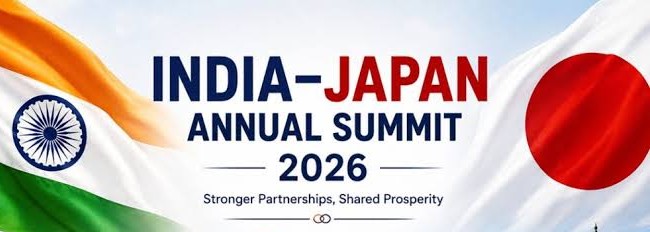
The 16th India-Japan Annual Summit was held in New Delhi from July 1–3, 2026. It brought together Indian Prime Minister Narendra Modi and the recently appointed Japanese Prime Minister Sanae Takaichi. It was PM Takaichi’s first official visit to India. The high-level meeting aimed to consolidate the “Special Strategic and Global Partnership”.
Landmark Outcome Documents
The bilateral talks yielded three critical joint statements designed to foster long-term resilience: –
-
- Joint Declaration on Economic Security. Accelerated cooperation on critical minerals, secure semiconductor supply chains, and robust industrial networks.
- Joint Statement on Artificial Intelligence Cooperation. Establishing frameworks for collaborative AI innovation, deployment, and ethical standards.
- Joint Statement on Energy Resilience. Enhancing green tech, clean energy transitions, and clean hydrogen infrastructure.
Defence and Technology Highlights
-
- Defence Industrial Co-development. The materialisation of the UNICORN marked progress in the integrated naval mast project, signalling a breakthrough in defence tech transfers.
- Financial Infrastructure. The International Financial Services Centres Authority (IFSCA) signed a Memorandum of Understanding with the Japan Financial Services Agency (JFSA) to deepen sub-national regulatory cooperation and supervise unified financial services.
- Support for Japanese Commerce. Building upon Japan’s prior 10-trillion-yen investment target, PM Modi announced that the Indian Prime Minister’s Office (PMO) will dedicate a specialised weekly window to directly resolve operational bottlenecks faced by Japanese companies under the Make in India framework.
Diplomatic and Cultural Horizons
-
- 75 Years of Diplomacy. Both leaders announced that 2027 will be designated and celebrated as the “Year of Shared Horizons” to commemorate 75 years of formal diplomatic ties, featuring year-long cultural and people-to-people exchange programs.
- Sub-National Outreach. The summit highlighted the rapid increase in state-to-prefecture alignment, bolstered by the newly formed India–Japan Governors’ Network for Friendship and Exchange.
- 17th Annual Summit Invitation. PM Takaichi extended an official invitation to PM Modi to visit Japan for the 17th Annual Summit in 2027, which was accepted with pleasure.
Inputs to the Questions by the Journalists
What, according to you, was most striking about PM Sanae Takaichi’s visit to India, and why do you think so?
-
- The depth and breadth of outcomes in a short visit stood out the most.
- It marked a clear shift in the relationship from one primarily centred on economic cooperation to a broader one encompassing strategic technology, defence, and supply chain resilience.
- The emphasis on emerging technologies, semiconductor cooperation, and defence collaboration demonstrates that the partnership is no longer transactional but is becoming structural.
- How will Indo-Japan’s joint focus on “free and rules-based Indo-Pacific” help the cause of the greater region?
-
- A free and rules-based Indo-Pacific is all about preserving international law, freedom of navigation, open trade, and peaceful resolution of disputes.
- India and Japan are among the largest democratic powers in Asia, and their cooperation would help in reinforcing these principles.
- Their cooperation would improve maritime security, strengthen disaster response, and diversify supply chains.
- It would result in regional stability and economic growth.
- India and Japan also signed their first agreement for the co-development of defence projects. What’s most significant about it? How do you think this will develop in the next five years?
-
- The agreement signifies a shift from a conventional buyer-seller relationship to one centred on co-development and co-production.
- It exemplifies an increasing strategic trust between the two nations.
- The agreement is in alignment with India’s’ Make in India’ initiative and defence policies.
- It will afford Japanese companies enhanced opportunities to engage in India’s growing defence industrial ecosystem.
- Over the next five years, collaboration is likely to increase in areas such as unmanned systems, maritime surveillance technologies, electronic warfare, cyber capabilities, and next-generation defence manufacturing.
- Modi and Takaichi signed at least 129 MoUs on technology, investment and Artificial Intelligence (AI). What impact will this have on India’s economy and broader supply chains in the Indo-Pacific region?
-
- Japan historically has been known for advanced manufacturing and high-quality standards.
- These agreements could deepen India’s integration into global supply chains.
- Partnerships in AI and technology could accelerate India’s digital transformation. It would strengthen semiconductor and electronics manufacturing in India. It would also enhance research collaboration and create high-skilled employment.
- For the Indo-Pacific, it would diversify production networks. This, in turn, would make the regional supply chains more resilient to geopolitical disruptions.
- However, the ultimate impact will depend less on the number of MoUs signed and more on their timely implementation, regulatory coordination, and sustained private-sector participation.
- Is there anything else that you would like to share on this topic with my readers?
-
- At a time when the global economy is being reshaped by geopolitical competition, trusted partnerships are becoming as important as traditional trade relationships.
- The India-Japan cooperation is a long-term strategic partnership.
- The two countries can become anchors of stability, innovation, and sustainable economic growth in the region.
- This partnership could become one of the crucial bilateral relationships in Asia.
16th India-Japan Annual Summit Joint Statement
Advancing a Partnership of Strategic Convergence and Trust for Shared Growth, Prosperity and Resilience
- At the invitation of the Prime Minister of India, H.E. Shri Narendra Modi, the Prime Minister of Japan, H.E. Ms TAKAICHI Sanae, paid an Official Visit to India from 1-3 July 2026 for the 16th India-Japan Annual Summit. A high-level delegation, including senior officials, CEOs, and industry leaders, accompanied Prime Minister Takaichi. This was Prime Minister Takaichi’s first official visit to India.
- The two Prime Ministers reviewed developments since the last Annual Summit. They discussed a wide range of areas for further cooperation to enhance the India-Japan Special Strategic and Global Partnership. They recognised that strengthening such strategic and global cooperation between the two countries will be mutually beneficial and contribute to a resilient and prosperous Indo-Pacific and beyond.
- In recognition of the strategic salience of the India-Japan partnership in an increasingly volatile and uncertain geopolitical environment, the two Prime Ministers reaffirmed their commitment to developing a mutually complementary relationship. Building on the success of the 15th India-Japan Annual Summit, they agreed to advance cooperation in three priority areas: defence and security cooperation; economic partnership, including economic security, energy resilience, technology, and innovation; and people-to-people exchanges. They shared the view that India and Japan are natural and indispensable partners in their efforts to realise respective national interests.
- The two Prime Ministers reiterated that as leading democracies and major economies of the world, they have a duty to shape and uphold an international order which is free, open and based on the rule of law. To this end, Prime Minister Modi welcomed the updated “Free and Open Indo-Pacific (FOIP)” and shared that it closely aligns with the Indo-Pacific Oceans’ Initiative (IPOI) and Mutual and Holistic Advancement for Security and Growth Across Regions (MAHASAGAR). They reiterated their commitment to deepen further concrete cooperation in line with their shared strategic outlook.
- The two Prime Ministers expressed deep satisfaction that bilateral defence and security cooperation is on an upward trajectory and reaffirmed their commitment to deepening cooperation based on the Joint Declaration on Security Cooperation, adopted at the last Annual Summit. They directed their Ministers to hold the fourth round of the 2+2 Ministerial Meeting in Tokyo by the end of this year. They welcomed the progress in cooperation among the respective services, including the successful conduct of the naval exercise “JAIMEX 25”, supported by both services on the Japanese side. India welcomed Japan’s participation in the International Fleet Review 2026, held in Visakhapatnam. They concurred on deepening maritime security cooperation through enhanced exercises, maritime domain awareness using satellite capabilities, naval maintenance, repair and overhaul (MRO) cooperation, and defence equipment and technology cooperation under the framework of “Make in India”.
- Prime Minister Modi welcomed Japan’s review of the three principles on the transfer of defence equipment and technology and hoped that it would further deepen the defence partnership between the two countries. The two Prime Ministers expressed satisfaction that an agreement has been reached in principle on the remaining technical details regarding the Unified Complex Radio Antenna (“UNICORN”) project. They expressed their expectation of an early conclusion of the project and agreed to explore ways to materialise other projects in the field of defence equipment and technology.
- The two Prime Ministers recognised that the current international situation calls for both countries further to promote tangible cooperation in the areas of economic security. They committed to deepening economic security cooperation and developing key initiatives to support a resilient and prosperous region. They reiterated their grave concerns about the use of economic coercion and non-market policies and practices, including arbitrary export restrictions that may lead to supply chain disruptions, particularly in critical minerals and critical industrial sectors, as well as price manipulation. They underscored the importance of diversified, resilient and reliable global supply chains, a fair and competitive global environment, and the need to avoid reliance on any one country. They reaffirmed their commitment to promote and protect key technologies while respecting their regulations and related rules.
- Both sides consented to further protecting high technology trade while mutually easing export control challenges. Further, they decided to advance consultations among the relevant Ministries of the two countries. They appreciated the strides made by the two countries under the Economic Security Initiative, which was launched at the last Annual Summit, including the inaugural Private-Sector Economic Security Dialogue and the second round of the Economic Security Dialogue earlier this year. They adopted the India-Japan Joint Declaration on Economic Security Cooperation to promote further project-based collaboration in the key sectors of semiconductors, critical minerals, information and communication technology, clean energy and pharmaceuticals.
- Recognising their shared status as major energy-consuming nations impacted by volatility in global energy markets, the two Prime Ministers underscored the urgency of deepening India-Japan cooperation on energy security. They reiterated the importance of ensuring unimpeded freedom of navigation and the uninterrupted flow of global commerce, including through the Strait of Hormuz, and of opposing any restrictive measures that hamper the flow of commercial vessels. They welcomed the prospects for expanded collaboration across the energy value chain. They reaffirmed their commitment to working together, bilaterally and through multilateral platforms, to enhance the resilience of energy supply chains and to promote stability in global energy markets.
- The two Prime Ministers concurred on exploring collaborative opportunities, including joint investments, across the maritime energy transport value chain. They highlighted the importance of regional initiatives to strengthen energy resilience, such as Japan’s Partnership on Wide Energy and Resources Resilience (POWERR Asia), India’s support to energy security in South Asia, and the Quad Initiative on Indo-Pacific Energy Security. They welcomed the adoption of the Joint Statement on Energy Resilience. They also agreed to strengthen cooperation on strategic petroleum reserves, including through the exchange of best practices and technical collaboration on the strategic stockpiling ecosystem. Against this backdrop, Prime Minister Takaichi affirmed her support for India’s membership in the International Energy Agency (IEA).
- The two Prime Ministers concurred on taking forward their partnership in the clean energy sector. They appreciated the launch of the India-Japan Cooperative Biogas for Growth Initiative (CBG Initiative) as a new project of India-Japan cooperation to scale up biogas production, in light of India’s target of establishing 1,000 biogas and organic fertiliser plants across the country. They welcomed the signing of a Memorandum of Cooperation (MoC) between the Ministry of Economy, Trade and Industry of Japan and the Ministry of Cooperation and the Department of Animal Husbandry and Dairying of India. They recognised the importance of hydrogen and ammonia not only for decarbonization but also for enhancing energy security. They reaffirmed their commitment to promoting the landmark clean ammonia project in Odisha, with continued support from both governments. They also acknowledged the importance of promoting clean energy projects in areas such as clean ammonia, green hydrogen, solar PV technologies, and nuclear energy.
- The two Prime Ministers shared the view that promotion of innovation in new technologies, including AI, is crucial to further broadening the base of cooperation. They concurred on the need to enhance national capabilities in AI and strengthen cooperation on trusted and resilient digital infrastructure. They confirmed the necessity to promote innovation through the utilisation and application of AI technology for the sustainable and inclusive development of AI, including in the area of hard infrastructure, while harnessing opportunities and appropriately mitigating related risks and ensuring a resilient, agile, diverse, and trustworthy AI supply chain in the spirit of the Hiroshima AI Process and the New Delhi Declaration on AI Impact. In this context, they welcomed the inaugural India-Japan AI Strategic Dialogue. They adopted the Joint Statement on AI cooperation to further build on the progress made under the India-Japan AI Cooperation Initiative.
- The two Prime Ministers welcomed the increasing private investment from Japan to India and recognised its contribution to India’s national goal of Viksit Bharat. They appreciated the progress made towards achieving the target of 10 trillion Yen set at the last Annual Summit. They agreed to work towards enhancing the investment environment by using the fast-track mechanism under the India-Japan Industrial Competitiveness Partnership (IJICP). Noting that more than 15 years have passed since the two countries signed the Comprehensive Economic Partnership Agreement (CEPA) and recognising the need to enhance and diversify bilateral trade, they agreed to accelerate the review of its implementation and the full and effective utilisation of the CEPA to make it more forward-looking. The Japanese side recognised the facilitation extended to leading Japanese financial institutions and banks to strengthen their presence in India’s banking and non-banking financial sectors in accordance with applicable laws and regulations. They endorsed bilateral efforts to strengthen cooperation in logistics, textiles, food processing, agriculture, automotives, and industrial capital goods under IJICP. They also reaffirmed the importance of enhancing bilateral financial cooperation and collaboration on payment systems between India and Japan, including local currency transactions. They also recognised the importance of strengthening collaboration in the healthcare sector, including pharma supply chains.
- The two Prime Ministers welcomed the inauguration of the India-Japan SME Forum and the visit of an SME Mission on the aeronautical sector from Japan to India. They welcomed the steady progress of various efforts to improve the business environment and to enhance the network for both Japanese and Indian businesses, especially SMEs and startups. Building on the Japan-India Startup Support Initiative (JISSI), they expressed a willingness to further encourage the participation of Japanese SMEs and startups in the Indian market, in collaboration with various universities. They also underscored the importance of greater participation of Micro, Small and Medium Enterprises (MSMEs) and linkages between Japanese enterprises and India’s Tier-II and Tier-III supplier ecosystem. In this context, they reiterated their commitment to facilitate greater investment flows, industrial collaborations and technology partnerships.
- The two Prime Ministers noted with satisfaction the significant contribution of Japan’s development cooperation support to the socio-economic development of India. They welcomed the recent progress on four projects: Mumbai Metro (Line 11), Bengaluru Metro (Phase 3), the healthcare delivery and education systems in Maharashtra, and sustainable horticulture in Punjab, which will help strengthen connectivity and promote clean, sustainable socio-economic development. They shared the intention to promote development cooperation in a way that contributes to co-creating economic growth.
- The two Prime Ministers reaffirmed the importance of the Mumbai-Ahmedabad High Speed Rail as a flagship project between India and Japan. Prime Minister Takaichi stated that Japan fully understands India’s target to commence commercial operations on priority sections in 2027 and remains committed to extending the necessary cooperation. They acknowledged the goal of introducing the E10. They also expressed a willingness to explore ways to cooperate on future high-speed corridors to achieve India’s vision of a national High Speed Rail network of 7,000 km. Prime Minister Modi invited Japanese companies to explore opportunities to participate in developing future corridors and conveyed his readiness to facilitate such engagement, a welcome from the Japanese side. They also shared the view that private-sector-led cooperation and investment in High Speed Rail and comprehensive mobility should be accelerated, to combine Japan’s advanced mobility technologies with India’s excellent human resources and market potential across the country. To this end, they welcomed the signing of the MoC on the Next-Generation Mobility Partnership between the two sides. They acknowledged the importance of cooperation in the shipbuilding sector, including collaboration among human resources.
- The two Prime Ministers underscored that collaboration and exchange in the field of cutting-edge science and technology is a key pillar of the bilateral ties. In this connection, they noted with satisfaction the ongoing joint research collaborations between academic institutions, exchange visits by scientists and researchers from the two countries, and industry-academia collaborations through internship opportunities at Japanese companies. They noted the increasing number of Indian talents accepted under the LOTUS Programme, and the Sakura Science Exchange Program of the Japan Science and Technology Agency, with Japanese high school students invited under the initiatives by the Department of Science and Technology (DST). They also underlined the importance of further advancing student and university exchanges through programs such as the Indo-Japan Cooperative Science Programme (IJCSP) of DST, the Japan Society for the Promotion of Science (JSPS), the MEXT Scholarship, and the Inter-University Exchange Project. They noted with satisfaction the ongoing progress in the Lunar Polar Exploration (LUPEX) Mission between the Indian Space Research Organisation and the Japan Aerospace Exploration Agency. They welcomed the recent signing of the Letter of Intent in Quantum Technologies between India’s DST and Japan’s Cabinet Office.
- The two Prime Ministers reaffirmed their commitment to promote people-to-people exchanges further, recalling that the talent circulation between the two countries constitutes a mutually complementary relationship that addresses challenges on both sides. They affirmed further promotion of Japanese language education in India, appreciating the progress made so far, including through the Nihongo Partners programme. They welcomed the fact that visitors between the two countries numbered 540 thousand in 2025 and reiterated their commitment to promoting two-way tourism. They appreciated the ongoing intellectual and cultural exchanges between the two countries aimed at deepening institutional and people-to-people connections. They highlighted the important role of creative industries, such as anime, manga, gaming, and film, especially among youth. Recognising the increasing people-to-people exchange, including among tourists, they confirmed the importance of promoting dialogue on consular affairs between relevant authorities.
- The two Prime Ministers acknowledged the important role played by Indian States and Japanese prefectures and municipalities in deepening economic and people-to-people connections between the two countries. They welcomed the ever-growing exchanges at the regional level, including the establishment of India-Japan Governors’ Network for Friendship and Exchange and recent high-level collaborations between Yamanashi Prefecture and Uttar Pradesh, Toyama Prefecture and Andra Pradesh, Shizuoka Prefecture and Gujarat, Hamamatsu City and Ahmedabad, Wakayama Prefecture and Maharashtra, San’in Region and Kerala, Ehime Prefecture and Tamil Nadu, Fukuoka Prefecture and Delhi as well as Kitakyushu City and Telangana.
Regional and Global Issues
- In light of the updated FOIP and the Act East Policy and to realise a resilient and prosperous Indo-Pacific, the two Prime Ministers highlighted the strategic importance of India’s North Eastern Region (NER). Prime Minister Modi appreciated Japan’s robust support in enhancing hard, soft, and people-to-people connectivity in the region, including road networks, bridges, social infrastructure in healthcare, forest management, and disaster risk reduction. They welcomed vibrant economic activity by Japanese and Indian enterprises in the semiconductor and biofuel sectors, as well as skill development, Japanese-language training, and human resource exchange. They reaffirmed their shared commitment to developing industrial value chains connecting the NER with the Bay of Bengal region, in close collaboration with relevant partners and regional organisations, including BIMSTEC. They also acknowledged the successful holding of the Sixth India-Japan Intellectual Conclave in February 2026 in Shillong, Meghalaya. They concurred on the importance of holding the next round of the Act East Forum (AEF) at an early date.
- Towards the shared goal of a resilient and prosperous Indo-Pacific, the two Prime Ministers reiterated their commitment to advancing cooperation among like-minded countries. They welcomed the steady progress under the Quad framework and reaffirmed their shared commitment to enhancing practical cooperation. They underscored the importance of Quad collaboration across the four pillars of maritime and transnational security; economic prosperity and security, including critical minerals; critical and emerging technologies; and humanitarian assistance and emergency response. They noted that growing bilateral cooperation in these areas would further strengthen and complement the Quad efforts. They reaffirmed their commitment to cooperating towards an early convening of the next Quad Leaders’ Summit. They also highlighted the importance of cooperation with ASEAN Member States to strengthen regional resilience and promote peace, stability and prosperity. In this context, they agreed to begin preparations for the inaugural trilateral 1.5-track policy dialogue with the Philippines. They reiterated their strong support for ASEAN’s Centrality and unity and their unwavering support for the “ASEAN Outlook on the Indo-Pacific (AOIP)”. Furthermore, they underscored the importance of cooperation in strengthening critical mineral supply chains among like-minded countries, including through Multilateral Development Banks (MDBs)s, such as the World Bank Group’s Resilient and Inclusive Supply-chain Enhancement (RISE) Partnership and Asian Development Bank (ADB) Critical Minerals-to-Manufacturing Financing Partnership Facility (CMM-FPF).
- The two Prime Ministers expressed serious concern over the situation in the East China Sea and the South China Sea. They reiterated their strong opposition to any unilateral actions that endanger the safety and freedom of navigation and overflight, as well as attempts to change the status quo by force or coercion. They shared their serious concerns over the growing militarisation of disputed features. They reaffirmed that maritime disputes must be resolved peacefully and in accordance with international law, as reflected in UNCLOS.
- The two Prime Ministers shared serious concern over North Korea’s nuclear and missile programs. They reaffirmed their commitment to the complete denuclearisation of North Korea in accordance with relevant United Nations Security Council (UNSC) resolutions. They stressed the importance of addressing continued concern regarding the proliferation of nuclear and missile technologies to and from North Korea in the region and beyond. They urged all UN Member States to abide by their international obligations under the UNSC resolutions to implement sanctions, including the prohibition on the transfer to North Korea or procurement from North Korea of all arms and related material. They reconfirmed the necessity of the immediate resolution of the abduction issue.
- The two Prime Ministers remain concerned over the situation in Myanmar and its regional impact. They reiterated their call for the immediate cessation of hostilities and the creation of a conducive environment for inclusive dialogue among all stakeholders toward a Myanmar-led, Myanmar-owned, peaceful and durable solution.
- The two Prime Ministers reiterated their commitment to sustainable peace and stability in the Middle East. Regarding the situation surrounding Iran, they stressed the importance of ensuring free and safe navigation through the Strait of Hormuz, maintaining stable supply chains for energy and other essential goods, and upholding international law, particularly as reflected in UNCLOS. They stressed the imperative of advancing the Comprehensive Plan to rebuild Gaza and of living up to the commitment to ensuring a two-state solution. They reaffirmed that continued diplomatic efforts are indispensable to restoring stability at the earliest and achieving lasting peace in the region.
- The two Prime Ministers reaffirmed their commitment to promoting collaboration in Africa as envisioned in the India-Africa Forum Summit (IAFS) mechanism and Japan’s Tokyo International Conference on African Development (TICAD), as well as the Economic Region Initiative of the Indian Ocean-Africa. Towards this end, they noted the formulation of the Strategic Outlook for Expanding Japan-India Cooperation in Africa and the industrial concentration in India to establish a hub for trade and investment and to advance the India-Japan Cooperation Initiative for Sustainable Economic Development in Africa. They reiterated their commitment to further promoting concrete cooperation based on the synergy of these initiatives.
- The two Prime Ministers expressed support for a just and lasting peace in Ukraine in accordance with international law, including the UN Charter. They also welcomed the ongoing diplomatic efforts by various countries to achieve a just and lasting peace.
- On the multilateral front, the two Prime Ministers reiterated their commitment to working closely with the other G4 countries for an urgent reform of the United Nations Security Council (UNSC), including through the expansion of both permanent and non-permanent categories, which a majority of member states support, to reflect the current geopolitical realities better better. They expressed their determination to accelerate UNSC reforms, particularly by commencing text-based negotiations under the Inter-Governmental Negotiations framework, with the overall objective of achieving concrete outcomes within a fixed time frame. They expressed their mutual support for each other’s candidacies for permanent seats on a reformed UNSC. They also noted with appreciation that India and Japan have reached an understanding on mutual support for respective candidatures to non-permanent seats in the years 2028-29 and 2033-34. They also underscored the need for UN reform to increase the efficiency and effectiveness of the UN, thereby contributing to global governance in a changing world.
- Prime Minister Modi welcomed Japan’s support for India to host the 4th United Nations World Conference on Disaster Risk Reduction in 2030 with the intention to carry forward the spirit and principles of the Sendai Framework for Disaster Risk Reduction 2015-2030, such as the importance of investment in disaster risk reduction and “Build Back Better.” They committed to continuing cooperation in the field of disaster risk reduction, including through the Asia-Pacific Ministerial Conference on Disaster Risk Reduction to be held in Sendai, Japan, in 2027. They concurred on further enhancing policy consultations between the Foreign Ministries on regional affairs such as Africa, Asia, and the Middle East/West Asia, and on the multilateral agenda, including UN reform, space, cybersecurity and maritime domains, climate change, terrorism, and the Arctic, as well as policy planning.
- The two Prime Ministers unequivocally and strongly condemned terrorism and violent extremism in all its forms and manifestations, including cross-border terrorism from Pakistan. They condemned in the strongest terms the terrorist attack in Pahalgam, Jammu and Kashmir, on 22 April 2025. They took note of the United Nations Security Council Monitoring Team Report dated 29 July 2025, which mentions The Resistance Front (TRF). They also condemned in the strongest terms the terror incident in Delhi on 10 November 2025. They called for the perpetrators, organisers, and financiers of this reprehensible act to be brought to justice without any delay. They also called for concerted actions against all UN-listed terrorist groups and entities, including Al Qaeda, ISIS/Daesh, Lashkar-e-Tayyiba (LeT), Jaish-e-Mohammad (JeM) and their proxies, and to take resolute actions to root out terrorists’ safe havens, eliminate terrorist financing channels and their nexus with transnational crime, and halt cross-border movement of terrorists.
- The two Prime Ministers reaffirmed the importance of the Annual Summit mechanism to advance India-Japan cooperation across a range of sectors. Celebrating 75 years of diplomatic relations as the India-Japan Year of Shared Horizons, they renewed their commitment to further strengthening the Special Strategic and Global Partnership and to deepening people-to-people ties through year-long commemorative programmes.
- Prime Minister Takaichi thanked Prime Minister Modi for the hospitality extended during the visit and extended an invitation to Prime Minister Modi to visit Japan next year for the 17th Annual Summit, which Prime Minister Modi accepted with pleasure.
New Delhi
July 02, 2026
Please Add Value to the write-up with your views on the subject.
For regular updates, please register your email here:-
References and credits
To all the online sites and channels.
Pics Courtesy: Internet
Disclaimer:
Information and data included in the blog are for educational & non-commercial purposes only and have been carefully adapted, excerpted, or edited from reliable and accurate sources. All copyrighted material belongs to the respective owners and is provided only for wider dissemination.
References: –
- Ministry of External Affairs. (2026, July 2). 16th India–Japan Annual Summit: Joint statement—Advancing a partnership of strategic convergence and trust for shared growth, prosperity and resilience. Government of India. https://www.mea.gov.in/
- Ministry of Foreign Affairs of Japan. (2026). Japan–India summit meeting. https://www.mofa.go.jp/
- Prime Minister’s Office. (2026). 16th India–Japan Annual Summit. Government of India. https://www.pmindia.gov.in/
- International Financial Services Centres Authority. (2026). Press releases. https://ifsca.gov.in/
- Japan Financial Services Agency. (2026). News releases. https://www.fsa.go.jp/en/