810: PAKISTAN’S WAR OF ITS OWN MAKING: AFGHAN POLICY COMES FULL CIRCLE


In the early hours of February 27, 2026, explosions shook the Afghan capital Kabul. Pakistani jets streaked across the night sky, striking Taliban government defence facilities, ammunition depots, and military sites in Kabul, Kandahar, and the southeastern province of Paktia. Pakistan had done something almost unthinkable just a few years ago. It bombed the capital of a neighbouring country and declared that it was now in a state of “open war.” This was not an impulsive act but the result of years of deteriorating relations. The situation had been building since the Taliban returned to power in Afghanistan in 2021.


A Historical Overview of The Broken Brotherhood

Pakistan and Afghanistan share a relationship that defies easy description. The South Asian neighbours are both Muslim-majority states and share a 2,611-kilometer border.  For decades, Pakistan was among the most important backers of the Afghan Taliban, supporting the movement ideologically, financially, and logistically through its powerful Inter-Services Intelligence (ISI) directorate. When the Taliban swept back into Kabul in August 2021 following the withdrawal of American and NATO forces, Pakistan initially welcomed the development as a strategic gain. Pakistan thought a friendly government in Kabul might counter Indian influence and give Islamabad so-called “strategic depth.”

That calculation unravelled almost immediately. The Taliban government in Kabul was not interested in being a client state of Islamabad. Far from reining in anti-Pakistan militant groups operating from Afghan soil, the Taliban appeared unwilling to do so. The Tehreek-e-Taliban Pakistan (TTP) started using Afghan territory as a base from which to launch increasingly devastating attacks on Pakistan. Pakistan’s frontier provinces bordering Afghanistan (Khyber Pakhtunkhwa and Balochistan) bore the brunt. Suicide bombings, ambushes on security forces, and targeted assassinations increased. A particularly devastating attack struck a Shia Mosque in Islamabad, killing at least 40 people and claimed by the Islamic State Khorasan Province (ISKP), adding another militant dimension to Pakistan’s security nightmare.

At the same time, the Durand Line (the colonial-era boundary drawn by the British in 1893) remained a festering point of contention. Afghanistan has never formally recognised this border as legitimate, viewing it as an arbitrary demarcation that divides the Pashtun ethnic group between two states. The Taliban government maintained that position firmly, resisting Pakistan’s attempts to fence the border and frequently allowing its fighters to interfere with construction efforts. It is estimated that there had been at least 75 recorded clashes between Afghan and Pakistani forces along the Durand Line between 2021 and 2026, a frequency that made some form of major escalation almost inevitable.


The Military Balance

The difference in military strength between Pakistan and Afghanistan is stark. Pakistan, a nuclear-armed country, has a considerable military force with 660,000 active personnel (560,000 soldiers in the army, 70,000 in the air force, and 30,000 in the navy). Pakistan also boasts of 465 combat aircraft, over 260 helicopters, more than 6,000 armoured fighting vehicles, and over 4,600 artillery pieces.

The Afghan Taliban, by contrast, commands approximately 172,000 active military personnel. When the Taliban returned to power in 2021, it inherited a substantial inventory of US-supplied military equipment left behind by the former Afghan National Army, including armoured vehicles, artillery, and aircraft. But without international recognition, without access to spare parts, and without functioning military training institutions, much of that equipment became unusable. Afghanistan has no functioning air force to speak of: at most six aircraft, some of Soviet vintage, and 23 helicopters, the airworthiness of an unknown number of which remained in doubt.

On paper, Pakistan could crush the Taliban’s conventional military capacity with relative ease. Yet history has shown repeatedly that wars in Afghanistan are not won on paper. It is called the “Graveyard of Empires” for a reason. The Taliban’s fighters are combat-hardened veterans of a 20-year insurgency against the most powerful military alliance in history. They know their terrain intimately. And Islamabad should know better than most that guerrilla warfare in the mountains of Khost and Kunar can render any conventional military advantage irrelevant.


Collapse of the October 2025 Ceasefire

The crisis did not erupt without prior warning. In October 2025, Afghanistan and Pakistan had already fought a week of fierce and deadly clashes along their contested frontier. More than 70 people were killed on both sides in what at the time represented the worst bout of open fighting between the two neighbours in recent memory. The violence was enough to prompt international intervention. Qatar and Turkey brokered an emergency ceasefire in Doha, and for a few months, the shooting largely stopped.

But the ceasefire was always fragile. Sporadic violations continued, and none of the underlying causes had been addressed. Pakistan still wanted the Taliban to crack down on the TTP. The Taliban still refused to recognise the Durand Line. Militant attacks inside Pakistan continued. Border crossings, including the key Torkham and Chaman crossings, remained largely shut, causing severe economic strain on both sides and enormous suffering for Afghan refugees and returnees caught between two hostile states. Several rounds of negotiations followed the October ceasefire, reportedly involving Qatar and Turkey as mediators, but no lasting agreement emerged.


The February 2026 Skirmish

Pakistan launched airstrikes targeting what it described as militant camps belonging to the TTP and ISKP in Afghan provinces (Nangarhar, Paktika, and Khost). Islamabad claimed that the strikes had killed at least 70 terrorists. The Taliban government and independent observers had a different story. The UN mission in Afghanistan reported that at least 13 civilians had been killed in those initial Pakistani strikes. Taliban spokesman Zabihullah Mujahid said the attacks had “killed and wounded dozens, including women and children.” A provincial director of the Afghan Red Crescent Society said 18 people were killed and many more wounded in Nangarhar alone. These were not terrorists on a training ground, but residents of border villages.

Afghanistan issued a stern warning, which Pakistan dismissed. On the night of February 26, Afghan forces launched a large-scale offensive operation against Pakistan.  They targeted Pakistani military installations along the Durand Line.

Pakistan responded by launching Operation Ghazab lil Haq (Righteous Fury) on 27 Feb 26. It involved combined air and ground strikes against Taliban posts, headquarters, and ammunition depots.

According to Pakistan’s Information Minister Attaullah Tarar, the operation killed at least 133 Afghan Taliban fighters and wounded more than 200. Pakistan also claimed that 27 Taliban posts had been destroyed and nine captured, along with over 80 tanks, artillery pieces, and armoured personnel carriers. The Taliban gave a starkly different account: eight of its fighters killed and eleven wounded, and 55 Pakistani soldiers killed, with 19 posts seized. Neither set of figures could be independently verified by the time news organisations were reporting from the ground.

The conflict quickly introduced new dimensions of warfare. Afghanistan claimed its forces had “successfully conducted” drone strikes hitting military targets inside Pakistan. Pakistan’s Information Minister said the drone attempts had been intercepted by anti-drone systems in the cities of Abbottabad, Swabi, and Nowshera, with no damage to life.

The Torkham crossing remained one of the most dangerous and symbolically loaded flashpoints. It had been kept partially open for Afghans returning en masse from Pakistan. Now those returnees found themselves trapped between two armies.


Regional and Global Reactions

The international response to the outbreak of open war was swift and almost uniformly alarmed. The United Nations Secretary-General António Guterres was among the first to respond. He called for both parties to de-escalate immediately and continue to seek to resolve the differences through diplomacy.

India condemned Pakistan’s airstrikes. It described the strikes as “another attempt by Pakistan to externalise its internal failures”. It also affirmed India’s support for Afghanistan’s sovereignty, territorial integrity, and independence. Pakistan’s Foreign Office rejected India’s comments and alleged that the Taliban had become a proxy for India.

Iran has borders with both countries and has long positioned itself as a bridge between them. It called on both governments to resolve their differences within the framework of good neighbourliness. Iran also offered mediation and readiness to assist in facilitating dialogue.

China maintains close ties with both Pakistan and the Taliban government in Kabul. It expressed deep concern and conveyed Beijing’s willingness to play a constructive role in cooling the situation. Russia called on both parties to immediately halt cross-border attacks and offered to mediate if requested by both sides. Turkey’s Foreign Minister Hakan Fidan held separate calls with his counterparts in Pakistan, Afghanistan, Qatar, and Saudi Arabia to coordinate diplomatic pressure. Saudi Arabia’s Foreign Minister Faisal bin Farhan spoke with Pakistan’s Ishaq Dar to discuss “ways to reduce tensions.”

Former Afghan President Hamid Karzai, though holding no official position, issued a public statement. Pakistan cannot free itself from the self-created problems of violence and bombings. Still, it must change its own policy and choose the path of good neighbourliness, respect, and civilised relations with Afghanistan.


What Drives This War

The hostility between Pakistan and Afghanistan is the product of an irreconcilable contradiction. Pakistan created, supported, and enabled the Taliban as a strategic instrument for more than two decades. It sheltered the Taliban’s senior leadership during the years of US occupation. It allowed recruitment and fundraising on Pakistani soil. It lobbied internationally for international recognition of Taliban governance. Pakistan expected gratitude and compliance from the Taliban’s return to power in 2021.

What it got instead was a sovereign government that pursued its own interests. It refused to recognise the Durand Line, declined to crack down on the TTP, and increasingly viewed Islamabad as a threat rather than a patron. The Pakistani analyst Mariam Solaimankhil, a member of Afghanistan’s Parliament in Exile, framed it bluntly in a television interview during the crisis: “Pakistan is fighting the monster it helped create.” She argued that the TTP’s roots, the Afghan Taliban’s ideology, and the networks of militant groups were all products of Pakistani state policy over decades, and that the civilians now dying in Pashtun villages on both sides of the border, in Balochistan, in Khyber Pakhtunkhwa, were paying the price for choices made in Rawalpindi’s military headquarters.


Where It Might Lead

Where the conflict goes from here remains deeply uncertain. The military balance favours Pakistan overwhelmingly in conventional terms, but history suggests that Afghanistan defeats its invaders not by winning battles but by outlasting occupiers. Pakistan has no stated intention of occupying Afghanistan. Still, each round of airstrikes radicalises new fighters, destroys what little infrastructure the Taliban government has, and strengthens the hand of hardliners on both sides.

The international community (China, Russia, Iran, Turkey, and the UN)  has called for de-escalation, but none of these actors has the leverage or the will to impose a solution. The United States, which spent 20 years and trillions of dollars trying to stabilise Afghanistan and failed, is unlikely to re-engage substantively. Qatar and Turkey, who brokered the October 2025 ceasefire that lasted barely four months, again tried to mediate, but without addressing the root causes. In this scenario, any ceasefire will be temporary.

The Durand Line was drawn by a British diplomat in 1893 to serve imperial interests. More than 130 years later, it remains a wound that neither side can agree to close. Until it is resolved, the cycle of violence that has defined this relationship will continue to grind on—one airstrike, one ceasefire, and one broken promise at a time.

Please Add Value to the write-up with your views on the subject.

1977
Default rating

Please give a thumbs up if you  like The Post?


For regular updates, please register your email here:-

Subscribe


References and credits

To all the online sites and channels.

Pics Courtesy: Internet

Disclaimer:

Information and data included in the blog are for educational & non-commercial purposes only and have been carefully adapted, excerpted, or edited from reliable and accurate sources. All copyrighted material belongs to the respective owners and is provided only for wider dissemination.


References:

Ahmed, R. (2000). “Taliban: Militant Islam, oil and fundamentalism in Central Asia”. Yale University Press.

Bijan Omrani, B. (2009). “The Durand Line: History and problems of the Afghan-Pakistan border”. Asian Affairs, 40(2), 177–195.

Center for Strategic and International Studies. (2021–2026). “Tehrik-i-Taliban Pakistan and regional militancy reports”. https://www.csis.org

Chatham House. (2021–2026). “Afghanistan post-2021 political and security analysis”. https://www.chathamhouse.org

Council on Foreign Relations. (2021–2026). “Backgrounders on Afghanistan, Taliban, and regional geopolitics”. https://www.cfr.org

International Crisis Group. (2021–2026). “Pakistan-Afghanistan border tensions and militancy reports”. https://www.crisisgroup.org

International Institute for Strategic Studies. (2025). “The military balance 2025”. Routledge.

Reuters. (2025–2026). “Coverage of Pakistan-Afghanistan conflict and regional tensions”. https://www.reuters.com

Rubin, B. R. (2002). “The fragmentation of Afghanistan: State formation and collapse in the international system” (2nd ed.). Yale University Press.

806: SPACE – THE NEW ARENA OF WARFARE


(Inputs to Questions)


Q1. Compressing the Sensor-to-Shooter Timeline

In today’s evolving warfare landscape, the true strength and deterrence now come from long-range strike weapons, unmanned systems, loitering munitions, airborne tankers, space-based ISR networks, and the collaboration between manned and unmanned systems. This shift in military strategy calls for a broader structural change. Delays in taking action are no longer just tactical setbacks; they become a significant strategic vulnerability.

The sensor-to-shooter timeline compression is not only a technological problem but also a fundamental issue in decision architecture. Compressing that timeline requires work in several areas.

First, satellites must carry onboard AI capable of detecting, classifying, and cueing targets.  They should be able to transmit actionable intelligence over tactical data links. This eliminates the round-trip to a ground station for analysis.

Second, pre-authorised engagement envelopes, i.e. defined target criteria against which strike authority is delegated to the satellite before conflict begins. A satellite can trigger an execution sequence rather than a consultation.

Third, a direct machine-to-machine network between ISR assets and strike platforms, with AI cross-referencing satellite data with other sensors (UAVs, SIGINT, and ground radars) to automatically produce a confidence-rated target package.

The legal and ethical concerns surrounding a misattributed strike are understandable, highlighting the importance of having a careful approach in the kill chain. It’s essential to keep the human in the loop, ensuring the human authorises each kinetic attack. While smart machines can identify and designate targets, human oversight remains a crucial safeguard.


Q2. Fighting Through the Electronic Fog

Fighting through the Fog of war has existed since wars began. Electronic fog is a part of it. In the future, assessments of the threat environment should treat GPS jamming and ISR spoofing as baseline assumptions in conflict scenarios. The opening moves of any conflict involve cyber and electronic attacks before any kinetic exchange. Electronic attack is now a feature of even ostensibly non-combat environments (IAF aircraft flying into earthquake-hit Myanmar faced GPS spoofing).

The response must be across three levels. At the platform level, the need is for integrated systems with multiple guidance modes (inertial navigation, terrain-referenced navigation, NavIC integration, and optical terminal guidance). so that loss of GPS does not render the platform/weapon ineffective. Multi-constellation receivers (combining NavIC, GLONASS, and Galileo) would force an adversary to jam multiple frequencies simultaneously. In the future, quantum computing will enable precise navigation without reliance on GPS. At the same time, the implementation of quantum cryptography will secure communications.

At the space segment level, satellites should be capable of operating in a degraded communications environment. Resilience must be built into the architecture from the outset. They need anomaly-detection capability, frequency agility and hardened electronics. Optical communication between satellites is one way of reducing RF vulnerability.

At the operational level, the goal is not to eliminate the electronic fog but to remain functional inside it. Combat personnel must train regularly in GPS-denied and communications-degraded environments. Spectrum-agile systems, low-probability-of-intercept communications, and redundant networks are required to counter EW threats. Redundancy in sensors, communications, and commanders’ cognitive habits produces all-around resilience.


Q3. Distributed Constellations vs. Exquisite Satellites

The doctrine of “space deterrence” has become a key part of modern defence strategies. Protecting satellites through resilience and backups is now more important than ever. While a single valuable satellite can be a tempting target, having a group of smaller satellites spreads out the risk, making the overall system much sturdier. Each small satellite is less critical on its own, but together, they create a network that’s much harder to disrupt.

However, there are some trade-offs. Smaller satellites can carry smaller payloads. They have lower sensor resolution and have narrower per-node bandwidth. They may be suitable for tactical ISR functions, but insufficient for certain high-end ISR requirements. The practical answer is a tiered architecture. A mix of a small number of high-capability strategic satellites complemented by a larger constellation of capable, expendable ones.

Stratospheric airships present an exciting alternative! Operating comfortably at altitudes of 20–30 km, they blend the long-lasting qualities of satellites with the flexibility of terrestrial systems. Unlike geostationary satellites, airships can be moved, repaired, or upgraded with ease, allowing them to adapt to changing mission needs. The successful flight trial of DRDO’s stratospheric platform in May 2025 is a significant milestone. While these platforms won’t replace satellites, they offer a cost-effective addition to the overall surveillance setup.

India’s SBS-III programme, targeting 52 dedicated military satellites (equipped with SAR, electro-optical, and infrared payloads), is a step in the right direction. The involvement of private industry in a significant portion of those satellites signals an important shift toward faster production and greater cost efficiency.


Q4. Fusing Space Assets into a Common Operational Picture

The data fusion problem is a real challenge. Without integration, more sensors produce more confusion, rather than clarity. The challenge is to get the processed sensor data to the right person, in usable form, at the right time. It is more of an organisational and doctrinal issue than a technical one.

The information from space sensors must be fused into a single picture. The Common Operational Picture that a field commander can rely on must be continuously updated and remain current.  It needs AI-driven correlation engines that perform real-time multi-sensor fusion, with confidence scoring for each data element, so a commander knows not just what the picture shows but how much to trust it.  Building this requires common data standards across the IAF, the Army, the Navy, and the Defence Space Agency.  This is a foundational necessity.

The most critical single step is to establish a jointly manned Space and Intelligence Fusion Center. The center should have real-time data access, direct connectivity and the authority to produce an integrated assessment. In the current model, information from different agencies passes through separate chains before being reconciled at a higher level. It introduces a delay that defeats the purpose of persistent surveillance. AI-enabled networked solutions for data collection, analysis, planning, dissemination, and monitoring must sit at the heart of this center.


Q5. Responsive Space and Tactical Satellite Launch

Space is becoming more militarised, with countries developing anti-satellite weapons, directed-energy systems, and cyber tools to disrupt vital assets such as GPS, reconnaissance, and communications satellites. Countries that can quickly rebuild their space infrastructure during challenges enjoy a lasting edge over those that can’t.

Tactical gaps can arise during hostilities due to satellite attrition or new threat activity not accounted for in pre-conflict planning. The ability to task a launch in response to these situations is necessary. The concept needs a shift in mindset of viewing the space as a static strategic asset to a fluid manoeuvre domain. In the longer term, the vision of a field commander requesting coverage over a sector and receiving a dedicated satellite within 24 to 72 hours is both feasible and strategically significant.

Current launch timelines are measured in weeks or months, not hours. Closing that gap requires investment in small launch vehicles with rapid turnaround capability. India’s SSLV technology transfer to industry is a step in the right direction. A stock of ready-to-launch, pre-integrated satellites with modular payloads needs to be built up.  Launch infrastructure capable of supporting surge operations, including mobile or dispersed pad options, would also be required.

The more immediately achievable priority is responsive tasking of satellites already in orbit. The existing assets should be dynamically reprogrammable to cover a priority area at short notice. That is primarily a software and ground architecture problem and should be the near-term focus while launch responsiveness matures.

Please Add Value to the write-up with your views on the subject.


1977
Default rating

Please give a thumbs up if you  like The Post?


For regular updates, please register your email here:-

Subscribe


References and credits

To all the online sites and channels.

Pics Courtesy: Internet

Disclaimer:

Information and data included in the blog are for educational & non-commercial purposes only and have been carefully adapted, excerpted, or edited from reliable and accurate sources. All copyrighted material belongs to the respective owners and is provided only for wider dissemination.


805: REIGNITED DEBATE: FIGHTER JETS VS. LONG-RANGE VECTORS AND DRONES


The Russian-Ukrainian war and the US-Israel-Iran War have reignited the debate about the cost-benefit analysis of fighter jets vis-à-vis long-range vectors and drones. Some analysts feel that the fighter aircraft have become obsolete.


The Cost-Benefit Reality

The approximate cost of various air platforms and weapon systems is as follows: –

    • A modern aircraft would cost anywhere between 100 and 120 million dollars.
    • A loitering munition would cost approximately 20,000–50,000 dollars.
    • A cruise missile would cost around 2 million dollars.

On a per-unit cost basis, the cost asymmetry among fighter aircraft, loitering munitions, and cruise missiles is stark. However, the cost-benefit analysis in warfare is not purely a function of unit cost. It depends on the effect achieved (Bang for Buck). It is measured across the full mission profile, including survivability, reusability, flexibility, and escalation management.

Fighter jets are reusable. A modern fighter that completes a strike mission and returns to base amortises its $100 million price tag across every sortie it flies over a 30-year service life. A cruise missile or kamikaze drone is single-use. When you factor in sortie economics across a full operational life, the per-strike cost of a modern multi-role fighter often competes favourably with standoff missiles for missions that don’t require deep penetration of layered air defences.

The greater cost-benefit advantage of long-range vectors and drones lies in scenarios with high attrition risk. This is the genuine strategic logic behind standoff weapons. It is not that they are cheaper in absolute terms, but that they preserve the most expensive and irreplaceable asset in the equation, i.e. the trained pilot. It takes a decade and an enormous investment to produce a combat-ready fighter pilot. A cruise missile battery can be replenished within months if the industrial base is functioning.

Drones depend on datalinks, GPS navigation, and communications.  In a sophisticated EW environment, these dependencies become vulnerabilities. Fighter jets, on the other hand, with onboard avionics, EW self-protection suites, and pilot judgment, prove to be more robust.


Obsolescence / Relevance Deliberation

The short answer is that the recent wars have not signalled the obsolescence of fighter aircraft. However, they have issued a clear warning about the utilisation pattern.

The Ukraine conflict has demonstrated that surface-launched systems can achieve kill rates against aircraft. It makes conventional air operations near the front line prohibitively expensive. The aircraft do not become irrelevant, but they are forced to operate at the outer edge of the threat envelope. They serve as a standoff launch platform.

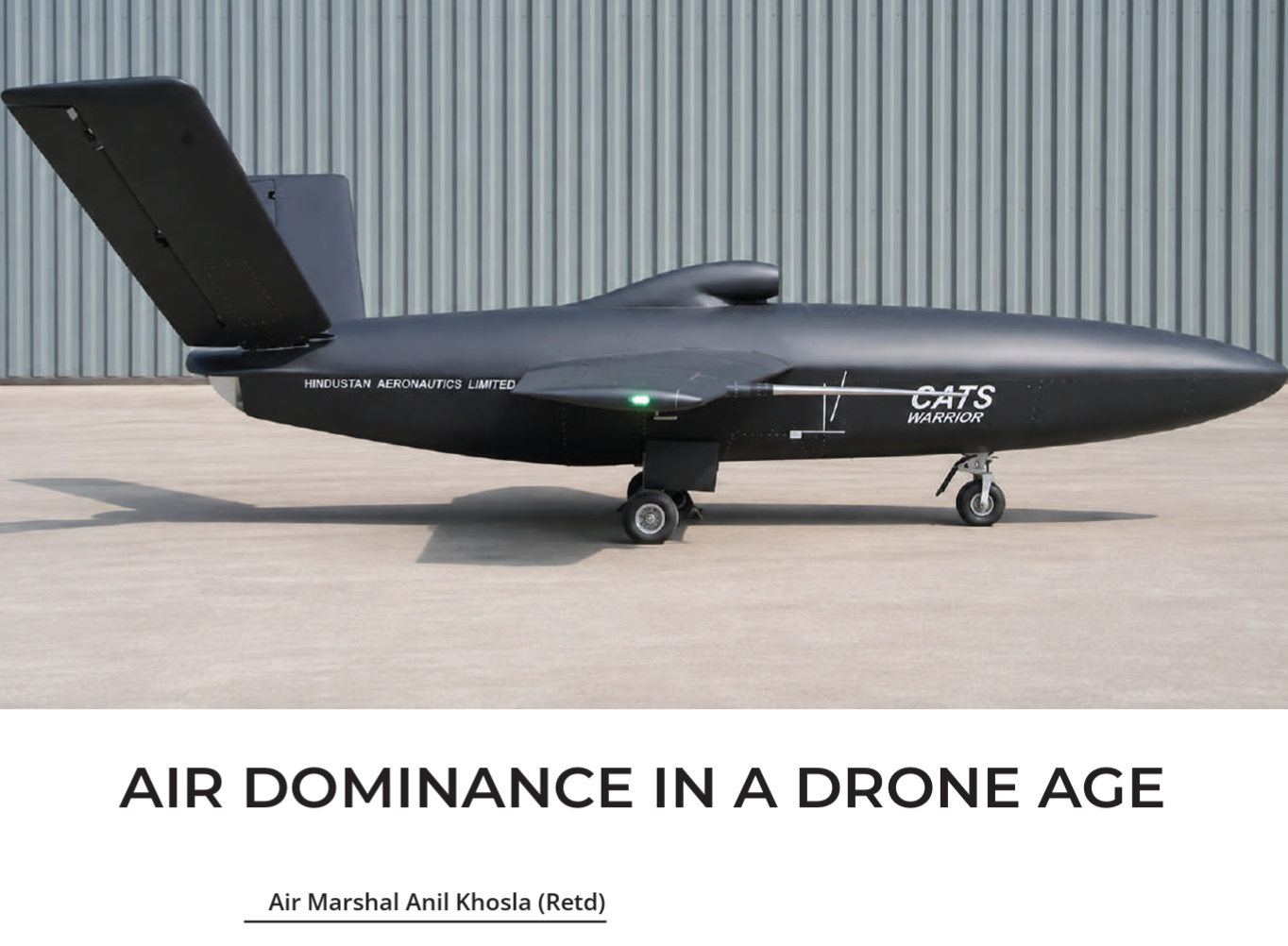
The drone utilisation in the war in Ukraine is revolutionary. Cheap FPV drones could destroy air and ground platforms worth millions. They could disrupt logistics and even impose psychological costs.

The US-Israel-Iran exchanges offer a different set of lessons.  This is the cost-benefit problem in reverse: defending against mass drone and missile attacks with expensive interceptors is fiscally unsustainable in repeated exchanges.

The broader conclusion these conflicts bring out is that fighter jets have not become obsolete. However, their employment methodology has evolved. They are not the sole instrument of the kill chain of air combat.


Noteworthy Changes to be Adapted

Three things have genuinely changed, and air forces need to absorb them.

    • First, forward basing of high-value aircraft is more dangerous than ever. The logic of static forward basing is being superseded by the demands of survivability, dispersal, and mobility.
    • Second, electronic warfare and EW resilience are now as important as kinetic capability. Investment in the electromagnetic dimension of air combat is no longer optional.
    • Third, the cost-comparison (between incoming projectiles and defence weapons) problem is real and demands a structural response. The answer is to develop a layered response that places cheap effectors against cheap threats and reserves expensive ones for high-value targets.


Fighter jets remain the most flexible, survivable, and capable instruments of air power available for high-end contested environments.

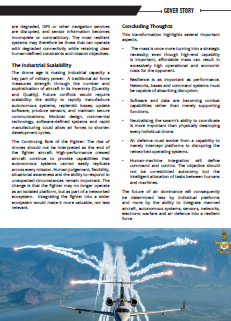
Fighter jets are the most capable instruments of air power. However, no single platform or vector can win the modern air war. The answer lies in integrating manned fighters, Long-range standoff weapons, drones, and layered air defences into a coherent operational architecture.

The air forces that will prevail in future conflicts are not those with the most aircraft, nor those that have replaced aircraft with drones. The ones that will prevail are the ones that have integrated the full spectrum of air power tools under a doctrine sophisticated enough to deploy them appropriately.


Please Add Value to the write-up with your views on the subject.


1977
Default rating

Please give a thumbs up if you  like The Post?


For regular updates, please register your email here:-

Subscribe


References and credits

To all the online sites and channels.

Pics Courtesy: Internet

Disclaimer:

Information and data included in the blog are for educational & non-commercial purposes only and have been carefully adapted, excerpted, or edited from reliable and accurate sources. All copyrighted material belongs to the respective owners and is provided only for wider dissemination.


English हिंदी