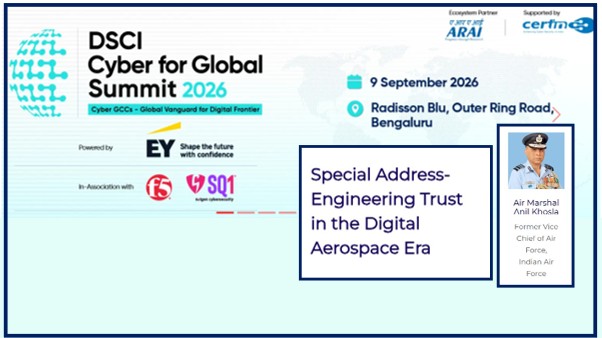
Shared my views on the subject at the DSCI Summit
on 09 Sep 26
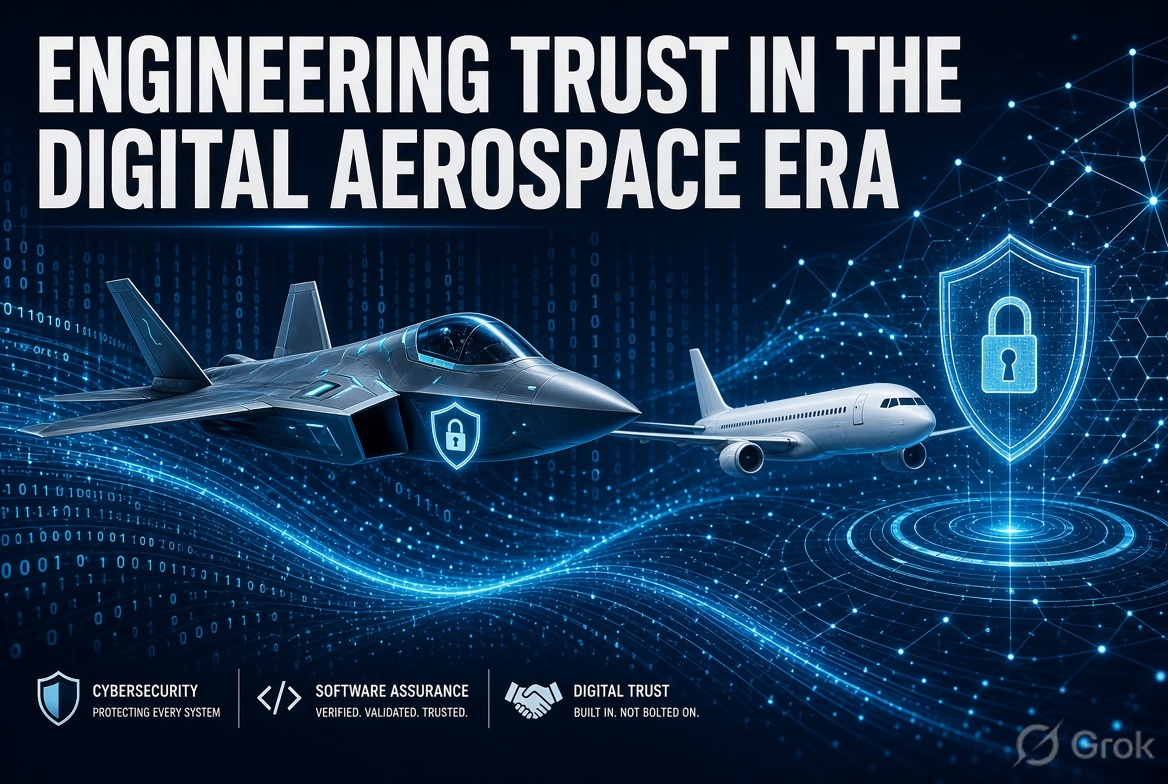
Aerospace is undergoing the deepest transformation since the shift from piston to jet propulsion, except that this one is digital rather than mechanical. Aerospace systems are becoming software-defined, networked, and AI-enabled.
Flight control laws, mission systems, maintenance procedures, and command networks are increasingly mediated by software, sensors, and, increasingly, machine learning models. These models can make decisions or influence them at a speed no human operator can independently verify in real time.
In an era where aerospace systems are defined as much by lines of code as by laws of aerodynamics. A compromise of software, data or communications can have consequences comparable to physical damage. In this environment, the “Engineering Trust” is taking on a new connotation.
Transformation of the Definition of “Engineering Trust”.
Engineering trust means designing, testing, and building systems so predictably safe and transparent that humans and regulators can rely on them without hesitation. The digital aerospace era has transformed the scope of “engineering trust”. Beyond the stated definition, it now also includes “having complete confidence that digital tools, data networks, and artificial intelligence (AI) systems are safe, secure, and fully verified”.
Trust must therefore extend from the physical platform to code, data, identity, networks, AI and the supply chain. It is no longer merely a peripheral technical concern. Engineering trust has become a central focus. Engineering digital trust requires validating each link, including hardware, flight software, network communications, and operational execution. It must be demonstrated, verified, and maintained throughout the system lifecycle.
The challenges relate to both the software code and the Data.
-
- Code-related matters emphasise the importance of trust, Verification, authentic updates, and isolating compromised software to enhance resilience.
-
- Data-related matters include data poisoning, Model manipulation, Adversarial inputs, AI Hallucination, unreliable outputs, and supply-chain digital compromises.
Core Pillars of Digital Aerospace Trust
Safety, Reliability, and Airworthiness. Safety, reliability, and airworthiness require that digital systems (such as flight controls, mission systems, avionics, MRO platforms, and autonomous functions) act predictably in normal, failed, and off-nominal situations without compromising platform or mission safety.
Cybersecurity and Cyber Resilience. The term cybersecurity, with an expanding scope, has been transformed into “digital mission assurance”. Aircraft, satellites, ground systems, and supporting infrastructure must be protected against cyber threats. Protective systems must prevent, detect, contain, withstand, and recover from attacks. This protection is required across the product lifecycle and supply chain.
Software Assurance and Verification. The development, verification, and certification of flight-critical software must be thorough and should follow the certification procedures adopted by aviation regulatory bodies such as the FAA and EASA. Formal methods and mathematical verification can complement testing and provide greater assurance of correctness, especially for functions that require a high level of assurance. Assurance must also extend to software updates, digital twins, and the growing number of adaptive systems.
Data Integrity and Sovereignty. Ensuring data integrity and sovereignty means that navigation, telemetry, sensor, maintenance, and operational data must be accurate, genuine, and readily available. It must also be protected against manipulation or spoofing. Solid data pipelines, anti-spoofing methods, and sensor integration (for example, combining GNSS, INS, and optical tracking) can increase resilience. Regarding data sovereignty, it is also necessary to control where the data is stored, who can access it, and which legal or regulatory system applies, especially for multinational and classified programs.
AI Trustworthiness and Bounded Autonomy. AI/ML is used in predictive maintenance, decision support, pilot assistance, and autonomous systems. In these cases, evidence of robustness, transparency, accountability, and suitable human oversight is required. Autonomous features must operate within clearly defined and verifiable safety limits; deterministic safety mechanisms or “wrappers” (protective software boundaries or guardrails that surround an adaptive AI algorithm to restrict its behaviour and ensure safety) should keep adaptive algorithms within their certified operational envelopes.
Human–Machine Trust. The trust humans place in automation requires that pilots, engineers, and operators have enough insight into the system’s status, limitations, uncertainty, and decision-making logic to know when to rely on the automation and when to intervene or take over.
Supply-Chain and Firmware Integrity. Trust must extend throughout the entire manufacturing process, from component sourcing to software development, integration, deployment, and maintenance.
Continuous Lifecycle Assurance. Trust cannot be established once and then assumed; it must be maintained through configuration control, monitoring, vulnerability management, software updates, supplier changes, operational data, and evidence provided throughout the entire system lifecycle.
Policy Framework for Engineering Trust in the Digital Era
Appropriate measures are required to ensure that India’s digital ecosystem for the aerospace and defence sector is secure, sovereign, traceable, certifiable and internationally trusted. The framework should contribute to national security, speed up the adoption of digital engineering and AI, improve supply chain resilience, support certification and exports, and, at the same time, increase confidence in India’s expanding indigenous aerospace and defence industrial base.
Make Digital Engineering Safe and Trustworthy. Set up a reliable digital engineering framework for the aerospace and defence sectors to guarantee the safety, reliability, security, and integrity of digital models, software, hardware, and digital twins. Adopt internationally recognised aerospace standards where appropriate and create end-to-end digital traceability covering the entire process from requirements, through design, implementation, verification, to certification. At the same time, maximise the automation of verification and testing and incorporate cybersecurity throughout the entire engineering lifecycle.
Protect Manufacturing and MRO from Cyber Attacks. Build robust and cyber-secure manufacturing, maintenance, repair and overhaul (MRO), testing, and operating environments using zero-trust principles. Ensure strong identity management, multi-factor authentication, least-privilege access, network segmentation, continuous monitoring, and strict third-party controls are in place. Cybersecurity requirements must cover the entire supply chain, including measures to ensure production and maintenance can continue during a cyber incident.
Make AI Safe and Trustworthy. We should establish a governance and assurance framework so that AI may be safely introduced into the aviation and defence sectors. Clear boundaries must be set regarding the level of autonomy of AI, and there must be adequate human supervision for any decisions which are of safety or mission importance. AI systems must be thoroughly tested under normal, abnormal, and failure conditions, monitored throughout their operational life, and supported by appropriate measures for accountability, data provenance, transparency, security, and auditability.
Create Digital Traceability for Parts and Products. Set up a complete digital traceability system for important aerospace and defence parts and components. Give each item a unique digital identity and keep reliable records relating to its origin, certification, configuration, inspections, repairs, modifications, and full lifecycle history. Apply tamper-evident technologies and digital product passports, as appropriate, in order to enhance authenticity, prevent the use of counterfeit components, and meet regulatory and customer assurance requirements.
Control Sensitive Data and use the Sovereign Cloud. Establish a national framework which covers the classification, protection, storage, processing, and controlled sharing of sensitive, classified, proprietary and export-controlled information. Sensitive aerospace and defence data should remain under the proper control of the nation and the organisation. For important programmes, use sovereign or controlled cloud environments, while allowing secure international cooperation without jeopardising sensitive data or intellectual property.
Develop Certifiable Digital Engineering Capability. Build national and industrial capabilities in the areas of model-based engineering, model-based systems engineering, and digital twins. Ensure digital engineering practices conform to international aerospace standards and automate verification where possible. Create definitive digital evidence to support airworthiness certification, obtain regulatory approval, and gain international customer acceptance.
Set up a Zero-Trust Defence Industrial Base. Introduce a zero-trust approach to cybersecurity in all defence organisations and within their industry ecosystem. Protect critical networks and systems by implementing robust identity management, using multi-factor authentication, applying segmentation, applying the principle of least privilege, and maintaining continuous monitoring. Make cybersecurity assurance a fundamental requirement of defence procurement and supplier management, backed by a common framework for managing cyber risk across the defence industrial base.
Develop sovereign AI and Cloud Capabilities. Create sovereign AI and cloud infrastructure for sensitive aerospace and defence applications, ensuring the nation maintains control over critical data, models, infrastructure, and intellectual property. Develop secure AI capabilities for areas including UAVs, predictive maintenance, mission support, simulation, and other defence applications, while allowing controlled collaboration with international partners.
Establish Governance for AI in Safety-Critical Systems. A governance protocol is required for using AI in safety-critical systems. It should contain clearly defined sector-specific rules. It should also include requirements for human supervision, intervention, testing, monitoring, accountability, and assurance throughout the system lifecycle. The governance framework must align with established principles of trustworthy AI, including safety, security, transparency, privacy, fairness, robustness, and accountability.
Concluding Thoughts
A digital platform, network, or system that you do not trust should not be considered a capability but rather a liability. The principle in question—that trust is essential—has not changed with digitalisation; in fact, digitalisation has made it harder and more urgent to engineer trust.
Trust in the digital aerospace era should not be treated as a secondary issue or as a compliance item to be dealt with after the project has been completed; instead, it must be built into the system from the very first line of code, the very first component, and the very first hour of operator training. It must be maintained throughout the system’s entire lifecycle.
Engineering trust in the digital era is therefore not merely about aerospace system reliability. It is about ensuring that their safety and security are continuously demonstrable, auditable, and verifiable.
Please Add Value to the write-up with your views on the subject.
For regular updates, please register your email here:-
References and credits
To all the online sites and channels.
Pics Courtesy: Internet
Disclaimer:
Information and data included in the blog are for educational & non-commercial purposes only and have been carefully adapted, excerpted, or edited from reliable and accurate sources. All copyrighted material belongs to the respective owners and is provided only for wider dissemination.
References: –
- SAE International. “Guidelines for development of civil aircraft and systems”, SAE Aerospace Recommended Practices ARP4754B, 2023.
- International Civil Aviation Organisation. “Cybersecurity action plan”, 2022.
- Rose, S., Borchert, O., Mitchell, S., & Connelly, S., “Zero trust architecture”. Special Publication 800-207, National Institute of Standards and Technology, 2020.
- Boyens, J., Smith, A., Bartol, N., Winkler, K., Holbrook, A., & Fallon, M. “Cybersecurity supply chain risk management practices for systems and organisations”. Special Publication 800-161 Rev. 1, Update 1, National Institute of Standards and Technology, 2024.
- National Institute of Standards and Technology. “Secure software development practices for generative AI and dual-use foundation models”, NIST AI 600-1, supplementary guidance, 2024.
- Tabassi, E., “Artificial intelligence risk management framework (AI RMF 1.0)” (NIST AI 100-1), National Institute of Standards and Technology, 2023.
- Autio, C., Schwartz, R., Dunietz, J., Jain, S., Stanley, M., Tabassi, E., Hall, P., & Roberts, K., “Artificial intelligence risk management framework: Generative artificial intelligence profile”, NIST AI 600-1, National Institute of Standards and Technology, 2024.
- Lee, J. D., & See, K. A. “Trust in automation: Designing for appropriate reliance”, Human Factors, 46 (1), 50–80, 2004.
- Indian Computer Emergency Response Team. “Blueprint for reducing exposure and defending against AI-assisted vulnerabilities exploitation in digital infrastructure”, 2026.
- Ministry of Defence, Government of India. *Security manual for licensed defence industries, 2025.