
Compilation based on open-source data available on the Internet
The rapid development of artificial intelligence (AI) has transformed the way people access information, communicate, conduct research and perform professional tasks. Companies such as OpenAI, Google and Anthropic are investing heavily in developing increasingly sophisticated AI systems capable of understanding and generating human language. However, the development of these systems requires enormous quantities of high-quality training data. This demand has created important questions about the ownership, use and protection of intellectual property.
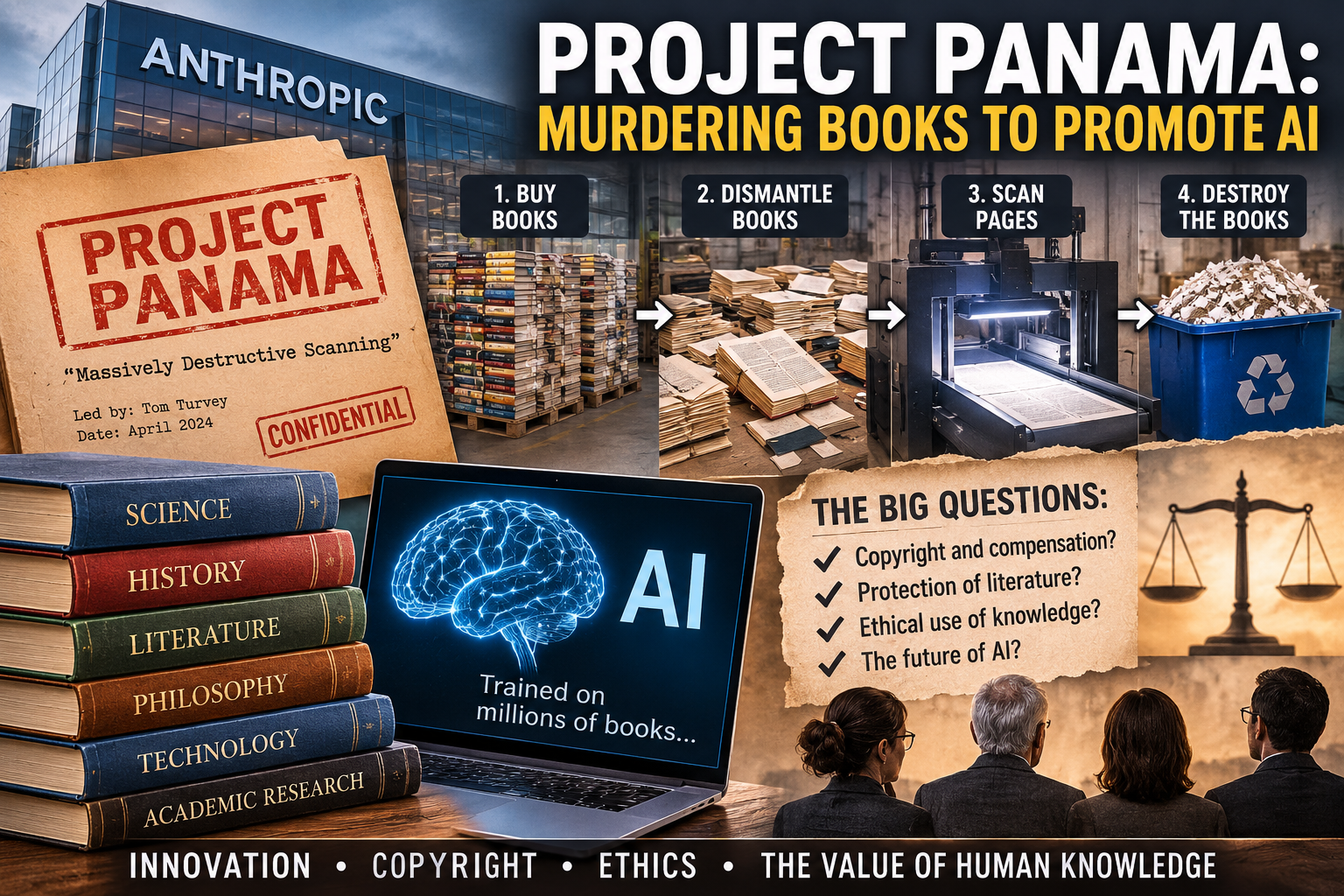
One of the most contentious examples of this is Project Panama, carried out by Anthropic (the US AI company that makes the Claude AI models). Project Panama involved buying up large numbers of physical books, taking them apart, scanning the pages and turning the books into digital text. The aim of the project was to augment the company’s training data and thereby improve the performance of its AI systems.
Project Panama generated a lot of interest following the release of previously confidential internal documents through copyright litigation. The leak sparked a whole host of questions about copyright, the obligations of tech companies, the protection of literature and the nature of the relationship between technological innovation and the creative industries.
The project illustrates a fundamental challenge facing the AI industry: how can companies obtain the information required to develop advanced AI systems without undermining the legal and economic rights of the people who create that information?
Project Panama
Background. Anthropic was spun out of OpenAI in 2021. It’s an AI company focused on building reliable, safe AI systems and is very much about responsible AI. Its flagship product is Claude, a family of large language models which are capable of understanding instructions, reasoning about information, producing text and assisting with a wide variety of tasks. Large language models need to be trained on huge amounts of text. That text is used to teach the AI system all sorts of things, including grammar, vocabulary, ways of thinking, the relationships between facts and all the various styles of writing. The internet is full of information, of course, but that doesn’t necessarily mean it’s reliable, complete or professionally edited. Books have their own advantages in this respect. They can contain a great deal of detail, well-structured arguments, specialist knowledge and original research that you won’t find anywhere else. Anthropic therefore went in for a bit of an expansion of its access to books via an initiative internally known as Project Panama.
The Project. Project Panama was led by Tom Turvey (former Google exec, previously involved in the Google Books project). The internal planning docs from April 2024 refer to the project as one of massively destructive scanning. The use of a codename and the instruction not to talk about it at all were a clear indication of the level of secrecy the company wanted around the project. The project details became very well known as a result of the release of the internal documents in relation to the Bartz v. Anthropic copyright case in January 2026.
Objectives. Project Panama had several important objectives: –
- Expand the Training Data. Anthropic wanted access to a much larger corpus of high-quality written material. Books in particular contain a huge amount of information which is very useful in terms of teaching the model how to understand things and how to communicate.
- Improving Language Quality. Professionally written books provide examples of well-organised sentences, coherent arguments, technical explanations and sophisticated vocabulary. Such material can help AI models develop more advanced language capabilities.
- Obtaining Less Commonly Available Material. The project reportedly placed particular interest on less common books, including specialist and professional publications. Such works can contain valuable knowledge in areas such as science, technology, humanities, social sciences and other academic disciplines.
- Reducing Dependence on Internet-based Information. Online information can include inaccurate material, repetitive content and AI-generated text. Books provide a substantial source of human-authored material that may help reduce some of these problems.
Modus Operandi. The most odd thing about Project Panama was the way it did its scanning. Rather than just take photographs of the books and leave them as they were, Anthropic chose to disassemble the books, remove the bindings and separate out the pages. The physical books were no longer preserved in their original bound condition. The paper was reportedly sent for recycling after the scanning process. As per reporting based on internal docs, Anthropic spent tens of millions on books and looked at various arrangements for hundreds of thousands, if not millions, of titles. The sheer scale of the operation was indicative of the enormous amount of money that tech companies are willing to spend on acquiring good training data.
Ethical Issues. Apart from legal questions, Project Panama raised several ethical concerns. One of the most contentious issues was the decision to destroy the books after they’d been scanned. The decision to destroy the physical books is a very significant one in terms of the responsibility that technology companies have to cultural heritage. Authors put in a huge amount of time and effort to write books. Many authors may not have expected their published works to become part of AI training datasets. If their work is in fact being used to train commercial AI systems, then surely they should have got some form of compensation or licensing fee? The whole confidential nature of Project Panama was a source of concern in that respect. Of course businesses will want to protect their commercial confidentiality, but a project of this scale involving so much copyrighted material had an impact on millions of creators and publishers.
Implications for the Future of Artificial Intelligence. As AI systems become more sophisticated, companies will require increasingly diverse and specialised information. This may create greater demand for academic publications, historical documents, technical books and other forms of intellectual property. Governments and regulatory authorities may also need to establish clearer guidelines concerning AI training datasets. These could address copyright permissions, transparency, compensation and accountability. Another important development could be the creation of ethical data repositories containing properly licensed material. Such repositories would provide AI companies with access to reliable information while protecting the interests of copyright owners. Project Panama therefore offers an important lesson: the quality of artificial intelligence depends not only on computing power and algorithms but also on the quality, legality and ethical sourcing of the information used to train it.
Analytical Perspective. Project Panama can be viewed in two very different ways. On the one hand, it’s a very technology-focused project, an attempt by Anthropic to get a very large quantity of high-quality human-written material for the purposes of AI training. Books contain knowledge that has been accumulated over the generations, and making that knowledge available in a digital format can be of immense benefit to research, to education and to technological development. On the other hand, it’s a very social and ethical project which raises all sorts of issues around the balance of power between the tech companies and the actual content creators. The tech companies have the money, the computing power and the ability to process vast quantities of information, whereas the authors themselves have very little leverage in terms of being able to control how their work is used.
Concluding Thoughts. Project Panama is an important example of the complex relationship between artificial intelligence, intellectual property and human creativity. Anthropic’s initiative to acquire, dismantle and digitise large quantities of physical books demonstrated the enormous demand for high-quality information in the development of advanced AI systems.
Although it was a perfectly legitimate technological project in itself, the fact that it was a secret project, the fact that it was doing destructive scanning and the fact that it was linked to copyright issues all led to a fair bit of criticism. The litigation that followed served to underline the need to be able to tell the difference between material that was legitimately obtained and material that was an unauthorised digital copy.
The whole thing also served to highlight that AI development can’t be judged on purely technological grounds. It has to be assessed from the standpoint of the law, the ethics, the economics and the preservation of culture.
Ultimately, Project Panama serves as a reminder that artificial intelligence is built upon human knowledge and creativity. The future of the industry should therefore involve cooperation between technology companies, authors, publishers and policymakers.
Project Panama is therefore more than a story about scanning and digitising books. It is a significant case study in determining how society should balance the opportunities of artificial intelligence with the responsibility to protect human knowledge, creativity and intellectual property.
Bottom Line
According to online sources, Anthropic spent tens of millions of dollars on Project Panama to buy, scan, and destroy physical books, while separately agreeing to pay $1.5 billion to settle a copyright class-action lawsuit (Bartz v. Anthropic) over its use of pirated books.
Please Add Value to the write-up with your views on the subject.
For regular updates, please register your email here:-
References and credits
To all the online sites and channels.
Pics Courtesy: Internet
Disclaimer:
Information and data included in the blog are for educational & non-commercial purposes only and have been carefully adapted, excerpted, or edited from reliable and accurate sources. All copyrighted material belongs to the respective owners and is provided only for wider dissemination.
References: –
- The Washington Post (27 January 2026), Inside an AI start-up’s plan to scan and dispose of millions of books.
- United States District Court, Northern District of California (23 June 2025), Bartz v. Anthropic – Order on Fair Use.
- Euronews (5 August 2026), Project Panama: How Anthropic secretly destroyed millions of books to train its AI.
- S. Copyright Office. (2025). Copyright and artificial intelligence, Part 3: Generative AI training (Pre-publication version).
- United Nations Educational, Scientific and Cultural Organization. (2021). Recommendation on the ethics of artificial intelligence.
- Autio, C., Schwartz, R., Dunietz, J., Jain, S., Stanley, M., Tabassi, E., Hall, P., & Roberts, K. (2024). Artificial intelligence risk management framework: Generative artificial intelligence profile (NIST AI 600-1). National Institute of Standards and Technology. https://doi.org/10.6028/NIST.AI.600-1
- Authors Guild. (n.d.). Bartz v. Anthropic settlement: What authors need to know. Read the Authors Guild explanation.