862: IAF @94: SHAPING IT FOR FUTURE CHALLENGES


Article published in the Oct 2026 edition of “Life of Soldier” Journal.


The Indian Air Force (IAF) has spent much of the past several decades dealing with familiar questions: the size and composition of its combat fleet, modernisation of ageing platforms, induction of new aircraft, availability of weapons, and the persistent challenge of maintaining an adequate force structure in the face of competing demands. These remain important questions. But they no longer define the future of Indian air power.

The more consequential question is how the IAF will transform itself for a battlespace in which technology changes faster than traditional military acquisition cycles, the distinction between air and other domains is increasingly blurred, and relatively inexpensive unmanned systems can impose disproportionate costs on sophisticated platforms.

The answer cannot be reduced to the number or generation of combat aircraft in the inventory. The wars of the future will be fought in an increasingly transparent, contested and networked battlespace in which air power will have to contend simultaneously with long-range precision weapons, autonomous systems, massed drones, electronic and cyber warfare, space-based surveillance, increasingly sophisticated air defences and attacks on the very infrastructure that sustains combat operations.

The implication is consequential. The IAF’s future challenge is not simply to modernise its existing force structure, but to transform how it generates combat power.


Changing Character of Air Warfare

Two characteristics are defining future warfare. First, the compression of the sensor-to-shooter cycle; second, the proliferation of capabilities that can challenge the advantages of advanced air forces.

The emergence of inexpensive unmanned systems is particularly significant. The operational use of drones and loitering munitions in recent conflicts has demonstrated that relatively low-cost systems can perform surveillance, targeting, electronic warfare and strike missions while imposing disproportionate demands on conventional air defence.

At the other end of the spectrum are increasingly sophisticated integrated air-defence systems, long-range missiles, passive sensors and electronic warfare capabilities designed to deny or degrade the employment of high-value aircraft.

Air forces will have to find targets in an environment in which adversaries actively conceal, deceive and disrupt. They will have to generate combat sorties while their bases and communications infrastructure are under attack. They will have to operate when the electromagnetic spectrum is contested and when access to individual sensors or networks cannot be assumed. The concept of Air superiority will increasingly be less about controlling the air through fighter performance alone and more about controlling the adversary’s ability to sense, decide, and engage while preserving one’s own ability to do the same.


From Platforms to Combat Ecosystems

Platforms have heavily influenced traditional measures of air power: how many fighters, what type of aircraft, how many missiles, how much airlift, or how many airborne early-warning aircraft. The traditional platform remains an important unit of military capability because aircraft determine range, payload, persistence and survivability. Yet the platform is increasingly becoming one component of a larger combat system.

Future air warfare is unlikely to be determined by the performance of an individual fighter aircraft alone. It will depend on the ability to connect sensors, weapons, platforms, data, artificial intelligence, electronic warfare, space-based capabilities and command-and-control systems into a coherent combat architecture. This suggests a fundamental change in how the IAF should conceptualise force development. The IAF will therefore need to move progressively from a platform-centric conception of air power towards an adaptive and networked conception of aerospace power.

This isn’t a completely new approach since the IAF has already shown an interest in unmanned systems, swarm technologies, artificial intelligence, and manned-unmanned teaming. The challenge now is to turn these initiatives into a broader force transformation.


Technology Absorption Cycles

In the future, the ability to absorb technology will matter more than the ability to acquire it. A country can purchase a sophisticated aircraft and operate it effectively. But genuine technological advantage comes from the ability to understand, integrate, modify, upgrade and eventually replace the technologies on which that capability depends.

Traditional acquisition cycles are designed around major weapons platforms whose development and service lives span decades. Artificial intelligence algorithms, sensors, communications architectures and autonomous systems evolve much faster. The IAF therefore needs an institutional mechanism that can operate at two speeds. Long-cycle programmes will remain necessary for fighters, transport aircraft, tankers, and other major systems. Alongside them, however, there must be a much faster pathway to experiment with and adopt emerging technologies.

The objective should be continuous technological insertion. A promising technology should be able to move from laboratory demonstration to operational experimentation and, if successful, limited induction without becoming trapped in a decade-long acquisition process. This requires greater tolerance for experimentation and, crucially, for failure. The IAF therefore needs to institutionalise experimentation as a core military function.


Manned-Unmanned Teaming

Manned-unmanned teaming (MUM-T) is therefore more than another technology programme. It could change the architecture of air combat. The crewed aircraft could become a command-and-control node for a larger group of autonomous systems. The pilot would no longer simply fly an aircraft and employ its weapons, but manage a distributed combat formation.

This creates new possibilities but also new vulnerabilities. The communications links required to control or coordinate autonomous systems will themselves be contested. Electronic warfare could disrupt them. Cyber operations could attempt to compromise them. An adversary could seek to deceive the autonomous system’s sensors.

Consequently, MUM-T must be developed alongside resilient communications, electronic warfare, cyber protection and autonomous decision-making. The objective should not be to create autonomous systems that require continuous human intervention. Nor should it be to remove humans from the decision-making loop indiscriminately. This balance will become a doctrinal question, not merely a technological one.


The Drone Question

High-end fighters will remain necessary for air superiority and other missions requiring range, speed, sensors, weapons, and survivability. But some missions may no longer be most efficiently carried out by deploying an expensive crewed aircraft. Surveillance, decoy operations, electronic attack, communications relay, battle-damage assessment and selected strike missions could increasingly involve unmanned or autonomous systems.

The IAF has recognised this emerging requirement. Its technology initiatives have included unmanned systems, swarm technologies, counter-UAS capabilities and manned-unmanned teaming. The Mehar Baba competitions have sought to connect operational requirements with Indian industry and the innovation ecosystem. At the same time, Dronathon-2026 has focused on unmanned and counter-unmanned technologies, autonomous operations, swarms and electronic warfare.

The proliferation of unmanned systems also raises a question considerably larger than how many drones the IAF should acquire. It raises the question of the balance between future exquisite, survivable, and expensive drones and affordable, numerous, and potentially attritable ones.


All-Prevailing Information Superiority

 The next major contest will also be over information. The force that can sense first, understand first, decide first and engage first will enjoy a significant operational advantage. This makes sensor fusion central to future air warfare. The IAF already operates a diverse network of airborne and ground-based sensors. The challenge is to fuse information from these systems, and increasingly from unmanned and space-based assets, into a coherent operational picture.

Artificial intelligence could help process the resulting volume of information. But AI should be approached as an enabler rather than a substitute for military judgement. Algorithms can identify patterns, prioritise information and accelerate decision-making, but they remain dependent on data quality, communications, computing infrastructure and the ability to withstand adversarial manipulation. The IAF should therefore pursue AI-assisted command rather than AI-dependent command.


Interconnected Domains

Future conflicts will require simultaneous actions across air, land, maritime, space, cyber and electromagnetic domains. The IAF must therefore be capable of operating both independently as well as an integral part of a broader multi-domain warfighting system.

The IAF’s future will also be inseparable from developments in space and cyberspace. Modern air operations already depend on space-based communications, navigation, surveillance and meteorological information. The degradation of these capabilities could significantly affect combat effectiveness. Air operations need to be integrated with the cyber and space domains. The transition from air power to multi-domain aerospace power is therefore not merely semantic.

Indigenous Capability for Strategic Agility

Indigenisation is another area where the objective needs broadening. The strategic value of self-reliance is not simply that India can manufacture a greater proportion of an aircraft or missile domestically. Its real value lies in freedom of action during a prolonged conflict. Strategic autonomy will be measured by the following abilities: –

  • Repair a system when external supply chains are disrupted.
  • Modify software rapidly.
  • Integrate a new weapon.
  • Scale production quickly.
  • Identify and replace a vulnerable component.

This requires a deeper defence-industrial ecosystem involving the IAF, DRDO, public-sector enterprises, private industry, start-ups, universities and specialised technology companies.


Tuning the Acquisition Process

Technology-driven capability enhancement and the acquisition process are limited by technological cycles. An aerial platform may justify a long acquisition cycle; however, software capabilities, autonomous systems, or electronic-warfare applications do not. In a rapidly changing scenario, being late can be more dangerous than being imperfect.

A more useful model would combine long-term capability programmes with rapid technology insertion and experimentation. This could include limited initial procurement, operational trials, iterative upgrades and modular architectures.


Personnel and Doctrine are Decisive

New technology alone cannot transform the IAF. The most sophisticated system is useless till the personnel are trained to employ it, operators understand its limitations, and doctrine provides an appropriate framework for its use.

Future airmen will need greater familiarity with data, AI, autonomy, electronic warfare and cyber operations. Pilots will increasingly interact with autonomous systems. Ground personnel will manage increasingly software-intensive platforms. Commanders will have to make decisions based on information generated by multiple machines and humans.

Training consequently needs to evolve. Synthetic environments and advanced simulation should become integral to preparing crews for complex, contested scenarios. Exercises should increasingly test degraded communications, electronic attack, cyber disruption, loss of satellites and attacks on air bases.

Most importantly, doctrine should be developed through experimentation. The IAF cannot afford to wait for a future conflict to reveal whether a new concept works. It needs a permanent institutional mechanism for operational experimentation to test emerging technologies, challenge existing assumptions and translate lessons into doctrine. The organisation that learns faster will possess an advantage over the organisation that merely buys faster.


Transformation not Modernisation

IAF of the future should have the attributes required to prevail in a contested war. It should be: –

    • Networked, with sensors, shooters and command nodes operating as an integrated system.
    • Distributed, capable of generating combat power from multiple locations.
    • Resilient, able to sustain operations despite attacks on bases, communications and logistics.
    • Autonomous, employing unmanned systems to generate mass, persistence and risk tolerance.
    • Technology-absorptive, with institutions capable of rapidly identifying, testing and integrating emerging technologies.
    • Indigenous in critical capabilities, providing strategic freedom of action during crisis and war.
    • Adaptive, faster than the changes in the character of warfare.

The decisive advantage may ultimately belong not to the air force with the largest inventory or even the most advanced individual platform, but to the one that can sense faster, decide faster, adapt faster and regenerate combat power faster.


Please Add Value to the write-up with your views on the subject.


2173
Default rating

Please give a thumbs up if you  like The Post?


For regular updates, please register your email here:-

Subscribe


References and credits

To all the online sites and channels.

Pics Courtesy: Internet

Disclaimer:

Information and data included in the blog are for educational & non-commercial purposes only and have been carefully adapted, excerpted, or edited from reliable and accurate sources. All copyrighted material belongs to the respective owners and is provided only for wider dissemination.


References: – 

  1. Indian Air Force, “Joint doctrine of the Indian Armed Forces”, Ministry of Defence, Government of India.
  1. Ministry of Defence, Government of India, “New process for procurement of defence equipment”, Press Information Bureau. (2022).
  1. Ministry of Defence, Government of India, “IAF Dronathon 2026”, Press Information Bureau, 08 Sep 26.
  1. Khosla, A., “Q&A series: IAF—AI-powered unmanned platforms, space ops, and future challenges”, Air Marshal’s Perspective, 02 Oct 23.
  1. Khosla, A., “Manned-unmanned teaming (MUM-T) via-a-vis loyal wingman concept”, Air Marshal’s Perspective, 26 Oct 24.
  1. Khosla, A. “IAF challenges and necessities”, Air Marshal’s Perspective, 09 Mar 25.
  1. Khosla, A. “Aerial war: The shift from pilots to platforms to weapons”, Air Marshal’s Perspective, 24 Aug 25.
  1. Khosla, A. (2026, June 26). Wings of dominance: The future of air warfare. Air Marshal’s Perspective.
  1. Khosla, A. “IAF capability and capacity balance”, Air Marshal’s Perspective, 11 Sep 26.
  1. Horowitz, M. C, “Artificial intelligence, international competition, and the balance of power”, Texas National Security Review, 1(3), 36–57 (2018).
  1. Johnson, J. “Artificial intelligence and future warfare”, The RUSI Journal, 165(3), 1–12, 2020.
  1. Scharre, P, “Army of None: Autonomous Weapons and the Future of War”, W. Norton, 2018.
861: INPUTS TO MEDIA QUESTIONNAIRE ON IAF


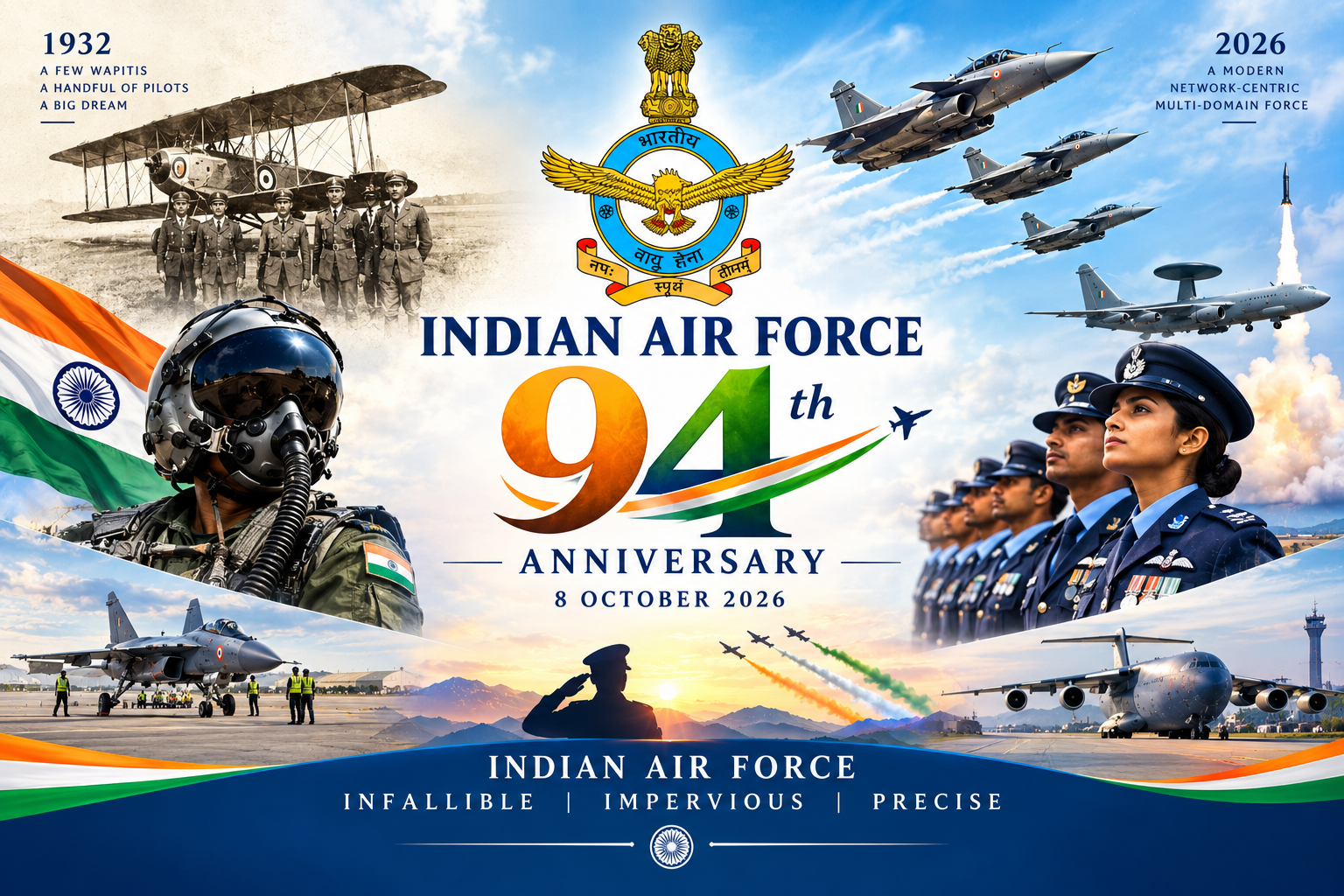
The IAF will celebrate its 94th anniversary on 08 Oct 2026.

Shared my views on some of the aspects the media highlighted.


  1. You have discussed India’s air power and the challenges beyond the border on both sides, as well as China’s extensive modernisation. What challenges has the IAF faced in your time in pushing for modernisation? Has it been enough? What would you have liked to see done in your time?

Perspective: China is rapidly modernising its defence forces. It is in competition with the USA and pulling way ahead of us. In the process, they are also pulling along their ally Pakistan, narrowing the gap with India. Of late, both have been belligerent.

India’s Past Approach to Military Modernisation. Until about a decade back, India’s approach was incremental. It was phased and reactive, with war-triggered acquisitions and reforms. It aimed to replace the legacy systems rather than prepare for the future.

Fresh Impetus. In the last decade or so, the approach has shifted to a more proactive stance, driving defence modernisation, self-reliance, and the development of the defence production ecosystem.

Past Challenges:

    • Budgetary Constraints. In the past, India did not spend enough on enhancing the capabilities of its defence forces.
    • Prolonged Procurement Cycles. Procurement processes were tedious and time-consuming, involving approvals, evaluations, trials, negotiations, clearances, and scrutiny.
    • Self-Reliance. The approach towards self-reliance was a step in the right direction. Unfortunately, the leapfrog method didn’t work due to several reasons. A classic example is the Tejas story.
    • Defence Production Ecosystem. The components of the defence production ecosystem worked in individual silos. Further, DPSUs faced no competition because the protectionist approach prevented private-sector participation.

Adequacy of Modernisation. Over the years, the IAF has grown in capability (high-altitude ops, Day, night, and all-weather ops, Precision, standoff, reach, strategic airlift, Combat support ops, etc.). However, its capacity to endure (e.g., the number of fighter squadrons and combat support aircraft) has not kept pace with the perceived threats.


  1. Since your tenure as VCAS, there have been considerable changes in how AI, and specifically LLMs, are used in warfare, with the most recent example being Iran-US and Anthropic. What challenges might the IAF face in adopting such autonomous systems? Is it outdated training, or is it domestic capacity and data security?

AI has made a significant impact on the aviation sector, including defence aviation. All three factors mentioned are important.

    • Data Security. AI-enabled fusion of sensors, platforms, and weapons has become central to airpower. The effectiveness of the fusion depends upon software, algorithms, and data. They need comprehensive protection.
    • Training and Doctrine. Air crew, ground crew, and commanders need training to operate in an AI-enabled environment. Synthetic training environments and advanced simulation have become essential. Training exercises need to include operations in degraded environments. Further, Air Forces need to incorporate institutional mechanisms for experimentation, contingency handling, and converting lessons into doctrine.
    • Indigenous Capability. This is the most important aspect to retain strategic autonomy. It also offers scalability when needed.

Broader Challenges.  Beyond the challenges above, broader challenges remain.

    • Change of Mindset. The mindset needs to shift from platform-centric (bean-counting) to developing a comprehensive combat ecosystem.
    • Technology Absorption Cycle. Technological development outpaces procurement cycles. A two-speed mechanism is required. Long-term procurement cycles for platforms, systems, and weapons, and a faster (Experimental and adaptive) cycle for technology absorption.
    • MUM-T Challenge. Manned-unmanned teaming is the future of combat. The loyal wingman concept is already being developed. Beyond the advantages, it also brings associated challenges. The vulnerabilities related to communications, electronic warfare, cyber aspects, and decision support systems need to be addressed.
    • Interconnected Domains. Operations in space, cyber, electronic, and information domains are interconnected. These operations require organisational adaptation. China combined all four domains into a single service. However, after a decade-plus, it realised the drawbacks and reverted to the US model of independent commands for each domain. India has agencies for space, cyber and special forces ops.
    • Extent of Autonomy. The world is still grappling with this question. Technology allows humans to be removed from the kill chain. The bigger question is about responsibility, legality, and ethics.


  1. It has been 94 years since the formation of the IAF, and nearly 8 decades since Indian sovereign skies have been protected. You have talked about different “eras” in the force’s life (pilot, platform, weapon); what comes next? AI and LLMs?

Air warfare has continuously changed in how air operations are conducted. It has changed from a pilot-centric era to a platform-centric one, and now to a weapon-centric one.

In my opinion, the next will be the era of three Cs. That is the era of Coherent, Collaborative Combat. Air combat will take place in an environment where all components (sensors, platforms, systems, and weapons) of airpower (ground-, air-, and space-based; manned and unmanned) work as a coherent combat ecosystem.

The acronym RADIANT summarises the characteristics of such a system.

    • Resilience. Can sustain ops even under degraded conditions.
    • Autonomous. With human oversight, accruing the advantage of mass and persistence.
    • Distributed. Ability to generate airpower from multiple, maybe mobile locations.
    • Indigenous. Allowing strategic freedom with the advantage of scalability.
    • Adaptive. Ability to adapt to changes rapidly.
    • Networked. Coherent and resilient architecture.
    • Technology Absorptive. Ability to develop and integrate new technology rapidly.


  1. From Operation Safed Sagar (part of Op Vijay) to Operation Sindoor, the IAF has carried out multiple direct strikes to protect its sovereignty. How have you seen the IAF’s operational capacity and strategy change to address direct and ubiquitous threats? Or has it been a mentality of “if not broken, don’t fix it”?

Proactive Approach. IAF’s approach to modernisation and capability enhancement has been proactive and continuous. Its air strategy has evolved over time.

Historical Evolution. The IAF was formed during the British era. It was tactical, supporting ground forces. It remained reactionary post-partition. Post-partition, it grew, with its role expanded to include border and airspace protection. 1971 war saw air campaigns being conducted in parallel. The IAF modernised in the last two decades of the previous century, inducting advanced platforms, systems, and weapons. During the Kargil War, the IAF demonstrated the capability to apply air power innovatively at high altitudes.  Over the last two-plus decades, the IAF has transformed into a capable strategic air force.

Doctrinal Adaptation. The IAF has also been evolving doctrinally. It has published three Doctrines. The first, published in 1995, was a basic doctrine on airpower, the importance of combat support ops, and modernisation. The second doctrine, published in 2012, linked airpower to the national objectives. It included airpower’s role in combating terrorism, as well as space ops, HADR, and the IAF’s role in nation-building. The last one was published in 2022, signalling a shift from airpower to aerospace power, with an emphasis on Multidomain ops and technology absorption.


  1. With gender parity in forces a major focus these days, and AVM Shakti Sharma becoming ACAS Education, do you think women fighter pilots will also see themselves elevated to senior ranks soon? Will the IAF see its first woman Chief of Air Staff before completing 100 years of operations?

The induction of women in the IAF has been gradual. From the medical branch to supporting services, then to combat and command roles. 1992, women officers were inducted into the admin branch for the first time. Thereafter, they were inducted into the flying branch (helicopters and transport aircraft) and eventually began flying fighters from 2015 onwards. From initial induction into the short service commission, they were granted a permanent commission. They are now even being utilised for combat and command roles. Now, women are joining the training institutions (NDA and Sainik schools) and being inducted into the non-officer ranks.

The IAF has led the integration of Women in the service. It has the highest percentage of women officers. The IAF has a good track record of balancing their individual aspirations with organisational goals. The IAF’s policies are gender-neutral, providing equal opportunities with no differentiation in performance or standards.

They have already started reaching the senior officer ranks. Someday, one of them may become Chief of the Air Staff. However, becoming CAS by the IAF’s 100th anniversary may not be possible, as they would not reach that seniority within the next six years.

Views are personal.


Please Add Value to the write-up with your views on the subject.


2173
Default rating

Please give a thumbs up if you  like The Post?


For regular updates, please register your email here:-

Subscribe


References and credits

To all the online sites and channels.

Pics Courtesy: Internet

Disclaimer:

Information and data included in the blog are for educational & non-commercial purposes only and have been carefully adapted, excerpted, or edited from reliable and accurate sources. All copyrighted material belongs to the respective owners and is provided only for wider dissemination.


860: GLOBAL FOOD SECURITY AMID PROLONGED ARMED CONFLICTS


Shared my thoughts on the subject with the news channel.


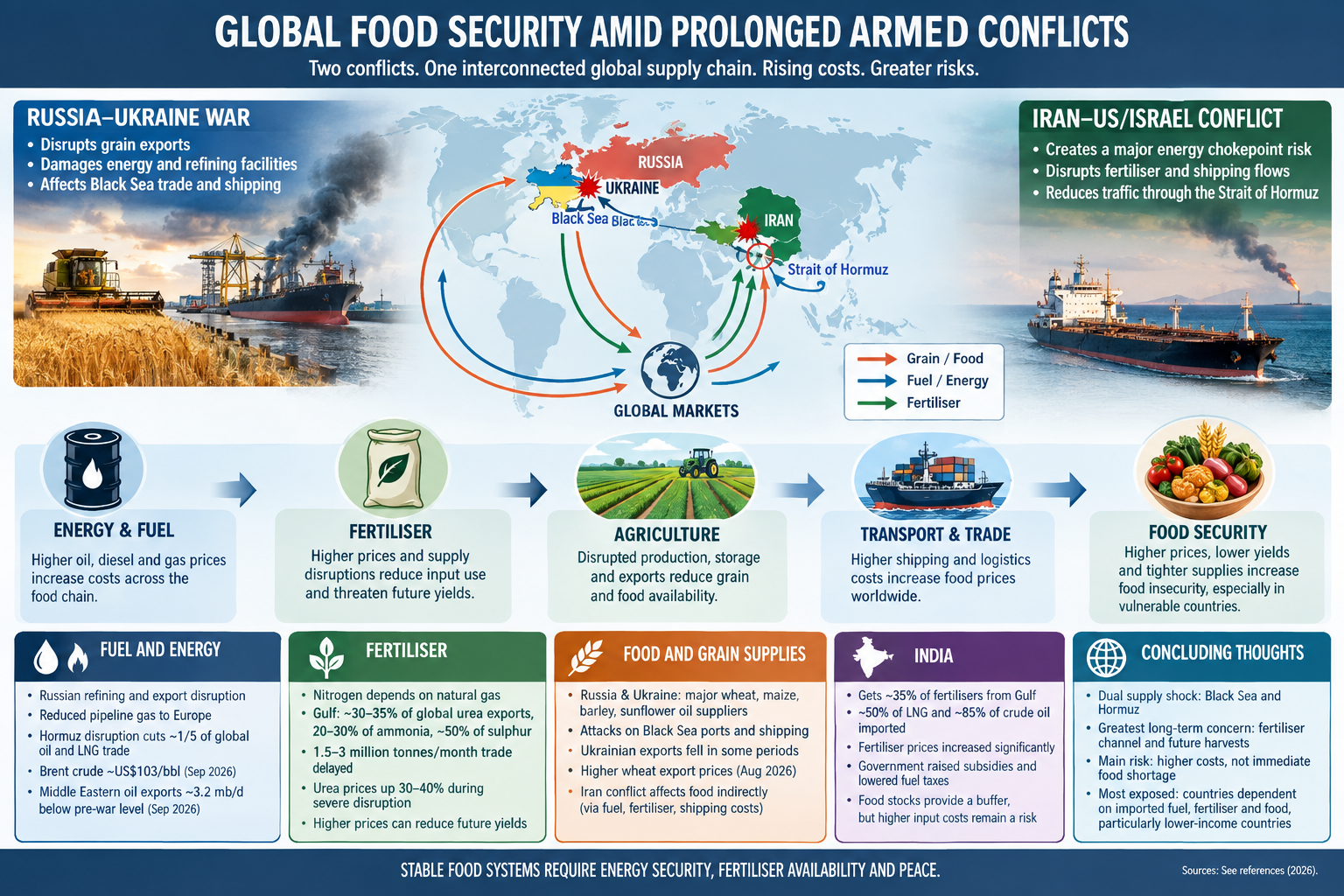
The ongoing Russia–Ukraine war and the 2026 Iran–US/Israel conflict are creating a compounding shock across global food, fuel and fertiliser markets. The two conflicts affect different parts of the supply chain: the Russia–Ukraine war has primarily disrupted grain exports, energy supplies and Black Sea trade, while the Iran conflict has created a major energy, fertiliser and shipping shock centred on the Strait of Hormuz. Together, they raise production and transport costs while increasing the risk of lower agricultural yields and tighter food supplies.


Fuel and Energy

Russia–Ukraine War. The war has disrupted Russia’s exports of energy and caused damage to its refining facilities. Attacks by Ukraine on Russian refineries have lowered the amount of fuel that can be processed and have thus led to more strained global markets for diesel and gasoline, while Russia’s limitations on fuel exports have increased the pressure on the supply side. Earlier cuts in Russia’s pipeline gas exports to Europe also meant that global energy markets had to depend more on liquefied natural gas.

Iran–US and the Strait of Hormuz. The Iran conflict has added a much larger chokepoint risk. The Strait of Hormuz normally carries roughly one-fifth of global oil and LNG trade and is also critical for Gulf fertiliser shipments. Conflict, attacks, insurance problems and shipping restrictions have sharply reduced traffic through the strait. Reportedly, Middle Eastern oil exports in September 2026 remained around 3.2 million barrels per day below their February pre-war level, while Brent crude was around $103 a barrel at the end of September.

Combined effect. The two conflicts therefore reinforce one another. Russian refining and export disruption and Hormuz disruption result in tighter fuel markets. Higher oil, diesel and gas prices manifest as higher costs for farming, irrigation, harvesting, processing and transportation. Fuel is a cross-cutting cost because virtually every stage of the food chain depends on it.


Fertiliser

Fertiliser is arguably the most important connection between the energy conflicts and future food supplies. Nitrogen fertiliser production depends heavily on natural gas. When gas and energy become more expensive or unavailable, fertiliser production becomes more expensive or is curtailed. Farmers then face a choice between paying much higher prices or reducing fertiliser application.

Russia–Ukraine. Russia remains a major exporter of nitrogen, phosphate and potash fertilisers. The war, sanctions, export restrictions and attacks on plants, ports and transport infrastructure have periodically tightened these supplies and forced importing countries to find alternative sources.

Iran–US and the Gulf. The Middle East is even more important for some fertiliser products. Gulf countries account for approximately 30–35% of global urea exports, 20–30% of ammonia and about 50% of sulphur exports. Sulphur is particularly important for phosphate fertilisers. The Hormuz disruption has therefore had an effect on both the production and transport of fertilisers. Plants in the Gulf have suffered production interruptions, and shipments of urea, ammonia and sulphur have been delayed or halted. Prices for fertilisers have gone up sharply, with urea prices rising by about 30–40% during periods of severe disruption. FAO has reported that 1.5–3 million tonnes of monthly fertiliser trade had been delayed by the disruption. The crucial effect is that the higher fertiliser prices today can translate into lower crop yields later. This makes fertiliser potentially more consequential for future harvests than the immediate effect of the energy shock itself.


Food and Grain Supplies

The two conflicts affect food supplies in different ways.

Russia–Ukraine. Russia and Ukraine are major suppliers of wheat, maize, barley, sunflower oil and other agricultural commodities. The war has disrupted farmland, ports, storage, processing facilities, vessels, and Black Sea shipping. Attacks on Black Sea infrastructure and shipping have intensified in 2026. Ukrainian agricultural exports have consequently fallen substantially in some periods, while attacks on Russian infrastructure have also affected grain and energy logistics.

Iran–US conflict. The Iran conflict initially affects food more indirectly. Its principal impact is through fuel, gas, fertiliser and shipping costs rather than a direct loss of major global grain production. Farmers facing unaffordable fertiliser may reduce application or switch to less fertiliser-intensive crops. The resulting reduction in yields could affect wheat, maize, rice and other crops in subsequent growing seasons.

The Compounding Effect. The two wars are affecting different links of the same agricultural chain at the same time. The key difference is that Russia–Ukraine has directly affected agricultural output and exports, while the Iran conflict has delivered a particularly severe energy and fertiliser shock. Together, however, they create a feedback loop in which higher energy costs make fertiliser more expensive, expensive fertiliser reduces agricultural input use, and reduced input use can eventually reduce food production.


Effect on India

India is on the receiving end of both aspects of this shock since its energy and fertiliser needs are largely met through imports, and at the same time it has a big agricultural sector that makes heavy use of these imports. It is reported that India obtains about 35% of its fertilisers from the Gulf. Fertiliser prices have increased significantly. In response, the government has increased its fertiliser subsidies and lowered fuel taxes, but this means that part of the external price shock is passed on to the public finances.

India does have an important buffer in the form of food stocks. Government warehouses held substantial quantities of wheat and rice, providing some protection against an immediate food shortage. However, this stockpile does not eliminate the longer-term problem of higher fertiliser, fuel and transport costs, particularly if weather conditions reduce domestic agricultural production.


Concluding Thoughts

The result of wars is a dual supply shock. The Russia–Ukraine war constrains important agricultural and energy flows through the Black Sea and Russian infrastructure, while the Iran conflict constrains energy and fertiliser flows through the Strait of Hormuz. The greatest longer-term concern is the fertiliser channel because today’s shortage or high prices can translate into lower harvests in subsequent growing seasons.

The principal risk is not necessarily that the world immediately runs out of food. The more significant risk is a sustained increase in the cost of producing, transporting and processing food.

The countries most exposed are those that are simultaneously dependent on imported fuel, fertiliser and food, particularly lower-income countries with limited fiscal capacity to subsidise these imports.


Please Add Value to the write-up with your views on the subject.


2173
Default rating

Please give a thumbs up if you  like The Post?


For regular updates, please register your email here:-

Subscribe


References and credits

To all the online sites and channels.

Pics Courtesy: Internet

Disclaimer:

Information and data included in the blog are for educational & non-commercial purposes only and have been carefully adapted, excerpted, or edited from reliable and accurate sources. All copyrighted material belongs to the respective owners and is provided only for wider dissemination.


References:-

Arita, S., Wang, M., & Glauber, J.  How fertilizer policies could exacerbate Hormuz price shocks. International Food Policy Research Institute.  (2026, May 22).

Food and Agriculture Organization of the United Nations. Global agrifood implications of the 2026 conflict in the Middle East: Impacts on energy and fertilizer trade, and food security. 2026

Glauber, J., & Arita, S. How are fertilizer markets coping with the continued closure of the Strait of Hormuz? International Food Policy Research Institute. IFPRI article, 18 Sep 2026.

International Energy Agency. Oil market report – June 2026. (2026, June 17).

International Energy Agency. How global oil supplies have readjusted to help fill the huge gap left by the Strait of Hormuz shock. (2026, June 22).

Ministry of Chemicals and Fertilizers, Government of India. 15 vessels safely cross Strait of Hormuz; India’s fertilizer stocks set to rise. Press Information Bureau, Government of India. (2026, July 5).

Pal, B. D., Kumar, A., Sirohi, S., Sainath, B., Sharma, K., & K. V., P. (Iran war supply chain disruptions: Impacts on India’s economy. International Food Policy Research Institute.  2026, June 25).

United Nations Conference on Trade and Development. From gas to grain: Fertilizer disruptions raise risks for food security and trade. UNCTAD. 30 Mar 26.

Welsh, C., Curtis, E., & Glauber, J. How do the latest Black Sea attacks affect global food security? Center for Strategic and International Studies. (2026, September 11).

Food and Agriculture Organization of the United Nations. FAO Chief Economist warns of severe global food security risks from disruption to Strait of Hormuz trade corridor.  (2026, March 26).

Food and Agriculture Organization of the United Nations. Strait of Hormuz crisis: FAO Director-General outlines risks, actions and policy responses. 28 Apr 26.

Food and Agriculture Organization of the United Nations. Export prices of wheat, maize and rice generally increased in August 2026, despite weaker Black Sea quotations. 14 Sep 26.

English हिंदी